Vocations

4th Sunday of Easter [C]
May 8, 2022
John 10:27-30

The fourth Sunday of Easter is famously called ‘the Good Shepherd Sunday’. This reason is that the Gospel is always taken from John chapter 10, and John 10 speaks of Jesus who introduces Himself as the Good Shepherd. This Sunday is also dedicated as ‘Vocations Sunday’. This tradition starts in 1964 when Pope Paul VI instituted the fourth Sunday of Easter as ‘the World Day of Prayer for vocations.’ This is because, in today’s Gospel, we listen, “My sheep hear My voice, and I know them, and they follow Me [John 10:27].”

In the Catholic Church, we understand vocation as the Good Shepherd’s calling to each one of us to follow Him. Thus, the primary vocation is to follow Jesus, stay with Him, and live in Him. In essence, our universal vocation is holiness.

Yet, through the centuries, the Church has recognized several authentic manifestations of this fundamental vocation. The biggest two categories are the laypeople and the clergy. The easiest way to distinguish the two is the sacred ordinations. After the ordination, a man is no longer a layperson, but a member of the clergy. They are three kinds of ordained ministers: the deacons, the priests, and the bishops. The Church teaches that “The ministerial priesthood is a means by which Christ unceasingly builds up and leads his Church [CCC 1547].” The ordained ministers are called to sanctify the people of God by offering the sacraments and teaching the truth of faith.

The second group is the laypeople, and this is the great majority of the Church’s members. Lay people are called to sanctify their lives, families, and societies. Particular to lay people is the vocation to married life and family. In marriage, a husband and a wife become holy when they love each other totally and radically in Christ. Like Christ who offers Himself up for the sake of the Church, the couple is called to give themselves entirely to each other. Meanwhile, parents’ vocation is to sanctify their children. They do not only give their children nutritious food, proper clothing, a strong house, and high-quality education, but also true faith and right morality. Perhaps, not all parents can explain well the faith, but they can always lead through upright examples and genuine witnessing.

Aside from these two grand categories, the Church also has a special vocation. These are people who professed vows. Traditionally, there are three vows: obedience, chastity, and poverty. When men and women make their vows, they become ‘a religious’ and usually they stay together in a community. If a priest has vowed, he will be a religious priest. Meanwhile, a priest without vows is called a diocesan priest because he attaches himself to a particular diocese. When a woman professes vows, she becomes a religious woman or ‘religious sister’. When a layman possesses vows, he turns to be a religious man or ‘religious brother’. With their vows, they dedicate themselves fully to God and for God’s affairs [see 1 Cor 7:32]

How do you know that you are called to a priest or a lay, as a religious sister, or as a married woman? There are no fixed answers for this, but we can use three easy steps.
The first one is recognizing our desire. A simple wish and attraction to a priestly life or religious life is already a seed God planted in us. Don’t waste it!
The second step is to know deeper and weigh different options in prayer. We look for more information and ask people who are living their lives. We may discover different yet interesting options. We also bring this effort in prayer and ask the Lord to guide our decision.
The third and final phase is to decide and commit fully. All vocations are good and ways to holiness. Thus, there is no wrong vocation, yet we can ruin it when we do not give our all to this vocation. It only bears fruits abundantly when we faithfully nurture and love our chosen vocation.

Valentinus Bayuhadi Ruseno, OP
Do You Love Me?

3rd Sunday of Easter [C]
John 21:1-19
May 1, 2022

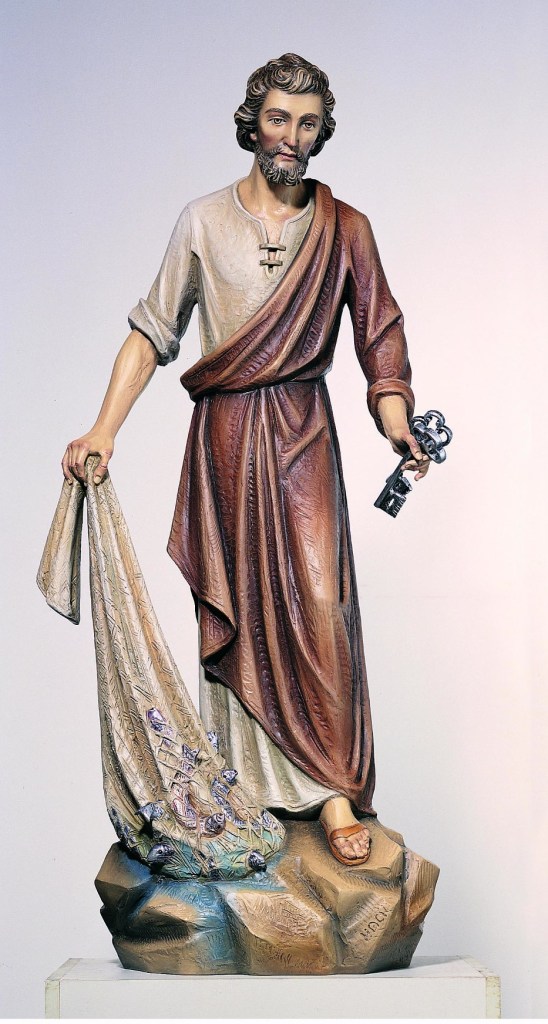
Simon Peter is a total mess. He is impulsive and even perhaps explosive. One time, he tried to remind his Master and thought he was better than Jesus, but immediately, Jesus scolded him and even told him, “get behind me Satan.” At the Gethsemane, Jesus told His disciples that they would desert Him, Simon once again was full of confidence, and said, “Though all become deserters because of you, I will never desert you.” Jesus famously prophesied that Peter would eventually deny Him. Simon immediately countered, “Even though I must die with you, I will not deny you” [Mat 26:31-35]

Unfortunately, Peter was nothing but empty words and promises. When Jesus was arrested and detained in the high priest’s house, Peter was near the charcoal fire and tried to warm himself on a chilling night. While Jesus was thrown into the dungeon, Simon only care about himself and conveniently refused to acknowledge his identity as Jesus’ disciple. When the rooster crowed, Simon remembered what Jesus has said, and he went away and wept bitterly. Peter’s pride was shattered into pieces, and he must have realized that he was nothing but a big failure.

Indeed, Peter could have ended as a total mess, yet Jesus did not give up on him. In Galilee, Peter once again saw his Risen Master, and Jesus had prepared a charcoal fire and fish and bread. Seeing this charcoal, Peter was brought back to that moment he denied the Lord. Peter had chosen his warm and comfort zone in exchange for the Lord. Then, the Lord asked Peter, “Simon, son of John, do you love me more than these?” John the evangelist informs us that Jesus is using the word ‘agape’, a higher and sacrificial love. This question shook Simon’s heart. Peter remembered how he used to say ‘I will sacrifice my life for Jesus’, but it was nothing but empty words. Now, Jesus demanded sacrificial love from Peter. Humbled by his failure, the best answer Simon could give is, ‘You know, I love you, Lord.” Here, Peter used the word ‘filia,’ a friendship friend.

Once again, Jesus demanded a total and radical love. For the second time, Peter could only offer ‘filia’. Simon did not want to repeat the same prideful mistake and knew at that moment, that Simon could only love Jesus as a friend. However, in the third question, Jesus made a dramatic change. Jesus did not longer demand sacrificial love, but rather accommodate Simon’s ability. Jesus asks, ‘do you love as a friend?’ Peter could not contain himself and was sorrowful. Jesus understood Peter’s heart and capacity and forgave and accepted Simon the way he was. Yet, that’s not the end of the story. Simon’s love for Jesus must grow, and the time would come when Peter would love Jesus radically and give himself up for Jesus.

The story of Peter is our story as well. Our lives have been a mess, but Jesus does not give up on us. And, when we are afraid to love Him, Jesus accepts us still. He journeys with us and enables us to grow in love, until the time we can say, “You know Lord, I love you!”

Valentinus Bayuhadi Ruseno, OP

Mercy Conquers All

Second Sunday of Easter [C]
April 24, 2022
John 20:19-31

Pope John Paul II has declared the Second Easter Sunday as the Divine Mercy Sunday. On April 30, 2000, the declaration took place when John Paul II canonized Sr. Faustina Kowalski. Since then, the devotion to the Divine Mercy has grown exponentially worldwide. Nowadays, many of us do not only pray the angelus prayer, but every three in the afternoon, the hour of Jesus’ death, recite the prayer of divine mercy. More and more people make divine mercy chaplet as daily devotion aside from the rosary. Many communities gather together and organize novena to the Divine Mercy. But, do you know what mercy is? And, why does it has to be the 2nd Sunday of Easter?

The Oxford dictionary gives us an exciting definition of mercy: compassion or forgiveness shown toward someone whom it is within one’s power to punish or harm. A story may illustrate this definition of mercy. During one of the Napoleonic wars, one of the young French soldiers deserted the army and fled the battlefield. Unfortunately, he got captured. Knowing that his son would be executed, the mother rushed to see Napoleon. She said to the general, “have mercy on my son!” Napoleon immediately replied, “your son’s crime is so heinous. Justice demands his death, and he does not deserve mercy.” The mother then answered, “It is not mercy if he deserves it!”.

Let’s go back to the Biblical Hebrew language. Mercy is related to the word ‘rahamim,’ which is rooted in the word ‘Rahim’ meaning ‘womb.’ Thus, ‘rahamim’ implies a mother’s feelings and attitude toward her children. We know that we have hurt our mothers too often if we try to reflect on our lives and our relationship with our mothers. Since we live in their wombs until we grow to adulthood, we give them countless headaches and heartaches. Yet, despite the terrible things we have done, our good mothers keep accepting and loving us as their children.

Then, why the second Sunday of Easter? This Sunday, the Church always selects the story of resurrection from John, the evangelist. There are some exciting details. The disciples locked themselves in the room because of fear of the Jews. Yet, more than fearing the Jewish authorities, they dreaded Jesus, who returned and took His vengeance. Yet, Jesus came not to bring punishment but forgiveness. Thus, the first thing He said was ‘Peace’! They have peace because Jesus, who has the power to inflict punishment, decides to have mercy on them.

Yet, Jesus does not stop there. He also breathed the Holy Spirit and gave them the divine authority to forgive sins. To teach the true meaning of mercy and forgiveness, Jesus has to suffer the cross, die, and get buried. Jesus teaches them that the worst things may fall upon Jesus, but this hatred, wrath, and vengeance will not have the last say.

We deserve death and hell with so many sins we have committed, but the resurrection points to us that however terrible we treat Jesus, mercy will always triumph. His forgiveness is always ready to embrace us. We need to do one thing: beg for that mercy.

Valentinus Bayuhadi Ruseno,OP

Jesus Resurrected?

Easter Sunday [C]
John 20:1-9
April 17, 2022

Jesus has risen! Alleluia! This is the foundation of our faith and our salvation. We know for sure that what Jesus said and what He did for us are true. Death is conquered, and the darkness’ power is decisively defeated.

photocredit: Bruno van der Kraan

But, what is the evidence of Jesus’ resurrection? The answer is the empty tomb.
Yet, how do we know for sure that Jesus has indeed risen from the dead? Is an empty tomb enough evidence for His resurrection? Is there a possibility that Jesus’ body was stolen, or Jesus was still alive and was able to escape? Let’s check whether these arguments can hold water.
Firstly, His disciples came at night and stole their master’s body. Then they spread the rumor that Jesus has risen from the dead. At first, this sounds possible, but after closer examinations, we realize that Roman soldiers guarded the tomb. A bunch of fishermen was not just a match for the professional army. At the same time, the disciples were in complete disarray after their master was captured and crucified.

Secondly, the one crucified was not Jesus, which is a case of mistaken identity. This argument is not attainable. Judah played an essential role in ensuring that the one arrested was Jesus, not someone else. Jesus’ trial was done in public, and thus, it was easy to recognize whether the person was Jesus. Plus, the mother and other disciples of Jesus were also present during the crucifixion, and they recognized the one on the cross was Jesus.

Thirdly, Jesus was not dead, and He was able to find His way out of the tomb. This argument is implausible. Jesus was tortured severely and crucified. A soldier pierced His side to verify His death, which alone could deal a mortal blow. Just in case Jesus survived all these ordeals, the tomb would seal Jesus inside, and without proper ventilation and immediate treatment, Jesus would suffocate and die.

Aside from these counterarguments, had Jesus’ resurrection been a lie, it would eventually die down. Many Jewish people believed in the resurrection of the dead, but it will occur at the end of time, not during their lifetime. The Greeks and the Romans thought the idea of resurrection silly. Yet, Jesus’ disciples would gladly die for this truth. Even after horrific forms of torture, they would not give up their belief in the resurrection because it is simply the truth.

Another interesting detail is that the first witnesses of the empty tomb are women. In ancient Jewish society, women’s testimony was not honored. The evangelists could have altered the women’s witnesses with more credible male counterparts. Yet, they did not do that because they could not change the truth that the women were indeed the witnesses of the empty tomb.

There is no other fitting explanation than the resurrection. Jesus has risen, and our faith is not in vain. We have been redeemed, and we know that is true. We rejoice and celebrate for this Jesus’ victory over death.

Valentinus Bayuhadi Ruseno, OP
Writing on the Sand

5th Sunday of Lent [C]
April 3, 2022
John 8:1-11

Jesus was facing an unsurmountable dilemma when confronted with a woman caught in adultery. The Pharisees demanded that Jesus throw her with a stone, following the Mosaic Law, which reads, “If anyone is caught sleeping with a married woman, both of them must die [Deut 22:22].” However, the flip side was that every Israelite at that time knew that they were not allowed by Roman Law to carry out the death penalty. So, if Jesus had not thrown the stone, He would have been accused of being unfaithful to the Law and not a man of God. However, if Jesus threw stones, He would be dealing with the Romans. What did Jesus do?

Jesus wrote on the ground. What did Jesus write? We don’t know for sure, and quite a lot of opinion has developed over the last thousand years. However, there is one interesting tradition about this. Jesus was fulfilling Jeremiah’s prophecy. About 600 years before Christ, Jeremiah once prophesied that ‘those who have turned away from Thee will be written on the earth because they have forsaken God, the fountain of living waters [cf. Jer. 17:13].’ Jesus was writing the names of those who had put Him to the test, the fountain of living water [cf. John 7:38].

Now it’s Jesus’ turn. Jesus threw this question back at them, “Who is without sin, let him throw the first stone.” Of course, Jesus was sinless, but the Pharisees always clamoured that they were an elite group who lived blemished according to the Mosaic Law and even had an obsession to force others to live Mosaic Law their ways. So it’s as if Jesus was saying, ‘OK, you who claim to be the perfect enforcers of the Mosaic Law, throw the first stone and prove that you are truly faithful to the Torah.’

A surprising thing happened. The Pharisees chose not to throw stones. They would rather disobey the Mosaic law than deal with the Romans. This shows that they are nothing more than opportunists and hypocrites. In front of the crowds, they showed themselves to be lovers of the Law, but they were ready to leave the Law in a disadvantageous situation.

It’s incomplete if we don’t see a little bit of Jesus’ action towards the woman. Jesus didn’t throw stones, but that doesn’t mean Jesus condoned or tolerated what happened. Jesus clearly said, ‘Go, and sin no more.’ Jesus stated that this woman was a grave sin that violated the sanctity of married life. However, Jesus, the God who has the right to forgive, read this woman’s contrite heart. Jesus forgave her. However, Jesus’ forgiveness was not cheap. Jesus demanded a radical change from a life of sin.

Who are we in this story? Are we like the Pharisees who are busy finding fault with others? Are we like those busy showing off, but we run away when we face a tough choice? Are we the ones who wallow in sin and don’t know what to do? Or, are we those who cannot appreciate the grace of God?

Valentinus Bayuhadi Ruseno, OP

The Story of the Elder Son

4th Sunday of Lent [C]
March 27, 2022
Luke 15:1-3, 11-32

The parable of the prodigal is one of the most beautiful and heart-warming stories in the entire Bible. It is, in fact, the longest among Jesus’ parables and loaded with exciting details. While a great deal of the parable is given to the younger son, the story ends with the elder son. Many of us identify with the younger son. We used to live in the life of sin, far from God, and even become the enemies of God. Yet, we felt empty, and our lives go in the wrong direction. Then, going back to our senses, we repent and go back to the Lord. However, not a few identify themselves with the elder son.

Personally, I tend to be sympathetic to the elder son, perhaps because I am also the eldest in the family. I feel that the elder son’s anger is nothing but natural. I will be angry if my younger brothers ask for his inheritance and leave the family behind for a life of dissipation. I will be even more enraged when he suddenly comes back, and my parents will accept him as if nothing happens. At least, he must be disciplined and make reparations for what he has done. It is just and right!

Yet, after I go deeper into the story, I realize some critical details. The elder son is angry, and, in his wrath, he refuses to enter the home. Without realizing it, the elder son does what, the younger son did: leaving his house. Then, He says, “this son of yours!” He could have said, “Father, why do you treat my brother like this!” Without realizing it, the elder son does what the younger son did: distancing and disassociating himself from his father. Another interesting fact is that the elder son says, “I have been working like a slave for you.” Without realizing it, the elder son becomes what, the younger son has been: a slave.

Son though he is, he never considers himself as one, but rather a mere slave. We can see how the elder son only views his brother as another runaway slave and his father as an enslaver. A disobedient slave must be punished severely, and the loyal servant must be rewarded. Therefore, he is distraught. His paradigm is violated. He fails to see from his father’s perspective, and thus, he suffers.

From this story, we see a deeper meaning of metanoia or repentance. Metanoia [change of mind] does not simply mean turning from a life of sin to a life with God. It also means having the mind and heart of God. We are invited to think and act, no longer as slaves fearing punishment, but as mature children of God. Unfortunately, some of us are like the lost firstborn, who see ourselves as nothing more than servants, and we build our relationship with God based on fear, not love. We go to church because otherwise, we will go to hell. We serve because otherwise, we will be cursed. And we begin to see our neighbors as servants who have to follow the rules blindly; otherwise, they will be severely punished. Metanoia means no longer living in fear but as children of God living in love and freedom.

Valentinus Bayuhadi Ruseno, OP

The Joy of Two Women

4th Sunday of Advent [C]
December 19, 2021
Luke 1:39-45

Mary was going to the place of Elizabeth in haste. But, why did she have to go in haste? Mary was full of excitement and joy Mary because she knew that her beloved relative had received the miracle from God. Elizabeth who called barren, was pregnant with a child. Mary was full of joy as she would like to witness this mighty deed of God.

STRUB, Jakob o Hans_La Visitacion, c.1505_ 382 (1929.21)/ Stitched Panorama

The excitement and joy were shared by Elizabeth when Mary arrived and greeted her. By the Holy Spirit’s guidance, Elizabeth recognized who Mary is. She is not just another relative, but Mary is the blessed among women because she was with God-made-man. Thus, Elizabeth dared to call her the mother of her Lord. Mary’s encounter with Elizabeth is also the first encounter between two great protagonists in the Gospel: Jesus and John the Baptist, between the Messiah and the one who prepares His way. Elizabeth immediately felt that the baby in her womb was leaping for joy upon hearing Mary’s greetings. Joy and excitement are not being shared by Mary and Elizabeth, but by John.

However, behind excitement and joy, there were great dangers and uncertainties. Mary was pregnant without a man. According to Torah [Deu 22:20], she could have been stoned and died. If she survived the death, Mary would bear the stigma and shame for her entire life. Elizabeth’s situation was not much better. As a woman who was already advanced in age, pregnancy and the process of deliverance could be extremely risky and even leading to death. Things just do not look good for these two mothers.

Yet, despite these terrible possibilities, both Mary and Elizabeth chose to rejoice and be full of excitement. What are the reasons? Firstly, both Mary and Elizabeth believed in the word and plan of God. Elizabeth herself said, “Blessed are you who believed that was spoken to you by the Lord would be fulfilled.” Both Mary and Elizabeth both understood that God’s plan for them was not always readily comprehensible and often involved great sufferings. Mary was facing the real possibility of stoning, and Elizabeth may not survive the childbearing, but both believed that God’s will is always the best plan for them. Joy springs after Mary and Elizabeth die to their own selves and let God’s will live in their wombs. Joy is always a pure gift, and these women are amazingly strong to open their hearts to God’s works.

Secondly, Mary and Elizabeth do not work alone. Another reason Mary visited Elizabeth is to accompany and assist her in the days of pregnancy and birth. Mary as a much younger and stronger relative opted to give her best supports in Elizabeth’s life-giving moment. We may argue that Elizabeth safely gave birth to John because Mary was giving her helping hands. At the same time, Elizabeth as an elder relative of Mary, strengthened and comforted Mary in this troubled time. Both survived and flourished because of God’s grace and also their love and care for one another.

Mary and Elizabeth are strong women because they rely on each other. Mary and Elizabeth are the happiest women because they give themselves up to God.

Valentinus Bayuhadi Ruseno, OP

Rejoice Always

Third Sunday of Advent [C]
December 12, 2021
Luke 3:10-18
Phil 4:4-8

The third Sunday of Advent is well known as Gaudete Sunday, or the rejoicing Sunday. The lovely Sunday takes its root from St. Paul’s letter to the Philippians, our second reading for the mass. St. Paul reminds the Christians in Philippi to rejoice always [Phil 4:4]. Thus, Gaudete Sunday invites us to possess that lasting joy, and must not be gloomy while we are preparing ourselves for the coming of our Lord, Jesus Christ.

photocredit: kelly sikk

if we try to closely reflect St. Paul’s words, we will discover something utterly amazing. St. Paul is not simply advising us to rejoice from time to time, but he commands us to rejoice all the time! How is it possible? Sadness and sorrow are inevitable parts of our lives. We are sad when we experience failures, we mourn when we lose someone important in our lives, and we feel the pain when we are hurt. It seems that St. Paul was overly optimistic about life. Yet, Paul simply teaches the truth. On a deeper level, sorrow and joy are not contradictory. For Paul, we can have a profound joy despite our sadness and sufferings.

If we try to examine Paul’s life, we will have a better understanding of what he means. Paul used to be the archenemy and persecutor of the Church, but after he encountered Jesus, he repented and became a zealous apostle of Christ. Was his life getting better after following Jesus? Not at all! Paul himself shared many hardships he had to endure for the sake of Christ and His body. Often, he got stoned, bitten, and imprisoned. When he was traveling, he endured the scourging sun and the freezing nights. Sometimes, he faced betrayals and false brothers. Yet, most of all, he had to take care of his flocks with all their problems and stubbornness.

His final ordeal was when he was under house arrest in Rome. He was waiting for his trial before Caesar, and the future was bleak as Nero the mad man was the emperor. He was in the chain and a Roman soldier constantly watched over him. Yet, despite this, he wrote a letter to the Philippians and asked them to rejoice always. How is it even possible?

The secrets are within the same letter. After commanding the Philippians to rejoice always, St. Paul asked for two things: do not worry about anything and to pray in thanksgiving always. Firstly, Paul was indeed in terrible situations, but he was not worried because he entrusted his life to God. He had faith that God would take care of him well. Secondly, Paul offered everything to the Lord in his prayer. More remarkably, he gave thanks always in his prayers. Paul even was able to appreciate ‘bad things’ in his life as an opportunity to praise the Lord. This is the secret of joy according to St. Paul. Do not worry, pray and be grateful!

What is more fascinating is that the word thanksgiving used by Paul in Greek is ‘eucharistia’. This reminds us of all that at the core of our worship is thanksgiving. Everytime we worship the Lord in the mass, we throw away our anxiety, offer our lives, and give thanks for everything we have received. Thus, joy is the inevitable result of our worship.

Valentinus Bayuhadi Ruseno, OP

The Reason behind John’s Baptism

Second Sunday of Advent [C]
December 5, 2021
Luke 3:1-6

On the second Sunday of Advent, we encounter John the Baptist. He is one of the most prominent and impactful figures in the Gospel. The four evangelists mentioned him and often described him as a fearless man who even dared to challenge the most powerful man in Galilee, Herod Antipas. From the desert, he went and positioned himself in a strategic position in the Jordan valley. That was the major passageway that connected Jerusalem with the rest of Israel, and John seized the moment to preach the coming of Messiah. We could imagine his strong voice thundered throughout the valley and shook every heart who listened.

photocredit: John Applegate

The Messiah is coming, and His way must be prepared. Yet, one does not prepare His arrival with a red carpet, a flower garland, or a grand musical parade. He will not come and check the honor guards. He does not need external preparation but demands internal transformation. Thus, John shouted with a loud voice, “Repent!”

One question may keep us wondering: why did John baptize people? To baptize means to wash with water and washing oneself with water was a common Jewish ritual to cleanse oneself from ritual uncleanliness. Jewish pilgrims would wash themselves before they entered the Temple of Jerusalem, and there were many small pools for this purpose called ‘mikvah’. One tradition recognized that John was coming from a Jewish sect named Essenes. This group was famous for its strict adherence to the Law of Moses. In fact, they had an extreme measure when it came to ritual purity, and they would take a ritual bath several times a day. If this tradition is true, John knew too well how important baptism was.

However, John did not simply repeat the old Jewish purification ritual. In fact, He revolutionized it. John baptized people with water as an external sign of internal repentance. For John, it would be useless if people go to the Temple and perform various rituals, but their hearts are far from the Lord.

John the Baptist brings to mind the core of Advent: the spiritual preparation for the coming of Jesus. We recognize that Advent is the season of preparation for Christ’s coming, but often, we do not know how exactly to prepare. Sometimes, we are spending our time and money to buy gifts, to prepare Christmas decorations, and to plan for holidays. Sometimes, we are busy practicing for Christmas services, or ready ourselves for parties and celebrations. Yet, if we forget to prepare spiritually, we may lose everything.

The liturgical color of Advent is purple, and the very same purple that we use in the Lenten season. If the purple in Lent means the color of repentance, the purple of Advent has the same character. As John the Baptist reminded the people of his time to prepare the way for the Messiah by change of hearts, the Church also calls us to prepare the coming of our Lord with repentance and spiritual exercises.

Valentinus Bayuhadi Ruseno, OP

How to Prepare the Coming of Christ

First Sunday of Advent [C]
November 28, 2021
Luk 21:25-28, 34-36

photocredit: Ai Nhan

We are entering the season of Advent. The word of Advent comes from the Latin word ‘Adventus’ meaning ‘coming.’ Thus, from its name, we easily understand that it is the season dedicated to preparing ourselves for the coming of Christ. Generally, Advent makes us ready for the joyful celebration of Christmas, the Birth of Jesus Christ in Bethlehem two thousand years ago. Yet, this season is also reminding us of the second coming of Christ at the end of time, Parousia. This is the reason that the Church chooses the Gospel that speaks about the coming of the Son of Man at the end of time today.
While it is true that we do not know when the hour is, and perhaps it will not be happening during our lifetimes, it remains true that all of us will die and face a private judgment before God. Some of us will experience dying moments, but some others will not have the privilege to pass through this dying stage. Thus, the Advent season is called for all of us to always be ready. How are we preparing ourselves?
Jesus provides us with His precious instructions. The first step is that we must be aware of inordinate attachment to worldly pleasures, drunkenness, and excessive worriedness. Worldly pleasures are not evil in themselves, and in fact, there is part of God’s good creation. What makes them dangerous is when we are addicted to them, and making them our priorities, instead of God. Drunkenness is dangerous because we intentionally intoxicate ourselves. When we are under the influence of alcohol, we become irrational, and we are open to many sins. We are also warned of excessive worry. Anxiety is not a mortal as drunkenness, but it greatly inhibits our spiritual growth towards God. Our anxiety shows our lack of faith in God and excessive reliance on ourselves.
The second step is to train and strengthen ‘our spiritual muscles’. Jesus gives us specific instructions: keep vigilant and pray. Doing vigil is basically fasting from sleep. To have a good rest is surely a pleasure, but we intentionally deprive ourselves of it so we can provide more time in prayer. This is a kind of fasting that is intimately related to prayer, and purposedly to train our spiritual strength amid sleepiness and human weakness. In fact, a vigil is one of the most favorite forms of prayer among the saints. After the night prayer with the community, St. Dominic de Guzman often stayed at the chapel and spent more time in prayer. Some brothers who witnessed his vigil reported that St. Dominic often prostrated himself before the altar in the form of a cross or wept for the poor sinners at the feet of the altar. Yet, it was recorded also that he fell asleep and spent the night inside the chapel with the Lord. Through years of spiritual practices, his spiritual strength grew exponentially, and he was known as the indefatigable champion of the faith. His spiritual strength manifested excellently in his dying moment. At his dying bed, he said to his brethren, “Do not cry for me. I will be more useful when I am in heaven.”
Thus, from Jesus, we have twofold preparation to welcome Him: to detach from earthly pleasures and concerns and to grow in prayer and holiness.

Valentinus Bayuhadi Ruseno, OP