
Jesus, the New Temple of God

3rd Sunday of Lent

March 7, 2021

John 2:13-25

We, modern readers, often misunderstand today’s Gospel. This particular Jesus’ story becomes a basis for some to refuse the church building and parish vicinities for non-religious activities, however good its intention is. I personally agree that the inside of the Church’s building is a place set aside for worship and prayer. This is the sacred ground for people to encounter God and experience heaven.

However, today’s Gospel is more complicated than it seems. We tend to assume that Jesus cleansed the Temple from the animal vendors and money traders because Jesus saw them as not originally part of the Temple, but suddenly they were not mushrooming in the Temple’s area. Yet, if we go back to the time of Jesus, animal vendors and coin traders were part of the Temple’s system. The pilgrims from different parts of Palestine and the world streamed to the Temple every day, and though bringing their animal sacrifice was possible, it was not practical. The animals certainly would add inconvenient burdens, and they might get some brushes or injuries along the way. With the wounds or damages, the animals were no longer fit for the sacrifice. Thus, to offer a solution to these weary pilgrims, vendors in Jerusalem were ready to help by providing a healthy and worthy animal sacrifice.

Money changers are also tied to the Temple. To support the upkeep of the Temple, pilgrims were to donate some money, yet the Temple did not accept the Roman coins. Temple’s authority perceived the coins were a sign of foreign oppression. They are also considered blasphemous because the coin recognized Caesar as divine. Meanwhile, the Jews were not allowed to mint their coins. As a solution, they were accepting coins from the neighboring city of Tyre. Here comes the role of the coin traders. Without animal sellers and money exchange service, the Temple of Jerusalem would not perform as it should be. We can imagine how difficult it is to produce our own wine and bread for the celebration of the Eucharist.

Ordinarily, the animal vendors and coin traders were located near but outside the Temple. Yet, the problem began when the Temple’s authorities allowed these sellers to be inside the temple area, especially around the court of the gentiles. Jesus was doing what is right. However, farthest from the inner sanctuary, the court of the gentiles is still an integral part of the Temple and remains a place of prayer, especially for those non-Jewish people who believed in the God of Israel.

Jesus wanted to protect the house of God as a house of prayer and worship and desired that the Gentiles have a place in this house of prayer. While unfortunately, the Temple of Jerusalem was destroyed in 70 AD by the Roman empire, Jesus’ vision lives on. His desire to unite the nations in prayer and worship of the true God is realized and achieved perfection in His body, the new Temple of God.

Where do we find now the Body [and Blood] of Christ? It is in the Eucharist. In the Eucharist, people from different nations and languages gather to offer worthy worship to the true God. Every time we celebrate the Eucharist, we become the living testimony of this Jesus’ vision of worship for all nations. We can worship the true God because Jesus prepares the place for us.


Valentinus Bayuhadi Ruseno, OP

Climbing the Mountain

Second Sunday of Lent [B]

February 28, 2021

Mark 9:2-11

Mountain is a special place in the Bible. It is a place where God meets His people. In the Old Testament, there are many instances where mountains become a pivotal point of salvation history. After the great flood that cleansed the world, the Ark of Noah landed on Mount Ararat, and there, Noah offered sacrifice to God [see Gen 8:4]. Abraham was asked by God to offer his son Isaac on Mount Moriah. Just right before the sacrifice, the angel of God prevented Abraham and God recognized Abraham’s faith [see Gen 22]. When Moses was tending the flock of his father-in-law, Moses saw a burning bush yet was not consumed, and there, on the mount of Horeb, God called Moses to save Israelites from the Egyptians [see Exo 3]. After the liberation from Egypt, Moses and the Israelites the Law and established a covenant with God on the mount of Sinai [see Exo 24:18].

Jesus’ important life events took place in the Mountains. There is the mountain of temptation, where the devil brought Jesus and offered Him the worldly glories. There is the mountain of prayer, where Jesus spent His solitude with the Father. There is the mountain of teaching, where Jesus taught the most remarkable lessons like Beatitudes and love for enemies. There is a mountain of Transfiguration, where Jesus manifested His divine glory. There is the mountain of the cross, or Golgotha, where Jesus gave His life for our salvation. Lastly, there is the mountain of ascension, where Jesus went back to the heavens and sent His disciples to preach and baptize all the nations.

One distinctive feature in the Mount of Transfiguration is that he invited three disciples: Peter, James, and John. There are many reasons why these three were selected. St. Ambrose of Milan, representing the Fathers of the Church, believed that these three were chosen because of Peter who received the kingdoms’ keys, John, to whom was committed our Lord’s mother, and James who first suffered martyrdom. Meanwhile, St. Thomas Aquinas, a Middle age theologian, argued that James was the first martyr, John was the most beloved, and Peter was the one who loves Jesus most. However, we can also see it in a simple way. These three were disciples who were ready to follow Jesus and climb the high mountain.

Climbing the mountain is a challenging mission. One has to make necessary preparation without being excessive. Climbing requires physical stamina as well as mental toughness. As the climbing progresses, the persons’ authentic characters will be revealed. Facing difficulty, one can be very selfish or selfless. Confronting challenges, one can march with courage or retreat in fear. In a dire situation, one can exhibit decisive leadership or get panicked and lose his way. Peter, James, and John were up for the challenge, and they persevered to see the transfigured Jesus.

Often Jesus calls us to climb a mountain with Him. Sometimes, we climb the mountain of prayer as we need to face many hurdles in our prayer life. Occasionally, we need to climb the mountain of teaching because we are struggling with the Church’s particular teachings. Sometimes, we climb the mountain of Calvary, and we need to carry our cross, and on the top, we find no consolation but the death of the Savior.

Yet, the good news is that Jesus, who invited us to climb the mountain, is also walking with us. As we walk with Jesus, He guides us, strengthens us, and forms us. If we are faithful in mountains of temptations and Calvary, we will participate in His Transfiguration, resurrection, and ascension.

Valentinus Bayuhadi Ruseno, OP

photocredit: Tim Foster

Forty Days in the Wilderness

First Sunday of Lent [B]

February 21, 2021

Mark 1:12-15

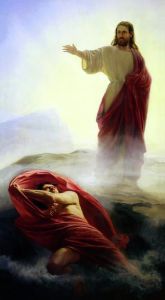
Why did Jesus have to stay in the wilderness for 40 days? The answer is not difficult. He was reperforming what the Israelites did when they were liberated from Egypt. The Israelites stayed for 40 years in the wilderness before they entered the promised land. Yet, there is one more thing! Mark gives us a small, however important detail: in the wilderness, Jesus was staying with the beasts. Why so? If there is one man closely connected to the beasts in the scriptures, he is no other than Adam. Jesus is the new Israel who endured the harsh conditions of the desert and the new Adam who faced the onslaught of the devil.

Jesus entered the wilderness for forty days, and He was tested there by the harsh conditions of the Judean desert. Not only facing the barrenness of the desert, but Jesus was also confronting the devil himself. From here alone, we can draw a strong connection between the Israelites in the wilderness and Jesus, as well as Adam and Jesus. Like the old Israel who struggled with their own ego, Jesus was also enduring human weakness. Like Adam was facing the tempter, the devil tempted Jesus. However, there are significant differences.

While the Israelites murmured and complained, Jesus faithfully fasted and prayed. While the Israelites were grumbling for the food and Adam ate the forbidden fruit, Jesus rejected Satan’s temptation to change stone to bread. While the Israelites were losing faith and worshipping the demon in the form of the golden calf, and Adam wanted to be like God, Jesus refused to bow down to the devil despite all the worldly glory it offered. While the Israelites losing hope in the promised land and Adam blamed the woman, Jesus remained steadfast and refused to test God. Jesus is the new Israel and the new Adam. While the old Israel faltered and Adam succumbed to the trials and temptations, Jesus emerged victorious. Jesus corrected and perfected ancient Israel and old Adam.

We are the body of Christ, and we are part of the new Israel. As Jesus enters the wilderness, so we are going to our spiritual battle. However, we can only become triumphant when we are holding on to God and participating in Christ. The devil is much stronger than us, and without God, we march for sure defeat.

How are we going to win against this spiritual battle? Jesus gives us the answer: fasting-abstinence, almsgiving, and prayer. Fasting makes us hungry, yet it makes us realize that not all our bodily desires need to be fulfilled immediately. Almsgiving may hurt our pockets, but it opens us to the truth that we live meaningfully by giving, not hoarding things. Prayer may be a waste of time, but it offers us the most fundamental reality that we are nothing without God. We are part of the new Adam and the new Israel, and only in Him, we achieve our real victory.


Valentinus Bayuhadi Ruseno, OP

photo credit: nathan-mcbride

Leprosy

Sixth Sunday in Ordinary Time [B]

February 14, 2021

Mark 1:40-45

Leprosy in the time of Jesus is not only physically and mentally deadly, but also spiritually incapacitating. Leprosy or currently known as the Hansen’s disease is horrifying sickness because it does not kill the person slowly, but it gradually deforms and incapacitates the person. The bacteria cause terrible damage in peripheral nervous to the point that the person is no longer feeling the sensation, especially pain. Without this sensation, the person fails to recognize and avoid bodily injuries. Losing limbs is shared among the victims with advanced stages of leprosy.

Since the sickness was incurable and highly contagious in ancient time, it was a natural reaction for the people to exclude the infected persons from the community. We can imagine the effects of exclusion suffered by the victims. They were cut from the bare necessities, separated from their family and friends, and aware that they will die a horrible death. People could quickly become insane. This awareness that they would not survive outside society pushes the people with leprosy to gather and form their community. Thus, lepers’ colonies were deemed a practical solution to support one another in the face of the bleak reality of life.

In the Jewish context, skin diseases, especially leprosy, are about biological and mental problems, but it is a religious issue. The Book of Leviticus states that people with certain skin diseases, including leprosy, have to present themselves to the priest and have their bodies examined. The priest may declare that persons as unclean. After the verdict, the persons have to go out from the community, wear rent cloth, and let their hair dishevel. These become visible signs that they are with contagious diseases and unclean. Yet, if a person remains going closer to them, they shall shout, “Unclean! Unclean!” This is to make sure healthy and clean persons will not come nearer. Being declared unclean means the person is not fit for the religious service and cannot enter the holy ground like the temple. Thus, for a Jew who contracted leprosy, he was excluded physically and mentally and religiously. The sickness also cut them from God they serve and worship.

In the Gospel, we see the leper who took the initiative to approach Jesus, thus breaking the most fundamental prohibition to stay away from people and God. The leper’s request was not to be healed, but rather to be ‘clean.’ The deepest desire of this leper is not physical healing, but to worship his God. The real healing comes only when we can approach and worship the true God. Looking at his courage and deepest longing, Jesus was moved by pity and made him clean.

The leper in the Gospel teaches us a lot about the genuine desire for healing. Perhaps, many of us look for God because we wish to be cured of diseases, seek financial success, or free from other problems. Yet, we seldom desire to see God because we want to be healed spiritually, liberated from sins, and be one with Him. The Gospel teaches us that true healing is more than physical health and economic stability, but the union with God.

Valentinus Bayuhadi Ruseno, OP

Photocredit: Claudio Schwartz

Jesus, Healer of Our Souls

Fifth Sunday in Ordinary Time [B]

February 7, 2021

Mark 1:29-39

Jesus cannot be separated from His healing ministries. Some of the healings are remarkable, like the healing of a woman with the hemorrhage and Jarius’ daughter [Mark 5:321-43]. They are astonishing because these are practically impossible cases. The woman has suffered for twelve years without sign of hope, and Jarius’ daughter is as good as dead. Yet, Jesus does heal not only those with grave illness but also those with curable sickness.
Jesus is at the house of Simon, and He discovers that Simon’s mother-in-law has a fever. Fever is a symptom that points to an infection, from ordinary flu to covid-19. In the case of Simon’s mother-in-law, we can safely assume that she has a curable sickness. Without proper rest and treatment, she will get back to her usual activities. Yet, despite this fact, and even without a particular request from the person, Jesus decides to heal her anyway. Jesus understands that sickness, no matter insignificant it is, remains improper in our lives. To be a healthy person is God’s plan for us.

If we see our lives, we quickly recognize that getting sick is part of our life. Sickness becomes a constant reminder that our bodies are limited and fragile. Indeed, we have an immune system, but often this potent protection is not enough. With the pandemic caused by covid-19, we realize that human beings are not powerful as we think. As we struggle to find the cures, the virus, bacteria, and other sickness causes are also evolving and getting deadlier. The illness causes pain and suffering, and these weaknesses remind us of our death. Yet, despite this realization, deep down, we know that sickness is not the real deal, and it is a privation rather than perfection. We desire to be healthy. We fight to be healthy, and only by being healthy, we may achieve our potentials.

This is why we go to the doctors if we are sick, hit the gym, do other exercises, and live a healthy lifestyle. It is the same reason that the persons with the gift of healing are sought for. It is the same reason that many people want to see Jesus. 

We may ask, why does not Jesus heal all of us? The answer might not be that simple, but we can say that Jesus first comes to heal our broken relationship with God. He saves us from our sins. His miraculous healings are signs of this redemption. Even in His providential way, God can use our illness and suffering to make us even spiritually closer to Him. St. Dominic de Guzman is known to have very rigid mortification practices, and a witness said that a cord of chains was tied in his tight and just removed when he died. Mortification is one of the favorites ways of the saints to seek God. They do not want that their healthy bodies become a hindrance to seek God. Meanwhile, Beato Carlo Acutis, who got sick of leukemia, a severe illness that eventually took his life, offered his suffering to the Lord. He said, “I offer all the suffering I will have to suffer for the Lord, for the Pope, and the Church.”

Jesus brings us healing to our souls and bodies. Yet, in His providential care, our bodily weakness can lead us even closer to God.

Valentinus Bayuhadi Ruseno, OP

photo credit: jonathan-borba

Jesus and Exorcism

Fourth Sunday in Ordinary Time [B]

January 31, 2021

Mark 1:21-28

Jesus performed His first exorcism in the Gospel of Mark. Reading the context, we discover that Jesus was teaching in the synagogue, and the people recognized Him teaching with authority. When Jesus taught with authority, it does not merely mean He preached with eloquence and chrism, but His teachings manifested in powerful signs, like healings and exorcism.

The word exorcism is usually understood as expelling the evil spirits or demons from a person possessed or a place infected. Unfortunately, because of Hollywood movies’ influence, the understanding of exorcism has been corrupted, deformed, and even ridiculed. Yet, the Catholic Church, exorcism is rooted in Jesus Christ Himself.

The literal meaning of ‘exorcism’ is to ‘bind with an oath.’ Then, how did this word become related to evil spirits? When we swear an oath, we need to invoke a higher being as the guarantor of our promise. Naturally, an oath is to say a pledge by invoking the Lord Himself as a witness. In the context of exorcism, the priest-exorcist will invoke the name of God to bind the demons and send them ‘at the feet of the cross of Jesus’ for the judgment. There is no genuine and effective exorcism without invoking the name and power of the true God.

What is interesting is that Jesus drove out demons without invoking the name of God. He said, “Quiet, come out of him!” Jesus was exorcising with His authority, and the demons obeyed Him because they recognized His divine power. The demons also acknowledge Jesus not as Messiah or the king of the Jews, but as ‘the Holy One of God.’ If we go back to the Old Testament, this particular title refers to Israel’s high priest. “… Aaron, the holy one of the Lord… [Psa 106:16].” The demons revealed another dimension of Jesus’ identity: He is the high priest. From this truth, we may conclude that exorcism is a priestly duty.

Participating in the high priestly office of Jesus, the bishops are the chief exorcists in their dioceses. We remember that bishops are high priests in their respective dioceses. Each bishop then may appoint and delegate some well-trained priests to become exorcists. I was fortunate to meet and discuss many things with Fr. Jose Syquia, an exorcist of the Archdiocese of Manila.

However, we must not forget that we also share in the priesthood of Jesus Christ because of our baptism. So, we also have authority over the evil spirits. As laity, we are allowed to say specific prayers of deliverance when we feel extraordinary presence and activities of the evil spirits. The prayer to St. Michael, the archangel, is most recommended for the laity. Yet, we must not forget that the evil spirits work in very subtle ways, primarily through temptations to sin. Often, without realizing it, we are already under the control of the devil as we live a life full of vices. This is our daily war against the kingdom of Satan, and we cannot win without invoking the name of Jesus, constant prayers, the sacraments, and the help of the Church.


Valentinus Bayuhadi Ruseno, OP

We are Fishers of Men

3rd Sunday in Ordinary Time [B]

January 24, 2021

Mark 1:14-20

We once again listen to the story of the calling of the first disciples: Simon and Andrew, as well as James and John, the sons of Zebedee. Jesus called them, and He would make them ‘the fishers of men.’ Yet, from countless possibilities of professions and occupations, why did they have to be ‘the fishers of men’? Why not merely Jesus’ promotion team? Why not Jesus’ soldiers?

The answer is not far from who the first disciples were. They were fishermen of Galilee. Yet, this time, they were no longer catching fish but gathering people for Christ. While they left almost everything behind and followed Jesus, they brought their lives, characters, experiences, and skills with them. They remained fishermen, but this time Jesus transformed the object of their catch: men and women.

The second reason why they were called ‘fishers of men’ is even more profound. It speaks of the fulfillment of the Old Testament’s prophesy. The great prophet Jeremiah who lived around 500 years before Christ, once said, “For I will bring them back to their land that I gave to their ancestors. I am now sending for many fishermen, says the Lord, and they shall catch them… [Jer 16:15-16].” The historical context of this prophecy is critical. After Salomon’s reign, the kingdom of Israel was divided into two smaller kingdoms. The northern kingdom was the coalition of 10 tribes, and the southern kingdom was the tribe, Judah and Benjamin. In 721 SM, the northern kingdom was destroyed by the Assyrian empire, and the ten tribes were deported to foreign lands. Then in 587 SM, the southern kingdom was demolished by the Babylonian empire, and the inhabitants were brought to the Babylonian lands. Jeremiah prophesied that God would bring back the scattered Israelites by sending ‘fishermen.’

By calling His first disciples as ‘fishers of men,’ Jesus was fulfilling Jeremiah’s prophecy. Jesus was gathering back the lost tribes of Israelites to Himself as the new Israel. This is why Jesus called and chose twelve apostles. The twelve apostles shall serve as the leaders of the new twelve tribes of Israel.

The identity and mission as ‘fishers of men’ are primarily for the apostles, yet every baptized Christians are sharing in this identity. We are fishers of men and women for Christ. Some of us may be called to get a quantity gain, like a priest who baptized thousands of people. Some of us may be invited to have a quantity yield, like parents who raise and educate their children as mature and responsible Catholics. Some of us stand in between these two kinds of catches, like zealous catechists, courageous lay missionaries, faithful religious sisters who take care of schools or orphanages, or indefatigable community leaders.

Surely to be a fisherman is not a stress-free job. Sometimes, we are facing storms and dangers. Sometimes, we are getting nothing after our best effort. Occasionally, we get in a disagreement with our fellow fishermen. However, the Gospel reminds us that we are not fishermen because we are good, but because Jesus calls us and makes us His fishermen. We draw our purpose and strength from Jesus because we are participating in Jesus’ mission to gather people to Himself. We are working together with apostles to fulfill God’s promise of the New Israel. We are the fishers of men.

Valentinus Bayuhadi Ruseno, OP

photocredit: paolo-nicolello

Jesus, Our Lamb of God

2nd Sunday of Ordinary Time [B]

January 17, 2021

John 1:35-42

John the Baptist identified Jesus as the ‘Lamb of God.’ If we are attending the celebration of the Eucharist, we cannot miss hearing this phrase. Just before the communion, the priest will hold the consecrated bread and wine, and present them to the faithful, then saying, “Behold the Lamb of God, Behold Him who takes away the sin of the world. Happy are those invited to the supper of the Lamb!”

I am a cradle Catholic, and I could no longer remember when I heard this Lamb of God for the first time. Yet, I never bother asking why Jesus is called such because it does not make much sense. Perhaps, it is just another fancy title of Jesus. I gradually learn this beautiful truth as I go deeper into my theology study and scriptures.

If we put ourselves in the shoes of the disciples who were living in the first century Palestine, we will see a lot more going on. When the disciples heard ‘the Lamb of God who takes away the sin of the world,” they quickly understood. It was undoubtedly mind-blowing, but they were expecting to hear that.

Firstly, a lamb was a primarily sacrificial animal in the Jerusalem temple. Every day lambs were slaughtered and offered to God. Especially during the feast day of Passover, thousands of lambs were brought to the Temple and sacrificed. It was a massive display of devotion to behold. Though the lamb’s sacrifice is not the only way to worship the true God, it serves as the ordinary way of worship. By calling Jesus the Lamb of God, we acknowledge that God’s true worship takes place in Jesus.

Secondly, one of the most important Jewish feasts is Passover. It celebrates the freedom from the slavery of God. One of the central features of this celebration is the sacrificed lamb. The Book Exodus gives the details of how the Passover has to be commemorated. An unblemished one-year-old lamb has to be slaughtered. Its blood was placed on the Jewish household doorpost, and its roasted body shall be eaten [see Exo 12]. To accept Jesus as the Lamb of God, we recognize that the sacrifice and blood of Jesus save us, and we need to eat also His body.

Thirdly, one prophesy that connects a person, and a lamb is from Isaiah. The great prophet spoke about the mysterious figure of ‘suffering servant of God.’ This man shall redeem Israel, but He has to endure great suffering and death, despite being innocent.  The prophet wrote, “He was oppressed, and he was afflicted, yet he did not open his mouth; like a lamb that is led to the slaughter… [Isa 53:7].” By receiving Jesus as the Lamb of God, we accept Jesus as our Redeemer who has to suffer and die for us.

Now, we have recognized Jesus as the Lamb of God; we need to do like the first disciples did: they remained with Him. The disciples did not merely know and accept Jesus, but they followed and stayed with Him. It is not enough for us to see Jesus as the Lamb, but we are invited to remain with Him, to become His true disciples.

Valentinus Bayuhadi Ruseno, OP

photo credit: Daniel Sandvik

Baptism and the Cross

Baptism of the Lord

January 10, 2021

Mark 1:7-11

Baptism of the Lord is one of the defining moments in the life of Jesus. The synoptic gospels [Matthew, Mark, and Luke] writes this event, though with their own perspective and emphasis. We are in the liturgical year B, and thus, we are listening from the Gospel of Mark. Mark’s version is noticeably the shortest, but it does not mean it does not deliver a powerful message. The Baptism of Jesus in the River Jordan is a turning point in Jesus’ life. After this Jesus will be in the desert for 40 days, tempted by the devil, but he will prevail. Then, from this, Jesus will begin His public ministry and unreservedly move toward Jerusalem, to Cross, Death, and Resurrection.

Often, we ask, “why should John baptize Jesus?” We are well aware that John’s baptism is an outward sign of inner repentance. If a person repents, it means that the person has been living a sinful life. Does it mean that Jesus is a sinful man, He asks for John’s baptism? Surely, Jesus who is God, is perfectly sinless, but the question remains, “why should Jesus be baptized?”  Mark does not give us a straight answer, yet the Church offers us the reason. Catechism of the Catholic Church states, “The baptism of Jesus is on his part the acceptance and inauguration of his mission as God’s suffering Servant. He allows himself to be numbered among sinners… Already he is anticipating the “baptism” of his bloody death… [CCC 536].”

Simply put, Jesus’ baptism speaks of this solidarity with us sinners, and this solidarity does not stop in the symbolic baptism of John, but this will find its fulfillment in the cross. As sinners, we deserve to die, but it is God who dies for us. The Church’s answer is beautiful, but is it truly in the mind of the evangelists, especially Mark?

When Jesus is baptized, Mark describes the sky as ‘torn apart’ and a voice came, “You are my Son, the Beloved…” The Greek word for ‘tearing apart’ is ‘schizo,’ and the same word is employed again by Mark when he recounts the happening in the Temple when Jesus died on the cross: the giant curtain that separates the holy place and the holiest place inside the Jerusalem temple [see 15:38]. Meanwhile, Mark also recounts a Roman centurion proclaims that Jesus is truly the Son of God, after witnessing remarkable events during Jesus’ death. From here, we can draw an interesting insight. With this basic pattern between what happens in baptism and in the cross, Mark is telling us that these two events are indeed related. The Baptism points to the Cross, and the Cross is the fulfillment of the Baptism.

It reveals the reason why the Father is so ‘so well pleased with His Son.’ The reason is through baptism, Jesus signals to all of us His eagerness to do His Father’s will. Though Jesus is sinless, He takes up our burden of sin and dies for us as proof of the Father’s love for us.

If in His baptism, Jesus accepts the cross, we, as the baptized Christians, are also called to carry our crosses. As we share Christ’s cross and carry it faithfully, we can hope to love radically. As we love deeply, we may hope for our salvation.


Valentinus Bayuhadi Ruseno, OP

We are the Magi

The Epiphany of the Lord

January 3, 2021

Matthew 2:1-12

The Christmas season ends with the feast of Epiphany of the Lord or the Feast of the Three Kings. However, if we read the Gospel carefully, we will discover that one who visited Jesus is magi, and the word “king” is not used to describe them. The Gospel of Matthew also reveals neither their number nor names. St. Matthew only speaks of three gifts offered: gold, frankincense and myrrh.

Magi is coming from the Greek word ‘magos’, and it is the same root word for magic. In his book ‘Jesus of Nazareth: The Infancy Narratives,’ Pope Benedict XVI explains that Magi has a wide range of meanings. In one sense, it may point to a black magician like Simon the Magician [see Acts 8:9-24], but in another sense, the magi may refer to the philosophers of noble birth coming from the land of Persia. Ancient philosophers are educated people who devoted themselves to the pursuit of wisdom. This is the reason why we call the magi also the wise men. It seems that the wise men have eventually discovered through their careful study, that the great king who is the embodiment of wisdom herself has been born in the land of Judea.

Are they kings? The Church recognizes that the magi who brought three particular gifts are the fulfillment of ancient prophecy. Isaiah said, “Nations shall walk by your light,

and kings by your shining radiance. Raise your eyes and look about; they all gather and come to you… bearing gold and frankincense, and proclaiming the praises of the LORD [Isa 60:3-4,6; which is our first reading].” In short, Isaiah prophesized that the light will guide kings, and they will come and bring gifts of gold and frankincense, and praise the Lord. The magi match the description of Isaiah’s prophecy, and from here, we can also say that the magi are also kings who were guided by the light of the star and offered precious gifts to Jesus. They might be indeed kings of small nations or perhaps, members of royalty, otherwise Herod the great would not have received them in his palace and welcome them cordially.

What about their names? Writing from the 8th century, ‘Excerpta Latina barbari,’ introduces them as Balthasar, Melchior and Gaspar. Whether these are their real name or not, we are never sure. However, we are invited to have the spirit and character of these wise men.

To find Jesus, they left their homes’ comfort and embarked into a long and challenging journey. They also learned to open their hearts as they discovered that the great king is not in Herod’s palace, but a poor home of Joseph and Mary. Ultimately, they humbled themselves before Jesus as they worshipped Him and offered the best gifts representing their lives. Then, they may go home with great joy.

Epiphany means God’s manifestation to the nations, yet this manifestation requires the magi to get up, search, and be humble. We are the magi. We are invited to look diligently for Jesus. To be baptized, catholic is undoubtedly excellent, but it is just the first step of our incredible journey. We are called to go deeper into the beauty of our faith. We are challenged to see Jesus in even the most unexpected places. Unless we go out and seek, we never find. It is because we are the magi.

Valentinus Bayuhadi Ruseno, OP