

Feast of the Holy Family [B]
December 27, 2020
Luke 2:22-40
 We are celebrating the feast of the Holy Family, and indeed, we are celebrating not only the family of Jesus, Mary, and Joseph but every human family. Through this liturgical celebration, the Church is inviting us to recognize the importance and the value of our family. Not only acclaiming the fundamental worth of family, but we are also invited to embrace and celebrate family lives.
At a human level, many social experts have understood that healthy and thriving societies begin in robust families. The families do not only fill the communities with human populations, but they provide an environment where children can grow into physically and psychologically mature men and women. A healthy and mature adult turns to be an asset to society.
From the perspective of faith, the Church always considers family as the basic unit of society and the Church herself. In his apostolic exhortation, Familiaris Consortio, Pope St. John Paul II affirmed the family’s fundamental role as the intimate community of life and love. In the family, husband and wife learn to love each other deeper and deeper every day. In the family, parents offer unconditional and sacrificial love for their children. In the family, the children learn to give honor and respect to their parents and their brothers and sisters. Because only in love, human persons find their true fulfillment as God’s image who is Love.
The Scriptures also give premium to family life. To honor our mother and father is one of the Torah’s highest commandments [Exo 20:]. Sirach even claimed that honoring our parents can atone for our sins [Sir 3:3]. St. Paul himself, in his letter to the Colossians, instructed each member of the family on how to behave [see Col 3:12-21].
Yet, going back to Jesus, we discover that for Him, a family is indeed indispensable. As God, Jesus could have come to us directly from heaven. He did not need human aid. Yet, He chose to be born of the virgin Mary, and through the angel, instructed Joseph to become the husband of Mary and, thus, His foster father. When He became man, He entered a human family and grew through Joseph and Mary’s guidance and protection. Jesus has become part of a family, and His presence sanctified His human family. This is a poignant message for all that family is a school of holiness because Jesus is present.
We also admit that family life is not always smooth and sweet. Moments of frustrations, misunderstanding, anger, and sadness often come and struck us. Various problems ranging from economic stability to emotional immaturity beset our familial relationship. However, these ugly situations may be transformed into means of holiness if Jesus is present among us. Raising children can be tough and even irritating, but we can offer this cross to the Lord as prayer. A relationship with our spouse can be filled with misunderstanding, but before we vent our emotions, we may pause a moment and ask the Lord the best course of action we shall take. Thus, through these difficulties, we are made closer to the Lord.
We thank the Lord for the gift of life, love, and family.
Happy feast day of the Holy Family!
Valentinus Bayuhadi Ruseno, OP
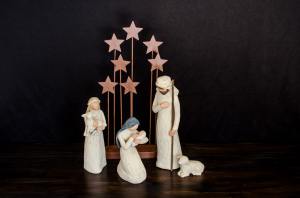 Christmas is one of the most beautiful and joyous times of the year. Christmas is the time to gather with the families and friends and to have an exchange of gifts. Christmas is the time to put up Christmas trees, place Nativity scenes, and play Christmas songs. Surely, Christmas is the time when families once again go to the church together.
 Christmas is fast approaching, and the Church is inviting us to reflect on the story of the Annunciation. Allow me to once more focus on the Blessed Virgin’s Fiat. To appreciate her answer to God’s will and plan, we need to see at least two things. Firstly, it is her historical and social context. Secondly, it is the language analysis of her response.
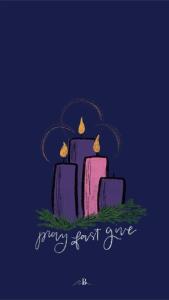 This Sunday is special. We are still in the season of Advent, and yet we see a different liturgical color. It is a rose color [not pink!]. This beautiful color symbolizes joy and hope, and it is in line with the spirit of the third Sunday of Advent, the Gaudete Sunday. Gaudete is a Latin word meaning “Rejoice!” The name is rooted in the introit or the opening antiphon of the Mass, from Phil 4:4-5, “Rejoice in the Lord always; again I will say, Rejoice. 5 Let your gentleness be known to everyone. The Lord is near” In the second reading, St Paul reiterates the motif, “Rejoice always. Pray without ceasing. In all circumstances give thanks, for this is the will of God for you in Christ Jesus. [1 The 5:16].”
 On the second Sunday of Advent, we are reading from the beginning of the Gospel of Mark. After all, this is the beginning of liturgical year B, and it is fitting to start with the first chapter of Mark. Yet, unlike Matthew and Luke, Mark has neither infancy narratives nor the childhood stories of Jesus. Mark commences his Gospel with John the Baptist, who announces the repentance and the coming of Christ.
 We are entering a joyful season of Advent. The first Sunday of Advent is also the beginning of the liturgical year of the Catholic Church. Advent is from the Latin word “adventus” meaning “the coming.” From this name alone, we can already deduce the purposes of this lovely season. It is to prepare us for the coming of Jesus, yet we must not forget that the Church teaches us that there are two comings. The first coming is two thousand years ago in Bethlehem, as a baby at Mary’s hands. The second coming is Jesus’ arrival at the end of time as the glorious king and the judge.
 To be the subject of a king is a foreign experience for many of us. I was born in Indonesia, and our country is a republic, and we espouse democracy to elect our leader. Some of us are citizens of kingdoms like Great Britain, Belgium, Thailand, and Japan, but the kings or queens here are serving under the constitution. When we speak of absolute monarchs, we are reminded of the powerful ancient kingdoms like Assyrian, Babylonian, and Persian empires. Here, the king’s words are the highest law, and disobedient to the king’s wish is acts of treason. Surprisingly, we still have some existing absolute monarchs in our time, like Brunei, Saudi Arabia, and the Vatican!
 The original meaning of talent is not God’s given ability, but a unit of weight and value, normally gold and silver. More importantly, talent is a huge amount of money. One talent is equal to around six thousand denarii. If one denarius is the wage of ordinary daily labor, one talent means six thousand days of works or approximately seventeen to twenty years of work.
 A wedding ceremony is one of the most beautiful events in many cultures and societies. This includes the Jewish community in the first century AD Palestine. For the Hebrew people living in the time of Jesus, the wedding ceremony has two stages. The first one is the exchange of vows or betrothal. The couple is officially married, and they are recognized as husband and wife in the eyes of the Jewish community. Yet, they are going to wait for around one year before they are living together. The husband will prepare for the house as well as the reception celebration that may last for seven days.
 Today the Church is celebrating the Solemnity of all saints. This is one of the ancient feasts in the Church that commemorates and honors all holy people who had gone before us and received their eternal reward, God Himself. We may recognize some of them, like St. Ignatius, St. Dominic de Guzman, St. Francis of Assisi, and St. Catharine of Siena, but this is only a tiny fraction of the entire heavenly host. There are countless we are not aware of. The good news is that all of them are praying for us, and who knows, some of our departed beloved have been parts of this holy communion.
 In Medio Ecclesiae