

The Feast of the Holy Family [December 30, 2018] Luke 2:41-52
 We are celebrating the feast of the Holy Family of Nazareth, the feast day of Jesus, Mary, and Joseph. The last event in the Bible that presents the Homily Family together is the Finding of the Child Jesus in the Temple. After this event, Joseph no longer appeared in the Bible, and according to the tradition, he passed away even before he was able to see Jesus in His public ministry. Since this is the last episode where Joseph gets involved in the narrative, we shall reflect more about him.
In today’s Gospel, we discover a seemingly a fatal mistake of Joseph and Mary. They allow the child Jesus to be lost! That was careless! Yet, are Joseph and Mary really careless? Looking deeper into their context, it is not really the case. When Joseph and Mary go to Jerusalem for the festival of Passover, they do not go by themselves, but with other relatives and neighbors from Nazareth. Traveling together may slow them down, but it gives protection from robbers and avoids the food shortage. The responsibility of taking care of the children are also shared among the adults. After all, Jesus is twelve years old and big enough to take care of younger members of the group. Surely, it is not carelessness, but the trust is given to Jesus that allows Jesus to stay behind in Jerusalem. As dedicated parents, Joseph and Mary are looking for Jesus anxiously. To look for a boy in the capital city Jerusalem is just like finding a needle in the mount of straw, but, miraculously, they are able to find Him: Jesus is in the midst of teachers of the Jewish Laws, discussing and answering them with eloquence.
When Mary asks Jesus why he is missing, Jesus’ answer is mind-boggling, “Did you not know that I must be in my Father’s house?” (Lk. 2:41) Mary does not understand with the answer, and she is pondering all these things in her heart. But, how about Joseph, the foster father of Jesus? What will be his reaction and feeling when he hears, “… I must be in my Father’s house?” Will Joseph punish Jesus for disrespect to him and Mary? Will he get furious after Jesus goes away without permission? Will Joseph disown Jesus after Jesus seemingly refuse to call him as a father?
Though it is hard to determine because Joseph is a silent man, I do believe Joseph will not do these violent things because he is a peaceful person. When Joseph knew Mary was pregnant out of wedlock, he could have thrown the first stone. Yet, he chose mercy and spared Mary from vengeance. As he was merciful to Mary, so he will be merciful to Jesus. Yet, there is something more. Beyond these initial reactions, I believe that Joseph is grateful and proud of Jesus. And why should he be thankful and proud? We recall that Joseph is described as the righteous man or in original Greek, “diatheke”. He is righteous not only because he knows well the Law of God, and abide by it, but because he loves the Law dearly. One of the basic duties of a Jewish father is to teach his children to learn and to love the Law. Thus, If Jesus is able to answers the teachers, to a certain extent, it is because Joseph has taught Him well. Moreover, Jesus prefers to engage with His Father’s affairs. This means Joseph does not only teach Jesus the technicalities of the Law but fundamentally, to love God above all.
St. Joseph becomes an example of every man, especially how to raise children. The first and foremost duty of every father is to lead their children to the Lord and to teach them to love God, and to love others for the sake of God. And how to do that? Like St. Joseph, we need to teach our children by example.
Deacon Valentinus Bayuhadi Ruseno, OP
Deacon Valentinus Bayuhadi Ruseno, OP
 Today’s Gospel is truly beautiful. We have two protagonists. They are women, and they are both pregnant. Who are they? Mary and Elizabeth. Yet, why is the story beautiful? It is just natural for women to get pregnant. Unless we need to go closer to the stories and place ourselves in the shoes of Mary and Elisabeth, we can never see the true beauty of their story.
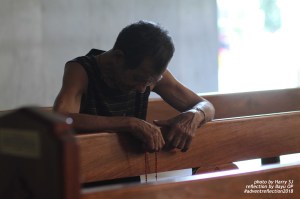 The second question that Archbishop Socrates Villegas of Lingayen-Dagupan asked us during our ordination was, “Are you broken enough?” Once again his question raised eyebrows and was, indeed, counter-intuitive. We want to be flawless, whole and perfect. We desire to achieve more in life, to be wealthy, healthy and pretty. We wish to be socially accepted, respected and gain certain prominence. We want to become somebody, and not nobody. We like others to call us as the famous doctors, the creative entrepreneurs, or successful lawyers. Or for us, people in the Church, we like people to consider us well-sought preachers, generous and builder-priests, or skillful and well-educated sisters.
 During my ordination, Archbishop Socrates Villegas of Lingayen-Dagupan asked this question to us who would receive the sacred order, “Are you weak enough?” The question was mind-blogging and unexpected because often we have strength, power, and talents as our favorite subjects, and even obsession. We like to show to the world that we are achievers and conquerors. We parade our good education, high-earning job, or a beautiful face. The ‘superior’ mentality does not only affect the lay people traversing in the ordinary world, but also people dressed in white walking through the corridors of the Church. The clergy, as well as religious men and women, are not immune to this hunger for approval and sense of worthiness.
 I have been in the Dominican formation for more than 12 years, and if I add four years of my minor seminary formation in Indonesia, it stretches to 16 years! It is insanely long that it occupies a more than half of my life. If we believe that everything has a purpose, I can ask myself, “what is the point of this extremely lengthy formation?” Why should I stay through thick and thin of formation life, through hours of assiduous study, through various programs, through daily rigor of prayer life?

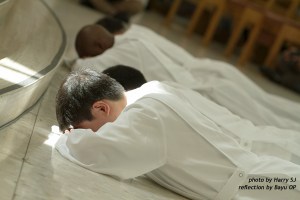 In Jesus’ time, the scribes are the well-educated Jewish men who are expert in the Law of Moses. Some of them come from the wealthy families, and others hail from the priestly clan. Being able to teach and interpret the Law, they receive the respect and honor from the ancient Jewish society. Thus, ordinary Jews will greet them and prepare them the seats of honor in the synagogues and the banquets. Surely, there is no problem with receiving greetings and sitting as honor guests. Jesus Himself is often greeted as “Teacher” or “Rabbi”, and He attends the banquets as guest of honor (see Mar 14:3). The problem comes when some of the scribes possesses “narcissistic desire” and intentionally look for these privileges.
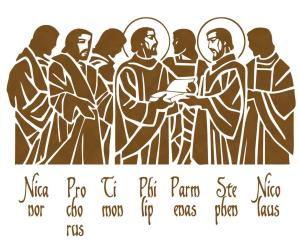 I am currently preparing for my ordination to the diaconate. It is a transitional stage before I become a priest of Jesus Christ. Despite the fact of being transitional, a deacon in itself is an important state in the life of the Church. Bishop Virgilio David, DD of Kalookan reminded the 15 newly-ordained Jesuit deacons in his homily last October that we shall not see a deacon as a mere stepping step toward higher states, like priests and bishops. It is the very core in the layers of concentric circles that make up the ordained ministries of the Church. The diaconate is not a lower rank but the core, without which both the offices of presbyters and bishops collapse. It is the foundation on which we build leadership in the Church. Yet, why do the deacons have to be placed at the core, and become the foundation?
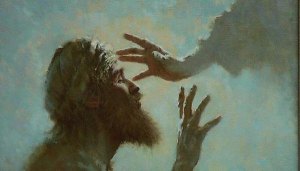 I made my religious vow more than eight years ago with 12 other Dominican brothers. One of the most touching moments within this rite of the religious profession was when Fr. Provincial asked us, “What do you seek?” and we all prostrated, kiss the ground, and declared, “God’s mercy and yours!” After a brief moment, Fr. Provincial asked us to stand, and we began professing our vows before him. As I recall this defining moment in my life, I am pondering in my heart, “Why it has to be mercy?” Why do we not choose other Christian virtues? Why not fortitude, one of the cardinal virtues in the Christian tradition? Why not love, the greatest of all virtues?
 In Medio Ecclesiae