

Fourth Sunday of Lent [March 31, 2019] Luke 15:1-3, 11-32
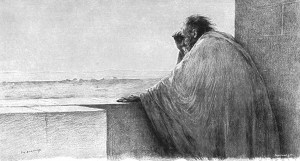 The Parable of the Prodigal Son is one of the most moving stories of Jesus and has been regarded as the all-time favorite. Why? I guess one of the reasons is the story of the Prodigal Son is also our story.
Let us look at some details of the parable especially the father and the younger son. The son demands his inheritance while his father is still alive and well. That’s a no-no! It simply means the son wishes his father’s death, and wills that he is no longer part of the family [see Sir 33:20-24]. The offended father has the authority to discipline the ungrateful son, but he does not! Because of his tremendous love for the son, he allows the son to get what he wants. Like the son, we often offend the Lord, wishing to be away from Him. We choose “the inheritance”, the good things God created like wealth, power, and pleasure above and over Him. We keep abusing His love and kindness, knowing that He is a Good Father.
However, the younger son’s action has a terrible consequence. The farther he is away from his father, the more pitiful his life becomes. The inheritance without the true owner is nothing but a passing shadow. The Jewish young man loses everything, and even becomes the caretaker of pigs, the very animal Jews hate! He becomes so low to the point of eating what the pigs eat. Like the younger son, without God, we become miserable. Yes, we may become richer, more powerful and famous, but we have lost our souls. We never become truly happy because these pleasurable things without God are mere addiction.
The son comes to his sense when he remembers his father and his life with him. Even the father is far away, it does not mean he is idle. He is drawing his lost son through good memories they share. No matter far we are from God, He is constantly pulling us back to Him through His mysterious ways. Yet, it remains our choice to heed the voice of our conscience but ignore it and plunge ourselves further into sin.
The parable also speaks about the father who is patiently waiting, looking forward to the day that his son returns home. The moment he sees his son from distance, without a second thought, he runs toward his son and embraces him and kisses him. The son never thinks that he deserves to be his son once more, and just wants to be treated like a servant. But, mercy precisely is to receive something we do not deserve. The father receives back his young man as his child.
Allow me to close this simple reflection with a story. In 1988, a terrible earthquake hit Armenia. In just four minutes, buildings crumbled, and thousands died. A man immediately ran to a school where his son studied. He had promised to his son that he would be there to fetch him. He saw that the school was now piles of rubbles. He rushed to the site where the class used to be. He started digging barehandedly. Some people tried to help him but stopped afterward. Some people discouraged him, saying, “It is useless. They are dead!” He refused to give up, and continue digging for hours. Then after more than 30 hours of searching, he heard a small voice from the rubble. He shouted, “Arman!” and he heard a response, “Father!” His boy was still alive, and together with him were other pupils. That day, the man had saved 14 children who got trapped. Arman told his friends, “I told you, my father will come no matter what!”
The parable of the Prodigal Son is so beautiful because it does not only reflect who we are but also reveals who our God is. He is a merciful Father who refuses to give up hope on us, however desperate we have become.
Deacon Valentinus Bayuhadi Ruseno, OP
 It normally takes around three years for a fig tree to reach its maturity and fruition. If it does not produce fruit by that time, it is not likely to bear fruit at all. The owner has a reasonable right to cut the tree, but through the effort of the gardener, it is given another chance. Like the fig tree, through the effort of our Chief Gardener, the new Adam of eternal Eden, Jesus Christ, we are given another chance to change and be fruitful.
 One time, during a Bible class I facilitated, one of the participants asked me, “how was Peter able to recognize that it was Moses who stood beside Jesus during the Transfiguration?” It was a valid question, and yet I personally never thought of it. I thought of with several possible answers. Perhaps, Moses appeared bringing two stone tables of the Law. Perhaps, as Jesus was conversing with Moses and Elijah, Peter was able to pick up the names. Perhaps, the divine inspiration enlightened Peter’s mind on the identity of Moses. Eventually, I have to answer, “When you go to heaven, don’t forget to ask both Peter and Moses.”
 The Spirit leads Jesus to the desert and Jesus remains there for forty days. The questions are: why does the Holy Spirit bring Jesus to the desert? Why does it have to be forty days? If we are familiar with the Old Testament, we recall that the journey of the Israelites in the desert lasted for forty years – the great exodus. After the great escape from the slavery of Egypt, they needed to walk through the desert before entering the Promise Land. Yet, it is not simply about the story of greatest escape in the history, but how God formed Israel as His people. In desert, God made a covenant with Israel through the mediation of Moses. In desert, God gave the Law as the basic guide for the Israelites living as His people. In the desert, God provided them with water, manna from heaven, and protected them from their enemies. However, in the desert also, the Israelites rebelled against God. They made and worship the golden calf. They complained a lot, and they wanted to kill Moses. It was a foundational story that covered almost the four Books of Moses [Exodus, Leviticus, Numbers and Deuteronomy].
 We listen today the Beatitude, but unlike the famous Beatitude from the Gospel of Matthew, we have today from the Gospel of Luke. Unlike from Matthew who has eight sayings of blessedness, Luke has four blessedness and for four “woes”. The most striking difference is while Matthew seems to emphasize “the poor in spirit”, Luke wants us to understand poverty in a more literal sense.
 This Sunday, we listen to the vocation stories of great men in the Bible. From the first reading, we learn how Isaiah was called by God to be His prophet to Judah. In the Temple of Jerusalem, he saw the Lord God surrounded by His seraphim. Isaiah was terrified and said that he had unclean lips. An angel then placed a burning ember on his tongue to remove his wickedness. God, then said, “Whom shall I send?” Isaiah replied with confidence, “Here I am, send me!”
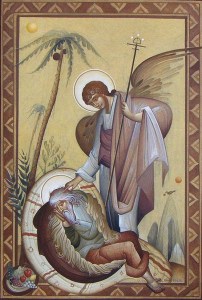 In today’s Gospel, Jesus compares Himself with the Israelite greatest prophets, Elijah and Elisha. But, who are these two prophets? For many Catholics, we are not familiar with these two prominent figures in the Old Testament, and thus, we often do not appreciate why Jesus deliberately cites their names.
 The synagogue is the place of prayer for the Jews. On the center during the service in the synagogue is the reading of the Hebrew Bible (or what we call the Old Testament) and the explanation of those readings. In the Gospel, we learn that Jesus stands as the leader of the service. First, He stands and reads the Scriptures, and the chosen portion is from the Prophet Isaiah. Then, He sits down, assuming the position of teacher. The Jews in the synagogue are eager to listen to Jesus. However, there is something different in Jesus’ teaching from other Jewish Rabbis. Jesus neither simply expounds the reading from Isaiah, nor makes commentaries on the text. He neither simply discusses the meaning of the readings, nor explains the context of the text. He fulfills what is written in the Scriptures. He says, “Today this scripture passage is fulfilled in your hearing.” (Lk. 4:14)
