Fraternal Correction

23rd Sunday in Ordinary Time. September 10, 2017 [Matthew 18:15-20]

“If your brother sins (against you), go and tell him his fault between you and him alone. If he listens to you, you have won over your brother.  (Mat 18:15)”
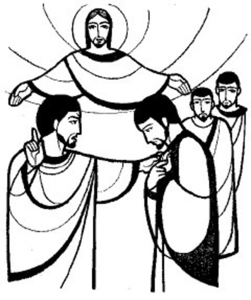
fraternalcorrectJesus understands that in any human community, including His own community of disciples, or the Church, there are always members affected by human weakness and sinfulness. Even in the Christ-oriented communities like the religious convents, the parishes, and various ministries and groups in the Church, inevitably we are hurting each other. Thus, Jesus, the Just God and merciful man, outlines a procedure or ‘fraternal correction’ to deal with misunderstanding, quarrels, and conflicts. It begins with the individual and personal encounter, then when it does not work, we ask the help of a witness or mediator, and lastly it goes up to the community level.

Every stage is important, but the first step is always decisive. The first level is challenging because it requires both humility to accept one’s weakness as well as prudence to express the message of reconciliation in a charitable manner. Yet, the temptation is that either we skip this preliminary level or we execute it without charity. Without mercy, things will just get worse, and the individual encounter will collapse or even turn violent. Often also, to avoid direct confrontation, we jump to the next level. Instead talking personally and privately to the person, we expose them to the public. Either we talk behind them, even creating gossips, or we shame and humiliate them in public. I myself are struggling with this process of fraternal correction. I am basically introvert, and I have tendency to keep things to myself and avoid direct confrontation. Things may seem peaceful, but I know I do not resolve the problems.

The first step is fundamental because after all, we all are members the same community, the same Church. We are all children of God, and thus, brothers and sisters to one another. As our Father in heaven deals mercifully with us, we are also learning to deal with others in mercy. Being merciful means willing to talk and try to understand the other side of the corner. Often, after being offended, we just do nothing but harbor prejudices, then fueling more anger and grudges, but perhaps, they have their own stories that need to be heard. Once in my Postulancy, I got annoyed with an outspoken brother who often criticized me. Later, I discovered also many brothers had the same sentiment. Sometimes, things got escalated, and some brothers refused to talk to him anymore. Till one day, we had a faith sharing, and we learned that he came from a dysfunctional family. His father left the family, and as the oldest son, he had to work and assume the responsibilities for his younger siblings. He had a hard life and he had to be tough also to discipline his younger siblings. Then, we understood why he was also tough with us, his younger brothers.

Often we understand the stages of fraternal correction ends with things settled by the community or Church, but actually Jesus offers one final step. We need to pray. Before we begin the entire process, we should pray. When we bring things to God in prayer, we are no longer controlled by emotions, we start to suspect the good in others, and we have more serenity to forgive. At the end of the process, we pray together asking for forgiveness and healing. My friend and brother in the Order, John Paul, does not agree that time heals. For him, time does not heal, but only God heals. We remember that when two or three people, especially those are in conflict, gather together in prayer, Jesus is there.

Br. Valentinus Bayuhadi Ruseno, OP
 

The Enemy

22nd Sunday in Ordinary Time. September 3, 2017 [Matthew 16:21-27]

“Get behind me, Satan!” (Mat 16:23)

ignatius n francisWe come to one of the most heated exchange of words in the Gospel, and this occurs no less than between Jesus and Simon Peter. The apostle rebukes Jesus for revealing to the disciples that he has to go Jerusalem, suffer and die, but be raised on third day. In return, Jesus reproofs him and calls him Satan. Why does this harsh quarrel take place between Jesus, the most merciful Lord, and his trusted disciple, Simon whom he has just declared as the Rock?

If we try to enter the shoes of Peter, we will understand that what Peter does is something very human. Peter loves his Master and he does not want something bad to happen to Jesus. As a friend, he is ready to prevent Jesus do silly things that will harm Him.  Often, we act like Peter.  We disagree with our good friend who wants to help the street children in a notorious depressed area in Manila. Parents often dismiss their young children’s wish to enter the seminary or convent. Despite being in need of financial stability, any family will lodge opposition against its member who wish to go and work abroad. To wish for safety and wellbeing of our loved ones is just part of our human psychological makeup.

It is just Peter’s human tendency to keep Jesus safe. Yet, why does Jesus need to harshly rebuke Peter and call him ‘Satan’? In the Bible, the word ‘Satan’ has several meanings. The first common understanding is that Satan is the chief evil spirit that wages war against God and humanity. Yet, ‘Satan’ may also mean a man, woman or entity who acts as an adversary or an enemy. In ancient court setting, ‘Satan’ plays the role of the fierce accuser. Literally, Peter may fall under Satan’s temptation in delaying the plan of God, but it may also mean that calling Peter ‘Satan’ Jesus perceives Peter as acting like ‘Satan’, an adversary to Jesus’ mission, and one who accuses Jesus of doing stupid things. By following human tendency, Peter is in opposition to God’s saving plan.

However, how do we know that we begin to act as an enemy to God’s will? Like Simon Peter, we must wrestle to discover God’s will in our lives. Perhaps, encouraging our friend to work with the poor is the right decision. Perhaps, supporting our children to enter seminary is the best option. Perhaps, staying behind with the family rather than going abroad is a better choice. We never know what the future brings. Yet, Jesus gives us a guideline. When we cling too much to our own lives, are obsessed to keep our space small, and gain the world just for ourselves, we must know that we have become ‘Satan’ to God’s ever-expanding love.

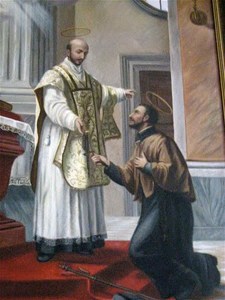
Ignatius of Loyola and Francis Xavier were among the first Jesuits. Both were close friends since they met in Paris as they shared the same room, table and books. As the general of the Society of Jesus, Ignatius had the authority to assign his friend close to him, yet this means to curtail Francis’ gift to love enormously. Ignatius eventually sent Francis as a missionary, and allowed him to spread the faith and expand his love for people of the Far East. Francis Xavier would be always remembered as one the greatest missionaries in the Church. It is when we deny ourselves, our selfish desires, and carry the cross of love, that we genuinely follow Jesus as His disciples.

Br. Valentinus Bayuhadi Ruseno, OP

Name and Story

21st Sunday in Ordinary Time. August 27, 2017 [Matthew 16:13-20]

“You are the Christ, the Son of the living God (Mat 16:16)”

happy chilren 2Today’s Gospel is well known as the Confession of Peter. Jesus asks the disciples who He is, and Simon confesses that Jesus is the Christ, the Son of the living God. He gets it right, and Jesus Himself reveals that his answer does not come from his human weakness, but from the heavenly Father. I used to think that this revelation is an instant inception of divine idea inside Simon’s mind. Right there and then, like Archimedes who discovered the Law of Hydrostatic, Simon also shouts “Eureka! I have found it!”

However, I realize there is a different understanding of revelation. It is not an instant one, but a revelation that involves Simon’s entire life as well as his active participation. Simon is able to formulate his answer because God has led him to meet Jesus, and on his part, Simon decides to follow him and live as his disciple. The revelation comes through a long process of listening, witnessing and sometimes, misunderstanding his Master. Simon sees Jesus’ miracles. He hears Jesus’ teachings. He feels Jesus’ compassion for the poor and the afflicted. Simon gradually recognizes Jesus personally and intimately. Simon’s confession is born of this intimate knowledge and friendship. He knows Jesus’ story, and at the right moment, he is ready to share his story of Jesus with others.

This is not far from our daily experiences. When we address our loved ones and close friends, we do not just call them with ordinary names, but names imbued with our intimate stories. My mother simply calls me Bayu, but I know that it is a lot different from a stranger who calls my name. Often, we also have terms of endearment. Among close friends in the Philippines, we call each other as “Friend”, “Friendship”, “Best”, “Bessy” among other. These names are beautiful because we hold each other’s stories dearly. Indeed, our humanity is conceived because our ability to gather our common stories and to share them confidently.

Therefore, it is a serious offense to our humanity when we suppress other people’ stories, and address them with improper words. Our refusal to recognize the others’ stories is in fact, the root of many discriminations, like racism, sexism, and fundamentalism. The worst is when we erase all together the names and the stories behind them. Victor Frankl, the author of “Man’s Search for Meaning” was once a prisoner at Nazi’s camps. He narrated how prisoners were called by set of number as their identity, like prisoner 1234, and gradually they also lost their humanity, as they were treated, tortured and disposed as mere numbers.

The war on drug in the Philippines has been one of the bloodiest in the Philippine history. Thousands have been killed, the suspects, the law-enforcers, and even innocent civilians. Yet, many do not care, “Anyway, it is just number and statistics.” Till Kian, a teenager student, was mercilessly killed allegedly by the law-enforcers, and the event recorded in CCTV camera awakens the nation’s conscience. The investigation was held by the Senate and Kian’s parents faced the alleged killers of their son. During this hearing, the parents narrated Kian’s stories as an ordinary boy who aspired to become a policeman himself. Kian began to emerge to be a human person with stories, hopes and dreams, not just a faceless number. And the mother ended her statement by saying to the alleged perpetrators, “Ama ka rin (You are also a father).” It was not only a call to their conscience, but also reminder to all of us that we fail as humanity if we no longer listen to and share our stories.

Br. Valentinus Bayuhadi Ruseno, OP

The Canaanite Woman and Mother

20th Sunday in Ordinary Time. August 20, 2017 [Matthew 15:21-28]

“Please, Lord, for even the dogs eat the scraps that fall from the table of their masters (Mat 15:27)”

canaanite woman 2Why does Jesus, the compassionate man and just God, have to “humiliate” the Canaanite woman? If we put ourselves in the context of Jesus’ time and culture, we will understand that what Jesus does is just expected of him. Jesus is dealing with a woman of gentile origin. Generally, Jews avoid contacts with the non-Jews, and a Jewish man does not engage in dialogue with a woman who is not his wife or family in public. Jesus does what every Jewish man has to do. However, in the end, Jesus praises the woman’s faith and heals her daughter. Eventually, mercy overcomes differences and love conquers all.

How big is this woman’s faith? If we carefully read the dialogue between Jesus and the Canaanite woman, there are three stages of humiliation. Firstly, the woman cries out loudly to Jesus, addressing him as Lord, Son of David, and asks for pity for her daughter. Jesus ignores her.  Secondly, the woman keeps crying out, and Jesus refuses her with a reason that he is sent only to the Jews. Thirdly, the woman touches the ground and worships Jesus, begging for the life of her daughter. Jesus associates her with a dog, perhaps because the relationship between the Jews and the Gentile in this region has become so sour that they call each other as dogs. Yet, despite these series of humiliation, the woman perseveres and wittily answers that even dogs receive mercy from their master. There is a progression of humiliation, yet there is also progression of humility and faith. From someone outside the group, she persistently makes her way inside to the point of ‘under the table’ of her master.

What inspires such great humility and faith? I believe that it is her far greater love. She is not just a woman and a Canaanite, she is also a mother. We know good parents, especially a mother, would do practically anything for their children. There is a natural bond between a mother and the child of her womb, a bond that empowers a woman to even sacrifice her life. Jesus allows this humiliation because He knows well the capacity of this mother to love. God allows things to get messy in our lives, because He knows well our capacity to love which can grow exponentially.

Let me end this little reflection with a story. on the day of graduation in one of the top universities in the Philippines, a young man, top of his batch, gave his valedictory remarks. He narrated a story of a young woman who was expecting a child. Yet, she was diagnosed with a dangerous illness that required aggressive treatments. The medication may cure her, but it will be too strong for the infant inside her womb.  So, she was left with a choice either to choose her life or her baby’s. Many encouraged her to let the baby die since she has a bright future, a promising career. Yet, to the surprise of all, she decided not to take the medication, and allowed her baby live. Trusting to her baby to her husband, she died after giving birth to a healthy little Babyboy. Then, with teary eyes, the young valedictorian revealed to all that he was that little baby. He is able to live, to grow, and achieve his dream because his mother loved him so much to the point of giving her own life for him.

We remember and thank our mothers who have loved and sacrificed a lot for us. And just like them, God calls us to have faith and love that make us bigger than our small lives.

Br. Valentinus Bayuhadi Ruseno, OP

Ocean

 19th Sunday in Ordinary Time. August 13, 2017 [Matthew 14:22-33]

 “O you of little faith, why did you doubt?”  (Mat 14:31)

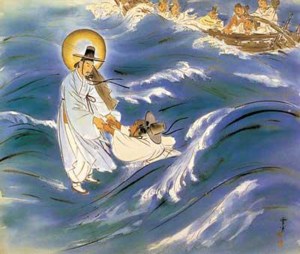
jesus rescues peter - korea Ocean is a gift to humanity. For many of us, ocean means a great variety of seafood, a place to spend our vacation. When we imagine a vast sea with beautiful beach, we are ready to enjoy swimming, snorkeling or diving. However, for millions of fishermen and seafarers, sea simply means life as they depend their lives and their families on the generosity of the sea, the resources it offers, and the works it generates. Unfortunately, the sea is not always merciful. The sea is home to powerful storms and with its giant waves that can even engulf the biggest of ships. With the effects of global warming, massive sea pollution and destructive ways of fishing, it is getting hard to get a good catch. Novelist Ernest Hemingway in his book “The Old Man and the Sea” narrates a life of fisherman who after risking his life to catch a giant fish, brings home nothing but a fishbone as his catch was consumed by other fishes. Majority of fishermen who continue struggling with lingering debt and difficulty to get fuel for their boats, become poorer by the day. These make fishermen and seafarers a perilous profession.

The Sea of Galilee is not a sea at all, but technically a lake. Certainly, it is a lot safer than the open sea, but the Gospels constantly tell us that the lake can be deadly sometimes even to seasoned fishermen like Peter and other apostles. Like Peter and the apostles, Filipino Dominican missionaries to Babuyan group of islands at the northern tip of the Philippines know well what it means to be at the mercy of the ocean. To go to their mission stations, they have to cross a sea strait by a small boat for around 4 to 8 hours. It might be a tiny strait, but it is a wild and dangerous one because it connects to two great seas, the Pacific Ocean on the east and South China Sea or West Philippine Sea on the west. When the sea is rough and the boat is hit and tossed by the giant waves, it is the time when our missionaries and all others in the boat to pray, and perhaps it is their sincerest prayer ever. When at the mercy of the ocean, we begin to realize that what matters most in life is actually life itself, and as only this life that we hold dear, everything else seems to be trivial and passing.

However, there comes the paradox. In the midst of raging ocean, holding on to fragile life, we begin to be closest to the creator of life Himself. The mighty sea washes away those things that stand between us and God. All those things that add layers upon layers to our lives are swept away. As we achieve wealth, physical beauties, educational attainments, physical beauties, possessions and honor, we tend to be full of ourselves, and become more independent from God who grants us those blessings. Like Peter, our faith becomes little, relying too much on ourselves. Then, when the storm comes and we begin to sink, we realize that all those achievements will not save us.

What are those things in our lives that stand between us and God? Are we like Peter, a man of little faith? What are the stormy sea experiences in our lives? How do you encounter God in these stormy sea experience?

 Br. Valentinus Bayuhadi Ruseno, OP


Metamorphosis

The Feast of Transfiguration. August 6, 2017 [Matthew 17:1-9]

 “He was transfigured before them; his face shone like the sun and his clothes became white as light (Mat 17:2).”

transfiguration 2This Sunday, the Church is celebrating the feast of Transfiguration.  The word ‘transfiguration’ comes from Matthew who writes Jesus transfigures before the three disciples, Peter, James and John, his face shines like the sun and his clothes become white as light (17:2). The word “transfigure” is the direct transliteration of the Latin Vulgate Bible “transfigurare”. It is a combination of two words “trans” meaning to across, and “figura” meaning figure.  Thus, transfiguration literally means the change of figure. It is a fitting word to describe what happens to Jesus.
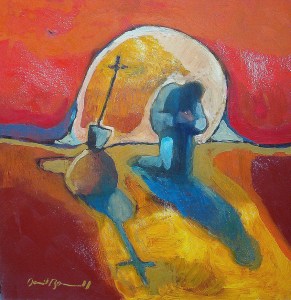
However, if we look at the original Greek, Matthew used the word “metamorphos” which is actually the root of the English word metamorphosis. Many of us understand metamorphosis as a biological term. It is a marked and more or less abrupt developmental change in the form or structure of an animal. The classical examples are the transformation from a leaf-eating caterpillar into a beautiful butterfly, or an aquatic tadpole into a land-dwelling frog. Metamorphosis is surely a radical change, but we do not use this term to describe what happens to Jesus in Mount Tabor perhaps because we do not want to limit Jesus’ transformation to the biological sphere only. It is something more fundamental, spiritual and even divine.

In our time, the medical technologies have advanced considerably, and this enables us also to undergo a metamorphosis. We can look young despite our age. We can reduce our excess fat in no time. We can make even our face bright and vibrant, even ‘shining like the sun’. I have to admit that often I do not pay much attention to my physical and facial improvement, but I believe that our efforts to care for our bodies and improve our beauty are part of appreciating God’s creations. The problem sets in when we become excessive and even obsessive. Spending huge amount of money just for beauty products and cosmetic surgery while our neighbors are dying of hunger is simply unchristian. Spending our fortune for the companies that cause environmental damages or sufferings to people is also our participation in this injustice.

However, we are called not simply to metamorphosize but to transfigure. While the change and improvement in our body can be good and beautiful, transfiguration is not only a matter of physical alteration. We need to change in a more fundamental, spiritual and even divine way. It is a change that pleases the Father because we become like Jesus, we become His sons and daughters. Through the sacrament of baptism, we have been made God’s children, and now it is our mission to act and behave like His worthy children. Like Jesus, we need to be more aware of the sufferings around us and be compassionate to our poor brothers and sisters. Like Jesus, we fight against the injustices and abuses that take place around us. Like Jesus, we instruct and educate our family, friends and neighbors in truth.

Finally, Matthew places the event of the Transfiguration just before Jesus goes to Jerusalem as He offers His life for our salvation. The true transfiguration enables us to become less and less self-centered and empowers us to do sacrifices for our loves ones. We are called to make the world a better place for us and all children of God. Like Jesus, we are called to be transfigured and be pleasing to the Father.

Br. Valentinus Bayuhadi Ruseno, OP


Jesus, We and Human Work

17th Sunday in Ordinary Time. July 30, 2017 [Matthew 13:44-52]

“…out of joy he goes and sells all that he has and buys that field (Mat 13:44).”

parable of hidden treasureFrom today’s parables, we learn that Jesus appreciates human labor, the use of technology, and economic activities. The parables speak of men buying and selling land, merchants making transactions, and fisher folk catching and selecting the fish. Yet, the appreciation comes with a particular condition: the activities have to be honest and just.
I used to question why the man in the parable has to buy the land first before he takes the hidden treasure.  He could have taken the treasure away even without buying the land. I realize that the buried treasure might be in a massive quantity that to unearth it requires a lot of effort, but it is also something to do with a right ownership. In ancient times, burying or hiding one’s wealth is not uncommon, especially in time of war and chaos. The treasure must have been hidden for a long period of time and the original owners are no longer alive to claim it. It also does not belong to the current landowner because he is oblivious to its presence in his land. Thus, by selling everything he has, and buying the field, he wants to make sure that he becomes the rightful owner of the land and all that is in it.

The second parable speaks of a merchant, and being a merchant is a profession that many people hate in ancient Israel. They do not like merchants because this work is susceptible to deceit and dishonesty. Yet, today’s parable gives us a merchant who is willing to sell everything he has, just to buy the fine pearl. It is a risky and even dangerous move since he is left with nothing and a serious possibility that he will not profit from the rare pearl, but instead employing some illegal tricks, he makes sure that he will become a true owner of that precious gem.

To be involved in various kinds of economic activities and works is not only necessary for human survival but also part of God’s plan for our flourishing. Our intellectual capacity that God gives empowers us to create professions that do not only sustain our lives, but also build up human society and even the Kingdom of God. With the advances of science and technology, new occupations that did not exist ten years ago now are part of our daily lives. IT experts, software developers and men and women working in robotic industries are few examples of these. Yet, traditional works remain essential. Teachers, farmers, fishermen, business men and women, and many others are still the backbone of healthy society. Jesus appreciates all of this.

One thing, however, that corrupts this human capacity to work is greed, an inordinate passion to gain more profit at the expense of others. One of the basic economic laws is the principle of efficiency, that is to get the maximum benefit with minimum amount of resources. This law is balanced by the principle of equity, that is to distribute the economic prosperity fairly among the members of the society. Unfortunately, greed destroys this balance and corrupts people to sacrifice other people and nature just to gain more profit. Jesus calls us not only to be involved in the economic activities, but also to uphold honesty and justice. Only with these two virtues, do we find true satisfaction in labor and contribute to the greater good of society, and in fact, give glory God.

Br. Valentinus  Bayuhadi Ruseno, OP


Jesus, Nature and Us

16th Sunday in Ordinary Time. July 23, 2017 [Matthew 13:24-43]

“The kingdom of heaven is like a mustard seed that a person took and sowed in a field. (Mat 13:31)”

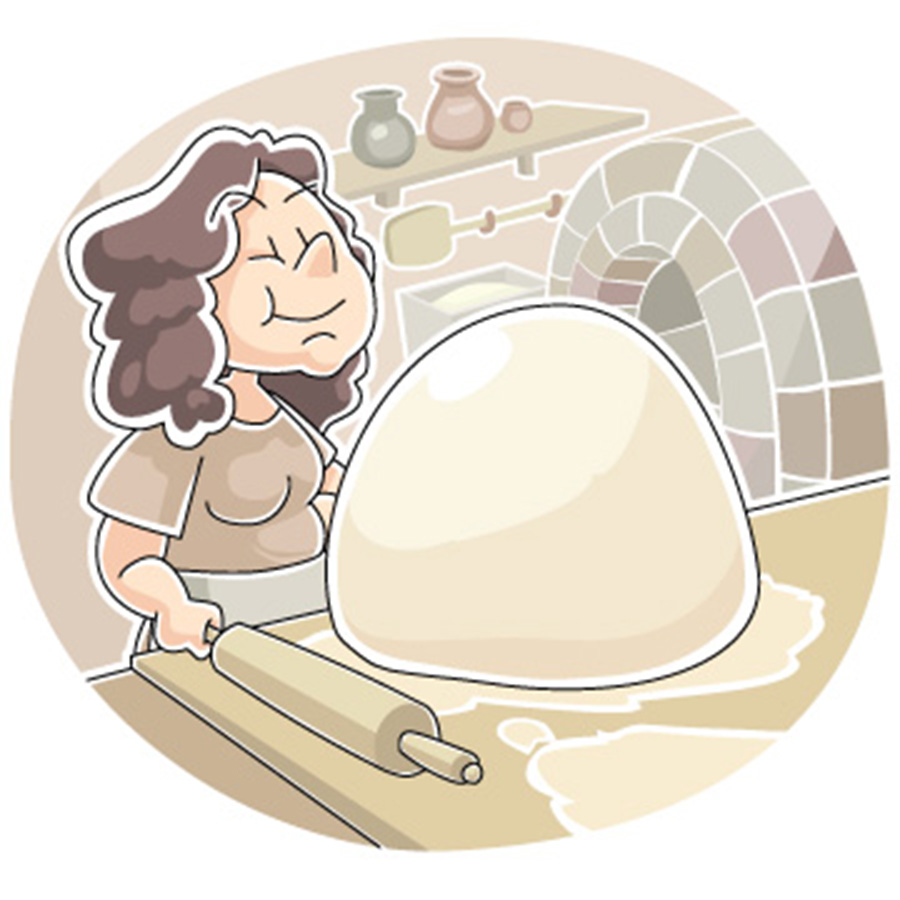
 parable mustard seedFrom the several parables that Jesus tells us in today’s Gospel, we learn that Jesus is keen on how nature works. He observes how seeds of wheat and weed grow, and how the yeast would affect the dough in the process of baking. Jesus also is observant of human ingenuity in working with nature for the benefit of the human community. Men and women till the land, are observant to the cycle of nature, sow the well-prepared seeds, take care of the growth and then harvest the result for the good of community. The use of yeast for baking is a very ancient method of cooking. Women would place yeast in dough, and the microorganism would interact with the carbohydrate in the flour, creating carbon dioxide, and as an effect, the leaven dough would expand. Though unleavened bread will last longer, this yeast would make the bread softer and tastier, making it more enjoyable for human consumption.

By mentioning the beauty of nature and the human creativity, Jesus acknowledges the greatness of God, the creator of all as well as the goodness of creation. He sees harmony between nature and human, and when both work together, all will manifest the beauty of creation. Yet, Jesus also reminds that the evil one is working to destroy this harmony, by planting the seed of greed, hatred and injustice in our hearts. Instead of using our God-given talent and reason to nurture nature, we choose to manipulate it and exploit it for our own benefits and pleasures.

We are proud with our cellular phone. It has become a modern lifestyle, and we often keep changing for the latest and more advanced models. Yet, we are not aware that men, women and even children are working under terrible conditions somewhere in long chain of production. A single cellular phone is a complex combination of metals, and extracting these minerals from earth seems easy yet at the same time most problematic. For example, the greater part of a cellphone’s battery is made of cobalt, and the mining of cobalt does not only cause massive environmental problems, but also fuel arm conflicts in Congo, causing loss of human lives, and great refugee problems. Other materials are coming from developing countries like Indonesia, Chile and the Philippines. That is just a cellular phone; other gadgets like laptop, personal computers, and other electronic devices, require even more of these raw materials.

I myself am participating in this environmental problems, as I am writing this reflection in my old laptop, and sending this reflection through my cellphone. I do believe that many of us want to follow Jesus in preserving the harmony between nature and human creativity, and we are just caught up in this global web of disharmony. Yet, we must not be hopeless. We do not have to throw away our gadgets, but at least, we should be aware of the massive injustice done to nature and fellow human. We are also invited to be more conscious with what we have, like cloths, food and electricity, and how their creation often has upset nature. To have Jesus as our God, means following His example of being observant to nature’s work and appreciative of human ingenuity. Moreover, we are following His footsteps in caring for the creations which have been beautifully created by His Father as well as our Father.

Br. Valentinus Bayuhadi Ruseno, OP


Yoke

14th Sunday in the Ordinary Week. July 9, 2017 [Matthew 11:25-30]

 “Take my yoke upon you and learn from me, for I am meek and humble of heart; and you will find rest for your selves.  (Mat 11:29)”

yoke 1Yoke is a device, usually of wood, placed on the shoulder of animals or persons to carry a burden. In agricultural settings, a yoke is used to pull a plow to make a furrow on the ground so that the soil will be ready for the seed planting. But, a yoke can be used also to drag a cart and transport various goods. Because its primary function is to carry a load or burden, a yoke turns to be a symbol of responsibility, hard work, and obligation. In our seminary in Manila, a leader among the brothers is called a decano. In the beginning of the formation year, we elect our decano, and as he assumes his responsibility, he ceremonially receives a wooden yoke from the outgoing decano. The yoke reminds him of responsibility and great task that he has to endure through the year.
In the Bible, a yoke often symbolizes a means of oppression and slavery. The yoke reminds the Israelites how they lived as slaves in Egypt. The yokes were placed upon their shoulders and they have to carry heavy materials, and to work for the construction of Egyptian colossal buildings. At the time of Jesus, the yoke has slightly evolved to symbolize tedious religious obligation. When Jesus criticized some of the Pharisees and Jewish religious leaders for putting so much emphasis on the details of the Law and rituals, and forgetting what truly the essentials, Jesus called this practice as the yoke of the Pharisees.

However, in today’s Gospel we learn that Jesus asks us to carry His yoke. Wait! Does it mean like the Pharisees, Jesus also wants us to carry a yoke of burden? Jesus clarifies further that His yoke is easy and my burden is light. So, Jesus’ yoke is just less burdensome compare to that of the Pharisess, yet it is still a yoke, a load. How then we can be truly restful if it is just a matter of changing of yoke?

To understand Jesus’ yoke, we need to know that in ancient Israel, like in our time, there are different kinds of yokes. There is a yoke for a single animal, but there is also a yoke that unites two animals together in pulling the burden. When Jesus speaks about His yoke, He is referring to this yoke for two animals or persons. When we carry the yoke of Jesus, it does not mean that Jesus simply gives us the yoke for us alone to shoulder, but we carry it together with Jesus. It is not a transferring of responsibility, but sharing of the burden. And when we feel tired and exhausted because of the heavy burden, we can rest a while since Jesus is the one who now carries the burden for us. In fact, as a carpenter, He knows best how to make a yoke more convenient to carry. That is the yoke of Jesus.

We are carrying the yoke of life with Jesus. And indeed it is a great consolation for us. We are burdened by so many problems in life and often it is too heavy to bear. Yet, we are never alone. Jesus is bearing the yoke for us, the Church is working together with us, our family and friends are one with us. This gives us rest in trial time, yet when others’ life are heavy, like Jesus, we are also helping in carrying others’ yoke, because it is only one yoke, the yoke of Jesus.

Br. Valentinus Bayuhadi RUseno, Op


Bigger Family

13th Sunday in Ordinary Time. July 2, 2017 [Matthew 10:37-42]

 “Whoever loves father or mother more than me is not worthy of me, and whoever loves son or daughter more than me is not worthy of me (Mat 10:37).”

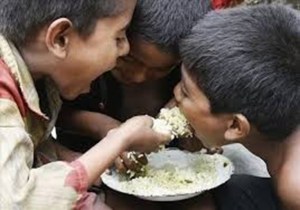
hungerWhen God calls us, God does not only call us privately and individually. In the Bible, God also calls us with our family, our community. God created the first man and woman not only to complete each other, but also to “multiply” or to build a human family. Noah entered the ark together with his wife and children. They were saved as a family from the flood. Abraham and Sarah were called from the land of Ur, and establish their own family and clan in the land of Canaan. When God called Moses to deliver the Israelites from slavery, God also called Aaron and Miriam, Moses’ brother and sister, to assist him in his mission. Finally, the life of Jesus of Nazareth would not be complete without the family of Mary and Joseph of Nazareth.

Surely, it is a good news for family-oriented persons. For many cultures, like Filipino and Indonesian, family is at the center of our value system. When I ask some of my Filipino friends, “If your house is burning, what are the first things you will rescue?” Their answer is not money, important documents or jewelries, but family pictures! In 1977, the Tanzanian President Julius Nyerere, one of the most prominent African figures during that time, visited US and talked before the African students who studied there. Before them, he criticized those Africans who received much support from their families and clan, yet refused to go back after their studies. It was an act of cowardice and betrayal to Africa.

However, if we read today’s Gospel, Jesus made a tough demand for His disciples. In preaching the Kingdom, they had to love Jesus more than they love their family. In ancient Israel, like many Mediterranean societies, respect and honor of the parents was a sacred duty of every child. It was in fact enshrined in the Decalogue as the fourth commandment.  To the point that if a child failed to honor their parents and brought nothing but headache, he would be punished severely by the community (see Dt 21:20-21). As a Jew, He knew this too well, yet He insisted that His disciples had to be committed first to Him and His Gospel before their families. Does Jesus want to cut us from our families? Is Christ-centeredness opposed to family centeredness? Does following Jesus mean leaving our family behind?

God indeed calls us with our family and as a family, but He does not call us only for our family. As old proverb goes, “Charity begins at home, but it does not end there.” We surely love our families, but as Christians we are called to serve a bigger family of humanity and even our mother Earth. It is impossible to serve others, if our allegiance is for ourselves and a small family. Many corruptions take place because we want to enrich our families and clans at the expense of other people. To serve the bigger family of humanity, we are called to first love God who is the merciful and just Father to all, who pour rains and gives sunshine both to the good and not so good. Jesus does not want to destroy families because surely He loves Mary and Joseph, yet He loves His Father most, and this love empowers Him to give His life for all whom His Father loves.

Br. Valentinus Bayuhadi Ruseno, OP