

The Nativity of the Lord [December 25, 2017] John 1:1-18
“And the Word became flesh and made his dwelling among us, and we saw his glory, the glory as of the Father’s only Son, full of grace and truth. (Joh 1:14)”
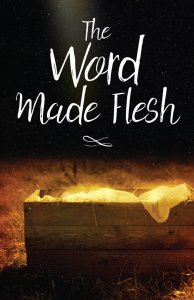 Christmas is one of the most joyous events in the Church and the world. But, what makes us happy this Christmas? Is it only about partying? Is it all about buying gifts? Is it about family gathering? Is it about fulfilling our obligation of going to the Church? Is there something more than these? Immersed in many celebrations, merriment, spending, and holidays, we often forget the main reason behind Christmas. We all know Christmas is the birthday of Jesus Christ, but what is the meaning and significance of this birth for us? Let us stop for a while and reflect on the Gospel of John.
John describes the birth of Jesus in just one line, “and the Word was made flesh and dwell among us.” It is a short yet powerful line, but demands an explanation. “…was made flesh” means that the Word becomes a totally human being. He breathes the air we breathe, feels what we feel, and works for a living just many of us. He is human like us in all respect except sin (see Heb 4:15).
Yet, this man is also fundamentally different from us, because he is the Word. Who is this Word? At the beginning of his Gospel, John the evangelist gives us an extremely brief but potent description of the Word. He was with God since the beginning, and the Word was God. With boldness, John the evangelist proclaims that this Word is God the Son, the second divine person of the Holy Trinity. He has existed with the God the Father in eternity, and only through Him, all creations come to existence. In the Annunciation, this all-powerful Word became man, and in Christmas day, He was born in Bethlehem.
It is true that Christmas accounts of Luke and Matthew are more vivid and details as compare to John. Matthew has the three Magi, and Luke has the angels and shepherds. Yet, despite its brevity, only John connects Christmas to the divine Word. Christmas reaches its deepest meaning when we are able to appreciate the Word, the God the Son, decides to be born as man. Then why does God choose to be a man, fragile, prone to pain and suffering, and mortal like us?
The only answer is love. God is love (1 Jn 4:8) and God so loves us, that He gives only Son for us. God is madly in love with us, to the point that He becomes one of us, and by becoming a man, we may feel His love in a most radical manner. We can discuss various theories of love at length, but unless we put into actions, love is meaningless. So thus, the love of God is manifested in the most concrete manner as He becomes man. We might do not understand why this kind of love, but God is like a mother who is so in love with her newly born baby, will do anything to ensure his wellbeing even to the point of sacrificing her own life. Christmas is indeed one of the happiest events because here we are able to feel and appreciate the love of God in a most radical way. It is the gift of love, and only true love that can make us truly happy.
Br. Valentinus Bayuhadi Ruseno, OP
 Luke has a poignant and unique way in narrating the story of the Annunciation. He deliberately places the story of Zachariah and of Mary side by side, and lets his readers see both stories in comparison. The first story speaks of a holy man who serves in the Temple. Zachariah is a symbol of the ideal Israelite who stands at the center of the holy ground. The second story speaks of an ordinary woman who lives in Nazareth, a small town far from the center. In a patriarchal society, Mary is a symbol of the poor and marginalized Israelite who is pushed to the peripheries. Angel Gabriel appears to both, and God does marvelous deeds for both. Yet, the Annunciation to Mary turns to be far more excellent. The Angel greets Mary with the title of honor, the highly favored one, while the angel does not even greet Zachariah. The Angel makes Zachariah mute because of his doubt, but he assures Mary when she is confused. The conception of John the Baptist is done through natural means, while the conception of Jesus in the womb of Mary takes place through the supernatural way. Zachariah and Elizabeth represent the outstanding God’s marvel in the Old Testament like when God opened the womb of Sarah, the wife of Abraham, and Hannah, the mother of Samuel, despite their old age and barrenness. Yet, what happens to Mary surpasses and outshines these Old Testament miracles.
 In the Fourth Gospel, John the Baptist has an important role. It is not only to baptize, but to become a witness. He is to witness to the light, to the true Messiah, to Jesus Christ. When the priests, Levites, and Pharisees from Jerusalem, come to him , and interrogate him to clarify his identity, he makes it clear that he is not the Messiah, not even the prophet, but rather enigmatically saying “a voice that cries in the desert.” It seems it is an easy thing to do for John. Questions are thrown at him, and he simply gives straight and confident answers. Yet, looking deeper into the reality, it is actually the opposite.
 Today, we read the beginning of the Gospel according to Mark. Among the evangelists, only Mark explicitly introduces his work as the “Gospel”. The English word “Gospel” simply means the Good News, or in original Greek, “Evangelion.” Commonly, we understand a gospel as a written account of the life and words of Jesus Christ. The Church has recognized four accounts as canonical or true Gospel. We have Gospel according to Matthew, Mark, Luke, and John.
 Talent is one of the few biblical words that has become part of our modern language. Talent connotes a God-given ability or a natural unique skill, and yet it has not fully developed. Thus, we are called to use and harness our talents in order to achieve our full potentials and contribute to the progress of society. In fact, talents have become well-sought commodity in our society. Companies only hire the talented employees. Schools are marketed as venues of talents development. Our TV channels and social media outlets are filled by shows where we perform, compete and prove that we possess the best talent in singing, dancing, and the like. How our world is now obsessed with talents!
 Reading this Sunday’s Gospel, I feel that Jesus is reprimanding His priests and ministers for “preaching and yet not practicing.” Unfortunately, many of us are failing in this matter. We preach forgiveness, but some priests are having prolonged quarrels with other co-priests and some of their parishioners. We teach kindness and friendship of God, yet some of us appear to be aloof and snobbish. We proclaim justice, but sometimes we fail to be just to the simple people working in the parish or convent.
 What is love? If we ask young couple who are in love, love means more time together and be connected online even up to late hours of the night. For young priests, love may mean patiently listening to confessions for hours, and attending to sick calls. For a couple who have their newly-born baby, love is changing the baby’s diapers even at middle of the night. Love is passion, dedication and sacrifice.
 “In this world nothing can be said to be certain, except death and taxes.” Benjamin Franklin once said. Indeed, tax is an unpleasant and unavoidable fact in our lives as ordinary citizen. A portion of our hard-earned wage is suddenly taken away from us, and only God knows where it goes. In modern society, almost all we have, we gain, and we use are taxed. The practice of taxing people goes back to first known organized human societies. The basic idea is that tax will provide a common resource for the improvement of the community, like building roads, free education and quality health care. Yet, the ideal is often met with abuses. In olden time, the kings and chieftains taxed people so they could build their grand palaces and feed their wives. Unfortunately, the situation does not change much in our time.
