

28th Sunday in Ordinary Time. October 15, 2017 [Matthew 22:1-14]
“Go out, therefore, into the main roads and invite to the feast whomever you find!” (Mat 22:1)
 Jesus is already in Jerusalem. The confrontations between Jesus and the Jewish authorities have turned bitter, and Jesus is approaching His final days on earth. With this context, the parable may be understood easily. The invited guests stand for some elite Israelites who refuse Jesus, and thus, reject God Himself. The burning of their towns and cities may point to the invasion of the Roman Empire and the destruction of Jerusalem in 70 AD. The commoners who are later invited represent the people from all nations who accept Christ. Yet, some people who are already at the Wedding banquet do not wear the expected wedding garment. This proper dress decorum is a basic sign that the guests are honoring the host, and also becomes the symbol of our faith, our good works and our holy lives. For those who fail to honor the King through their garment are thrown out from the banquet.
At that level, the parable is indeed easy to comprehend. We are called not to imitate the example of some elite Israelites but to receive eagerly God’s invitation. As to the wedding garment, we are also expected to live out our faith to the fullest. However, something continues to bother me within this interpretation. It presents a conflicting image of a king that is authoritarian and vengeful and a king who is exceptionally generous, seen in his persistence to invite his first set of guests, and his openness to accept the ordinary people. As to the first image, he exacts his justice in violent ways. Like any king in ancient times, he will destroy the people who dishonor him, to the point of burning their towns or throwing them into darkness. If we are not careful enough, we may identify this king with our image of God. We may believe that our God is a God who rewards the good and punishes the wrongdoers even with severe and violent ways. He is easily offended by simple mistakes, and is not compassionate enough as to give a second chance.
We remember that we are created in the image of God. Now if we have this kind of vindictive and unforgiving God, then we gradually behave like that image of violent God. In the Philippines, where the majority are Christians, the killings of alleged criminals are in steady rise. Surprisingly, some people seem to approve it and even happy with this bloody happenings. This attitude might be a reflection of our image of God that is vengeful and violent.
This kind of God’s image may manifest also in more subtle ways. Despite their sincere apology, it is difficult to forgive a friend who has hurt us, a husband who has betrayed us, or a boss who has acted unjustly. As husband and father, we act like a supreme leader, and refuse to listen to our wives and other family members. As priests, religious sisters, or lay leaders, we think that we are always right and do not accept any correction. We focus on the weakness of others, rather than their struggles to become better. Instead helping them to rise from their failures, we ridicule them and enjoy gossiping about them. These are some instances that we are influenced by the false image of God. This kind of image is only preventing our growth in faith, but also destroying our healthy relationship with others.
I believe that some asects of the parable remain true and relevant, like God’s radical openness to all people, and our faith that has to be lived fully. Yet, in more profound level, the parable challenges our false image of god, the god who is vindictive and violent. It invites us to rediscover God’s image in the person of Jesus who loves us to the end, and dies so that we may live.
Br. Valentinus Bayuhadi Ruseno, OP
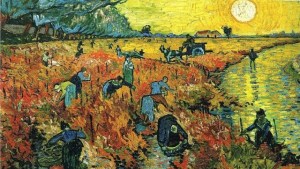 The image of a vineyard is close to Israelites’ hearts because this springs from their prophetic tradition. Isaiah uses this metaphor to describe Israel and God (see Isa 5:1-8). Consistent with this great prophet, Jesus crafts His parable of the vineyard to describe the relation between God and His people. God is the just and generous vineyard owner, and we are His workers. Now, it is up to us to work hard for the Lord in His vineyard and receive abundant harvest, or be lazy, and expelled from the vineyard.
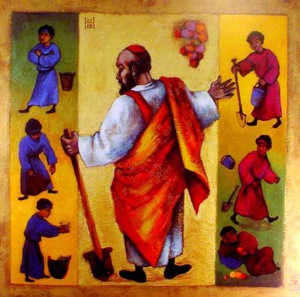 The road to hell is paved with good intentions. This old proverb attributed to St. Bernard of Clairvaux may sound rather morbid and threatening, but the truth remains. If we have only good intentions, marvelous plans, or great designs, but we never lift a finger to begin the first step, nothing will happen. We want to focus on our study, yet we are distracted by Facebook’s status and newsfeeds, our online chatting, or endless videos in YouTube, we will not make any progress. We wish to accomplish a lot of works, but our attentions and energy are consumed by so many other concerns. Then, our wish stays a wish.
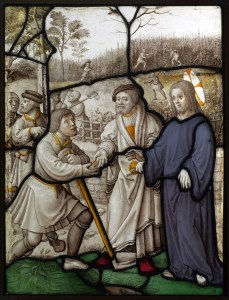 Jesus is the storyteller genius. The parable he shares to us today does not only surprise us with its unexpected ending, but it also creates a sense of puzzlement and wonder. We expect that the workers who labored the whole day would get the better wage compared to those who came late. Yet, it did not happen. All got the same wage regardless of their working hours. The vineyard owner was right to explain that he did not violate the agreement with his laborers, but deep inside us, there is something quite off. If we were militant enough, we would stage a rally to protest the vineyard owner’s decision.
 Why is it difficult to forgive? One of the reasons is that after we are wronged, the immediate reaction is to seek justice or even revenge. We want that the pain and the loss we experienced are also felt by those who inflicted them on us. We want “a tooth for a tooth, an eye for an eye”. Unfortunately, consumed by anger and hatred, our cry for justice can easily turn into an intense desire of revenge. If justice seeks to balance scale, revenge seeks to inflict a greater punishment, or even to destroy those who have harmed us. Unless we get what is due, unless they receive what they deserve, there is no forgiveness.
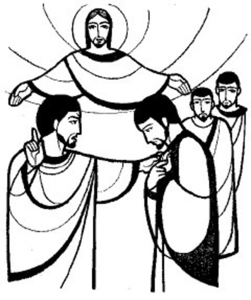 Jesus understands that in any human community, including His own community of disciples, or the Church, there are always members affected by human weakness and sinfulness. Even in the Christ-oriented communities like the religious convents, the parishes, and various ministries and groups in the Church, inevitably we are hurting each other. Thus, Jesus, the Just God and merciful man, outlines a procedure or ‘fraternal correction’ to deal with misunderstanding, quarrels, and conflicts. It begins with the individual and personal encounter, then when it does not work, we ask the help of a witness or mediator, and lastly it goes up to the community level.
 We come to one of the most heated exchange of words in the Gospel, and this occurs no less than between Jesus and Simon Peter. The apostle rebukes Jesus for revealing to the disciples that he has to go Jerusalem, suffer and die, but be raised on third day. In return, Jesus reproofs him and calls him Satan. Why does this harsh quarrel take place between Jesus, the most merciful Lord, and his trusted disciple, Simon whom he has just declared as the Rock?
 Today’s Gospel is well known as the Confession of Peter. Jesus asks the disciples who He is, and Simon confesses that Jesus is the Christ, the Son of the living God. He gets it right, and Jesus Himself reveals that his answer does not come from his human weakness, but from the heavenly Father. I used to think that this revelation is an instant inception of divine idea inside Simon’s mind. Right there and then, like Archimedes who discovered the Law of Hydrostatic, Simon also shouts “Eureka! I have found it!”
 Why does Jesus, the compassionate man and just God, have to “humiliate” the Canaanite woman? If we put ourselves in the context of Jesus’ time and culture, we will understand that what Jesus does is just expected of him. Jesus is dealing with a woman of gentile origin. Generally, Jews avoid contacts with the non-Jews, and a Jewish man does not engage in dialogue with a woman who is not his wife or family in public. Jesus does what every Jewish man has to do. However, in the end, Jesus praises the woman’s faith and heals her daughter. Eventually, mercy overcomes differences and love conquers all.
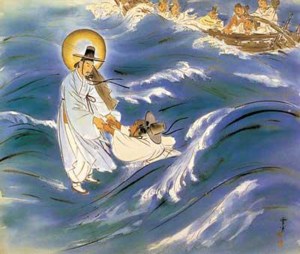 Ocean is a gift to humanity. For many of us, ocean means a great variety of seafood, a place to spend our vacation. When we imagine a vast sea with beautiful beach, we are ready to enjoy swimming, snorkeling or diving. However, for millions of fishermen and seafarers, sea simply means life as they depend their lives and their families on the generosity of the sea, the resources it offers, and the works it generates. Unfortunately, the sea is not always merciful. The sea is home to powerful storms and with its giant waves that can even engulf the biggest of ships. With the effects of global warming, massive sea pollution and destructive ways of fishing, it is getting hard to get a good catch. Novelist Ernest Hemingway in his book “The Old Man and the Sea” narrates a life of fisherman who after risking his life to catch a giant fish, brings home nothing but a fishbone as his catch was consumed by other fishes. Majority of fishermen who continue struggling with lingering debt and difficulty to get fuel for their boats, become poorer by the day. These make fishermen and seafarers a perilous profession.
