

Solemnity of the Most Holy Trinity [A]
June 7, 2020
John 3:16-18
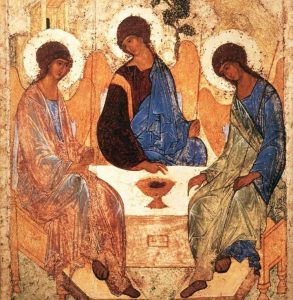 We are re-entering the ordinary season of the Church, and one of the greatest feasts within the ordinary time is the solemnity of the Most Holy Trinity. The Church has placed the celebration of the great feast on Sunday after the Pentecost. The reason may not be that obvious, but if we look at the bigger picture, it is nothing but a natural procession of truth. In Easter, we are celebrating the resurrection of Jesus that cements the divinity of Christ. On the Pentecost, we witness the divinity of the Holy Spirit being affirmed [see last Sunday’s reflection]. Now, we are rejoicing for the Three divine persons in God.
The Trinity Sunday is admittedly the most dreaded by many preachers because many are still at a loss of how to show the beauty of this most profound truth, and others are afraid to explain the Trinity because they may spread erroneous concepts. After all, we are facing the source and summit of all mysteries, the mystery of all mysteries. However, it is not the right excuse not to bring forth the beauty of the Holy Trinity. The preachers have to roll up their sleeves and spend more time in researching and preparing our homilies.
In my reflection, I would like to bring you to the Old Testament. In the Old Testament, the reality of the Trinity is hidden in most parts, and yet the sacred truth comes up in the surprisingly key moments. Let us read Gen 1:1-3, “In the beginning when God created the heavens and the earth, the earth was a formless void and darkness covered the face of the deep, while a wind from God swept over the face of the waters. 3 Then God said, “Let there be light,”; and there was light.” The early Christians like St. Irenaeus of Lyon, immediately saw this as Trinity working as one, God, the Spirit, and the Word. The good news is that the creation is the masterpiece of the Holy Trinity, and to a certain degree, it reflects the perfection of the Trinity.
And wait, something more! In Gen 1:26, when God created the man and the woman, God said, “let us create the man and woman in our image and likeness.” This passage is a bit strange because why God, who is one, suddenly self-refer in plural? The Jewish tradition would interpret that God is addressing His heavenly council, the angels, but again, the Christian tradition instinctively saw them as the three divine persons. The good news is that if we are created in the image of God, and if our God is the Trinity, then we are created in the image of Trinity.
This explains a lot of things. Indeed, we cannot fully comprehend the mystery, but we surprisingly are very close to this mystery. Trinity is both our origin and destiny. As the image of Trinity, we cannot discover real joy by hoarding things to ourselves. We cannot be selfish and truly delighted at the same time. Like the Father and the Son love each other in the Holy Spirit, we are called to give ourselves to others in life.
Why does the Catholic Church fearlessly defend the sacredness of marriage? Because through marriage, the man and woman may give themselves totally to each other in love. Their love is so strong that love can give birth to life. When this new life [children] come to their lives, their love can grow even exponentially. In loving and giving ourselves, we may find the fullness of our identity, the image of Trinity. Indeed, it is tough, but the good news is that we are designed to give love and life. Holy Trinity is our origin, and Holy Trinity is our destiny.
Valentinus Bayuhadi Ruseno, OP
 Kita memasuki kembali masa biasa Gereja, dan salah satu perayaan terbesar dalam masa biasa adalah kesungguhan Tritunggal Mahakudus. Gereja telah menempatkan perayaan besar ini pada hari Minggu setelah Pentekosta. Alasannya mungkin tidak begitu jelas bagi kita, tetapi jika kita melihat gambaran yang lebih besar, itu sebenarnya adalah prosesi kebenaran yang wajar. Di Paskah, kita merayakan kebangkitan Yesus yang mengukuhkan keilahian Kristus, dan pada hari Pentekosta, kita menyaksikan keilahian Roh Kudus ditegaskan [lihat refleksi hari Minggu lalu]. Sekarang, kami bersukacita karena Tiga pribadi Ilahi di dalam Tuhan.
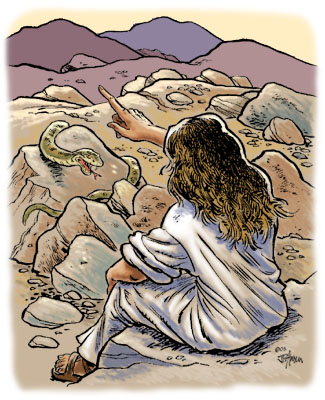 Hari Minggu Prapaskah pertama dimulai dengan kisah Yesus di padang gurun, berpuasa dan dicobai oleh iblis. Matius memberi kita lebih banyak perincian dalam kisah pencobaan, dan dari Matius, kita menemukan tiga pencobaan Kristus. Mengapa Setan menggoda Yesus? Kenapa tiga godaan?
 At the heart of Jesus’ teaching in the Mount is the formation of the heart. However, the heart in the Bible is not limited to our affective side or emotions. It also stands for the center of intellectual capacity and freedom. The heart is the seat of life itself, and thus, represents who the man or woman is.
 Di hati pengajaran Yesus di atas gunung adalah pembentukan hati. Namun, hati dalam Alkitab tidak terbatas pada sisi afektif atau emosi kita. Ini juga berarti pusat kapasitas intelektual dan kebebasan. Hati adalah pusat kehidupan itu sendiri, dan dengan demikian, mewakili totalitas seorang manusia.
 Jesus is accused of unfaithful to the Law of Moses and the traditions of the elders. He no longer requires His disciples to performs ceremonial washings and many traditions of the elders [Mat 15:2]. Jesus heals people even during the Sabbath [Mark 3:1-6]. Jesus declares that all food is clean [Mark 7:19]. The worst part is when Jesus commands His disciples to drink His blood [see Lev 17:14; Mat 26:27-28]. Is Jesus breaking and changing the Law of Moses?
 Yesus dituduh tidak setia dengan Hukum Musa dan tradisi. Dia tidak lagi meminta murid-murid-Nya untuk melakukan ritual pembasuhan, dan banyak tradisi lain [Mat 15: 2]. Yesus menyembuhkan orang bahkan pada hari Sabat [Markus 3: 1-6]. Yesus menyatakan bahwa semua makanan halal [Markus 7:19]. Dan yang paling parah adalah ketika Yesus memerintahkan para murid-Nya untuk minum darah-Nya [lihat Im 17:14; Mat 26: 27-28]. Apakah Yesus melanggar dan mengubah Hukum Musa?
 Reading carefully, we may wonder, “Is it possible if the salt loses it, saltiness?” In everyday experience, we never experience tasteless salt. However, when we go back to the time of Jesus, we will be surprised that a salt losing its taste is a daily reality. In ancient Israel, the people would go to the Dead Sea, the saltiest body of water on earth, and gathered the “pillar of salt” formed surrounding the lake. Then, they would put inside a small bag, like a teabag”, and when it was needed for seasoning, the bag would be dipped into the water or soup. After some repeated use, the salt would lose its saltiness due to the chemical impurities. It turned to be nothing but an ordinary pebble, and shall be thrown away and trampled underfoot.
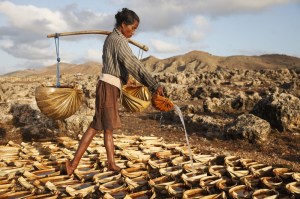 Membaca dengan teliti, kita mungkin bertanya-tanya, “Apakah mungkin jika garam kehilangan rasa asinnya?” Dalam pengalaman sehari-hari, kita tidak pernah menemukan garam yang hambar. Namun, ketika kita kembali ke zaman Yesus, kita akan terkejut bahwa garam yang kehilangan rasanya adalah kenyataan sehari-hari. Di Israel kuno, orang-orang akan pergi ke Laut Mati, laut yang memiliki kadar garam paling tinggi di bumi, dan mengambil bongkahan-bongkahan garam yang terbentuk di sekitar danau. Kemudian, mereka akan dimasukkan ke dalam kantong kecil, seperti kantong teh, dan ketika dibutuhkan untuk bumbu, kantong itu akan dicelupkan ke dalam air atau sup. Setelah digunakan berulang-ulang, garam akan kehilangan rasa asinnya karena kandungan kimia yang tidak sempurna. Bongkahan garam pun berubah menjadi batu biasa, dan akan dibuang dan diinjak-injak.
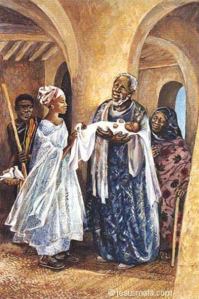 If we are given a chance to choose our parents, what kind of parents will be our choice? Perhaps, some will prefer billionaire parents so that we can sing like Bruno Mars, “I wanna be a billionaire… Buy all of the things I never had… I wanna be on the cover of Forbes magazine, and Smiling next to Oprah and the Queen.” Perhaps some of us want to become the children of a king. So, royal blood is flowing through our vein, and people call us as a prince, princess, or royal highness. Perhaps, we want to be born from Korean megastars, because we want to become the prettiest or the most handsome.
 In Medio Ecclesiae