Mercy Conquers All

Second Sunday of Easter [C]
April 24, 2022
John 20:19-31

Pope John Paul II has declared the Second Easter Sunday as the Divine Mercy Sunday. On April 30, 2000, the declaration took place when John Paul II canonized Sr. Faustina Kowalski. Since then, the devotion to the Divine Mercy has grown exponentially worldwide. Nowadays, many of us do not only pray the angelus prayer, but every three in the afternoon, the hour of Jesus’ death, recite the prayer of divine mercy. More and more people make divine mercy chaplet as daily devotion aside from the rosary. Many communities gather together and organize novena to the Divine Mercy. But, do you know what mercy is? And, why does it has to be the 2nd Sunday of Easter?

The Oxford dictionary gives us an exciting definition of mercy: compassion or forgiveness shown toward someone whom it is within one’s power to punish or harm. A story may illustrate this definition of mercy. During one of the Napoleonic wars, one of the young French soldiers deserted the army and fled the battlefield. Unfortunately, he got captured. Knowing that his son would be executed, the mother rushed to see Napoleon. She said to the general, “have mercy on my son!” Napoleon immediately replied, “your son’s crime is so heinous. Justice demands his death, and he does not deserve mercy.” The mother then answered, “It is not mercy if he deserves it!”.

Let’s go back to the Biblical Hebrew language. Mercy is related to the word ‘rahamim,’ which is rooted in the word ‘Rahim’ meaning ‘womb.’ Thus, ‘rahamim’ implies a mother’s feelings and attitude toward her children. We know that we have hurt our mothers too often if we try to reflect on our lives and our relationship with our mothers. Since we live in their wombs until we grow to adulthood, we give them countless headaches and heartaches. Yet, despite the terrible things we have done, our good mothers keep accepting and loving us as their children.

Then, why the second Sunday of Easter? This Sunday, the Church always selects the story of resurrection from John, the evangelist. There are some exciting details. The disciples locked themselves in the room because of fear of the Jews. Yet, more than fearing the Jewish authorities, they dreaded Jesus, who returned and took His vengeance. Yet, Jesus came not to bring punishment but forgiveness. Thus, the first thing He said was ‘Peace’! They have peace because Jesus, who has the power to inflict punishment, decides to have mercy on them.

Yet, Jesus does not stop there. He also breathed the Holy Spirit and gave them the divine authority to forgive sins. To teach the true meaning of mercy and forgiveness, Jesus has to suffer the cross, die, and get buried. Jesus teaches them that the worst things may fall upon Jesus, but this hatred, wrath, and vengeance will not have the last say.

We deserve death and hell with so many sins we have committed, but the resurrection points to us that however terrible we treat Jesus, mercy will always triumph. His forgiveness is always ready to embrace us. We need to do one thing: beg for that mercy.

Valentinus Bayuhadi Ruseno,OP

Jesus Resurrected?

Easter Sunday [C]
John 20:1-9
April 17, 2022

Jesus has risen! Alleluia! This is the foundation of our faith and our salvation. We know for sure that what Jesus said and what He did for us are true. Death is conquered, and the darkness’ power is decisively defeated.

photocredit: Bruno van der Kraan

But, what is the evidence of Jesus’ resurrection? The answer is the empty tomb.
Yet, how do we know for sure that Jesus has indeed risen from the dead? Is an empty tomb enough evidence for His resurrection? Is there a possibility that Jesus’ body was stolen, or Jesus was still alive and was able to escape? Let’s check whether these arguments can hold water.
Firstly, His disciples came at night and stole their master’s body. Then they spread the rumor that Jesus has risen from the dead. At first, this sounds possible, but after closer examinations, we realize that Roman soldiers guarded the tomb. A bunch of fishermen was not just a match for the professional army. At the same time, the disciples were in complete disarray after their master was captured and crucified.

Secondly, the one crucified was not Jesus, which is a case of mistaken identity. This argument is not attainable. Judah played an essential role in ensuring that the one arrested was Jesus, not someone else. Jesus’ trial was done in public, and thus, it was easy to recognize whether the person was Jesus. Plus, the mother and other disciples of Jesus were also present during the crucifixion, and they recognized the one on the cross was Jesus.

Thirdly, Jesus was not dead, and He was able to find His way out of the tomb. This argument is implausible. Jesus was tortured severely and crucified. A soldier pierced His side to verify His death, which alone could deal a mortal blow. Just in case Jesus survived all these ordeals, the tomb would seal Jesus inside, and without proper ventilation and immediate treatment, Jesus would suffocate and die.

Aside from these counterarguments, had Jesus’ resurrection been a lie, it would eventually die down. Many Jewish people believed in the resurrection of the dead, but it will occur at the end of time, not during their lifetime. The Greeks and the Romans thought the idea of resurrection silly. Yet, Jesus’ disciples would gladly die for this truth. Even after horrific forms of torture, they would not give up their belief in the resurrection because it is simply the truth.

Another interesting detail is that the first witnesses of the empty tomb are women. In ancient Jewish society, women’s testimony was not honored. The evangelists could have altered the women’s witnesses with more credible male counterparts. Yet, they did not do that because they could not change the truth that the women were indeed the witnesses of the empty tomb.

There is no other fitting explanation than the resurrection. Jesus has risen, and our faith is not in vain. We have been redeemed, and we know that is true. We rejoice and celebrate for this Jesus’ victory over death.

Valentinus Bayuhadi Ruseno, OP

Jesus’ Prayers on the Cross

Palm Sunday of The Lord’s Passion
April 10, 2022
Luke 22:14 – 23:56

Every Palm Sunday, we listen to the Passion Narrative of Jesus Christ. Since we are in the liturgical year C, we hear from the Gospel of Luke, and it is notedly the longest among the four Gospel. If we try to compare the passion narratives of the four Gospels, we will discover basic similarities, but also some obvious nuances. What makes Luke’s account unique?

photocredit: Grant Witthy

Surely, there are several unique stories in Luke, but one outstanding character of Jesus is that Luke consistently describes Jesus as someone who loves to pray. In short, Jesus always prays, especially in His important moments of His life. He prays when John is baptizing Him. He is praying while in the desert for forty days. He prays at the mountain when He is transfigured. He prays in the Garden of Gethsemane. Even, Jesus prays when he is the cross.

Luke even gives us a window to what Jesus expresses to His Father. Jesus’ first prayer in the cross is ‘Father, forgive them, for they do not know what they are doing [Luk 23:34].’ We remember that His close friend denies Him, another betrays Him, and others are running away from Him. He is accused falsely and tortured brutally. He receives treatment worse than animals. He is even going to die like the worst criminals, in the most agonizing and humiliating way possible. Yet, despite all these, He prays for all of them, and gives His forgiveness. Jesus does not only teach ‘to love one’s enemies’ or ‘to pray for those who persecute you’. Jesus truly walks the talk.
Jesus does not stop there. When one of the thieves is asking for Jesus’ forgiveness. Jesus does not only forgive, but He also promises Him paradise. Despite the terrible situations, Jesus does not only pray, but also blesses a man who needs its most. Lastly, Jesus closes His earthly with another prayer, “Father into your hands I commends my spirit.” This time, Jesus recites Psalm 31:6. His entire life has been an obedience to God’s will, and it is proper that He ends it with giving His spirit peacefully to His Father.
Certainly, there are so much to learn and reflect from these three prayers of Jesus. Yet, one thing we can learn from here is Jesus teaches us how to face life full of sorrow and sufferings. Our lives may be difficult, but it does not mean we have to become bitter and vengeful. The first step is to pray. Instead, uttering curses and hatred, we bring our problems and sufferings into prayers. ‘Cast all your worries upon him because he cares for you [1 Pet 5:7]’. The second step is to forgive and to seek forgiveness. One of the reasons why life is so bitter is because we refuse to forgive. To forgive is not about forgetting, but it is about to let go our hatred and resentment, and let God fills us with His peace. The third step is to be grateful. Is it possible to be grateful? When we offer our sufferings to God and to unite them with Christ’s suffering, our trials and sorrow even can become blessing for others. Then, we know we know that our sufferings are never useless. We have always a reason to be grateful.

Valentinus Bayuhadi Ruseno, OP

Writing on the Sand

5th Sunday of Lent [C]
April 3, 2022
John 8:1-11

Jesus was facing an unsurmountable dilemma when confronted with a woman caught in adultery. The Pharisees demanded that Jesus throw her with a stone, following the Mosaic Law, which reads, “If anyone is caught sleeping with a married woman, both of them must die [Deut 22:22].” However, the flip side was that every Israelite at that time knew that they were not allowed by Roman Law to carry out the death penalty. So, if Jesus had not thrown the stone, He would have been accused of being unfaithful to the Law and not a man of God. However, if Jesus threw stones, He would be dealing with the Romans. What did Jesus do?

Jesus wrote on the ground. What did Jesus write? We don’t know for sure, and quite a lot of opinion has developed over the last thousand years. However, there is one interesting tradition about this. Jesus was fulfilling Jeremiah’s prophecy. About 600 years before Christ, Jeremiah once prophesied that ‘those who have turned away from Thee will be written on the earth because they have forsaken God, the fountain of living waters [cf. Jer. 17:13].’ Jesus was writing the names of those who had put Him to the test, the fountain of living water [cf. John 7:38].

Now it’s Jesus’ turn. Jesus threw this question back at them, “Who is without sin, let him throw the first stone.” Of course, Jesus was sinless, but the Pharisees always clamoured that they were an elite group who lived blemished according to the Mosaic Law and even had an obsession to force others to live Mosaic Law their ways. So it’s as if Jesus was saying, ‘OK, you who claim to be the perfect enforcers of the Mosaic Law, throw the first stone and prove that you are truly faithful to the Torah.’

A surprising thing happened. The Pharisees chose not to throw stones. They would rather disobey the Mosaic law than deal with the Romans. This shows that they are nothing more than opportunists and hypocrites. In front of the crowds, they showed themselves to be lovers of the Law, but they were ready to leave the Law in a disadvantageous situation.

It’s incomplete if we don’t see a little bit of Jesus’ action towards the woman. Jesus didn’t throw stones, but that doesn’t mean Jesus condoned or tolerated what happened. Jesus clearly said, ‘Go, and sin no more.’ Jesus stated that this woman was a grave sin that violated the sanctity of married life. However, Jesus, the God who has the right to forgive, read this woman’s contrite heart. Jesus forgave her. However, Jesus’ forgiveness was not cheap. Jesus demanded a radical change from a life of sin.

Who are we in this story? Are we like the Pharisees who are busy finding fault with others? Are we like those busy showing off, but we run away when we face a tough choice? Are we the ones who wallow in sin and don’t know what to do? Or, are we those who cannot appreciate the grace of God?

Valentinus Bayuhadi Ruseno, OP

The Story of the Elder Son

4th Sunday of Lent [C]
March 27, 2022
Luke 15:1-3, 11-32

The parable of the prodigal is one of the most beautiful and heart-warming stories in the entire Bible. It is, in fact, the longest among Jesus’ parables and loaded with exciting details. While a great deal of the parable is given to the younger son, the story ends with the elder son. Many of us identify with the younger son. We used to live in the life of sin, far from God, and even become the enemies of God. Yet, we felt empty, and our lives go in the wrong direction. Then, going back to our senses, we repent and go back to the Lord. However, not a few identify themselves with the elder son.

Personally, I tend to be sympathetic to the elder son, perhaps because I am also the eldest in the family. I feel that the elder son’s anger is nothing but natural. I will be angry if my younger brothers ask for his inheritance and leave the family behind for a life of dissipation. I will be even more enraged when he suddenly comes back, and my parents will accept him as if nothing happens. At least, he must be disciplined and make reparations for what he has done. It is just and right!

Yet, after I go deeper into the story, I realize some critical details. The elder son is angry, and, in his wrath, he refuses to enter the home. Without realizing it, the elder son does what, the younger son did: leaving his house. Then, He says, “this son of yours!” He could have said, “Father, why do you treat my brother like this!” Without realizing it, the elder son does what the younger son did: distancing and disassociating himself from his father. Another interesting fact is that the elder son says, “I have been working like a slave for you.” Without realizing it, the elder son becomes what, the younger son has been: a slave.

Son though he is, he never considers himself as one, but rather a mere slave. We can see how the elder son only views his brother as another runaway slave and his father as an enslaver. A disobedient slave must be punished severely, and the loyal servant must be rewarded. Therefore, he is distraught. His paradigm is violated. He fails to see from his father’s perspective, and thus, he suffers.

From this story, we see a deeper meaning of metanoia or repentance. Metanoia [change of mind] does not simply mean turning from a life of sin to a life with God. It also means having the mind and heart of God. We are invited to think and act, no longer as slaves fearing punishment, but as mature children of God. Unfortunately, some of us are like the lost firstborn, who see ourselves as nothing more than servants, and we build our relationship with God based on fear, not love. We go to church because otherwise, we will go to hell. We serve because otherwise, we will be cursed. And we begin to see our neighbors as servants who have to follow the rules blindly; otherwise, they will be severely punished. Metanoia means no longer living in fear but as children of God living in love and freedom.

Valentinus Bayuhadi Ruseno, OP

From Transfiguration to Calvary

Second Sunday of Lent [C]
March 12, 2022
Luke 9:28b-36

Every second Sunday of Lent, the Church chooses the event of Transfiguration for our Gospel reading. During this moment, Jesus, together with three trusted disciples, went up to the mountain, and there, he was transfigured or changed appearance. He was radiating a divine glory, and His face turned to be a bright light. The two most outstanding persons in the Old Testament, Moses and Elijah, appeared and accompanied Jesus. He was manifesting His divine nature to the three disciples, and it was an overwhelmingly joyful moment. Simon did not want the experience to pass and offered to build tents there. The question is that why does the Church choose this reading for this season of Lent?

The answer lies on the topic that Moses, Elijah and Jesus were discussing: Jesus’ exodus. When we hear the word exodus, the first thing that comes to mind is that the Israelites under Moses escaped the slavery of Egypt. The Israelites passed through the Reed Sea, the desert from Egypt and eventually entered the Promised Land. Their final destination was the city of Jerusalem.
Then, why did Jesus speak about His exodus?
The reason is that Jesus is the new Israel, and as the old Israel passed through exodus, Jesus had to undergo His exodus. However, unlike the old Israel that started their exodus in Egypt, Jesus began His exodus in Jerusalem. Unlike the old Israel that was not faithful to God in the desert and worshipped idols, Jesus was obedient to His Father through suffering and death. Unlike the old Israel who entered the promised Land with many lost battles, Jesus rose from the death and won definitively against Satan and His kingdom. Unlike the old Israel who went up to the earthly city of Jerusalem, Jesus gloriously ascended to the heavenly Jerusalem.
After the event of Transfiguration, Jesus no longer stayed in Galilee but steadily moved toward the city of Jerusalem. This is why we have this reading for the season of Lent. As Jesus journeyed to His exodus in Jerusalem, we are also walking with Jesus in this season of Lent toward the Paschal Triduum: from the Mount of Transfiguration to the mount of Calvary.
The story of Transfiguration in the context of Lent gives us a precious lesson. Like Peter, we like to linger in the glorious moments of our lives. Yet, Jesus teaches that our real glory has to pass exodus. Our Egypt, our starting point, is none other than our old and sinful selves. Any moment of glory without dying to ourselves is fake, fickle and even addictive. It is undoubtedly not easy because we are craving for the feeling of pleasure, and when we get used to it, the harder it is to detach ourselves. Through the disciple of Lent, fasting, prayer and almsgiving, we are learning how to die to our desire to enjoy instant gratifications. When we can adequately order our worldly desires, the more our hearts desire for God, and the moment we are one with God, we find our true joy.

Valentinus Bayuhadi Ruseno, OP

Yesus, sang Setan, dan Sabda Allah

Minggu Prapaskah ke-1 [C]
6 Maret 2022
Lukas 4:1-13

Minggu Prapaskah ke-1 [C]
6 Maret 2022
Lukas 4:1-13

Pada Minggu pertama Prapaskah, Gereja selalu memberikan bacaan Injil tentang Yesus di padang gurun selama 40 hari. Ada beberapa alasan untuk pilihan ini. Pertama, karena Yesus tinggal selama empat puluh hari di padang gurun, kita juga diundang untuk memasuki padang gurun Prapaskah selama 40 hari. Kedua, karena Yesus berpuasa dan berdoa di padang gurun, kita juga dipanggil untuk berpuasa dan berdoa selama masa Prapaskah ini. Ketiga, Yesus mengajar kita bagaimana melawan iblis dan godaannya. Karena saat ini kita berada di Tahun Liturgi C, kita dapat belajar dari kisah Yesus di padang gurun dari sudut pandang Lukas. Salah satu yang menonjol dalam perdebatan antara Yesus dan sang iblis adalah bagaimana firman Tuhan digunakan.

Pada Minggu pertama Prapaskah, Gereja selalu memberikan bacaan Injil tentang Yesus di padang gurun selama 40 hari. Ada beberapa alasan untuk pilihan ini. Pertama, karena Yesus tinggal selama empat puluh hari di padang gurun, kita juga diundang untuk memasuki padang gurun Prapaskah selama 40 hari. Kedua, karena Yesus berpuasa dan berdoa di padang gurun, kita juga dipanggil untuk berpuasa dan berdoa selama masa Prapaskah ini. Ketiga, Yesus mengajar kita bagaimana melawan iblis dan godaannya. Karena saat ini kita berada di Tahun Liturgi C, kita dapat belajar dari kisah Yesus di padang gurun dari sudut pandang Lukas. Salah satu yang menonjol dalam perdebatan antara Yesus dan sang iblis adalah bagaimana firman Tuhan digunakan.

Yesus menghadapi tiga godaan Iblis. Ini adalah tiga area di mana pribadi manusia secara rohani lemah. Yang pertama adalah godaan kedagingan, dan hal ini menyerang keinginan kita untuk kenikmatan badani seperti makanan dan hubungan suami-istri. Yang kedua adalah godaan keserakahan, dan hal ini mengeksploitasi keinginan kita untuk memiliki hal-hal yang kita lihat. Terakhir tapi paling mematikan, adalah godaan keangkuhan. Godaan ini membingungkan cinta-diri yang sejati dengan perilaku narsistik. Godaan ini adalah yang terburuk karena keangkuhan akhirnya menyedot kita ke dalam gagasan palsu bahwa kita bisa menjadi tuhan-tuhan kecil.

Ini adalah godaan yang Iblis lemparkan kepada Yesus. Godaan kedagingan diluncurkan ketika Yesus lapar dan diminta untuk mengubah batu dan roti. Godaan keserakahan dimulai ketika Yesus dibawa untuk melihat keajaiban dunia dan ditawarkan untuk memiliki semuanya. Terakhir, godaan keangkuhan dimulai ketika Yesus diundang untuk memamerkan kuasa-Nya karena Dia memiliki otoritas untuk memerintahkan para malaikat.

Tentu saja, iblis gagal total. Namun, yang lebih menarik adalah cara Yesus melawan iblis. Setiap kali iblis melancarkan serangan, Yesus dengan bijak membalasnya dengan kutipan dari Perjanjian Lama. Sungguh, Firman Tuhan adalah senjata ampuh melawan serangan dan godaan iblis. Jadi, penting bagi kita untuk mengenal Alkitab kita dan mempelajarinya dengan baik.

Namun, itu bukan akhir dari cerita karena iblis pun menggunakan ayat Alkitab. Dia mengutip bagian dari Mazmur 91, “Dia akan memerintahkan malaikat-malaikat-Nya tentang kamu, untuk menjaga kamu… [Mzm 91:11]”. Apa yang lebih luar biasa adalah bahwa Mazmur 91 secara tradisional digunakan untuk pengusiran setan. Iblis menggunakan kata-kata yang digunakan untuk mengusirnya! Bagaimana ini mungkin? Pasalnya, iblis menggunakan ayat alkitab di luar konteks dan hanya sesuai dengan tujuannya, yaitu menjebak Yesus.

Dari kisah ini, kita mendapat pelajaran berharga. Kata-kata Kitab Suci, bila digunakan dengan cara yang tidak tepat dan hanya sesuai dengan tujuan kita, menjadi alat Iblis. Kita dipanggil untuk meneladani Yesus dalam menjalankan firman Tuhan. Hanya jika kita benar-benar membaca Alkitab dalam konteks yang tepat dan dalam relasi kasih dengan Tuhan, ini benar-benar menjadi Firman Tuhan yang penuh kuasa.

Valentinus Bayuhadi Ruseno, OP

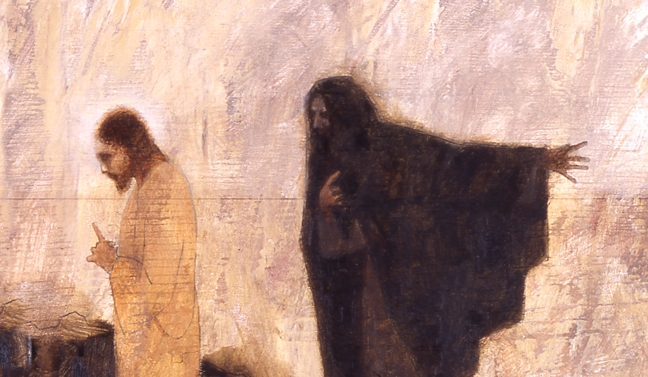
Jesus, the devil, and the Word of God

1st Sunday of Lent [C]
March 6, 2022
Luke 4:1-13

On the first Sunday of Lent, the Church always gives the Gospel reading on Jesus in the desert for 40 days. There are several reasons for this choice. Firstly, as Jesus stayed for forty days in the desert, we are also invited to enter the desert of Lenten season for 40 days. Secondly, as Jesus fasted and prayed in the desert, we are also called to fast and pray during this season of Lent. Thirdly, Jesus teaches us how to fight against the devil and his temptation. Since we are currently in the Liturgical Year C, we can learn from the story of Jesus in the wilderness from Luke’s perspective. One is prominent in the debate between Jesus and the devil is how the word of God is used.

Jesus is facing three devil’s temptations. The traditions call the three Concupiscences. These are three areas where human persons are spiritually weak. The first is the lust of the flesh, and it attacks our desire for bodily pleasures like food and sexual relationship. The second is the lust of eyes, and it exploits our desire to possess the things we see. Lastly but most deadly is pride. This confuses genuine self-love with narcissistic behaviors. This is the worst because pride eventually sucks us into the false idea that we can become a god without God.

These are the temptations that the devil throws into Jesus. The lust of the flesh is launched when Jesus is hungry and asked to turn stone and bread. The lust of the eye is commenced when Jesus is brought to see the worldly wonders and offers to have them all. Lastly, the temptation of pride is initiated when Jesus is invited to show off His power as He has the authority to command the angels.

Surely enough, the devil fails miserably. Yet, what is more, interesting is the way Jesus resists the devil. Every time the devil launches an attack, Jesus wisely counters it with the quotations from the Old Testaments. Indeed, the Word of God is a powerful weapon against the assault and temptation of the devil. Thus, we need to know our Bible and learn them by heart!

Yet, that is not the end of the story because even the devil uses the Bible verse. He quotes parts of Psalm 91, “He will command his angels concerning you, to guard you… [Psa 91:11]”. What is more remarkable is that Psalm 91 is traditionally used for exorcism. The devil is using the very words that used to expel him! How is this possible? The reason is that the devil uses the bible verse out of context and only to suit his purpose: to trap Jesus.

From this story, we learn a valuable lesson. The words of Scriptures, when misused way and only to fit our purpose, are become the instruments of the devil. We are called to imitate Jesus in living the word of God. Only if we indeed read the Bible in its proper context and a loving relationship with God, they truly become the powerful Word of God.

Valentinus Bayuhadi Ruseno, OP

Beyond Ordinary Love

7th Sunday in Ordinary Time [C]
February 20, 2022
Luke 6:27-38

‘To love your enemies’ is considered the most difficult of Jesus’ teachings. It is not only extremely tough, but it is practically impossible. Our natural tendency and feelings are to hate those who hurt us and despise those who harm us. Especially when we are still hurting, we want to get even as soon as possible. We desire our enemies to feel our pains, and the more pain, the better. How is this teaching even possible?

photocredit: Jan Tyson

However, Jesus does not say, ‘like your enemies’, but ‘love them’. The Gospel even specifies that the Greek word for ‘love’ here is ‘agape’. This is a love based not primarily on emotions but free will and commitment. It may be impossible to change our adverse feelings toward someone who hurt us, but it remains possible to decide not to inflict injuries and even do something good for them. Thus, after He says, ‘love your enemies, Jesus further clarifies, ‘do good to those who hate you, bless those who curse you, and pray for those who abuse you.’ To do good, bless, and pray are not feelings of love but acts of love. St. Thomas Aquinas synthesizes this teaching of Jesus and defines love as ‘to will the good of others’

Yet, despite the truth about agape and our God-given ability to perform something against our natural inclination, loving our enemies is just a hard pill to swallow. Though we know the theories, we are also struggling to do it. Then, we are back at our original question: ‘why does Jesus teach something impossible?’

To answer this, we have to see a bigger picture. The teaching to love our enemies is not the only hard saying of Jesus. Through His ministries, Jesus teaches several teachings and commandments that seems unthinkable. Jesus declares that divorce is not the plan of God for man and woman. Jesus reveals that His body is real food and His blood is a real drink, and only by consuming His body and blood we can have eternal life. And, most of all, Jesus unveils the most profound mystery of God, the Trinity, and He Himself is the second person of the Trinity than became flesh. All of these are humanly impossible to do and to believe, but why does Jesus insist on teaching them?

The answer lies in the grace of God. Jesus understands that these are divine revelations, and relying only on human wisdom and strength, we are bound to fail. Thus, the Holy Spirit and His grace supply what is fundamentally lacking in us. Like we cannot believe in Jesus as our Lord unless moved by the Holy Spirit, we will not be able to love our enemies unless the same Holy Spirit empowers us. Jesus knows that His teachings are humanly impossible, but He also gives us the necessary grace to enable us to perform the impossible. Then, loving our enemies is indeed grace-filled love and supernatural love. If we are still finding it hard to love our enemies, perhaps, this is the time to rely more on God’s grace.

Valentinus Bayuhadi Ruseno, OP

Woe to You

6th Sunday in Ordinary Time [C]
February 13, 2022
Luke 6:17, 20-26

Today’s Gospel presents us with the Beatitudes according to St. Luke. There is a fundamental similarity with Matthew’s version [see Mat 5:1-11], yet there are also some glaring differences between the two. One of the most apparent distinctions is the presence of ‘woes’ in Luke’s version. What is a ‘woe’ anyway?


In the context of the Bible, ‘woe’ is a cry of impending distress used by the prophet Israel [see Is 5:8–22; Amos 6:1; Hab 2:6–20]. The prophets called for repentance of Israel and return to the Lord God, yet if the Israelites remained stubborn, the woe should become a reality, and they would endure the terrible consequences. In the Gospel, Jesus practically did what His predecessors had done. Yet, there is also something new that Jesus introduced.


The prophets were pronouncing the woes to hardened people of Israel who truly did wicked things before the Lord. They worshipped other gods, abandoned the true God, and even worse, offered their children to these gods. They were also involved in sexual immorality and injustice to the weak and the poor. The Israelites were violating every single commandment in the Decalogue. In this context, God’s severe judgment was right and just. However, if we try to compare the prophets of the Old Testament and Jesus, we notice something remarkably odd.


Jesus’ woes were to those who are rich, filled with food, laughing, and praised. Jesus never said, ‘woe to you, idolaters!’ or ‘woe to you adulterers!’, but He pronounced judgment to those who are laughing. But why? Is it not to laugh is healthy? Is it genuinely evil to have money? Is it wrong to praise someone who deserves it? It seems that Jesus is a bit excessive when giving away His woes.
However, we must see entire things of Jesus’ saying. Jesus did not simply say ‘woe to you, rich people.’ The complete sentence is, ‘woe to you, who are rich, for you have received your consolation.’ Jesus emphasized the truth that the woe is for those who make wealth their consolation. Earthly goods, including wealth, are naturally good, but they always serve as means, not the end. The same with laughter and other bodily pleasures. These are good and natural to us human persons. In fact, laughter makes us uniquely human, as no other animals can do the same. Yet, again, if we prioritize our bodily pleasures and lose God in the process, everything will be for nothing.


It is also the same with praises and affirmation we receive. Parents’ honest appreciation will solidify our self-esteem as little kids, and genuine commendation will make us grow in confidence. Yet, if we are obsessed with getting praises and oblations, this may do more harm than good. The highest honors belong to God.


Like the prophets of old, Jesus sounded harsh teachings, but He is genuinely concerned with our salvation and happiness. Jesus tells us that if we fail to make God our end, blessing, especially earthly ones, can turn curses and woes. Jesus’ tough love constantly pulls us away from the eternal sadness.

Valentinus Bayuhadi Ruseno, OP