

Thirteenth Sunday in Ordinary Time [July 1, 2018] Mark 5:21-43
“Daughter, your faith has saved you. Go in peace and be cured of your affliction.” (Mk. 5:34)
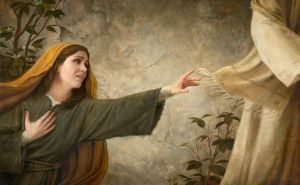 Today’s Gospel seems to be just another healing miracles of Jesus, but if we read it closely, the story of the healing of the woman with hemorrhage is extraordinary tale of faith. We are not sure what kind of hemorrhage she suffers, but the fact that she bears the sickness for 12 years, spends a lot for the medication, and does not get any better, means it is pretty serious, if not terminal. During this time, the physicians are extremely rare, and expectedly, the patients need to spend a lot of money. The woman may come from a wealthy family, but she is impoverished because her prolong sickness. The woman is losing her life and facing despair. I am currently assigned as an associate chaplain in one of the hospitals in Metro Manila, and my duty is to make pastoral visit to these patients. I encounter some patients who are suffering from certain health conditions that drain all their resources, and it seems the situation does not get any better. I realize the story of the woman with hemorrhage is not only her story happened in the far past, but it is also our stories here and now.
We must not forget that our protagonist is also a woman. Being a woman in the time of Jesus means being a second-class citizen in a patriarchal society and often, they are considered as mere properties of the husbands or the fathers. Generally, while the men work outside and socialize, women are expected to stay at home, and function as the housekeepers and babysitters. Normally, they are not allowed to communicate with the outsiders, especially men, except under the supervision of their husbands or fathers. Our protagonist is also having chronic hemorrhage, and this means she is ritually unclean, and those who are in contact with her shall be made unclean as well (Lv. 15:19).
The woman with hemorrhage has faith in Jesus and wants to be healed, yet to do that, she has to challenge the cultural norms that bind her. She traverses into greater danger. What if she is not healed? What if she makes Jesus and His disciples unclean? What if she will be branded as a shameless woman by the society? Shame restrains her, but faith propels her. Thus, she takes a ‘win-win’ approach. She tries to reach Jesus’ cloth, and she makes sure that she will not establish any contact with Jesus. Miracle happens, and she is healed. Yet, unfortunately, Jesus finds her. In tremble and fear, she fells down before Jesus and confesses. She is afraid not only because she “snatches” the power from Jesus, but because she has broken the standing cultural norms and the Law of Moses. However, Jesus’ response surprises his disciples and all who witness the event. Instead of castigating her for culturally improper behavior, Jesus praises her faith, “Daughter your faith has saved you.”
Indeed it is her faith that makes her a proactive protagonist of this particular story. She refuses to succumb to despair and makes her way all the way to Jesus. We notice most of the actions in this story is performed by the woman, and Jesus is there to affirm her. Rightly, Jesus calls her “daughter” acknowledging her also as the descendants of Abraham, the father of great faith. The story of a woman of hemorrhage is a journey of a woman of faith. It is a faith that grows even in the midst of hopeless situations of sickness, financial crisis, and uncertain future. It is a faith that thrives in the middle of human limitations, and transcend cultural boundaries. It is a faith that moves a mountain.
Br. Valentinus Bayuhadi Ruseno, OP
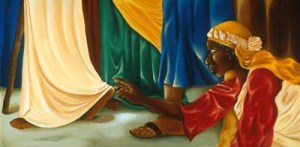 Injil hari ini tampaknya tidak berbeda dengan kisah-kisah mukjizat penyembuhan Yesus, tetapi jika kita membaca dengan seksama, kisah penyembuhan perempuan dengan pendarahan ini sebenarnya luar biasa. Kita tidak tahu dengan pasti pendarahan apa yang dideritanya, tetapi fakta bahwa ia menderita kondisi ini selama 12 tahun, menghabiskan banyak untuk pengobatan dan kondisinya semakin memburuk, ini berarti sangat serius. Pada zaman itu, tabib sangat jarang, dan berobat perlu mengeluarkan banyak uang. Perempuan ini mungkin berasal dari keluarga kaya, tetapi dia jatuh miskin karena kondisinya tersebut. Perempuan ini mulai kehilangan hidupnya dan menghadapi keputusasaan. Saya saat ini ditugaskan sebagai asisten imam di salah satu rumah sakit di Metro Manila, dan tugas saya adalah melakukan kunjungan pastoral ke pasien-pasien yang dirawat di rumah sakit tersebut. Tidak jarang saya menjumpai pasien yang menderita kondisi kesehatan yang menguras semua sumber daya mereka, dan tampaknya situasi mereka tidak menjadi lebih baik. Saya menyadari kisah perempuan dengan pendarahan ini bukan hanya kisahnya yang terjadi di masa lalu, tetapi juga kisah umat manusia di zaman ini.
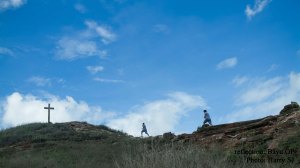 If Jesus is a carpenter, why does He speak about the vine in today’s Gospel? Does He have the competency to draw wisdom from a field that is not His expertise? We recall that Jesus grows and lives in Galilee, and in this northern region of Israel, the land is relatively fertile and agricultural industry is thriving. Some archeological findings suggest that in Nazareth, despite being a small village, the community members are engaged in small time farming, grapes press, and winemaking. A young Jesus must have been involved with this farming activities and perhaps even helped in a nearby vineyard. Thus, Jesus does not hesitate to teach wisdom using the imageries coming from the agricultural settings, like parables related to the vineyard (Mat 20:1-16), planting seeds (Mat 13:1-9), wheat and weed (Mat 13:24-30), and harvest (Mat 9:35).
 Jika Yesus adalah seorang tukang kayu, mengapa Ia berbicara tentang pokok anggur? Apakah Dia memiliki kompetensi untuk mengajar dari bidang yang bukan keahlian-Nya? Kita ingat bahwa Yesus tumbuh dan hidup di Galilea, dan di wilayah utara Israel ini, tanahnya relatif subur dan industri agrikultur cukup berkembang. Beberapa temuan arkeologi menunjukkan bahwa di Nazaret, meskipun adalah desa kecil, penduduknya terlibat dalam pertanian skala kecil, dan juga pembuatan anggur. Sebagai penduduk Nazaret, Yesus muda sedikit banyak terlibat dengan kegiatan pertanian ini, dan mungkin pernah membantu di kebun anggur terdekat. Karena pengalaman hidup ini, Yesus tidak ragu untuk mengajarkan kebijaksanaan menggunakan citra-citra yang berasal dari dunia agrikultur, seperti perumpamaan yang berhubungan dengan kebun anggur (Mat 20: 1-16), menanam benih (Mat 13: 1-9), gandum dan lalang (Mat 13: 24-30), dan panenan (Mat 9:35).

 In Medio Ecclesiae