


Twelve Sunday in Ordinary Time. June 25, 2017 [Mathew 10:26-33]
“What I say to you in the darkness, speak in the light; what you hear whispered, proclaim on the housetops (Mat 10:27).”
 St. Francis of Assisi once said, “Preach the Gospel all time. When necessary, use words.” He correctly points out that preaching is not only the job of the priests in the pulpit, or lay preachers in the prayer meetings. Preaching the Gospel is the mission of all of us. The preaching can happen in the family, as we show our children the meaning of true love, fidelity and respect. Preaching can take place in our workplaces as we uphold honesty, hard work, and dedication. Preaching may manifest in our daily life as we do justice, service to the needy, and kindness to our neighbors.
However, to preach Jesus Christ is not always smooth sailing. I myself have been in the ministry of preaching for some years, and at times, I have to face tough moments. When, I preach with a content and style that are outside of the box, some good and honest people come and rightly question the orthodoxy of my preaching. Yet, when I preach with predicted insight and usual delivery, young people will come and tell me it is boring. There are times that nobody’s listening to my preaching or reading my reflection. Sometimes, I feel tired, frustrated and bored. The same feelings may also befell us as we do our preaching in the family, workplace, the parish, or the society. It is frustrating when we are honest, but the rest are not. It is tiring when we know that we are the only one working hard. It is hurting to be backstabbed after all our service to others.
Yet, our life as a preacher is a lot better and safer than my brothers and sisters in other places. Our Dominican sisters of St. Catharine of Siena in Iraq chose to stay despite the ongoing war and turmoil that hit the country, and serve the refugees without any discrimination. In 2003, when US-led coalition invaded Iraq, they kept running the hospital in Baghdad amidst heavy fighting and looting in the capital. In 2014, when IS took the city of Mosul, the sisters were walking together with the refugees, and at forefront in helping and managing several refuge centers. For some others to preach Christ means violence and death. Last May, Fr. Miguel Angel Machorro was in critical condition after he was stabbed in the neck just right after saying the mass in Mexico City’s Cathedral. Fr. Teresito Suganob who was working among the Muslims in Marawi City, Philippines, was abducted when the group of extremists occupied the city. Nobody knows yet what happened to him.
What makes them preach the Gospel despite constant dangers to their lives? I believe that it is because they love the Lord dearly. This love, as Roman poet Virgil wrote, conquers all. Their love drives out the fear of death, empowers them in trials, and encourages them in face of frustrations and failures. In the words of St. Paul, “What will separate us from the love of Christ? Will anguish, or distress, or persecution, or famine, or nakedness, or peril, or the sword… No, in all these things we conquer overwhelmingly through him who loved us (Rom 8:35-37).” True preaching, then is fuelled by true love of God and not seeking after our own glory. Without this love, we will back out when our preaching seems to fail, or we will feel proud when our ministry meets success. Do we have this love for Jesus? Are our preaching motivated by this love? Are we allowed to be overwhelmed by God’s love for us?
Br. Valentinus Bayuhadi Ruseno, OP

 Santo Fransiskus dari Asisi pernah berkata, “Wartakanlah Injil sepanjang waktu. Bila perlu, gunakan kata-kata.” Dia menunjukkan bahwa pewartaan bukan hanya tugas para imam di mimbar, atau pengkhotbah awam dalam pertemuan doa. Pewartaan Injil adalah misi kita semua. Pewartaan bisa terjadi dalam keluarga saat kita menunjukkan kepada anak-anak kita arti kasih sejati, kesetiaan dan hormat. Pewartaan dapat berlangsung di tempat kerja saat kita menjunjung tinggi kejujuran, kerja keras, dan dedikasi. Pewartaan dapat terwujud dalam kehidupan kita sehari-hari saat kita berlaku adil, melayani saudara dan saudari kita yang kekurangan, dan berbuat kebaikan kepada sesama.


 Gambaran tentang Kenaikan Yesus yang ada dalam benak kita adalah Yesus yang diangkat ke langit, sementara para murid dengan penuh doa memperhatikan-Nya menghilang secara perlahan-lahan. Tidak salah jika disebut ‘Kenaikan’ Yesus karena Kristus yang telah bangkit akhirnya naik ke surga, kembali kepada Bapa-Nya. Di dalam film Risen, Kenaikan Yesus digambarkan sedikit berbeda. Yesus tidak diangkat ke surga, tapi Dia hanya berdiri di hadapan para murid-Nya, dan tiba-tiba cahaya yang menyilaukan datang dan menelan Yesus, dan Diapun menghilang dari pandangan mereka. Meskipun memiliki rincian yang berbeda, Kenaikan Yesus berbicara kepada kita tentang Yesus yang memisahkan diri dari murid-murid-Nya, dan meninggalkan mereka karena Ia harus kembali kepada Bapa-Nya.
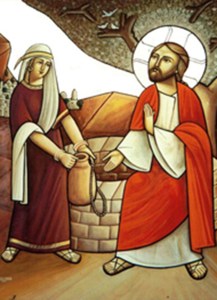 Many of us will see Jesus’ conversation with the Samaritan woman as something ordinary, a chat between a man and a woman. But, if we go back to the time of Jesus, we will discover it as unthinkable. This Samaritan woman embodied what the Jews hated most. Firstly, despite their common ancestry, the Samaritans and the Jews were excommunicating each other. Despite worshipping the same God, they condemned one another as religious heretics and they proclaimed their own religion as the true one. No wonder, sometimes, the encounter between the two turned violent and the Romans had to quell the riots.


 Yesus mengatakan bahwa kita adalah garam dunia. Yesus tidak berkata kita ‘seperti’ garam dunia. Keduanya sangat berbeda, seperti ‘saya adalah Bayu’ jauh berbeda dengan ‘saya seperti Bayu.’ Kalimat pertama memberi hubungan esensial antara subjek dan predikat, sedangkan kalimat kedua hanya hubungan kesamaan yang sementara. Yesus pun tahu persis hal ini.
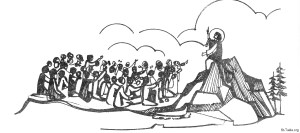 Matthew chapters 5 to 7 are well known as the Jesus’ sermons in the Mount. The section contains classic teachings and parables of Jesus like Beatitudes, the love for one’s enemy and the golden rule. Before Jesus began his sermon, He was sitting down. This gesture actually symbolizes the teaching authority of Jesus. On the Mount, Jesus was the teacher, and as a good teacher, He would expect people to listen attentively to His words. Thus, before Jesus commenced His sermon, He went up to the Mount to separate Himself from the crowd. Jesus knew that being part of the crowd was practically effortless and usually motivated selfishly: to be cured, to be fed and to be entertained. It could turn out to be very superficial, as a mass of people is drawn to one charismatic and powerful leader like Jesus, yet the moment its need is served or its leader is no longer satisfactory, it would be naturally disbanded.
 Injil Matius bab 5 sampai 7 dikenal sebagai khotbah Yesus di Bukit. Bagian ini berisi ajaran-ajaran dan perumpamaan Yesus yang sangat terkenal seperti 8 Sabda Bahagia, dan tentang mengasihi musuh kita. Sebelum Yesus memulai ajaran-Nya, Diapun duduk. Posisi ini sebenarnya melambangkan otoritas Yesus untuk mengajar. Di Bukit, Yesus adalah guru, dan sebagai guru yang baik, Dia akan mengharapkan mereka yang datang kepada-Nya untuk mendengarkan-Nya dengan penuh perhatian. Maka, sebelum Yesus memulai ajaran-Nya, Diapun naik ke bukit untuk memisahkan diri dari kerumunan. Yesus tahu bahwa menjadi bagian dari kerumunan adalah sangat mudah dan biasanya terdorong oleh motif-motif egois seperti ingin segera disembuhkan, untuk diberi makan dan dihibur. Alasannya sangat dangkal, mereka menjadi kerumunan karena tertarik dengan pemimpin karismatik seperti Yesus, namun saat kebutuhan mereka terpenuhi atau sang pemimpin tidak lagi memuaskan, kerumunan pun akan secara alami membubarkan diri.
 In Medio Ecclesiae