

Fourth Sunday of Advent [December 23, 2018] Luke 1: 46-56
“Blessed are you who believed that what was spoken to you by the Lord would be fulfilled.” (Lk. 1:45)
 Today’s Gospel is truly beautiful. We have two protagonists. They are women, and they are both pregnant. Who are they? Mary and Elizabeth. Yet, why is the story beautiful? It is just natural for women to get pregnant. Unless we need to go closer to the stories and place ourselves in the shoes of Mary and Elisabeth, we can never see the true beauty of their story.
First, Mary, she is young, and at the same time, she is pregnant with no husband. St. Joseph is indeed the husband of Mary, but he is not the father of the baby. Perhaps, in our time, if a woman gets pregnant and yet without a husband, this is an unfortunate event, but life goes on for both the woman and child. however, if we go back to the time of Mary, way back two thousand years ago, that woman would be a great disgrace her family and community. She would be expelled from the community, and sometimes, they would be also stoned to death. Mary understands that when she accepts the will of God, to be the mother of Jesus, she faces death. Indeed, death is the future of Mary.
Second, Elizabeth. Elizabeth has a husband, so nobody will stone her, but her situation is also difficult. She is too old to get pregnant. Once I asked my medical doctor-friends, why is it risky to get pregnant if you are old? One said that as we grow old, so does our body and our muscles. With weaker muscles, a mother will have a difficult time during the process of giving birth, and this can be very dangerous to the baby and the mother. I said further, why not caesarian? They said that it is also difficult if not deadly. As we grow old, our hearts weaken. If we place ourselves under the knife, with weaker hearts, there is a big possibility that we will not wake up. Like Mary, death may be the future of Elizabeth.
If Mary and Elizabeth know that it is dangerous and even deadly to be pregnant, why are they still following the will of the Lord?
The answer is at the very name of Elizabeth and her husband Zechariah. Zachariah is from the Hebrew word “Zakar”, meaning to remember. Meanwhile, Elizabeth is formed two Hebrew words, Eli and Sabbath, meaning God’s oath or promise. So if we combine the two names, Zachariah-Elizabeth, they mean “God remembers His promise” or “God fulfills His promise.”
Elizabeth knows it is deadly to have John in her womb, but she still follows the will of God, because she is aware the baby was a fulfillment of God’s promise. Mary from Nazareth, the north part of Israel, travels to Judea, the south of Israel, in haste. But, why in haste? Mary is excited, and she wishes to witness how God fulfills His promise to Elizabeth. The moment Mary sees Elizabeth; she knows that the baby inside her womb is also a fulfillment of God’s promise.
Every child, indeed every on us is the fulfillment of God’s promise. Mary and Elizabeth never see the babies in their wombs as mere inconveniences in their lives or unplanned garbage that can be disposed of. Yet, to accept these babies as gifts of God, Mary and Elizabeth have to be courageous because they are going to sacrifice a lot including their own lives. Elizabeth and Mary are brave women and mothers.
The questions are for us: Who among us is not coming from a woman’s womb? We are all here because of a mother. Indeed, not all mothers are perfect. Some of them are not rich, some are having attitude problems, some are not good examples. Yet, the mere fact we are here now, one woman in our life, against all odds, has decided to courageously accept us as a gift, as the fulfillment of God’s promise. To all mothers, thank you very much.
Deacon Valentinus Bayuhadi Ruseno, OP
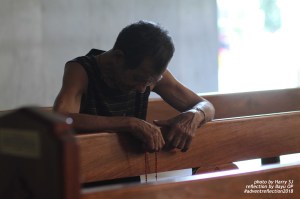 The second question that Archbishop Socrates Villegas of Lingayen-Dagupan asked us during our ordination was, “Are you broken enough?” Once again his question raised eyebrows and was, indeed, counter-intuitive. We want to be flawless, whole and perfect. We desire to achieve more in life, to be wealthy, healthy and pretty. We wish to be socially accepted, respected and gain certain prominence. We want to become somebody, and not nobody. We like others to call us as the famous doctors, the creative entrepreneurs, or successful lawyers. Or for us, people in the Church, we like people to consider us well-sought preachers, generous and builder-priests, or skillful and well-educated sisters.
 During my ordination, Archbishop Socrates Villegas of Lingayen-Dagupan asked this question to us who would receive the sacred order, “Are you weak enough?” The question was mind-blogging and unexpected because often we have strength, power, and talents as our favorite subjects, and even obsession. We like to show to the world that we are achievers and conquerors. We parade our good education, high-earning job, or a beautiful face. The ‘superior’ mentality does not only affect the lay people traversing in the ordinary world, but also people dressed in white walking through the corridors of the Church. The clergy, as well as religious men and women, are not immune to this hunger for approval and sense of worthiness.
 I have been in the Dominican formation for more than 12 years, and if I add four years of my minor seminary formation in Indonesia, it stretches to 16 years! It is insanely long that it occupies a more than half of my life. If we believe that everything has a purpose, I can ask myself, “what is the point of this extremely lengthy formation?” Why should I stay through thick and thin of formation life, through hours of assiduous study, through various programs, through daily rigor of prayer life?

 In Jesus’ time, the scribes are the well-educated Jewish men who are expert in the Law of Moses. Some of them come from the wealthy families, and others hail from the priestly clan. Being able to teach and interpret the Law, they receive the respect and honor from the ancient Jewish society. Thus, ordinary Jews will greet them and prepare them the seats of honor in the synagogues and the banquets. Surely, there is no problem with receiving greetings and sitting as honor guests. Jesus Himself is often greeted as “Teacher” or “Rabbi”, and He attends the banquets as guest of honor (see Mar 14:3). The problem comes when some of the scribes possesses “narcissistic desire” and intentionally look for these privileges.
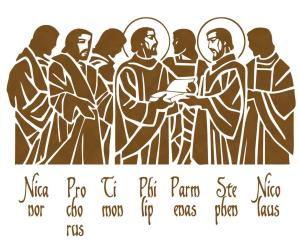 I am currently preparing for my ordination to the diaconate. It is a transitional stage before I become a priest of Jesus Christ. Despite the fact of being transitional, a deacon in itself is an important state in the life of the Church. Bishop Virgilio David, DD of Kalookan reminded the 15 newly-ordained Jesuit deacons in his homily last October that we shall not see a deacon as a mere stepping step toward higher states, like priests and bishops. It is the very core in the layers of concentric circles that make up the ordained ministries of the Church. The diaconate is not a lower rank but the core, without which both the offices of presbyters and bishops collapse. It is the foundation on which we build leadership in the Church. Yet, why do the deacons have to be placed at the core, and become the foundation?
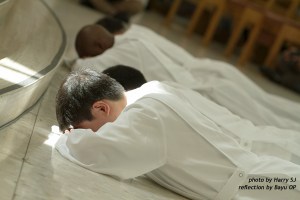
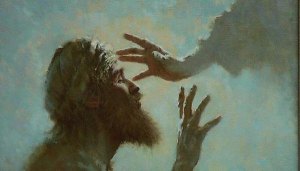 I made my religious vow more than eight years ago with 12 other Dominican brothers. One of the most touching moments within this rite of the religious profession was when Fr. Provincial asked us, “What do you seek?” and we all prostrated, kiss the ground, and declared, “God’s mercy and yours!” After a brief moment, Fr. Provincial asked us to stand, and we began professing our vows before him. As I recall this defining moment in my life, I am pondering in my heart, “Why it has to be mercy?” Why do we not choose other Christian virtues? Why not fortitude, one of the cardinal virtues in the Christian tradition? Why not love, the greatest of all virtues?
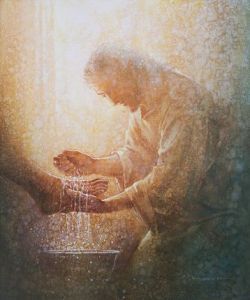 “Power tends to corrupt, and absolute power corrupts absolutely.” This familiar adage comes from an English noble, Lord Acton in his letter to Bishop Mandell Creighton in 1887. Lord Acton observed that people who possessed absolute control over other persons were inclined to abuse their power and exploit their subjects. This happens throughout human history. Jesus and His disciples themselves witnessed these corrupt powerful leaders during their time and eventually, became victims of this corruption.
 In Medio Ecclesiae