Exodus

First Sunday of Lent [March 10, 2019] Luke 4:1-11

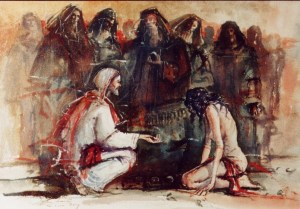
missionary of charityThe Spirit leads Jesus to the desert and Jesus remains there for forty days. The questions are: why does the Holy Spirit bring Jesus to the desert? Why does it have to be forty days? If we are familiar with the Old Testament, we recall that the journey of the Israelites in the desert lasted for forty years – the great exodus. After the great escape from the slavery of Egypt, they needed to walk through the desert before entering the Promise Land. Yet, it is not simply about the story of greatest escape in the history, but how God formed Israel as His people. In desert, God made a covenant with Israel through the mediation of Moses. In desert, God gave the Law as the basic guide for the Israelites living as His people. In the desert, God provided them with water, manna from heaven, and protected them from their enemies. However, in the desert also, the Israelites rebelled against God. They made and worship the golden calf. They complained a lot, and they wanted to kill Moses. It was a foundational story that covered almost the four Books of Moses [Exodus, Leviticus, Numbers and Deuteronomy].

The Spirit brings Jesus to the wilderness because Jesus is going to enter into His Exodus. Jesus is the New Moses who leads the New Israel into the new exodus. If we want to follow Jesus and call ourselves as the Christian, we need to follow Jesus to the wilderness and the new Exodus. Yet, the desert is far from being a comfortable place. It is a place of trials and temptation. But, why does Jesus want us to follow Him into the place of trials? Because Jesus understands that faith without temptation is empty, hope without challenges is fantasy and love without sacrifice is cheap.

If we read closely the story of Israel in the desert, they could reach the Promised Land in just two-week time even by walking. But, why did it took them forty years? It is because when they were about to enter the Land, they became afraid of the native people who stayed there, and they complained against God. They were just one step away from the promised land, and yet they squandered the opportunity because they did not have faith in God. Then, God punished them, and placed them in the desert for forty years. They needed to learn the lesson in a hard way.

Living a comfortable life does not make us really grow in faith. In fact, it is in the harshest places that we discover God alive and fresh. When I visited the hospitals, meeting the patients with terrible sickness like cancer and kidney failure; when I visited the jails, talking to inmates, I witnessed the stronger faith, hope and love.

Once I met this lady, just called her Mary. She was a single mother, and her only child was a special child. His brain is shrinking, and he cannot do anything but clap his hands. It was a truly difficult situation, and what made it worse was when some other Christians who professed that Jesus is Lord and Savior said to her that the child was a curse. She was living in a cruel world, and terrible people around him. She was figuratively living in the wilderness. And I asked her what made her remain active in the Church. She said, “because I know God loves me through my special child.” Once again I saw a faith that moves a mountain.

Often it is through trials, challenges and the “desert” that we learn the true value of faith, hope and love.

Deacon Valentinus Bayuhadi Ruseno, OP
Heart

Reflection on the 8th Sunday in Ordinary Time [March 3, 2019] Luke 6:39-45

prisoner prayer
Prisoner praying during church ceremony at Naivasha Maxium Security Prison. During the church service some prisoners pray on their own. – 24.11.2012. Copyright: Ulrik Pedersen

These past three Sundays, we have been listening on the series of Jesus’ teachings given at the Plain [Luk 6:20-49]. Two Sundays ago, we read about the Beatitudes. This is the set of conditions that leads us to true happiness and blessedness. Last Sunday we discover some practical steps to achieve this Beatitude, like we shall love our enemies. And this Sunday, we find the heart of Jesus’ teachings: it is the formation of the heart.

In our contemporary world, the heart generally symbolizes the source of affection, passion and love. Filipinos love basketball, and they give their best support every time their national team compete in international tournaments. Their battle cry is “Laban! Puso!” literally translated as “Fight! Heart!” Surely, the heart here refers to the burning passion to overcome enormous challenges during the ball game.

When a lady is not sure whether to accept or not a man to be her boyfriend, we often advise her to follow her “heart”. When she has a new boyfriend and is in love, she calls him as her “sweetheart”. But, when she suddenly loses her boyfriend because of unexpected betrayal, she suffers an immense “broken heart”. Because of this traumatic experience, she refuses to love anymore, and she now possesses “the heart of stone.” Surely, a lot of hearts!

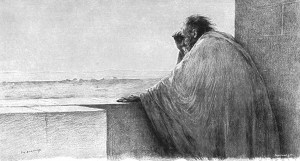
However, the word “Heart” in Bible has a slightly different meaning from our common understandings. Heart in the Bible is not just the source of our emotional life, but the center of the human life, vitality and personality. It is also the seat of human intellect, judgment and conscience. Thus, when Jesus says “A good person out of the store of goodness in his heart produces good…” it does not simply mean that person has the emotions that support him in doing good. It means a person has a fundamental judgement, stable attitude and permanent character to choose and do good, despite the contrary feelings he has. Good-hearted person can do good even person he hates. For Jesus, heart is not only affection, but it is also action.

In the context, the formation of the heart means the formation of the entire human person. Jesus understands that unless we possess the characters of a good man or woman, we are just staging a play, and become hypocrites [meaning actors] before other people.

How are we going to form our hearts? Jesus gives us a hint as He says, “from the fullness of the heart the mouth speaks.” The question then is: what fills our hearts? It is evil and wicked things, or good and holy things?

I am currently assigned in General Santos City, Mindanao, Philippines, and one of the highlights of my stay is when I visit and celebrate mass with the female inmates in the city jail. At first, I was hesitant and afraid to interact with them as I perceived them as being “criminals”. These are women with “wicked hearts”. But, I was totally wrong. When I prayed with them, I witnessed women prayed earnestly and deeply in faith. I met this woman, just call her Mary, and I listened to her story. She has been in the prison for five years, and due to ineffective justice system, her trial is still on going. She is a single mother with five children. She was caught using drugs, and she admitted it to escape from the reality of harsh life. She was crying as she narrated her story. And, I asked her what made endure her terrible situation. She simply answered, “I have God in my heart.”

We are living in much better condition than Mary, but do we have God in our heart? What fills our heart? Do we fill our hearts with Godly things? Do we allow God to reign in our hearts?

Deacon Valentinus Bayuhadi Ruseno, OP

Merciful like the Father

7th Sunday in Ordinary Time [February 24, 2019] Luke 6:27-38

Last week, we listened to the core teaching of Jesus Christ, the Beatitudes. This is the set of conditions that leads a person to blessedness or true happiness. This Sunday, we discover the practical steps on how to achieve this genuine joy. Last week, we learned that Jesus’ Beatitudes is the reversal of worldly order of happiness. For the world, to become greedy rich, violently powerful, and sexually potent are the conditions for happiness. Jesus reverses the order and says that those who are generous, gentle, merciful, and chaste are the ones who are truly happy.

As the Beatitudes are the reversal of worldly order, so also Jesus’ practical teachings on how to achieve these Beatitudes. The world tells us to seek revenge, a tooth for a tooth, an eye for an eye, but Jesus teaches us to forgive, to bless those who curse us, and to pray for those who mistreat us. The world tells us to give something and expect something in return. It is business and investment. But, Jesus instructs us to give in the generosity of heart, without counting the cost, without expecting something in return. The world tells us to love people who love us back and to hate people who hate us, but Jesus preaches that we shall love our enemies and do good to who hate us.

Jesus’ instructions are easier said than done, and in fact, they go against the natural tendencies we have. We may forgive people who do petty and unintentional mistakes, like someone who steps on our foot. However, how are we going to love someone who bullies us, lowers our self-esteem, and causes us depression? How are we going to forgive someone betrays our trust, steals from us, and makes use of us for their personal interest? How are we going to accept someone who sexually and physically abuses us? How are we going to do good to someone who murdered a member of our family? How are we going to forgive someone who never asks our forgiveness?

Human as we are, it is nearly impossible to follow Jesus’ teachings. Yet, it is not totally impossible because we are not animals who blindly follow instincts, but we are created in the image of God who is mercy. Jesus does not teach us the impossible because He knows who we truly are, the children of God. If God can be merciful to the wicked and the ungrateful, if He showers rain for the good and the bad, if He provides for the saints and sinners, we have the potential to imitate Him.

Last Sunday, January 24, in the middle of the Eucharist celebration, two bombs exploded inside and outside the Cathedral of Our Lady of Mount Carmel, July, Philippines. They killed more than 20 mass-goers and injured a hundred more people. Every victim has a story, and every soul has a family. Daisy Delos Reyes, Rommy Reyes and his wife Leah are several regular mass-goers who actively served in the Church. Their bodies were blown apart and deformed. It was so painful, and the people close to them cannot but be in a rage. However, hatred will not solve anything and vengeance never bring true peace. Our brothers and sisters in Jolo were shattered, but they rise from the ashes and rebuild their Church and faith.

Quoting Ed Sheeran, an English singer and songwriter, in his song “Photograph”

“Loving can hurt, loving can hurt sometimes

But it’s the only thing that I know

When it gets hard, you know it can get hard sometimes

It is the only thing that makes us feel alive”

Deacon Valentinus Bayuhadi Ruseno, OP

Blessedness and Woes

Sixth Sunday in Ordinary Time [February 17, 2019] Luke 6:17.20-26

“But woe to you who are rich, for you have received your consolation. (Lk. 6:24)”

indiaispoorWe listen today the Beatitude, but unlike the famous Beatitude from the Gospel of Matthew, we have today from the Gospel of Luke. Unlike from Matthew who has eight sayings of blessedness, Luke has four blessedness and for four “woes”. The most striking difference is while Matthew seems to emphasize “the poor in spirit”, Luke wants us to understand poverty in a more literal sense.
We want to have a happy life, and we do not like to have a difficult and poor life. It is just basic in our human nature. If we study diligently, we expect that we have a good result in our education. If we work hard and labor honestly every day, we wish that we will be rewarded with success. If we live our lives with passion and dedication, we look forward to acquire a fulfilling life.

However, in today’s Gospel, we listen that Jesus is telling us that the blessed one are the poor, the hungry, the weeping, and the persecuted, and for those who are rich, filled, and laughing, “woe” is their lot. Is Jesus pro-poor and anti-rich? Does Jesus want us to suffer, famish, and become malnourished? Does Jesus like that we are justly rewarded for our hard work and labor? Is Jesus hyper melancholic man, who sulk in sadness, and does not know how to enjoy life?

These are tough yet valid questions, and to answer these, we need to go back to the time of Jesus and discover the context behind the saying of Jesus. In the first century A.D. Palestine, the majority of the people, including Jesus Himself, were poor, hungry and oppressed. They were poor not because they were lazy but because they were living under a terrible time to live. Palestine was colonized by the Romans, and it was a common practice to levy a heavy tax on ordinary Israelites. Only some nobilities, few landowners, a handful of rich businessmen and Israelites who were working for the Romans, like the tax collectors, were enjoying a better life. Ordinary Israelites did not only have to face the Romans, but they had to suffer from the abuses from their fellow yet greedy and opportunistic Israelites who wished nothing but enrich themselves. It was a terrible time to live.

The message of Beatitude was more making sense now. Jesus promises hope and consolation for those who are poor and suffering due to injustice, and He woes those who are rich through dishonest and oppressive means. Thus, we know now that by His Beatitudes and Woes, Jesus does not hate all the rich guys, but greed and injustice that poison people’s hearts both the rich and the poor. When we have a good life because of our hard work and honest effort, then we praise the Lord. It is a blessing! Yet, Jesus is also reminding us that in good time, we must not be greedy, but remain humble and even to have concern for our brothers and sisters who are poor, hungry, and weeping because of injustice.

Deacon Valentinus Bayuhadi Ruseno, OP

Behind God’s Calling

Fifth Sunday of Ordinary Time [February 10, 2019] Luke 5:1-11

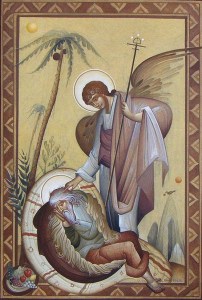
procession 2This Sunday, we listen to the vocation stories of great men in the Bible. From the first reading, we learn how Isaiah was called by God to be His prophet to Judah. In the Temple of Jerusalem, he saw the Lord God surrounded by His seraphim. Isaiah was terrified and said that he had unclean lips. An angel then placed a burning ember on his tongue to remove his wickedness. God, then said, “Whom shall I send?” Isaiah replied with confidence, “Here I am, send me!”
In the second reading, St. Paul wrote to the Church in Corinth and reminded them about the Gospel they had received. Paul assured them that he himself was the recipient of this Gospel no less from the risen Christ Himself. Though he used to be the zealous persecutor of Christians, Jesus called him. By the grace of God, Paul toiled day and night for the building up of the Church.

From today’s Gospel, we listen to the call of the first disciples: Simon, Andrew, James, and John. Luke the evangelist tells us about seasoned fishermen who failed to catch any fish, but Jesus, a carpenter, tells them to ‘go into the deep’. They hesitate, but they follow nonetheless. Lo and behold, they are able to catch a large amount of fish, to the point of destroying their nets. Eventually, Jesus calls them and makes them as fishers of men, and they follow Jesus.

Like Isaiah, Paul and the first Disciples, we are also called by God to follow Him. Some may receive a vocation to the priesthood, some others to religious life, others to build a family, and others may be single yet living a holy life. God also calls us in various ways. Like Isaiah or Paul, some receive extraordinary mystical experiences. But, many of us may be called in the most ordinary and unexpected ways. One day a young man asked whether he has a vocation to the priesthood, especially to the Dominican Order. I said to him, “Well, take the entrance exam first! If you pass you may have the vocation, if not, God may call you somewhere else.”

Sometimes, we ask the Lord a deeper question, “Why me Lord?” but often, we no longer bother to find the answer. Yet, it remains a valid question to be answered. Why did He choose Isaiah, Paul, and Peter? Why does Jesus choose you and me? The answer surprisingly is in the Bible.

When Moses made his farewell speech before the Israelites who were about to enter the Promised Land, he reminded them the reason why God chose Israel, “It was because the LORD loved you and because of his fidelity to the oath he had sworn to your ancestors (Deu 7:8).” God’s choice for Israel is because of His love and faithfulness. The same love and fidelity are the reason behind our calling. God just simply loves us and He draws us to Himself. It is not because we are good, smart and talented. It is not because we are worthy of the call. Isaiah was a man of unclean lips, Paul was a persecutor of the Church, and Peter had his own agenda. Yet, despite these imperfections, God keeps calling us and giving us what we need. How many times, when we betray Him and run away from His call, He remains patient with us and ready to accept us back. If it is not a love, what is it?

We have a God, and this God is love. This is why we are unworthy, yet called; unqualified, yet accepted; unlovable, yet loved.

Deacon Valentinus Bayuhadi Ruseno, OP

Jesus, Elijah, and Elisha

Fourth Sunday in Ordinary Time [February 3, 2019] Luke 4:21-30

elijah 1In today’s Gospel, Jesus compares Himself with the Israelite greatest prophets, Elijah and Elisha. But, who are these two prophets? For many Catholics, we are not familiar with these two prominent figures in the Old Testament, and thus, we often do not appreciate why Jesus deliberately cites their names.

Seven hundred years before Jesus, the great kingdom established by David had split into two smaller and weaker kingdoms, the Kingdom of Judah in the south, and the Kingdom of Israel in the north. The leaders of both Judah and Israel have both broken the covenant with the God of Israel, as they worshiped pagan idols, and established their temples. Not only did these leaders incur the sin of idolatry, they also committed gross injustices to the people. The worst would be the child sacrifices and slavery of the poor.

    In this terrible time in the history of Israel, God raised up prophets. Thus, God’s prophets are not the fancy guys who foretell future events, but they are God’s spokespersons to remind the people to go back to the Lord and do justice. Often, the prophets of God are also given the power to perform miracles as a sign that they were truly prophets coming from the true God. Among them, were two great names: Elijah and his disciple, Elisha.

    Elijah was a fearless prophet who confronted Ahab, the king of Israel and his wife, Jezebel. In one famous event, Elijah challenged the prophets of Baal in Mount Carmel to bring down rain and he proved them as hoax (1 Ki 18). He also rebuked Ahab who allowed Jezebel to kill Naboth and stole his vineyard (1 Ki 21). Another miracle story would be Elijah who provided food for the poor widow of Zarephath, as mentioned by Jesus in the Gospel (1 Ki 17). At the end of his ministry, he was rode on a chariot of fire going up to the sky (2 Ki 2).

    Elisha meanwhile was a disciple and successor of Elijah. As his mentor exited, Elisha requested for “double portion of Elijah’s spirit” and it was granted upon him. Thus, while Elijah was able to perform seven miracles, Elisha was able to double the number, fourteen miracles. Among his miracles was the healing of Naaman, the valiant army commander of Aram (Syria) but also a leper (2 Ki 5), and the multiplication of loaves (2 Ki 4:42-44). However, despite their strong prophesy and miracles, the Israelites did not change their hearts, and they kept worshiping idols and doing injustice.

    Like Elijah and Elisha, Jesus reveals a deeper nature of God and His relationship with creations, condemns unjust practices, and performs miracles. Surely, Jesus is much greater than Elijah and Elisha. Yet, Jesus’ lot is not far different from Elijah, Elisha and other prophets of Israel: Jesus was rejected by own people.

    When we are baptized, we are anointed as a prophet, and we share the lot of the prophet before us. Parents who do their best and want nothing but the best for their children are being misinterpreted as ‘controlling’ by their own kids. Teachers who try to inculcate the value of study life and culture of discipline, are considered to be ‘terror’. At times, however, being a prophet means nothing but total sacrifice. Many priests, religious and lay people work tirelessly and courageously in the most dangerous places around the globe, serving the poor of the poorest. Some of them eventually were abducted, tortured and killed. Special mention goes to the parishioners of Our Lady of Mount Carmel Cathedral, in Sulu, Philippines who sacrificed themselves as the bomb exploded during the liturgical service. It is really tough to become a prophet, but this is our vocation and mission to follow Elijah, Elisha, and Jesus.

    Deacon Valentinus Bayuhadi Ruseno, OP

Word of God Fulfilled

Third Sunday in Ordinary Time [January 27, 2019] Luke 1:1-4;14-21

deacon1The synagogue is the place of prayer for the Jews. On the center during the service in the synagogue is the reading of the Hebrew Bible (or what we call the Old Testament) and the explanation of those readings. In the Gospel, we learn that Jesus stands as the leader of the service. First, He stands and reads the Scriptures, and the chosen portion is from the Prophet Isaiah. Then, He sits down, assuming the position of teacher. The Jews in the synagogue are eager to listen to Jesus. However, there is something different in Jesus’ teaching from other Jewish Rabbis. Jesus neither simply expounds the reading from Isaiah, nor makes commentaries on the text. He neither simply discusses the meaning of the readings, nor explains the context of the text. He fulfills what is written in the Scriptures. He says, “Today this scripture passage is fulfilled in your hearing.” (Lk. 4:14)

What Jesus does gives us a fundamental attitude for every Christian: any Christian ministry, prayer and life have to be rooted in as well as the fulfillment of the Word of God. It is true that many of us are not priests, religious or catechists, but laypersons, like parents, professionals, and citizen of the country. Many aspects of our life are not directly dealing with the Bible, like working, eating, sleeping, etc. So, why do we need to allow the Word of God to permeate various aspects of our life?

We remember that in the Book of Genesis, God created the world through His Word. “God said, ‘Let there be light!’ and there was light.” And at the end of the creation story, with His Word, God blessed the world. Every existence in this world, including our life, finds its beginning, meaning, and fulfillment in God’s Word. The air we breathe, the light we see, the sound we hear bear witness to the Word of God. Thus, no matter who we are and what we do, the Word shall inspire, guide, and animate our daily lives. If we allow the Word to take charge, our lives turn to be the fulfillment of the Word of God.

However, how can the Word of God influence our lives if we do not read or hear the Bible? One serious issue among the Catholics is that we seldom read the Bible, and when we attend the Mass, often we are not paying enough attention to the sacred readings. After the reading, we simply respond “Thanks be to God!” while in our hearts, we say, “whatever it means!” We have a Bible in our home, but often it remains hidden, dusty and untouched. This ignorance of the Scriptures does not only affect the lay people but even the clergy and the religious people. Pope Francis in his encyclical Evangelii Gaudium, has lamented of the priests who preach anything but the Word of God. Indeed, this is lamentable.

However, we are not hopeless. More and more lay people now are involved in Biblical apostolate in the parishes or dioceses. Bible Sharing, study and quiz now are something common among the Catholics. In my part, every time I give a talk, I make sure that the participants will bring the Bible and my discussion will be based on the Scriptures. And all of us can begin reading the Bible on our own. We can read five chapters every day, and within a year, we may complete the entire Bible.

Let the Word be the air we breathe, the light we see, the sound we hear, that in the end, we are able to say, “Today the Scripture is fulfilled in your hearing.”

Deacon Valentinus Bayuhadi Ruseno, OP

Grace Abounds All the More

Conversion of St. Paul, the Apostle [January 25, 2019] Mark 16:15-18

st. paul conversion 2Today we are celebrating the feast of the conversion of St. Paul, the Apostle. St. Paul is one of the greatest names in our Church. Many churches are named after him, like one of the major Basilica in Rome, St. Paul outside the Wall. Not only churches but also many Christians are named after him, including our brothers in the house of formation, Bro. John Paul Sontillano, Bro. Paulus Gabriel Rambang Ngawan, and our former formator, Fr. Pablo Tiong.

Paul is an apostle and yet, he was not part of the 12 apostles. It is through a special revelation, he was called by Jesus and sent to preach the Gospel to all nations, thus, he was called also as the apostle to the nations or of the Gentiles. Indeed, he was doing his job very well, as he preached zealously, traveled tirelessly, and founded many local churches in Asia and Europe, like in Corinth, Thessaloniki, and Galatia. Thirteen of his letters addressed to these communities or to his co-workers like Timothy and Titus, have become part of the New Testament, considered inspired, and thus, the Word of God. And from his letters, the Church has shaped her teachings, doctrines, and orthodoxy, like the primacy of love in Christian living in 1 Cor 13, that love is patient, love is kind, love never fails. Or, in 1 Cor 11, we discover Paul condemns those who failed to celebrate the Eucharist worthily, rooted in the doctrine of the Real Presence of Jesus Christ in the Eucharist. Paul was so inspiring that he inspires St. Luke, the evangelist to devote half of his Acts of the Apostles, to the story and journey of St. Paul.

However, this is only half of the story. Before Paul, there was Saul. Saul was zealous Pharisee who hated Jesus and His followers so much. He went door to door just to arrest Christian, put them in jail, and persecuted them. Young Saul also consented to the murder of the first martyr, Stephen. The Acts of Apostles 9:1 described him as someone who breathes threats and murders. Saul was a dark character with much violence and anger.

However, the Good News of salvation for Saul: no matter dark, violent and broken Saul was, God, is more powerful than all these ugly things. God’s grace, mercy, and love can transform the persecutor of Christ into the vessel of grace. That is why we are celebrating the conversion of St. Paul, not only about St. Paul but the conversion. It is not about Paul’s greatness, achievement, and holiness, but it is God.

Like Paul, we all have our own darkness and brokenness, some may come from broken family, some having a broken family, some have traumatic experiences, some losing people we love in a painful way, some are victims of abuses, some struggling with sickness, with anger, with depression, with poverty or other problems. We are still wrestling with our sinful attitudes and tendencies. Yet, the Good News Paul received is also the same Good News we receive. All of these ugly things have not the last word on us. Our God is stronger than all of this ugliness of life.

As St. Paul himself says, “When sin abounds, grace abounds all the more!” (Rom 5:20)

St. Paul, the apostle, pray for us.

Deacon Valentinus Bayuhadi Ruseno, OP

Jesus the Bridegroom

Second Sunday in Ordinary Time [January 20, 2019] John 2:1-12

wedding ardiMary who was once a bride and has passed through the tiny-gritty of a Jewish wedding can sense immediately something goes wrong. The wine is running out. In the Jewish context, wine is an essential ingredient in every joyous occasion, as it is ordained by God to “gladden men’s hearts” (Ps 104:15) The lack of it can spell a disastrous result. It is the source of shame, and even a family dispute.

Everyone knows that it is the responsibility of the bridegroom to provide the wine, yet Mary does something unexpected. Instead of notifying the groom, she approached Jesus and points to him the gravity of the looming disaster. However, instead of getting an immediate favorable response, the plot twists even more. In a surprising statement, Jesus says to his mother, “Woman, how does your concern affect me?” (Jn 2:4). This statement is a Semitic expression indicating that the issue at hand is not Jesus’ problem. In a sense, Jesus is right because it is the job of the groom to fix the problem, but in a much more profound sense, Mary is also right because Jesus is the true Bridegroom.

Jesus understands that He is the Bridegroom, but the hour is not at Cana, but at the Cross. Thus, He says, “My Hour has not yet come.” (Jn 2:4) Yet, Mary as a mother knows her Son best. She has faith in Jesus, that Jesus is not only the Bridegroom at the Cross who gives His life for His Bride, the Church, but Jesus is also the Bridegroom in every marriage, family, a community that reflects this Church. Thus, when Jesus transforms the water into wine, it does not happen in historical level, but in a more profoundly symbolical way. Yes, Jesus helps the couple from disaster, but more than that, He supplies what is fundamentally lacking in every marriage: the best wine, the true joy of married life.

One of my duties as a deacon is to check whether the particular couple is canonically fit for the Church’s marriage. To fulfill this, I need to interview the couple and ask some pertinent questions. Yet, I usually go beyond, and I remind them why the Church does not recognize civil marriage. The answer is plain yet very basic: Jesus, the true Bridegroom, is not there, or to be precise, we make a deliberate effort to exclude Him in our marriage. The union between man and woman is not just a human, social and cultural phenomena but a divine reality. When a man and a woman commit themselves into marriage, God Himself who wills to make them one. Therefore, marriage is primarily and fundamentally God’s grace working in the human relationship. And if God unites them together, He will be the one who sustains and brings into perfection. This is why marriage is elevated into the level of sacraments of the Church.

However, I continue reminding the couples that marriage in the Church does not only mean to celebrate the sacrament of matrimony but to stay within the Church, the Bride of Christ, throughout their lives: to attend the Eucharist as a family, to participate actively in the Church as a couple, to pray regularly together. As the wine is impossible without a jar of waters, God’s grace will not work in our marriages unless we open ourselves to this grace. Like Mary who points Jesus what is lacking in the wedding in Cana, so the Church asks Jesus to fulfill every marriage with the best wine.

Deacon Valentinus Bayuhadi Ruseno, OP

Fatherhood

The Baptism of the Lord [January 13, 2019] Luke 3:15-16, 21-22

“You are my beloved Son; with you I am well pleased.” (Lk. 3:22)

baptism2One of the greatest joys of being a deacon is to baptize babies and little children. The joy is not simply springing from touching the cheeks of a cute little baby or be part of festive parents, but it is something deeper. In fact, my experiences with baptism are not always pleasant. I remember at my first baptism in Sto. Domingo Parish, Metro Manila, when I began pouring water upon the baby’s forehead, the little girl suddenly burst in tears and cried aloud. I realized the water has touched the baby girl’s eyes. I was shocked and almost paralyzed not knowing what to do next. The good thing is the parents were able to handle the situation well. As the little baby calmed down, I apologized and continued the rite. Traumatizing!

After that experience, the baptisms I minister do not seem to be any better. In Manaoag, Pangasinan, I could baptize 15 or more babies in each baptism. Often, with so many people jampacked in a small room, and with many babies crying, the experience, far from happy, could be stressful and forgettable for everyone including myself. So, where do I get the joy of baptizing babies?

It is springing from the Church’s understanding of baptism itself. Baptism as the sacrament instituted by Christ Himself as a means for us to receive the grace of salvation is not only Biblical and upheld by earliest Christian testimonies, but it is spiritually liberating and joy-engendering. Surely, we need one semester or more to discuss the biblical foundation and theology of baptism, and this is not the place for such discussion. Thus, allow me to share one of the reasons why baptizing is one of my most joyous moments as a deacon, and it is not far from our Gospel today.

Today we are celebrating the Baptism of the Lord, and our Gospel ends with an extremely rare revelation of God the Father in Jesus’ life. This reveals two things: First, Jesus is the Son of the Father; second, He is not only any son, but Jesus is also the joy of the Father. It is not just any rare revelation, but it is a revelation of joy. Yet, this joy is not surprising for it is natural for a father to be delighted in his newly born baby because he sees the best of himself in the baby. It is a joy of fatherhood.

One of the greatest gifts of baptism is our spiritual generation. It is true that in baptism, nothing much changes in our physical aspects, except our heads are getting wet. But, when the water of baptism touches our foreheads and the Trinitarian formula is pronounced, our souls are changed for eternity. We are not just the children of humanity, but wonderfully the children of God. And as we emerge from the baptism, our Father in heaven sees us, recognizes us as His own and says, “You are my beloved children, with you I am well pleased.”

It is my greatest privilege to share this spiritual fatherhood. As I minister baptism, I spiritually beget these little babies as my children, the children of God. As a young father rejoices in his baby, so I take delight in every newly spiritually born baby. I do not have my own children, and yet I am blessed to become a father. As looking forward to priestly understand, we understand why we call a priest “father” because he is indeed a father to his spiritual children. He begets his children in Baptism, he nourishes them in Eucharist, he leads the youth into maturity in Confirmation, he unites the love among them in Marriage, he brings back the stray in Penance, and he heals the sick in the Anointing. It is the joy of fatherhood.

Deacon Valentinus Bayuhadi Ruseno, OP