

32nd Sunday in Ordinary Time
November 8, 2020
Matthew 25:1-13
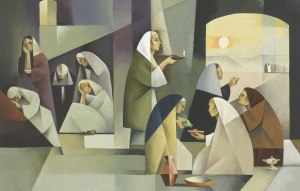
 A wedding ceremony is one of the most beautiful events in many cultures and societies. This includes the Jewish community in the first century AD Palestine. For the Hebrew people living in the time of Jesus, the wedding ceremony has two stages. The first one is the exchange of vows or betrothal. The couple is officially married, and they are recognized as husband and wife in the eyes of the Jewish community. Yet, they are going to wait for around one year before they are living together. The husband will prepare for the house as well as the reception celebration that may last for seven days.
The second stage is the wedding party. It begins with the groom fetch the bride from her ancestral house, and bring her to his home with a procession of dance and music. Since the procession usually takes place in the evening, fire and torches are indispensable. The ten virgins are part of the wedding ceremony which we may call today as the bridesmaids. They may be some of the close friends of the bride and even relatives of the couples. They are stationed not far from the wedding place to welcome the married couple. Since there is no internet and GPS, the ten virgins may not be able to locate precisely where the procession is, but they are expected to be ready.
It is interesting to see the attitude of the five foolish virgins. In Greek, the virgins are called as “moros” where we get the English word moron. It is undoubtedly a harsh word. Jesus applies the same word after His sermon on the Mount and points to people who listen to His preaching without practising them, “like a foolish man who built his house on sand [Mat 7:26].” Yet, if we observe, what we see that the virgins are doing foolish things. Not only they fail to prepare for the unexpected arrival of the groom, but they also look for the oil in the middle of the night. They are not living in the modern era where we can easily purchase it at the 24-hour convenient stores. The merchants are expectedly unavailable, and we can imagine how they rushingly search the vendors, and frantically knock their doors. This may cause unnecessary inconveniences and bring absolute shame to the couples. This may be the reason also why the wedding’s host refuses to admit these five foolish virgins.
This parable of Jesus gives us a potent reminder not to become foolish in living our lives as Christians. We are given a particular role and mission in our lives. Some of us are called to be married couples and parents. Some of us are serving as priests or religious men and women. Some of us are teachers of the faith; some of us are leaders of the community, and others are servants. In whatever role we are, Jesus asks us to be wise in doing our ministries and demands us not to do foolish things as to scandalize others or even cause others unnecessary suffering.
If we, as Christians, act foolishly, we bring shame, not only to ourselves but Christ Himself. But, if we think and produce wise deeds, we bring glory to the Lord, and more people will praise our God.
Valentinus Bayuhadi Ruseno, OP
 Upacara pernikahan adalah salah satu acara terindah di banyak budaya dan masyarakat. Ini termasuk di masyarakat Yahudi di Palestina abad pertama Masehi. Bagi orang Ibrani yang hidup pada zaman Yesus tersebut, upacara pernikahan memiliki dua tahap. Yang pertama adalah pertukaran janji. Pasangan tersebut sudah menikah secara resmi, dan mereka diakui sebagai suami dan istri di mata komunitas Yahudi. Namun, mereka akan menunggu sekitar satu tahun sebelum mereka bisa hidup bersama. Sang suami akan mempersiapkan rumah mereka serta perayaan pesta nikah yang mungkin berlangsung selama 7 hari lamanya.
 Today the Church is celebrating the Solemnity of all saints. This is one of the ancient feasts in the Church that commemorates and honors all holy people who had gone before us and received their eternal reward, God Himself. We may recognize some of them, like St. Ignatius, St. Dominic de Guzman, St. Francis of Assisi, and St. Catharine of Siena, but this is only a tiny fraction of the entire heavenly host. There are countless we are not aware of. The good news is that all of them are praying for us, and who knows, some of our departed beloved have been parts of this holy communion.
 Hari ini Gereja merayakan hari raya semua orang kudus. Ini adalah salah satu pesta kuno di Gereja yang memperingati dan menghormati semua orang yang telah berpulang dan menerima pahala kekal mereka, Tuhan Sendiri. Kita mungkin mengenali beberapa dari mereka, seperti St. Dominikus de Guzman, St. Fransiskus dari Assisi, dan St. Catharine dari Siena, dan St. Ignatius, tetapi ini hanya sebagian kecil dari seluruh penghuni surgawi. Kabar baiknya adalah bahwa mereka semua berdoa untuk kita, dan siapa tahu, beberapa dari orang-orang yang kita kasihi yang telah meninggal telah menjadi bagian dari persekutuan kudus ini.
 The question is, “what is the greatest law?” Once again, the historical and religious context is important. When Jesus and the Pharisees discuss the Law, they are speaking about particular Law. It is neither criminal law nor international law. It is the Law of Moses, the Torah, which points to Moses’s five books. According to the tradition of the Rabbis, the Torah contains 613 specific laws. Thus, the Pharisee is questioning Jesus on the most important among 613 commandments.
 Pertanyaannya adalah “Apakah Hukum yang terutama?” Sekali lagi, untuk mengerti pertanyaan ini konteks historis dan religius sangat penting. Ketika Yesus dan ahli Hukum Taurat membahas tentang Hukum yang terutama, mereka berbicara tentang Hukum Taurat yang paling utama. Hukum Taurat sendiri menunjuk pada lima kitab Musa [Kejadian, Keluaran, Imamat, Bilangan, dan Ulangan] dan sangat banyak peraturan ada di sana. Menurut tradisi para rabi, Taurat berisi 613 hukum. Jadi, orang Farisi sedang menguji Yesus tentang yang paling penting di antara 613 perintah.
 To understand today’s Gospel, we need to make time travel to the time of Jesus. The Jewish people in the first century AD Palestine were not free people, and they were subject to the Roman empire. Being subjects, they were required to submit heavy taxes. This money would eventually use to pay the army that maintained “the security” of Palestine. Naturally, paying taxes was one of the most irritating and politically charged issues. “Why should I pay for my own oppression?”
 Untuk memahami Injil hari ini, kita perlu melakukan perjalanan waktu ke zaman Tuhan Yesus. Orang-orang Yahudi pada abad pertama Masehi Palestina bukanlah orang-orang merdeka, dan mereka tunduk pada kekaisaran Romawi. Sebagai penduduk jajahan, mereka diharuskan membayar pajak yang cukup berat. Uang ini pada akhirnya akan digunakan untuk membayar tentara yang menjaga “keamanan” di Palestina. Tak ayal, membayar pajak adalah salah satu hal yang paling dibenci dan menimbulkan gejolak. “Mengapa saya harus membayar untuk penindasan saya sendiri?”
 To understand the parable, we need to see the surprising elements that Jesus offers. Firstly, this is no ordinary wedding, but the royal wedding of the king’s son. Surely, people in the royal list are honored and privileged guests, but they refuse to come, decline the invitation twice and even mistreat the king’s servants. What they do are unthinkable! They fail to see how precious the invitation and rather choose their own trivial business. They are like throwing insult to the king who has honored them. No wonder, the king punishes them.
 Untuk memahami perumpamaan yang kita dengar Minggu ini, kita perlu melihat elemen-elemen yang mengejutkan. Pertama, perjamuan ini bukalah perjamuan pernikahan biasa, tapi pernikahan putra raja. Tentunya, orang-orang dalam daftar undangan adalah tamu terhormat dan istimewa, tetapi mereka menolak untuk datang sampai dua kali dan bahkan menganiaya para utusan raja. Apa yang mereka lakukan tidak terpikirkan! Mereka gagal untuk melihat betapa berharganya undangan tersebut dan malah memilih urusan-urusan sepele mereka sendiri. Mereka sama saja melontarkan hinaan kepada raja yang telah menghormati mereka. Tak heran, raja menghukum mereka.
 In Medio Ecclesiae