


18th Sunday in Ordinary Time. July 31, 2016 [Luke 12:13-21]
“…is not rich in what matters to God (Luk 12:21).”
 Greed is one of the most sickening sins. It can plague practically anyone, rich and poor, young and old, lay people and even the leaders of the Church. Greed as the inordinate desire for wealth or money. Greed breeds corruption, stealing, cheating and violence. Greed produces injustice and poverty. And injustice and poverty cause nothing but suffering of countless people and permanent destruction to our mother earth.
Sometimes, we can easily accuse some persons in government and in business world as the greedy ones. Indeed, with their positions of power and intellectual capacity, they can suck a massive amount of money just for themselves. Instead using the money of the tax payers for building up the nations, the big portion of it goes to their individual pockets. But, we need to remember that greed does not only affect the affluent, but also the poor.
Movie Slumdog Millionaire (2008) tells us a story of Salim and Jamal Malik who are victims of this injustice and greed. After the killing of their mother because of religious hatred in slam area in India, they were forced to stay in a sanitary landfill. Then, they were adopted by ‘professional beggars’ syndicate. One particular scene that reveals the gruesome manifestation of greed is one little boy with sweet voice, Arwind, was blinded. Jamal later remarks, “Blind singers earn double.” The worst part of the movie is that the movie is not totally fiction, but many events are true to life.
Greed is even more sickening because it is not only about wealth or material possession. It is a vice that consumes our identity as human person, created as the image of God, with the capacity to love and share. In the parable of the rich fool, we discover the rich man only cares for himself, his harvest, his possessions, his life and his future. There is no place for other people, let alone God in his heart. Greed destroys our humanity to its core. We cling to our lives and our possession, and fail to see that all we have is blessings to share.
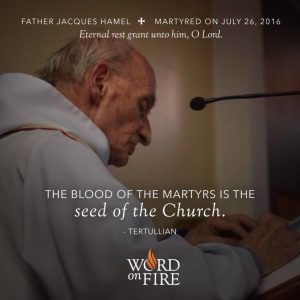
Just few days ago, Fr. Jacques Hamel was murdered inside the Church by the armed terrorists. The church Saint Etienne-du-Rouvray in Northern French was stormed during the morning mass. He and a mass-goer finally died after their throats were slit. While the world was shocked by this heinous cowardly act, we are once again invited to examine the life of this simple priest who gave his very life to the end. We may believe that life is stripped of him, but we forgot that actually he had given his life even before the day of his martyrdom. He lived a simple life and at age of 84, and he remained faithful to celebrate the sacraments and serve the people all the day of his life. He gave his life for God and the Church. His death is no longer loss but a moment of confirmation of his generosity that inspires the world. As St. Tertulian once said, the blood of the martyrs is the seed of Christians.
This utter generosity is a reflection of our deepest calling as human person, created in the image of God. And only in this true charity and abundant generosity, we may fight the greed that plague our souls.
Br. Valentinus Bayuhadi Ruseno, OP

 Keserakahan dan ketamakan adalah dosa yang sangat menhancurkan. Ketamakan dapat menjangkiti praktis siapa pun, kaya dan miskin, tua dan muda, awam dan bahkan para pemimpin Gereja. Ketamakan dapat dimengerti sebagai hasrat yang tak terkendali untuk memiliki kekayaan atau harta benda. Keserakahan melahirkan berbagai bentuk korupsi, pencurian, penipuan dan kekerasan. Keserakahan menghasilkan ketidakadilan dan kemiskinan. Dan ketidakadilan dan kemiskinan menyebabkan penderitaan bagi jutaan orang dan kerusakan permanen pada bumi ini.
 Few weeks ago, I participated in a seminar-workshop on personality recognition and development. The activity was organized by the ministry of Lectors of Santo Domingo Parish and facilitated by seasoned speaker Sr. Leticia Garcia, DC. As I expected, the test result told me that I was dominantly introvert, meaning I was silent and more reserved guy. I found strength in solitude. I shared this treats with many of the participants. Yet, not few were actually our opposite. They were extrovert, meaning they were people-oriented and action-driven. They were recharged in interaction with others. Sr. Garcia made a point that the difference must not bring us into animosity. When properly developed, our personalities shall complete each other and contribute in the service of God.
 uti seminar dan lokakarya tentang pengenalan dan pengembangan kepribadian di Manila, Filipina. Seperti yang saya duga, hasil tes menyatakan bahwa saya secara dominan adalah introvert, yang berarti saya kepribadian yang tenang dan pendiam. Saya menemukan kekuatan dalam keheningan. Saya tidak sendirian karena banyak juga peserta adalah introvert. Namun, tidak sedikit yang memiliki kepribadian yang berlawanan dengan kami. Mereka adalah ekstrovert, yang berarti mereka menyukai banyak aktivitas dan senang berinteraksi dengan orang lain. Sang pembicara mengingatkan bahwa perbedaan tidak boleh membawa kita ke permusuhan. Jika dikembangkan dengan baik, kepribadian kita yang unik akan saling melengkapi dan berkontribusi dalam pelayanan di Gereja dan kemuliaan Tuhan.
 Following Jesus is difficult. In today’s Gospel, He demands that we let go three things. The first is our concern for our enemies. It seems easy to ignore those people whom we don’t like, but in reality, they consume our attention and energy. My friend shared to me how he was bullied at his officemates, and this drained so much of his productivity and focus in work. Often, like James and John, our anger moves to seek revenge and even violence. “Lord, do you want us to call down fire from heaven to consume them (the Samaritans who rejected them)?” Yet, Jesus reminds us to leave these behind.
 Mengikuti Yesus itu sulit. Dalam Injil hari ini, Dia menuntut ada tiga hal penting yang harus kita berani lepaskan. Hal pertama adalah fokus kita pada musuh atau orang tidak kita sukai. Sepertinya mudah untuk mengabaikan orang-orang yang tidak kita sukai, tetapi dalam kenyataannya, mereka mengambil banyak perhatian dan energi kita. Seringkali, seperti Yakobus dan Yohanes, kemarahan kita mendorong kita untuk membalas dendam, bahkan dengan cara kekerasan. Pikiran dan emosi kita terkuras oleh kebencian dan menunggu saat pembalasan. “Tuhan, apakah Engkau mau, supaya kami menyuruh api turun dari langit untuk membinasakan mereka (orang Samaria yang menolak Yesus)?” Namun, Yesus mengingatkan kita bahwa hal ini harus kita lepas.
 What will be your answer to Jesus’ question “Who do you say that I am?” We may come up with multiple answers. He is my God, my savior, my friend or my brother. But, we seldom ask, “Do we really understand Jesus’ question? Do we get the right answer? Why is it that Peter would confess that Jesus is Christ of God in the first place?
 Apa yang akan menjadi jawaban kita saat Yesus bertanya “Menurut kamu, siapakah Aku ini?” Kita mungkin menjawab: Dia adalah Tuhan, Juruselamat, sahabat atau saudara. Tapi, apakah kita sudah mengerti dengan baik pertanyaan Yesus? Apakah jawaban kita inilah yang Yesus harapkan? Mengapa jawaban Petrus adalah Kristus dan bukan jawaban lainnya?


 In Medio Ecclesiae