

Fourth Sunday of Lent [March 11, 2018] John 3:14-21
“Just as Moses lifted up the serpent in the desert, so must the Son of Man be lifted up, (Jn. 3:14)”
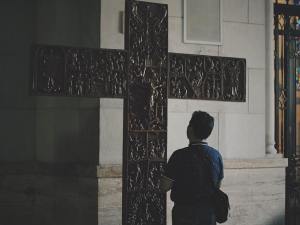
As early as chapter 3 of the Gospel of John, Jesus is aware that he is going to suffer and die on the cross. The crucifixion is the worst kind of punishment in the ancient time. It is reserved for the rebels and foulest criminals. For the Jews, death on the tree is considered accursed by God Himself (Deu 21:22-23). By dying on the cross, Jesus may be seen by Jewish contemporaries as an evil criminal, a great dishonor to the family and the nation, and an accursed by God.
However, Jesus sees His death on the cross, not in these horrible perspectives, but rather He likens himself to the bronze serpent lifted up by Moses in the desert. In the book of Numbers (21:4-9), the Israelites complain against the Lord and Moses in the desert. They particularly do not like the manna despite being freely and miraculously given by God. So, God sends serpents to punish the Israelites. When the Israelites repent, Moses lifts a bronze serpent on the pole, so those who behold it, will be healed from the snake’ bite and live. We notice that the serpent that becomes the instrument of punishment and death turns to be the instrument of healing and life. Like the serpent, the cross is originally a means of torture and death, but God transforms it into the means of forgiveness and salvation. Therefore, like the Israelites who see the bronze serpent, those who behold the crucified Jesus and believe in Him will have the eternal life.
The faith in the Crucified Man is fundamental in the life of every Christian. Yet, we, Catholics, seem to take this faith and Gospel verses pretty passionately. We do not only have faith in the Jesus Crucified; we literally behold Him on the cross. In every church, we see the cross both inside and outside the building. In Catholic schools, hospitals, and homes, the crucifix (cross with the body) is hanging on practically every wall. The crucifix is also inseparable from our religious and liturgical activities. The General Instruction of the Roman Missal no. 270 even states, “There is to be a crucifix, clearly visible to the congregation, either on the altar or near it.” Our rosaries always begin with holding the crucifix and ends by kissing it. During the Way of the Cross, we literally genuflect before the cross, and proclaim, “We adore You, O Christ, and we praise you. Because, by Your holy cross, You have redeemed the world.” Even, during the exorcism rite, a priest finds the crucifix, especially St. Benedict’s cross, as a powerful means against the evil spirits. Finally, we make the sign of the cross every time we pray because we acknowledge that our salvation comes the Jesus Crucified.
Like the Israelites in the desert behold the bronze serpent, we too behold Jesus on the cross. As the Israelites are healed and live, we are also saved and have eternal life in the Son of Man that is lifted up on the cross. This Lenten season, we are invited once again to reflect the meaning of the cross in our lives. Is the cross a mere cute accessory or ornament? Is making the sign of the cross a meaningless repeated practice? Are we ashamed of the cross of Christ? What does it mean for us to be the men and women who behold the cross?
Br. Valentinus Bayuhadi Ruseno, OP
 In Medio Ecclesiae