

5th Sunday of Lent [April 7, 2019] John 8:1-11
 Adultery is a serious sin according to the Law of Moses. It is a violence against the Basic Law, the Ten Commandments. It is in fact, one of the few crimes that are punishable by death [Lev 20:10]. Why so cruel? It is a grave sin because adultery profanes the holiness of marriage and the gift of sexuality. In the Book of Genesis, God has willed that man and woman through marriage and their sexuality participate in God’s work of creation and caring of creation. Since marriage is a sacred calling, violation to this holy mission is an utmost insult to God who calls man and woman into marriage.
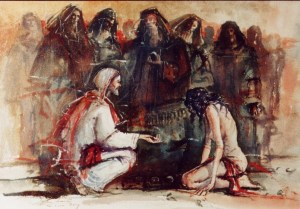
Some Jewish people bring a woman caught in adultery to Jesus. It is a tough dilemma for Jesus who knows well the Law of Moses. If Jesus agrees to stone the woman, He upholds the Law of Moses, but He is going to invalidate His preaching of mercy and forgiveness. If Jesus refuses to condemn the woman, He violates the Law of Moses, condones the evil committed by the woman, and denies the justice of God. Stoning means he is not merciful but refusing to stone means he is not just. “Damned if you do, damned if you don’t”.
Jesus then begins to write on the ground. The Gospel does not specify what Jesus writes, but we may come up with an intelligent guess. In original Greek, to write is “grapho”, but in this episode, the word used is “katagraho”, and this can be translated as “to write against”. Jesus is writing the sins of the people who brought the woman. Jesus says, “Let the one among you who is without sin be the first to throw a stone at her (Jn. 8:7).” After Jesus reveals their sins, they realize that they themselves deserve to be stoned. They go away, leaving Jesus and the woman.
The Law of Moses states that both man and woman caught in adultery shall be punished, but where is the man? Jesus points out that she is merely a pawn used to trick Jesus, and some are ready to sacrifice this woman just to get what they want. Her humanity is disregarded, her identity as a daughter of God is trampled, and she is treated as a mere tool. Manipulating our neighbors, especially the weak and the poor, for our own gain is a graver sin than adultery!
Jesus knows that the woman has committed a serious sin, but she herself is a victim of injustice and more serious sin. Jesus surely hates evil, but He forgives the woman and gives her a second chance because He understands what has happened to her. She has fallen into sin because of her human weakness and temptation, but God is greater than all ugly things that has befallen her, if she just repents and goes back to God.
There was a movie entitled “Malena”. It was the story of a beautiful woman in an Italian rural village during World War II. She received news that her husband died in the war. After this, her father, her only family, also died when the German planes bombed their village. Because of the poverty and desperation to survive, she was forced into prostitution, even to serve the German soldiers. After the loss of German forces, the villagers condemned her not only as a whore but also as a traitor. She was expelled from the village with humiliation. Surprisingly, her husband came back to the village, alive. He learned of what happened to his wife. Instead of condemning his wife, and looking for another wife, he fetched his wife and brought her back to the village. He proudly walked with his wife around the village as if telling everyone, “it is not her fault that she becomes a prostitute. She is still my faithful wife!”
Mercy gives justice is the beauty. With mercy, we see the bigger picture of our own and other people’s failures. Mercy empowers us to be patient with others and ourselves.
Deacon Valentinus Bayuhadi Ruseno, OP
 In Medio Ecclesiae