

4th Sunday of Advent [B]
December 24, 2023
Luke 1:26-38
‘Full of Grace’ is the most iconic title of the Blessed Virgin Mary. Every time we recite ‘Hail Mary,’ we immediately recognize that the first title after the name of Mary is full of grace. Not only is it her most recognized title, but it is also the most ancient. Even it goes back to the Bible, the first chapter of Luke’s Gospel. The angel Gabriel appeared and greeted Mary, ‘Hail, full of grace!’ (Luk 1:28). However, if we carefully read this passage, the title ‘Full of Grace’ is not there. What did the angel say to Mary? Why do we have ‘Full of Grace’ in the first place?
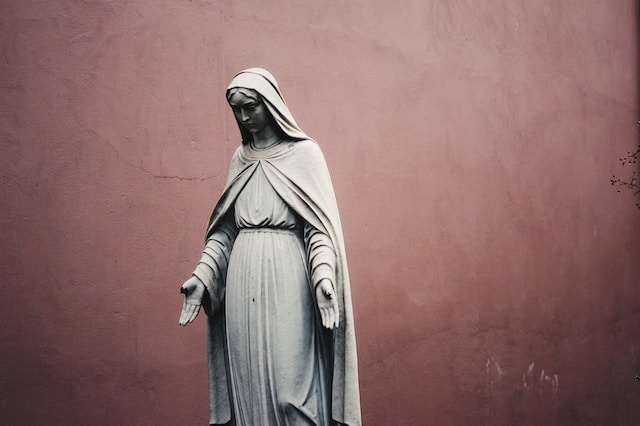
The title ‘Full of Grace’ appears in the Vulgate version of the Bible. Vulgate is the Latin Bible translation done by St. Jerome in the early fifth century. In Latin, it is ‘gracia plena’. Since Latin is the official language of the Roman Catholic Church, ‘gracia plena’ became the standard title of Blessed Virgin Mary and got translated into different languages. When ‘Hail Mary’ and the holy rosary became the most popular devotion in the Catholic world, the title ‘full of grace’ could no longer be separated from Mary, the mother of Jesus. But what is written in the Bible?
What St. Luke wrote in Greek is ‘κεχαριτωμένη’ (read: kecharitomene), and it literally means ‘one who has been graced’ or ‘one who has received grace.’ So, is St. Jerome mistaken? Not really. St. Jerome decided not to make a literal translation but rather a more poetic one, and by this choice, St. Jerome wanted to draw our attention to the total and continuous presence of grace in the life of Mary. Yet, why is the title ‘κεχαριτωμένη’ extremely important for Mary and us?
Firstly, we need to understand the meaning of the word ‘grace .’In Greek, it is ‘χάρις’ (read: Charis), and its most fundamental meaning is ‘gift’ or ‘favor .’Yet, in the New Testament, the word grace does not simply mean any gift, like birthday or graduation gifts, but it is the ultimate and the most important gift. Grace refers to God’s gift of salvation. The salvation is not only from sins and death but also for God. When we are saved, not only are our sins forgiven, but we are also enabled to share the divine life of the Holy Trinity. Grace is the gift of salvation, the gift of holiness, and the gift of heaven. (for a fuller discussion, see CCC 1996-2007)
Mary is wholly unique because she is the first person who has received grace even before our Lord was crucified and resurrected, and in fact, before He was born. The reality of grace perfectly manifested in her. It is not that Mary was worthy but that she was chosen. She did not earn it, but grace was given freely. It is not because of Mary’s plan but God’s providence. Yet, the moment of Annunciation also shows us that grace is free but never cheap. Though grace has filled her since the beginning, Mary still has to make the free choice to accept the grace and make it fruitful in her life. Thus, she said, “May it be done to me according to your word!” Mary’s yes to God’s grace is not only a one-time action but a lifetime commitment, even in the face of the cross.
Our Savior has died, risen for us, and poured out His grace for our redemption. Yet, like Mary, we must choose freely to accept the grace in our lives; through it, we flourish in God’s friendship. This is why we avoid sins, go to the mass regularly and devoutly, or do works of mercy. Not because we want to earn salvation, but to grow in God’s grace and express our thanks for the grace freely given.
Rome
Valentinus Bayuhadi Ruseno, OP
 In Medio Ecclesiae