Featured

The Wheat and Tares in Our Hearts

16th Sunday in Ordinary Time [A]
July 19, 2026
Matthew 13:24-43

Today we hear the Parable of the Wheat and the Tares. An interesting point arises when the landowner realizes that the tares are growing alongside the good crops, yet he chooses to let them live together. Why does he make this decision?

When the servants suggest that the tares be removed immediately, the landowner refuses for purely practical reasons. In their early stages of growth, the tares look almost identical to healthy wheat. If the servants insist on pulling the tares prematurely, they will mistakenly uproot the good wheat. While this action makes perfect sense in an agricultural context, Jesus does not explicitly explain in His theological discourse why God does not immediately punish those who carry evil in their hearts. This fact raises an important question: what is the deeper spiritual reason that God allows the wicked and the righteous to coexist in this world for a time?

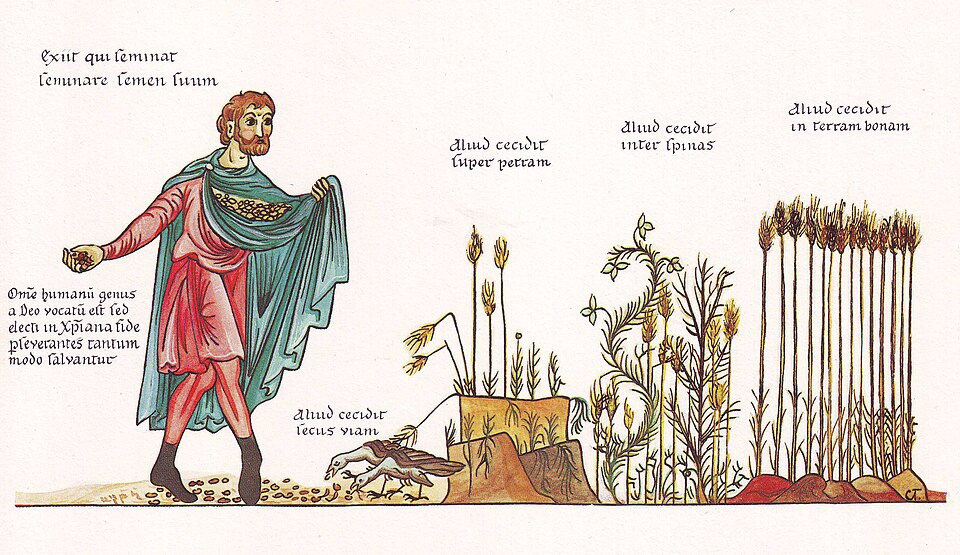
The answer is closely related to the Parable of the Sower, told earlier in Matthew 13:1-23 (the previous Sunday). In this parable, Jesus describes four types of soil that represent the disposition or condition of the human heart when hearing God’s Word: the path, the rocky ground, the thorny ground, and the fertile soil. Unlike the static nature of real-world soil, the spiritual disposition of the human heart is dynamic and can change over time. This dynamic nature is key to understanding why God delays the destruction of the spiritual “tares.” Within the human heart, both the Word of God and worldly influences constantly struggle to dominate the soil of our lives. When faced with the influence of evil forces, humans have varying responses; some ignore evil, some fight against it, and still others welcome it until it develops into sinful actions.

The human capacity for internal change explains why Jesus chose to allow the “tares” to continue growing among the wheat rather than passing instant judgment. God allows this spiritual struggle because He knows that even though a heart is currently being controlled by evil influences, that person’s life story is not over. Through His gracious free will, a person currently living as a “weed” has the opportunity to repent, change, and ultimately transform into “wheat.” This principle is tremendous good news for all of us. Even when the whispers of evil spirits try to conquer our hearts, God patiently continues to provide His help so that we have the opportunity to heal and bear good fruit.

God helps us fight the seeds of evil in our hearts in several practical ways. First, He works through His Word, planted within us through the Scriptures, which not only inspires us to do good but also trains us to recognize and resist evil. Second, He pours out His grace sacramentally, especially through the soul-nourishing Eucharist and the Sacrament of Reconciliation, which restores our relationship with Him. Third, God provides the Christian community as a vital refuge where we can find spiritual support and encouragement from fellow believers. Finally, He even uses life’s suffering and trials as a spiritual “pruning” process to remove harmful traits that cling to us, so that we can grow into stronger individuals.

Surabaya
Valentinus Bayuhadi Ruseno, OP

Guiding questions:
How deeply do we delve into Scripture so that we can clearly distinguish between the good seeds of God and the subtle weeds of the enemy in our daily lives? When we recognize bad tendencies or habits taking root in our hearts, do we actively seek help through the sacraments and community, or do we try to face the struggle alone? Finally, how can we shift our perspective on life so that we see current suffering and trials not as God’s abandonment, but as His patient and loving way of pruning us to become more fruitful?

Why Parables

5th Sunday in Ordinary Time [A]

July 12, 2026

Matthew 13:1-23

Today, we listen to Jesus’ iconic Parable of the Sower. Of course, this is not the only parable Jesus tells. He also teaches the Parables of the Hidden Treasure and the Costly Pearl (Mat 13:44-46), the Parable of the Ten Virgins (Mat 25:1-13), and the Parable of the Prodigal Son (Luk 15:11-32), to name just a few. From this frequency, we can conclude that Jesus favors teaching through parables. Yet, what exactly is a parable, and why does Jesus choose this specific method in the first place?

The English word “parable” comes from the Greek παραβολή (parabolē), which literally means “to throw alongside,” and signifies a comparison. In the Parable of the Sower, we see two distinct realities—daily human life and spiritual, divine truth—being placed side-by-side and compared. Jesus directly links the seeds scattered by the sower to the word of the Kingdom. Meanwhile, the four types of soil that receive the seed represent the four different dispositions of the human heart when encountering that word. But this raises another question: why does Jesus use a symbolic parable to teach rather than simply speaking in a straightforward, direct manner?

For many of us who regularly listen to Jesus’ parables during the Mass and hear priests explain them, the meaning of each story seems obvious and easy to comprehend. However, the experience was entirely different for Jesus’ disciples and the Jewish crowds who heard these parables for the very first time. In the Gospel, after Jesus delivers the Parable of the Sower, the disciples are confused and at a loss regarding its meaning. Consequently, they approach Jesus in private and ask, “Why do you speak to the people in parables?” (Mat 13:10).

Jesus then gives them the true reason behind this method: “Because the knowledge of the secrets of the kingdom of heaven has been given to you, but not to them” (Mat 13:11). This reveals that the purpose of a parable is dual: it is meant both to reveal and to hide. The ultimate key to unlocking a parable is faith in Jesus. For those who have faith, the secret behind the story is opened and properly understood; for those who lack faith, the meaning remains hidden. This is why the deeper explanation of the Parable of the Sower is given strictly to the disciples during a private moment with Jesus.

Understanding the truth behind Jesus’ parables is a beautiful sign that we possess faith in Him. Yet, true faith is never a static, passive acceptance of Jesus as our Lord; it is a life-transforming force. This is precisely the lesson embedded in the Parable of the Sower. The Lord has sown His word into our hearts, but we must do our part to allow that word to transform our lives. As Jesus clearly explains, unless the Word penetrates deeply and takes root in our hearts, we will fall away when difficult times arise. Likewise, unless we clear away the thorns of worldly anxieties and ambitions, the Word will be choked and fail to bear fruit. Ultimately, a parable is not just an invitation to understand Christ through faith, but a direct challenge to transform our daily lives and become truly fruitful in Him.

Bandung

Guide questions:
How deeply have we allowed the word of God to penetrate our hearts, and are we nurturing its roots so that our faith can withstand difficult times? What are the specific “thorns” of worldly anxieties and personal ambitions in our daily lives that are currently choking the word and preventing us from bearing fruit? Do we treat our faith as a passive, static acceptance of Jesus, or are we actively collaborating with Him to let His teaching transform our actions and choices?

The Holy Spirit and the Hour of Glory

7th Sunday of Easter [A]

May 17, 2026

John 17:1-11

In today’s Gospel, Jesus addresses His Father with the profound declaration that His “hour” has arrived—the hour of His glory. Yet, what does this hour of glory mean for Jesus?

To understand the weight of this statement, we must first examine what the world considers glorious. In antiquity, much as in the modern era, glory was synonymous with victory, achievement, and conquest. When Julius Caesar conquered Gaul (the modern-day of France), he marched into Rome to the roar of cheering crowds, parading captured leaders and spoils of war to secure his fame. We often seek glory in a similar fashion, displaying our trophies, diplomas, and credentials as symbols of our success.

However, when Jesus speaks of His glory, He refers to something diametrically opposed to worldly triumph: the hour of His Passion, crucifixion, and death. Jesus faced a false arrest, an unjust trial, and a brutal sentence. He was tortured and forced to carry the very instrument of His execution, ultimately hanging on a cross designed for maximum humiliation and agony. Yet, in this moment of profound suffering, Jesus sees glory. For Him, true glory is not found in fame, but in the total gift of Himself through sacrificial love. It is this radical love alone that possesses the power to transform death into life.

Throughout this Easter season, our first readings from the Acts of the Apostles highlight the expansion of the early Church. While the narrative often centers on the journeys of St. Peter and St. Paul, the true protagonist of the story is the Holy Spirit. Far from appearing only at Pentecost, the Spirit continuously directed the infant Church’s every move. It was the Spirit who guided Philip to the African official in Acts 8:26-40 and led Peter to the household of Cornelius in Acts 10, resulting in the baptism of the first Roman Christians. Furthermore, the Spirit initiated the formal mission to Gentile territories by selecting Paul and Barnabas in Acts 13:2.

This divine guidance remained the bedrock of the Church’s discernment. The Council of Jerusalem concluded that it was the Holy Spirit’s will not to burden Gentile converts with the Mosaic law (Acts 15:28), and later, the Spirit of Jesus redirected Paul’s mission from Asia toward Europe (Acts 16:6-10). Under this guidance, the young Church flourished as the Gentiles embraced the faith. Yet, these “glorious moments” were only half the story. While the Church grew, she also endured relentless persecution and hardship. Peter and Paul brought many to Christ, but their path also led to rejection, imprisonment, and eventually martyrdom.

Ultimately, the Holy Spirit does not lead the Church toward worldly success or comfort. Instead, the Spirit leads us to the specific places and “hours” where we are needed most. By following this divine advocate, we are empowered to imitate our Lord, finding our own glory in the moments where we give ourselves up totally for others.

Rome

Valentinus Bayuhadi Ruseno, OP

Guide questions:

In what areas of our life are we chasing “Caesar’s glory” (fame, credentials, or status), and how might we pivot toward “Jesus’ glory” by prioritizing sacrificial love and service to others? When we face “the hour” of our own personal trials or humiliations, do we see them only as obstacles, or can we identify ways that God might be using those moments to demonstrate radical love? The Holy Spirit led the early Church to places of need rather than places of comfort; where is the Spirit leading us to go right now that might require us to step out of our comfort zone?

The Holy Spirit and the Sacrament of Confirmation

The Sixth Sunday of Easter [A]

Acts 8:5-8, 14-17

May 10, 2026

The Sacrament of Confirmation is arguably the most underappreciated and misunderstood of the seven Sacraments. Yet, why do we fail to appreciate this sacrament? Does it even mention in the Bible? And, how does the sacrament reveal the secrets about the Holy Spirit?

We often struggle to value it because it lacks the immediate, visible impacts in our lives, yet its foundations are deeply biblical. In the Acts of the Apostles, specifically chapter 8, we see Philip the Deacon preaching and baptizing in Samaria. When the Apostles Peter and John arrived, they prayed for the converts to receive the Holy Spirit, as the Spirit had not yet fallen upon them. This ancient narrative confirms that since the time of the Apostles, a distinct sacrament existed specifically to impart the presence and gifts of the Holy Spirit, a ministry uniquely tied to the authority of the Apostles.

Continuing this tradition, the Church recognizes Bishops as the successors of the Apostles and the ordinary ministers of the sacrament. The name “Confirmation” is used because the Catholic Church teaches that the graces received here strengthen and solidify the initial grace of Baptism. While Baptism is viewed as a spiritual birth, Confirmation serves as a passage into spiritual adulthood. It is designed to equip the believer for their mission in the world and provide the necessary strength for spiritual warfare against the forces of darkness.

Despite its importance, Confirmation is often less popular than other sacraments because it doesn’t dramatically change a person’s external lifestyle or status, unlike Matrimony or Holy Orders. Furthermore, because it is only received once, it lacks the frequent reinforcement we find in the Eucharist or Penance. Many modern Christians also mistakenly equate spiritual growth with emotional sensations. When people do not feel “emotionally touched,” hear God’s voices, or experience spectacular gifts during the prayers, we are often tempted to perceive the sacrament as unexciting or stagnant.

However, St. Luke’s account in the Bible suggests that the Holy Spirit does not always work through spectacular displays. After Peter and John laid hands on the Samaritans, there was no mention of extraordinary fireworks, reminding us that the Spirit often works quietly and gradually. Through Confirmation, we receive an increase in the seven gifts: Wisdom, Understanding, Counsel, Fortitude, Knowledge, Piety, and Fear of the Lord. These gifts allow us to align our lives with God’s will even during trials. The true evidence of the Holy Spirit’s work is found in small, faithful acts—choosing to attend Mass when it feels boring, remaining loving during marital difficulties, or serving others without seeking praise. These are the quiet signs that the Holy Spirit through the sacrament is truly transforming the souls.

Rome

Valentinus Bayuhadi Ruseno, OP

Guide questions:

How often do I equate the strength of my faith with how “emotional” or “excited” I feel during prayer? How might I refocus on the quiet, steady growth the Holy Spirit provides? If Baptism is my spiritual birth and Confirmation is my entry into spiritual adulthood, in what specific areas of my life am I being called to move away from “infant” faith and take on the responsibilities of a mature Christian?

Sheep Shepherding another Sheep

Fourth Sunday of Easter [A]

April 26, 2026

John 10:1-10

Living in a modern and secular world, we are often confronted with the reality that those closest to us—our children, relatives, and friends—no longer believe that religion and religious activities are important. How do we respond to this with love, and how does Jesus, our Good Shepherd, provide an answer to this difficult situation?

First, we must recognize the source of our suffering. We want the best for those we love, and nothing is better for them than eternal life. Knowing that they live far from Jesus endangers their souls, and this is deeply painful for us. This awareness is crucial; it shows that our concern stems from genuine love, not a desire to control.

Since love inspires us, we must approach them with love. The first step is to understand that their rejection of religious life stems from unique reasons, which are often hidden. Some people reject religion because they believe that faith contradicts common sense, making it irrelevant in the modern world. Others no longer go to church because of painful past experiences with church leaders. Some simply want to maintain a “free” lifestyle that does not align with biblical teachings, while others are influenced by their environment or friends who have led them into misunderstandings about faith.

Furthermore, we can learn from the way the Good Shepherd cares for His sheep. The Good Shepherd guides with a firm voice, but never through coercion or violence. He walks ahead of His flock, leading by example. He cares for each of His sheep, knowing them by name and recognizing their unique characteristics. When danger approaches, He proves His love not by sacrificing the sheep, but by sacrificing His own life.

Like the Good Shepherd, we need to show care by listening to their stories and struggles. We must not come to judge, but to be respectful and trusted partners in dialogue. At the same time, we need to remain firm in our convictions, confident in the truth of our faith, and aware of the dangers of worldly desires. Most importantly, we must lead by example. We become living witnesses of our faith when we practice what we preach. Ultimately, we demonstrate that our faith is meaningful because it inspires us to stand by them when life becomes difficult, ready to sacrifice our time, energy, and even our lives for them.

Some may need logical answers about our faith, which means we must continue to learn more about it ourselves. Others need healing from past wounds, and we must be true companions on their journey home. All of this requires us to sacrifice our time, energy, and even our lives. Yet, we do so willingly because we truly love them and desire their eternal salvation.

Finally, we must remember that we are not the Good Shepherd; we are His sheep trying to shepherd other sheep. In the end, we may face failure, and it may feel as though our sacrifices are in vain. However, this must not cause us to lose hope. Instead, we must surrender everything to the true Good Shepherd. We have heard His voice, and by faithfully following Him, we will find our rest.

Rome

Valentinus Bayuhadi Ruseno, OP

Guiding Questions:

Am I truly listening to understand their unique struggles, or am I quick to judge and want to control? Do my daily actions reflect the compassion of the Good Shepherd? Do my patience, empathy, and willingness to sacrifice show those I love the positive and life-giving impact of my faith? When my efforts to help someone seem to fail and I feel discouraged, do I allow myself to fall into despair, or do I actively choose to entrust them to the true Good Shepherd?

The Story of Jesus

Easter Sunday [A]

April 5, 2026

Matthew 28:1-10

We naturally like stories, especially those filled with drama and unpredictable plot twists. Knowing this, God sent His only begotten Son to become man and enter into our human history. Then, under the influence of the Holy Spirit, His disciples narrated and wrote Jesus’ life into a story. It has become the greatest story ever told. Yet, why do we like to hear stories, and why the story of Jesus is best of all?

We are creatures of language. Through words, we not only communicate with each other, but also find meanings in our lives. In ancient time, people narrated mythical stories to make sense of various natural phenomena like rain, thunder, and stars. In modern time, we have science to explain these, but unless these scientific theories are elaborated like a story, they will not be easily understood, let alone attractive.

We are not only using stories to make sense our surroundings, but also to understand who we are. This is why we are naturally attracted to a good story in well-written novels, well-executed theatrical performances or films, because we can easily participate in them. Good stories make us laugh, cry and even angry, despite knowing that we are not really part of the story. Yet, the greatest stories are those who answer the meanings of our lives. We learn from the values each character holds, words they say and actions they do or fail to do.

One time, I decided to read a classic novel “The Brothers Karamasov” by Fyodor Dostoyevsky. Initially, I was discouraged by its size, more than 800 pages. Yet, when I began to read, I was drawn into it, not only because unexpected plot, but also each character seems to be truly alive. I was particularly attracted to Alyosha Karamazov, young man who struggles to find God when his beloved mentor, father Zosima passed away.

Going back to the story of Jesus, the reason His story is the most powerful story of all time is that Jesus’ life is filled with the most amazing plot twists: He was crucified, yet rose from the death, was betrayed, yet came back ever stronger, and was pushed to the lowest place, yet returned in glory. Furthermore, his life and words teach us the deepest meanings and ultimate destiny of our lives. His teachings like the parables, the sermons on the Mount, the Law of Love remain the eternal principles that guide us into the true happiness.

Finally, the story of Jesus is the greatest story of all because for those who have faith, the story of Jesus becomes a reality in our lives. Living in this world, we cannot but endure pains and sufferings, and ultimately, we are going to die. However, when we are faithful to Jesus, even the worst things that befall us will never have the final say in our lives. Even the darkest hours in our lives, we will make sense as we participate in His cross. As St. Paul said, “Now if we died with Christ, we believe that we will be also live with Him (Rom 6:8).”

Blessed Easter!

Leuven

Valentinus Bayu, OP

Jesus and the Crowd

Palm Sunday of the Lord’s Passion (A)

March 29, 2026

Matthew 21:1-11 and Matthew 26:14 – 27:66

Palm Sunday is a unique moment in the Catholic liturgy where we hear two readings from the Gospel. The first is the story of Jesus’ triumphant entrance into the city of Jerusalem, and the second is the Passion Narrative. Both accounts come from Matthew. We often hear that these two stories are connected by the “crowd.” It is frequently assumed that the people who initially welcome and cheer Jesus as king are the very same people who later shout, “Crucify Him!” Yet, is this true? Or is it just an unrealistic drama to spice up Jesus’ story?

To answer this question, we need to look back at the time of Jesus and understand what was happening in Jerusalem. In first-century Israel, the Jewish people were living under Roman occupation, and life was very difficult for ordinary citizens. The desire for liberation from Roman rule was incredibly strong, drawing inspiration from the Old Testament where God promised a Messiah (the anointed one) to lead them to freedom.

When Jesus appeared, He came as one possessing divine power. He taught the truth with authority and performed unprecedented miracles. Naturally, this raised the excitement of many Israelites, and people started to follow Him, hoping He was the long-awaited Messiah. As Jesus marched toward Jerusalem for His Passion, the Jewish festival of Passover was also approaching. This feast commemorates Israel’s liberation from Egypt (Exodus 12), and during this time, Jews from all over traveled to Jerusalem on pilgrimage.

We can imagine that as Jesus drew closer, more and more pilgrims recognized Him and joined His followers. The people’s expectations were further fueled by Jesus’ unmatched miracle of restoring sight to two blind men in Jericho, not far from Jerusalem (Matthew 20:29-34). As Jesus entered the city riding a donkey, the throng of people who had been following Him began to shout, “Hosanna to the Son of David.”

So, were the people who welcomed Jesus the same ones who demanded His death? I believe these were two different groups. Those who supported Jesus were fellow pilgrims, mostly from outside Jerusalem. In contrast, those who demanded Jesus’ execution were likely Jerusalem elites and some locals whose businesses had been disrupted by Jesus and His followers. In fact, the trial was conducted hastily in the early morning, suggesting it was well-orchestrated. Matthew also notes that the chief priests and elders persuaded the crowd to ask for Barabbas’s release (Matthew 27:20), indicating that this specific crowd was manipulated to follow the Jewish leaders’ plan.

However, despite the existence of two distinct groups, the possibility of individuals switching sides remains. Some of those who initially supported Jesus may have eventually caved and condemned Him. Yet, some of those who approved of Jesus’ crucifixion may have ultimately returned to His side. A good example is Peter, Jesus’ core disciple, who denied Him when He was arrested but returned to Him after the resurrection.

As we enter Holy Week, we follow Jesus in our own lives. When are we like the people who shouted, “Hosanna”? What are those moments when we ardently follow Jesus? When are we like those who shouted, “Crucify Him”? When are the times we fail Him and even rebel against Him? When are we like the weak Peter, running from God or hiding? And when are we like the renewed Peter? What are those moments when we allow God to restore us again?

Rome

Valentinus Bayuhadi Ruseno, OP

Jesus’ Tears

5th Sunday of Lent [A]

March 22, 2026

John 11:1-45

The Fifth Sunday of Lent reveals one of the most profoundly emotional moments for Jesus in the Gospel of John. Typically, John depicts Jesus as solemn and possessing a majestic composure, rarely revealing His inner psychological state. Yet, in Chapter 11, we are granted a glimpse into the depths of Jesus’ humanity.

When Jesus arrived in Bethany to visit his friend Lazarus, who had just passed away, Lazarus’s sister Martha greeted Him first. She expressed that had Jesus come earlier, her brother would not have died. Jesus assured Martha that He is the resurrection and the life. Martha professed her faith in Him, and for a moment, everything seemed peaceful. This tranquility, however, did not last. Shortly after, Mary came to Jesus, echoing her sister’s words. But she fell at His feet, weeping alongside those who had accompanied her. John the Evangelist notes that Jesus was “deeply moved in spirit” and “troubled.” As they led Jesus to Lazarus’s tomb, He could no longer contain His sorrow, and He began to weep.

Why did Jesus express such strong emotion? The Jews who witnessed it noted, “See how He loved him.” Jesus loved Lazarus, Martha, and Mary deeply; in losing His friend, He mourns and weeps. Jesus exhibits the very human reaction many of us experience when we lose someone we hold dear. The question, then, is this: if Jesus knew perfectly well that He had the power to raise Lazarus from the dead, why did He allow Himself to be so overwhelmed by grief?

Through this touching narrative, Jesus teaches us a profound truth. Humanly speaking, feeling deep sorrow and mourning is our natural way of coping with the painful loss of a loved one. Without this grief, we would never truly understand what it means to love and be loved—to hold someone precious and to be precious to them. God, as the author of our lives, recognizes this natural process in our humanity. Thus, in His infinite wisdom, He chooses not to remove this pain, but rather to sanctify it. But how? While the Lord will not raise someone from the grave every day, He assures us that He mourns and weeps with us. Jesus’ first coming into the world was not meant to immediately erase our tears and agonies, but to fill them with His presence, thereby making them holy.

One of the most difficult moments in my life as a priest is preaching at a funeral Mass. Sometimes, a grieving loved one will ask me, “Why did the Lord take him now?” Honestly, I do not always know what to say. I often wish I had the perfect answer, or even the miraculous gift to raise the dead. Yet, I have gradually come to realize that my presence there is not to solve their problems or erase their profound loss. I am there to be with them, to mourn with them, and, through the Eucharist, to bring Jesus into their mourning. When they have Jesus with them, even in the most painful moments of their lives, they can offer their grief to God as a pleasing and holy sacrifice.

Rome

Valentinus Bayuhadi Ruseno, OP

Guide questions:

How does knowing that Jesus openly wept for His friend change the way we view our own moments of grief and vulnerability? If deep mourning is a natural reflection of profound love, how might we invite the Lord to be present in—and make holy—a painful loss in our own life? How can we offer our mourning relatives or friends a comforting, Christ-like presence?

King David

Fourth Sunday of Lent [A]

March 15, 2026

1 Samuel 16:1b, 6-7, 10-13a

Continuing our journey through the great figures of the Old Testament, the Fourth Sunday of Lent brings us to King David.

David is undoubtedly one of the most pivotal characters in the biblical canon. He was a shrewd warrior who defeated the bigger, stronger and more experienced Goliath with a single sling stone (1 Sam 17:45-47). As a brilliant military strategist, he was victorious in nearly every campaign (2 Sam 8:6), and as a charismatic statesman, he successfully unified the twelve tribes of Israel (2 Sam 5). Furthermore, David demonstrated profound mercy, famously refusing to harm King Saul despite having the opportunity to do so (1 Sam 24:6). Finally, we remember him as the “sweet singer of Israel,” the inspired poet whose Psalms (such as 23 and 51) we continue to recite today.

However, despite these unrivaled achievements, David’s story starts with a humble beginning. As the youngest son of Jesse from the small village of Bethlehem, David was initially overlooked by Samuel, the prophet. Samuel’s human eyes were fixed on David’s elder brothers, who possessed more impressive physical statures and military experience. Yet, God sees what man does not; He chose the inexperienced shepherd boy. Upon his anointing, the Spirit of the Lord rushed upon David (1 Sam 16:13), and from that moment forward, his success was a testament to God’s favor.

Unfortunately, David’s string of successes eventually birthed a sense of pride. He began to believe he was invincible, acting as though he were above everyone. This hubris led to his fall into lust with Bathsheba and the subsequent calculated murder of her husband, Uriah (2 Sam 11). This grave sin necessitated a stern rebuke from the prophet Nathan. Later, David erred again by conducting a census—likely to measure his own military might rather than trusting in divine protection. This act of pride forgotten that victory comes from the Lord alone, leading to divine judgment (2 Sam 24). In both instances, however, David’s deep love for God was revealed through his sincere repentance, recognizing his humble beginning. Sadly, as king, his personal failings inevitably brought consequences upon his family and the nation.

The life of David offers us a vital spiritual lesson. Like him, we all begin from a place of humility and weakness. Any “success” we achieve—be it professional advancement, physical health, or flourishing relationships—is fundamentally a gift from God. This is equally true of our spiritual lives. Our ministries and the fruits of our prayer are movements of the Spirit, not personal trophies.

Yet, pride often poisons the heart. We begin to credit our own “genius” or effort for our successes, clinging to our achievements and demanding recognition. This is the threshold of our downfall. When we focus solely on maintaining our status, we become paralyzed by the fear of failure. We lose our spirit of gratitude and replace it with complaint and resentment. We may even find ourselves manipulating others to preserve our image of success, leading to a state of spiritual misery.

Like David, we are reminded that only true repentance can restore our orientation toward the Lord, who is the sole author of our salvation. Only when we remember our humble beginning and recognize God’s role in our lives, we find true happiness.

Rome

Valentinus Bayuhadi Ruseno, OP

Guide Questions:

How does God bring us high fro our humble beginning? When we experience a “win” in our career, family, or ministry, do we instinctively offer a prayer of gratitude, or do we begin to rely on your own “genius”? When we face failure or realize we have manipulated a situation to look better than we are, do we hide in your misery, or do we have the courage to let God rebuke and restore us?

Clay of the Ground

1st Sunday of Lent [A]

February 22, 2026

Genesis 2:7-9, 3:1-7

Traditionally, the Gospel reading for the first Sunday of Lent is the story of Jesus in the wilderness for forty days, where He fasted and was tempted by Satan. However, in this reflection, we will look deeper into the first reading from the Book of Genesis.

The Church combines two stories in this first reading: the creation of Adam (Gen 2:7-9) and the fall of our first parents (Gen 3:1-7). In order to do this, the lectionary skips around 16 verses (Gen 2:10-25), omitting Adam’s activities in the Garden of Eden and the creation of Eve. I believe the reason is not purely practical (simply avoiding overly long reading), but rather that the Church wishes to show us a hidden truth that connects the two stories.

First, we must recognize that the story of the creation of Adam is not merely a biological lesson, but a profound theological truth. Adam was created from the dust of the ground (עפר מן־האדמהapar min ha-adama). We, as humans, are nothing but mere soil—fragile, dirty, and essentially worthless. In fact, there is a clear play on words in Hebrew to remind us of our lowly origin: the word Adam (the first man) is almost identical to the word for ground (Adama).

However, the Book of Genesis pushes further by pointing out that while we are nothing, God is everything; while we are powerless, God is omnipotent. Yet, despite the infinite gap between God and us, the author of Genesis reveals God’s immense love for humanity. Depicted as a divine artisan with His skillful hands and life-giving breath, God formed this worthless dust into one of His most refined creatures. Furthermore, God made us His co-workers in His Garden, entrusting us to care for the other creatures. We are who we are solely because of God’s love.

Moving to chapter 3, the serpent tempts Adam and Eve. His strategy is simple yet extremely effective. He claimed that God was not telling the truth and that God did not want Adam and Eve to be like Him, thus forbidding them to eat the fruit. The idea of being like God was extremely attractive, and pride began to corrupt their hearts. They desired to be like God without God, acting as His rivals rather than living as His servants. They forgot the most fundamental truth about themselves: they are nothing but dust, and everything good they have comes from God. Consequently, they fell.

By joining the stories of Adam’s creation and his fall, the Church teaches us that when pride poisons our hearts, we begin to ignore our humble origins and are doomed to fall. As St. John Chrysostom stated in a 4th-century homily: “[the story of Adam’s creation] is to teach us a lesson in humility, to suppress all pride, and to convince us of our own lowliness. For when we consider the origin of our nature, even if we should soar to the heavens in our achievements, we have a sufficient cause for humility in remembering that our first origin was from the earth.”

Rome

Valentinus Bayuhadi Ruseno, OP

Guide questions:

In what areas of my life do I forget my humble origins (“dust”) and fail to recognize that all my gifts, talents, and successes ultimately come from God? How does pride manifest in my daily choices? Do I sometimes try to be “like God without God” by seeking total control over my life, rather than trusting Him as His servant and co-worker? When I “soar to the heavens” in my earthly achievements, what practical practices can I adopt to stay grounded and remember my fundamental reliance on God’s love?