

33rd Sunday in Ordinary Time [A]
November 15, 2026
Matthew 25:14-30
The Gospel of Matthew places a distinct focus on detailed financial terms, a characteristic that deeply reflects St. Matthew’s background as a former tax collector (Mat 9:9). Of particular importance is the Parable of the Talents (25:14–30). Not only is it one of the longest parables in Matthew at seventeen verses, but its use of specific financial vocabulary also reveals how dear this story was to the evangelist. To appreciate this fully, we can look at the specific financial terminologies Matthew employs throughout the parable.
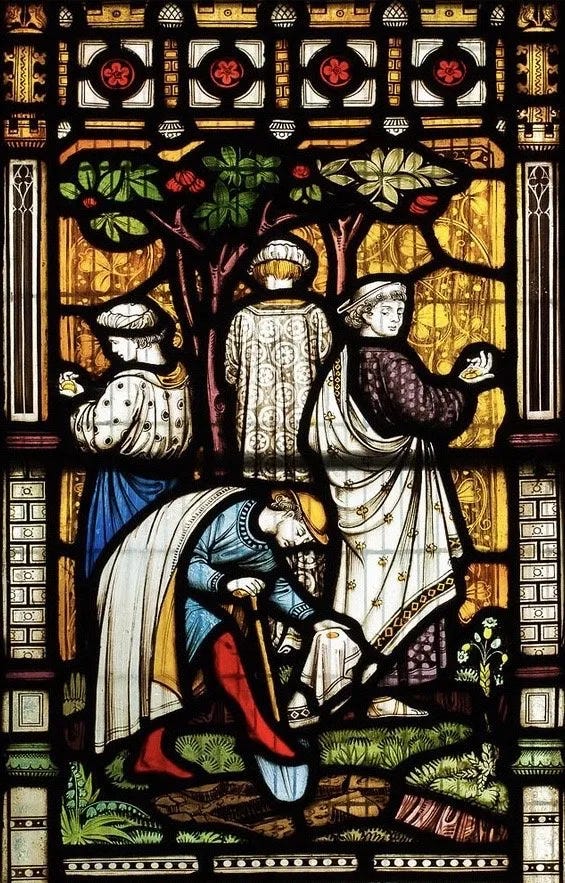
The most prominent term is the word “talent” itself. Today, “talent” typically refers to gifted abilities or skills, such as high intelligence or musical aptitude. For Matthew, however, a talent was a specific monetary unit representing an enormous sum of money—worth around 6,000 denarii, or roughly fifteen to twenty years of a manual laborer’s wages. By contrast, the parallel account in the Gospel of Luke (Luke 19:11–27) uses the mina (mna), which was a far smaller sum worth only about 100 denarii.
Aside from the word “talent,” Matthew incorporates several precise commercial and banking terms into the narrative, including “traded with them” (eirgasato, 25:16), “settled accounts” (synairei logon, 25:19), “bankers” (trapezitais, 25:27), and “interest” (tokō, Matthew 25:27). These technical expressions reveal Matthew’s sharp expertise as someone who dealt with money on a daily basis.
Furthermore, this pattern of using economic language extends well beyond the Parable of the Talents. Matthew alone specifies the thirty pieces of silver paid to Judas (26:15). He is also the only evangelist to include the account of Jesus paying the Temple tax (17:24–27), and he alone records the Parable of the Unforgiving Servant (18:21–35), a story that places massive financial debt at its very center.
From these unique details in the first Gospel, we learn a precious lesson from St. Matthew. Although he left behind his lucrative profession and wealth to follow Jesus, he did not abandon his core identity. Having been trained in finance and commerce for many years, he willingly placed his background and skills at the service of preaching the Gospel. He utilized not only his literacy—a rare and valuable skill in the ancient world—but also the familiar details of his former trade to illustrate Christ’s message clearly and effectively.
Ultimately, St. Matthew teaches us that we can serve the Lord simply by being who we are. We do not need to pretend to be someone else, as the only thing displeasing to God is our sinful behavior. Mothers serve the Lord by nurturing their children to the best of their abilities and guiding them closer to God. Professionals serve Him by performing their duties with excellence and integrity, and businessmen and women honor Him by conducting their enterprises wisely and morally. Just as St. Matthew used every fiber of his background to glorify the Lord, we too are called to offer the totality of who we are in praise of God.
Manila
Valentinus Bayuhadi Ruseno, OP
Guide questions:
Which of our unique skills, professions, or past experiences can we offer more intentionally to serve God and share His message? Are there parts of our authentic selves that we hold back from God, forgetting that He wants to use who we already are rather than someone we pretend to be? How can we turn our daily responsibilities—whether in our homes, workplaces, or businesses—into genuine acts of worship and integrity this week?

