

5th Sunday of Lent [B]
March 17, 2024
Jeremiah 31:31-34
In the bible, the word covenant (in Hebrew בְּרִית (Berit), in Greek διαθήκη (diatheke)) is an agreement between individual, families, tribes or nations. It is commonly used to bind the overlord king and his vassals. The supreme lord was obligated to give protection in times of need, while the vassals must be loyal and pay tributes. At the individual level, a covenant forged a familial bond between the parties. They become brothers, and thus, they must protect and help one another. Or, when the covenant involves man and woman, they become husband and wife, a new family.
Though covenant is a complex reality and even still debated by scholars, one thing is sure: that covenant is an agreement about the ‘exchange of people’ rather than the ‘exchange of items.’ A radical change of their identities is expected for those who enter the covenant.
The term covenant is a key to understanding the bible because God took the initiative to bind Himself to Israel through covenant. There are several moments where God formed a covenant with Israel, but the most famous one is the covenant at Mount Sinai through the mediation of Moses. The Lord said, “Now, therefore, if you will obey my voice and keep my covenant, you shall be my own possession among all peoples; for all the earth is mine, and you shall be to me a kingdom of priests and a holy nation (Exo 19:5-6).”
The covenant created Israel as a nation under God’s leadership. Thus, Israelites, as citizens of God’s nation, must obey and be faithful to one God alone, that is, the Lord, and follow His Laws. However, the covenant does not only form a king-people relationship but also a family. Often, Israelites are addressed as ‘sons of God’ (see Exo 4:22 and Deu 14:1). And what is even more intriguing is that a marriage relationship is also established through this covenant. Prophet Hosea famously describes the relationship between God and Israelites as husband and wife.
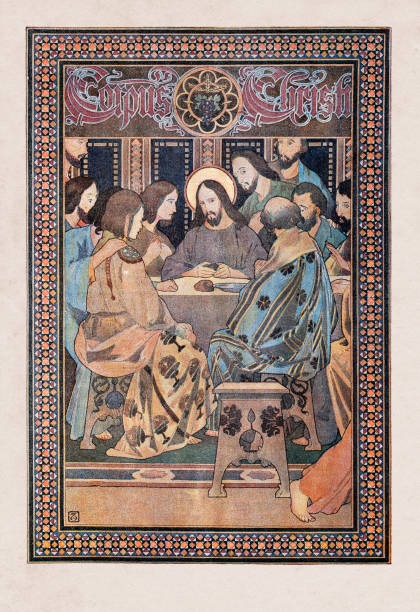
Prophet Jeremiah prophesized that there would be a new covenant (Jer 31:31, first reading). This is fulfilled in Jesus Christ. In the last supper, Jesus said, “This cup that is poured out for you is the new covenant in my blood (Luk 22:20).” One of the main purposes Jesus offered up himself at the cross is to forge and ratify this new covenant. Since the divine blood of Christ ratifies it, the covenant is everlasting and unbreakable.
Jesus offers us a covenant despite our unworthiness. Through faith and baptism, we enter the covenant, and our identity is radically transformed. The Lord is our God, and we become the people of the Kingdom of God. Yet, because of the same covenant, we are also His children, and we have a right to call God ‘our Father’. Moreover, a marriage is established. The Church is the spouse of Christ, and Christ loves His spouse so much to the point of giving His life for her. As the people of the new covenant, constantly renewed in the Eucharist, do we need to behave ourselves as obedient and loving children to our Father? Do we act as a faithful and loving spouse to Christ, our bridegroom?
Rome
Valentinus Bayuhadi Ruseno, OP
 In Medio Ecclesiae