

First Sunday of Advent. December 3, 2017 [Mark 13:33-37]
“Be watchful! Be alert! You do not know when the time will come. (Mrk 13:33)”
 The Season of Advent has begun. This season marks the beginning of the new Church’s liturgical year as well as of the four Sundays preparation for Christmas. A curious mind may ask: why the liturgical year has to be opened by the season Advent? Why not Christmas, Lenten or Easter seasons?
It has something to do with the liturgical year itself. Yet, what is the liturgical year? Simply put, liturgy is the official and public worship of the Church. Thus, it is through the liturgical year or calendar, the Church wishes to worship God every single day all around the year, and thus fulfilling St. Paul’s instruction to pray without ceasing (1 The 5:17). There is no single moment in the life of the Church and Christians that is not ordained for worshiping the Lord.
Yet, to worship God every moment of our lives is rather a tall order, if not impossible. For some of us, we just go to the Church on Sundays and perhaps pray privately once in a while. Some of us have freer time and commitment to the Church, so we attend Mass daily and join parish organizations. For Dominican religious brothers like myself, daily Eucharist and the Liturgy of the Hours have been integrated into our life structure in the convent, and thus easier to pray every day. But, for many of us who are working for a living, and studying for the future, more time in the Church is simply not possible. Even for me, without the structure of convent, I am often lost and have a hard time to pray.
From this perspective, the Advent season becomes even more crucial for us in shaping our right attitude and predisposition in entering this liturgical new year. The Catechism of the Catholic Church reminds us, “When the Church celebrates the liturgy of Advent each year, she makes present this ancient expectancy of the Messiah, for by sharing in the long preparation for the Savior’s first coming, the faithful renew their ardent desire for his second coming (CCC 524).” The first Christians possessed this “eschatological fervor” because they believed that Jesus was going to come very soon. They were so eager to welcome Christ as much as they would live as if they were not of this world. As Paul would say, “our citizenship is in heaven (Phil 3:20)”. Many of them sold their belongings so that they may focus on those truly important: the teaching of the apostles, communal life, breaking of the bread, and prayers (Act 2:42). Even the pagans would be so amazed and say, “See how they love one another!” It may be true that Jesus did not come in their lifetime, but their lifestyles have transformed their communities and societies to better places to live. Jesus did not come, but they brought Jesus in the midst of the world.
It is the call of Advent season to rekindle this “eschatological fervor” in us. To see that we are all pilgrims and sojourners on this earth and we walk towards our true home in Christ. Our happiness is not rooted in the things of this earth, money, gadgets, popularity, and success. It is true that we need to work for a living, and often our works leave a little time to worship God, but it is always possible to live as the sign of the Kingdom of God, to make our very lives a worship to God. To be honest in our workplaces or schools, to spend more quality time with our families, and to love the poor are some ways we live this fervor. Advent is not about waiting, but it is about engagingly bringing Jesus in our midst.
Br. Valentinus Bayuhadi Ruseno, OP
 Masa Adven telah dimulai. Masa ini menjadi tanda dimulainya tahun liturgi Gereja dan juga empat hari Minggu persiapan menuju Natal. Kita mungkin bertanya, “Mengapa tahun liturgi harus dibuka oleh masa Adven? Mengapa tidak Natal, Prapaskah atau Paskah?”

 Talent is one of the few biblical words that has become part of our modern language. Talent connotes a God-given ability or a natural unique skill, and yet it has not fully developed. Thus, we are called to use and harness our talents in order to achieve our full potentials and contribute to the progress of society. In fact, talents have become well-sought commodity in our society. Companies only hire the talented employees. Schools are marketed as venues of talents development. Our TV channels and social media outlets are filled by shows where we perform, compete and prove that we possess the best talent in singing, dancing, and the like. How our world is now obsessed with talents!
 Talenta adalah satu dari sedikit kata-kata dari Kitab Suci yang telah menjadi bagian dari bahasa kita sehari-hari. Talenta sering diartikan sebagai bakat yang diberikan Tuhan atau keterampilan yang unik seperti memiliki suara yang indah, kemampuan memecahkan persoalan matematika yang rumit, atau kemampuan berolahraga, namun belum sepenuhnya dikembangkan. Dengan demikian, kita dipanggil untuk menggunakan dan memanfaatkan talenta kita untuk mencapai potensi maksimal kita dan memberikan kontribusi pada kemajuan masyarakat.
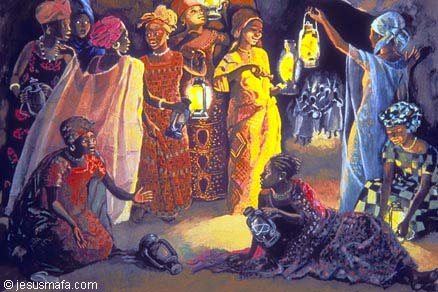 Pada zaman Yesus, seorang perempuan yang belum menikah harus tinggal dengan ayah dan keluarganya. Hanya saat dia menikah, dia akan pindah ke rumah suaminya. Peralihan dari keluarga asalnya ke keluarga barunya ini dilambangkan oleh perarakan pernikahan yang melibatkan hampir semua orang di desa. Pengantin laki-laki akan menjemput sang istri dari rumah ayahnya, dan bersama-sama mereka diarak kembali ke rumah pengantin laki-laki di mana biasanya perayaan pernikahan diadakan. Untuk alasan praktis, perarakan berlangsung setelah matahari terbenam, dan dengan demikian, pria dan wanita yang terlibat dalam perarakan harus membawa obor atau pelita mereka.
 Reading this Sunday’s Gospel, I feel that Jesus is reprimanding His priests and ministers for “preaching and yet not practicing.” Unfortunately, many of us are failing in this matter. We preach forgiveness, but some priests are having prolonged quarrels with other co-priests and some of their parishioners. We teach kindness and friendship of God, yet some of us appear to be aloof and snobbish. We proclaim justice, but sometimes we fail to be just to the simple people working in the parish or convent.
 Membaca Injil Minggu ini, saya merasa bahwa Yesus menegur para imam dan pewarta sabda-Nya karena “mengajarkannya tetapi tidak melakukannya.” Sayangnya, banyak dari kita gagal dalam hal ini. Kita memberitakan pengampunan, namun beberapa imam hidup dalam pertengkaran berkepanjangan dengan rekan imam lainnya atau dengan beberapa umat mereka. Kita mengajarkan kebaikan dan persahabatan dengan Tuhan, namun beberapa dari kita tidak pernah tersenyum dan tampak sombong. Kita memberitakan keadilan, tapi terkadang kita gagal memberi keadilan kepada mereka yang bekerja di paroki atau biara.
 In Medio Ecclesiae