

Easter Sunday [April 19, 2019] John 20:1-9

Mary Magdalene is a female disciple that loves her Teacher deeply, and being a woman, there is something that she teaches us. Luke describes her in his Gospel as a woman “from whom seven demons have come out” [see Luk 8:2]. It must be a terrible experience to be tormented by seven demons, and when Jesus heals her, she expresses her deep gratitude by following Jesus. As one of Jesus’ disciples, she is proven to be the most faithful to her Teacher. When many followers of Jesus are running away to save their lives, and even Peter, the leading figure in the group, denies Jesus, Mary follows Jesus in His way of the Cross to the end. She received the insult Jesus receives, she bears the humiliation Jesus bears, she carries the cross Jesus carries. In fact, she is standing beside the cross together with the mother of Jesus and John the beloved.
However, Mary’s love is even bigger than death. She is the first person who visits the tomb early in the morning. We recall that after Jesus died on the cross, his body was hastily brought to the tomb by Nicodemus and Joseph Arimathea because the Sabbath was drawing near. During Sabbath, Jews are not allowed to bury the dead. Mary knows that Jesus’ body was not taken care of properly, and she wants to make sure that Jesus deserves the proper burial. She comes to the tomb to express her love for the last time for the Teacher by anointing the body of Jesus. Yet, she only sees the empty tomb. Fear seizes her. She may think that some bad guys stole, inflicted further damages and desecrated the body. Instinctively, she runs towards the men of authority after Jesus Himself, Peter and John.
After checking the tomb, Peter fails to understand, and he goes back to the house. She also does not understand and weeps for the loss of her love, but unlike Peter, Mary stays at the tomb. In utter confusion and meaninglessness, Mary does not abandon Jesus. Indeed, the Savior does not disappoint and gives Mary Magdalene a singular privilege to witness the resurrected Jesus. Her great love and fidelity lead her to the joy of Resurrection. She becomes the first preacher of Resurrection.
In the Gospel, often female disciples are depicted as a model of love and perseverance. God created man and woman as equal in dignity, but they differ in characters. Indeed, men like Peter, are the figures of authority, but women excel in what often is lacking in male disciples. I have visited many places in Indonesia and the Philippines, and I give talks and reflections, but one thing in common from these places, is that women often outnumber the men. I am newly assigned in Redemptor Mundi Parish, Surabaya, Indonesia, and a simple gaze will prove that more women are attending our daily morning masses.
Mary Magdalene, a woman disciple, shows to us that it is possible to love and to be faithful when things got tough and rough, when life throws us its trash, and when confusion and meaningless seem to reign. Mary is those women who unceasingly pray for the priests despite so many failures they have made Mary are those mothers who make daily sacrifices for their children despite being unappreciated. Mary is those religious sisters who serve the poor committedly despite many setbacks and trails. We must thank many Mary Magdalene around us. They show us that there love truly conquers death and that there is a resurrection in even the senseless empty tomb.
Happy Easter!
Deacon Valentinus Bayuhadi Ruseno, OP
 Maria Magdalena adalah seorang murid perempuan yang sangat mencintai gurunya, dan sebagai seorang wanita, ada sesuatu yang dia ajarkan kepada kita. Lukas mengatakan dalam Injilnya bahwa Maria adalah sebagai seorang wanita “yang darinya tujuh setan keluar” [lihat Luk 8:2]. Pastinya merupakan pengalaman yang mengerikan untuk disiksa oleh tujuh setan, dan ketika Yesus menyembuhkannya, ia mengungkapkan rasa terima kasihnya yang mendalam dengan mengikuti Yesus. Sebagai salah satu murid Yesus, ia terbukti paling setia kepada gurunya. Ketika banyak pengikut Yesus melarikan diri untuk menyelamatkan hidup mereka, dan bahkan Petrus, tokoh utama dalam kelompok itu, menyangkal Yesus, Maria mengikuti Yesus dalam jalan Salib-Nya sampai akhir. Dia menerima penghinaan yang Yesus terima, dia menanggung malu yang Yesus tanggung. Bahkan, dia berdiri di samping salib bersama dengan ibu Yesus dan Yohanes yang terkasih.
 Seminggu yang lalu, tiga gereja di Surabaya, Indonesia diserang oleh para pelaku bom bunuh diri. Ketakutan segera memenuhi hati saya karena lokasi pengeboman tidak jauh dari komunitas Dominikan di Surabaya. Beberapa teman baik saya juga berasal dari Surabaya, dan mereka mungkin terluka karena ledakan bom. Namun, saya bisa bernapas lega setelah mengetahui bahwa mereka aman, tetapi bagian dari hati saya tetap sangat terluka karena banyak orang, baik umat Kristinani dan Muslim, polisi, warga biasa, dan bahkan anak-anak, menjadi kurban. Mereka adalah orang-orang yang dipenuhi harapan dan impian mereka, kisah dan iman mereka, dengan keluarga dan teman-teman mereka. Namun, serangan brutal itu langsung menghancurkan semuanya. Hari ini, kita bisa bertanya pada diri sendiri: Apa artinya merayakan Pentekosta, hari raya pencurahan Roh Kudus, di dunia yang dipenuhi rasa takut dan kekerasan?
 We normally do not want to part away from the people we love. The emotional bond that has grown makes it difficult and painful for us to be away from the persons whom we love. Parents do not want to be separated from their children. Couple hates when they have to be far from each other. Friends cry when they have to go separate ways.
 Kita biasanya tidak ingin berpisah dari orang-orang yang kita cintai. Ikatan emosional yang telah terbangun membuat kita sulit untuk menjauh dari mereka yang kita cintai. Orang tua tidak ingin terpisahkan dari anak-anak mereka. Sepasang kekasih benci ketika mereka harus jauh dari satu sama lain. Kita sedih ketika mereka harus berpisah dengan sahabat kita.
 We are living in the part of the world that violence and death have become our daily consumption. Every day, people’s lives are forcibly snatched away for unbelievably trivial reasons. Parents kill their babies. Brothers murder their brothers. Friends manipulate and sell their friends. Some of us used to go down on the street and cry for justice. Yet, many of us are just busy with daily pressing concerns like works, study and chores. We become numb or blind to the soil that has been painted red by the blood of our brothers and sisters. The life, precious in the eyes of God, turns out to be cheap at the hands of men.
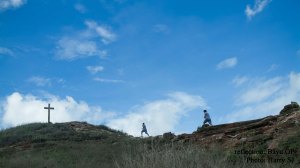 If Jesus is a carpenter, why does He speak about the vine in today’s Gospel? Does He have the competency to draw wisdom from a field that is not His expertise? We recall that Jesus grows and lives in Galilee, and in this northern region of Israel, the land is relatively fertile and agricultural industry is thriving. Some archeological findings suggest that in Nazareth, despite being a small village, the community members are engaged in small time farming, grapes press, and winemaking. A young Jesus must have been involved with this farming activities and perhaps even helped in a nearby vineyard. Thus, Jesus does not hesitate to teach wisdom using the imageries coming from the agricultural settings, like parables related to the vineyard (Mat 20:1-16), planting seeds (Mat 13:1-9), wheat and weed (Mat 13:24-30), and harvest (Mat 9:35).
 Jika Yesus adalah seorang tukang kayu, mengapa Ia berbicara tentang pokok anggur? Apakah Dia memiliki kompetensi untuk mengajar dari bidang yang bukan keahlian-Nya? Kita ingat bahwa Yesus tumbuh dan hidup di Galilea, dan di wilayah utara Israel ini, tanahnya relatif subur dan industri agrikultur cukup berkembang. Beberapa temuan arkeologi menunjukkan bahwa di Nazaret, meskipun adalah desa kecil, penduduknya terlibat dalam pertanian skala kecil, dan juga pembuatan anggur. Sebagai penduduk Nazaret, Yesus muda sedikit banyak terlibat dengan kegiatan pertanian ini, dan mungkin pernah membantu di kebun anggur terdekat. Karena pengalaman hidup ini, Yesus tidak ragu untuk mengajarkan kebijaksanaan menggunakan citra-citra yang berasal dari dunia agrikultur, seperti perumpamaan yang berhubungan dengan kebun anggur (Mat 20: 1-16), menanam benih (Mat 13: 1-9), gandum dan lalang (Mat 13: 24-30), dan panenan (Mat 9:35).
 In Medio Ecclesiae