

Fourth Sunday of Easter [A]
May 3, 2020
John 10:1-10
Today is the fourth Sunday of Easter and 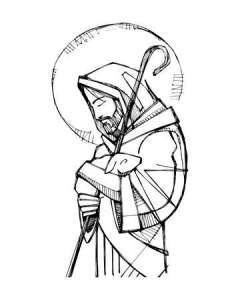 traditionally it is also called as the Good Shepherd Sunday. This is for an obvious reason. The Gospel reading tells us about Jesus who introduces Himself as the gate of the sheepfold and the Good Shepherd. The other readings also point the image of God as the good shepherd, like the world-renown psalm 23, “the Lord is my shepherd.”
The gospel of John has no parables like the other three gospels, but John has something else. The gospel gives us the seven “I AM” statements. “I am the bread of life.” (John 6:35, 41, 48, 51); “I am the light of the world.” (John 8:12); “I am the door of the sheep.” (John 10:7,9); “I am the resurrection and the life.” (John 11:25); “I am the good shepherd.” (John 10:11, 14); “I am the way, the truth, and the life.” (John 14:6); “I am the true vine.” (John 15:1, 5). These statements reveal the particular ways Jesus relates with us His disciples. If Jesus is the bread of life, we cannot live without consuming Him. If He is the light, we cannot see and find our way home.
When Jesus proclaims that He is the door of the sheep and the good shepherd, this assumes that Jesus treats us as His sheep. The question is why sheep? Why not cuter animals like Persian cats or Shih Tzu? Why not something useful like German shepherd or horse? Ok, sheep can be useful also as farm animal. Lamb and mutton are one of the finest meats, and the wool can turn to be expensive cloth. But, does Jesus consider us as sheep because our cuteness or usefulness?
Together with goats, sheep is are one of the domesticated animals. Humans have farmed sheep for the last ten thousand years. In the Palestine at the time of Jesus, sheep is a very common animal, and despite working as carpenter, it is not difficult for Jesus to observe the life of shepherd and its flocks. What makes sheep different from goat is that sheep has no built-in self-defense mechanism. Unlike the goats, they are equipped by sturdy horns and can be aggressive when attacked. Sheep are basically defenseless and thus, they depend heavily on the shepherds to protect them.
We might raise our eyebrow and reject the idea that we are helpless like the sheep. Afterall, humans are on the top of animal kingdom because our intelligence and physical prowess. Indeed, this is true, if we only limit ourselves to biological or natural aspect of our humanity. If we consider our spiritual life, we are no better than a sheep. Without God’s protection and His angels’, we are just punching bags of the evil spirits. Without God’s laws and guidance, we do nothing but harm ourselves. More importantly, without God, we cannot be saved.
In the final analysis, borrowing the words of Bishop Robert Barron, Christianity is the religion of salvation, and not self-help. No matter good we are, we cannot reach heaven without God’s grace. Our actions are only meaningful as far as it is aided by God’s love. The image of the sheep leads us to humble and grateful realization of who we are. We are nothing without God, yet no matter spiritually weak and defenseless we are, God remains faithful to us and will lead the green pasture because He is our Good Shepherd.
Valentinus Bayuhadi Ruseno, OP
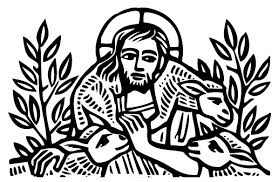 Hari ini adalah hari Minggu Paskah keempat dan secara tradisional juga disebut sebagai Minggu Gembala yang Baik. Bacaan Injil berbicara tentang Yesus yang memperkenalkan diri-Nya sebagai pintu gerbang domba dan juga Gembala yang Baik. Mazmur tanggapan diambil dari mazmur 23 yang menyatakan bahwa “Tuhanlah gembalaku.” St. Petrus dalam Suratnya mengatakan bahwa kita adalah domba-Nya yang hilang, tetapi sekarang telah kembali kepada Yesus sang Gembala [lih. 1 Pet 2:25].
 The two disciples went back home to Emmaus. One of them was Cleopas, and his companion probably was his wife. Perhaps they got afraid of the Roman and Jewish authorities who might go after them after they killed Jesus, the leader. Or maybe, they just got their hope and expectation shattered when Jesus, their expected Messiah, was crucified.
 The second Sunday of Easter is also known as the Divine Mercy Sunday. The liturgical celebration of the Divine Mercy Sunday is declared in the year 2000 by Pope St. John Paul II who had a strong devotion to the Divine Mercy revealed to St. Faustina. Though the feast itself is something recent, the truth of divine mercy is fundamental in the Bible and Sacred Tradition. If there is one prevailing character of God, it is not other than mercy. In the Old Testament, there are at least two Hebrew words that can be translated as mercy. One is rāḥam and the other is ḥeṣedh.
 Hari Minggu Paskah kedua juga dikenal sebagai Minggu Kerahiman Ilahi. Perayaan Minggu Kerahiman Ilahi ditetapkan pada tahun 2000 oleh St. Yohanes Paulus II yang memiliki devosi khusus kepada kerahiman Ilahi yang diwahyukan kepada St. Faustina. Meskipun perayaan liturgi ini sendiri adalah sesuatu yang baru, kebenaran akan kerahiman Ilahi adalah sesuatu yang mendasar dalam Alkitab dan Tradisi Suci. Jika ada satu karakter Allah yang paling penting, ini tidak lain adalah kerahiman-Nya. Dalam Perjanjian Lama, setidaknya ada dua kata Ibrani yang dapat diterjemahkan sebagai kerahiman. Yang satu adalah rāḥam dan yang lainnya adalah ḥeṣedh.
 Today is the day of resurrection. Today is the day Jesus has conquered sin and death. Today is the day of our victory. No wonder among the liturgical celebration of the Church, Easter is the grandest, the longest and the most spectacular. It is the time that the churches are flooded with the faithful. It is the time that parishioners got involved in many activities, practices, and services. It is the time when families gather and celebrate. It is the time the priests receive more blessings!
 Hari ini adalah hari kebangkitan Yesus. Hari ini adalah hari Yesus mengalahkan dosa dan maut. Hari ini adalah hari kemenangan kita. Tidak mengherankan di antara perayaan liturgi Gereja, Paskah adalah yang termegah, terpanjang dan paling spektakuler. Inilah saatnya gereja dibanjiri oleh umat beriman. Inilah saatnya umat paroki terlibat dalam banyak kegiatan, persiapan, dan pelayanan. Inilah saatnya keluarga berkumpul dan merayakan. Inilah saatnya para imam menerima lebih banyak berkat!
 Today we are celebrating the great feast of Pentecost, where the Holy Spirit, the third divine person of the Holy Spirit, comes in the form of a tongue of fire and fills the hearts of the disciples. Why do we call this day as Pentecost? Why does the Holy Spirit just come 50 days after Jesus rose from the dead?
 Hari ini kita merayakan hari raya Pentakosta, hari raya Roh Kudus yang datang dalam bentuk lidah api dan memenuhi hati para murid. Pertanyaannya yang bisa kita angkat adalah: Mengapa kita menyebut hari ini sebagai Pentakosta? Mengapa Roh Kudus datang hanya 50 hari setelah Yesus bangkit dari kematian?
