
God’s House

33rd Sunday in Ordinary Time – November 17, 2019 – Luke 21:5-9
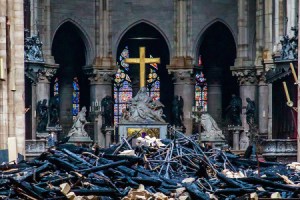
Cathedral of Notre-Dame of Paris fire aftermath, France - 16 Apr 2019During the reign of Herod the Great, the Temple of Jerusalem was refurbished, adorned by gold and other precious metals, and expanded, and thus making it the crown jewel of the Jewish nation. However, the Temple was not merely a magnificent building, but primarily the center of Jewish religious worship and religion. Every morning and evening, sacrifices were offered, and every year, Jewish men from all over the world made their pilgrimage, and paid their homage the Lord God. It was the place where God chose to stay, the place where the Israelites meet their God, and the house of God.

Looking at the majestic view of the Temple and its religious significance, many would believe that the Temple would last forever because God Himself would defend His house. Yet, Jesus prophesied against the sentiment of the Israelites and told His disciples that this beautiful Temple would be destroyed. Surely, Jesus’ words offended the religious sensitivity of His time and one of the accusations against Him was precisely because Jesus spoke against the Temple, against God Himself. Yet, 40 years later, in 70 AD, the Romans under General Titus, burned the Temple and razed the city to the ground.

Jesus’ prophesy opens us to the profound truth that even God allows His house on earth to be destroyed. Hagia Sophia in Constantinople (now Istanbul) was the grandest church in the 4th and 5th centuries and considered to be an architectural and engineering marvel. Yet, when Constantinople fell to the Turks, the church stopped functioning as a Christian worship place. In our time, the Cathedral of Notre Dame was an iconic Gothic building at the heart of Paris. Yet, on April 15, 2019, the fire destroyed many parts of this holy building. Just this month, some churches in Chile became the target of violent demonstrators. They forcefully entered the churches, took out the pews and other religious images, and burnt them outside the churches, not to mention, the desecration of the tabernacles. The houses of God have been the object of vandalism, violent anger, and untold destruction, and God allows those to take place in our midst. But why? Is God weak enough to stop these from happening? Does God not care? Has God forsaken us?

The Churches as the house of God symbolize the inner sanctuary of our faith. An attack on the Church means an attack on our cherished faith. If God allows His house to be humiliated, so God also allows our faith to be challenged, shocked, and shaken. God allows trials to batter our lives, doubts to question our faith, and darkness to envelop our vision. But why?

When the fire that burned the Church of Notre Dame was extinguished, many things have been lost, but at the center of the Church, one image survived the blazing fire: the huge cross stood still. God allows His houses destroyed, and our faith was shaken to show us what truly matters in life and our journey of faith. It is God and God alone. It is not so much the monuments we build for Him nor the works and mission for Him, even our talents, charism and fruits of prayers. These are surely important, but these easily vanish. Only one remains God alone. God allows us to be shaken so we may find Him again, surprisingly more alive and ever closer.

Valentinus Bayuhadi Ruseno, OP

Like Angels

32nd Sunday in Ordinary Time – November 10, 2019 – Luke 20:27-38

In today’s Gospel, the Sadducees attempt to test Jesus. Sadducees are a religious faction in first-century Judaism, but unlike the popular Pharisees, they only hold Torah as the only valid source of Jewish religious teachings and practices, and refuse the writings of the prophets, the wisdom books, and later traditions. One of their main doctrines is that they do not believe in the resurrection of the body. Jesus and the Pharisees though always in debate, share in a common fundamental belief in the bodily resurrection. Thus, to ridicule this kind of belief, the Sadducees are using the practice of the levirate marriage. In the Law of Moses, there is a practice to secure the bloodline and inheritance of a man who does not have any offspring. As a solution, the brothers or relatives of the deceased man will marry the widow and produce offspring on his behalf. Then, the Sadducees move to checkmate position. “In the resurrection, whose husband, this woman be?”

However, the Sadducees forget that nobody could win against Jesus in a debate. Jesus thoroughly destroys their plot by revealing what will happen in heaven: we will be like the angels. Who are these angels? Angel or “angelos” in Greek means the messenger. This points to their function, but their true nature is spirit. As a spirit, they have no physical body, and because of this, they are no longer bonded into the limitations of the body. They have no sexual desire or any desire, and therefore, they are not multiplying like humans. What attracts spirit is only a spiritual thing, and since God is the most perfect spirit [John 4:24], only God can give them perfection.

To be like angels in heaven is our destiny. One day, Mother Angelica, the founder of EWTN, talked with two men who had many titles behind their names, and they are proud of those achievements. Yet, during the conversation, they were amazed by Mother Angelica’s wisdom and serenity. She reminded them that the most important title is not what placed behind their names, but one put before their names, and this only has two letters: St. or Saint.

Our journey in this earth only makes sense if we are marching toward a destination beyond this world, and Jesus has pointed out to us that this goal is something spiritual, life like angels. Thus, it is important for us to examine our lives whether we are preparing ourselves every day to life like angels, or we keep ourselves busy with this earthly life. How we are going to prepare ourselves? We give more time to the spiritual things as well as spiritual aspects of our lives. Do we pray enough? Do we worship God often? Do we consult the Holy Spirit in our decision in our lives? Do we read Bible regularly? Do we spend quality time with Jesus? Do we help and love others sincerely?

It is important to remember that our God is the God of the living, thus our lives continue even beyond death. Thus, the kind of life we live here on earth will simply continue to the next life. If we live like an angel in heaven even now in earth, we will not have problem to adjust in the next life. Heaven starts here and now.

Valentinus Bayuhadi Ruseno, OP

Zacchaeus the Tax Collector

31st Sunday in Ordinary Time [C] – November 3, 2019 – Luke 19:1-10

zacchaeus 1In the time of Jesus, there are at least two kinds of taxes. The first tax goes to the Temple of Jerusalem. This is a “sacred tax”. Those who collect them are performing a sacred duty, and those who pay are fulfilling their due to God. Yet, the second tax is exacted by the Roman government. In order to effectively get the taxes, the Romans employs the local collaborators. The Jews are heavily burdened by this tax because they are unjustly hefty, and often collected by coercion. The Jews understandably loathe those Jewish tax collectors who willingly betray their own people and are involved in greedy malpractices. These are the worst sinners, unclean, corrupt and traitors.

Certainly, Joseph, Mary and Jesus as a poor family, are having a difficult time to pay taxes themselves, and perhaps, fall victims to greedy tax collectors. However, despite this bitter reality, Jesus has a different attitude towards tax collectors. He is known to be the friends of tax collectors and sinners [Mat 11:19]. He shares his table with tax collectors [Luk 5:30]. He presents the tax collector as the protagonist in his parable, while the Pharisee as the bad guy [Luk 18:9ff]. One of His disciples, Matthew, is used to be a tax collector before he leaves everything and follows Jesus.

Today, we listen to the story of Zacchaeus, not ordinary tax collector, but the chief. Despite his high position and richness, he is a small stature. Thus, people look down on him both in a physical and religious sense. Yet, Jesus does something remarkable: He takes the initiative to look upon Zacchaeus who climbs the sycamore tree, calls him by name, and gets Himself invited to Zacchaeus’ house. This is unthinkable: the God-man calls and enters the house of the number-one public enemy in town. We notice that Jesus does not perform any earth-shattering miracles, but Jesus’ simple and loving gesture touches deeply Zacchaeus’ heart. Right there and then, he repents and ready to repair the damages he causes. Jesus declares, “Today salvation has come to this house (Lk. 19:2).”

What Jesus does deeply disturb the minds of orthodox Jews who prefer to distance themselves from the sinners, to avoid the contamination. Thus, they jeer at Jesus. Yet, Jesus takes the opposite direction: to enter the house and share a table even with the worst kind of sinners, chief tax collector, for one reason: “For the Son of Man has come to seek and to save what was lost.” (Lk. 19:10).

The Gospel offers us two attitudes towards our brothers and sisters who are struggling in their lives. We can choose whether like the crowd, to distance ourselves, and let them rot in hell, and even discourage any effort to embrace them, or like Jesus to takes the initiative to help them, even with simple gestures. It is true that when we open ourselves, there is no guarantee that our effort will be successful, and sometimes, we will get betrayed and hurt. Mother Teresa of Calcutta took care hundreds of homeless, but some of them turned against her and threw nasty gossips, and yet Mother Teresa continued to serve till the end of her life. Jesus has made His choice, so also many of His followers, now the choice is ours to make.

Valentinus Bayuhadi Ruseno, OP

External and Internal

30th Sunday in Ordinary Time [October 27, 2019] Luke 18:9-14

pharisee n tax collectorIn Jesus’ time, they were several Jewish religious groups and one of them is the Pharisees. These are the people who love the Lord and devoutly observe the Law of Moses and the traditions of the elders even in their daily lives. Thus, Jewish people regard them as righteous because they are faithful to the Law, and pious because they pray often. Many Pharisees turn to be the caretakers of the local synagogues and zealously teach the Law during Sabbath days. No wonders, the Jewish people offer the Pharisees the best places in the worship places and the parties. The leaders are called the Rabbis or teachers.

In contrast, we have tax collectors. This is the profession that most Jews hate at least for two reasons. Firstly, tax collectors tend to corrupt by demanding more than what is due. Secondly, the tax collectors work for the Roman Empire, a gentile and oppressive nation. This makes them both sinners and unclean.

When Jesus presents these two characters in His parable, His Jewish listeners immediately see that the Pharisee is the good guy and the tax collector is the bad guy. The Temple of Jerusalem consists of several courts, from the Holy of Holies going out to the court of the Gentiles. The Pharisee as a devout and clean Israelite will pray at the inner court of the Temple, closer to the sanctuary. While the tax collector is standing perhaps at the court of the Gentiles, where the unclean people and sinners are allowed to get closer.

However, Jesus once again twists the minds of His listeners. The tax collector comes up as the hero of the story, as God hears his prayers and accepts his sincere repentance.

Before God, we are judged not so much by external appearance and social standing, but primarily by internal disposition, by faith. The Pharisee is full of himself and doing nothing but praying to himself [see verse 11]. How can a person pray to himself? He boastfully compares himself with others and puts down others. This is not a prayer, but rather a litany of self-praise. But, the tax collector in all humility recognizes himself as a sinner and asks nothing but God’s mercy.

Appearances and social standing do not guarantee our holiness, and this has a massive implication in our daily lives. We cannot simply judge that a priest who celebrates the mass, who stands on the sanctuary, is holier than an ordinary man who prays at last pew of the Church. We cannot judge a woman who visits the adoration chapel and recite the rosary every day is holier than a woman who has no time to visit the Church because she has to work hard to feed her children. We cannot judge that a man who is active in the parish is holier than a man who is inside the jail. In the first place, it is not our duty to judge others’ holiness. If we are busy judging others, we are no different from the Pharisee in the story who even prays to himself.

Valentinus Bayuhadi Ruseno, OP

Jesus, Women, and Perseverance

29th Sunday in Ordinary Time [C] – October 20, 2019 [Luke 18:1-8]

widowsThe widows are one of the most disfranchised groups in ancient Israel. In those times, women, in general, were considered to be less human. Every time a Jewish man in first-century Palestine woke up, he would pray and thank the Lord for he was not born as a Gentile, a slave or a woman. Often, women were treated as the properties of the patriarchs. While adult men were working outside the house, women were expected to stay behind to take care of the children and the household. Since many women were supported by their husbands, being a widow means loss of both financial foothold and honor. They were lucky if they had mature sons who would take care of them, but those widows without sons were the most pitiful.

However, Jesus comes to bring a fresh air of transformation. Especially, the Gospel of Luke, Jesus allows women to seize the center stage, and be protagonists. Jesus calls both men and women to follow Him and become His disciples. Jesus even allows Himself to be supported by the women [Luk 8:1]. Jesus has a close friendship with Martha and Mary [Luk 10:38-42]. Jesus places women as the main character of his parables like the story of the lost coin [Luk 15:8-10]. Today’s parable is even mind-blogging. Jesus presents a widow, representing the weakest group in the Jewish community, who is persistently pushing her cause against a corrupt judge, the most powerful person in the society. Beyond any expectation, the widow won her cause!

From this parable, we may learn several lessons. Firstly, the key to success is perseverance. While the context of our parable is on how we to pray, the value of perseverance can be applied also in many aspects of our life, like study, work, friendship, relationship, family life, and happiness. If we want to succeed, we need to be persistence and persevering. There is a saying attributed to Thomas Edison, “Success is one percent of inspiration, and ninety-nine perspiration.” Another one is by Isaac Newton, “If I have ever made any valuable discoveries, it has been owing more to patient attention, than to any other talent.” However, the problem with this view is that it is all about my persistence, my success, my glory. It is just too narrow and self-centered.

The second lesson we can draw from this parable is that Jesus empowers the women of His time and allows them to take leading roles. By doing this, Jesus introduces a wider understanding of salvation. When we encounter the word “salvation”, the first that comes to our mind is the salvation from sin, from sickness or from evil spirits. While this understanding is true, it does not capture the bigger mission of Jesus. Salvation also means to lead back into God’s original plan for the world. In the beginning, men and women were created equal in dignity despite their different roles and characters. It was because of sin that men and women were facing each other as enemies. Jesus is building the Kingdom of God, where men and women become truly the image of God. Yet, this is not easy because it is not only about our individual success and happiness. Thus, we need a lot of perseverance because if we want to follow Jesus and His mission of the Kingdom for all, we need to go even against our own selfish interest.

Valentinus Bayuhadi Ruseno, OP

Suffering and God’s Way

28th Sunday of the Ordinary Time – October 13, 2019 – Luke 17:11-19

Jesus_Mafa_Healing_of_LeperSuffering, sickness, and death do not care whether you are Jews or Samaritans, whether you are rich or poor, whether you are old or young. When it strikes, it strikes. In time of Jesus, leprosy or Hansen’s disease was still one of most dreadful sicknesses. It ate you your skin and made you ugly. It is highly contagious, and thus, cut you from your community. It was incurable and thus brought you a slow and agonizing death.

While it is true, and we thank God, that leprosy is now curable, humanity continues to battle with deadly diseases that bring untold suffering and death. When I was still in a brother in the formation, he was assigned to the hospital in Manila to be a chaplain. My duty was to accompany those people who were struggling with terrible sickness. Some were battling cancers and they had to endure painful chemotherapy. Some were having kidney failures and had to patiently undergo hemodialysis. Some were helpless victims of HIV and had to bear various complications.

I never forgot to meet one young man in that hospital. We just call him John. He was a new college graduate, and he had high hopes for his future life. Yet, all were changed when just several weeks after his graduation, he was diagnosed with cancer, stage 3. Thus, to survive he must take up severe medication like surgery and chemotherapy. In the hospital, I learned how painful chemotherapy was and there was no assurance that the treatment would succeed. In fact, it may destroy the body in the process. He lost his hair, he lost his appetite, and every time he tried to eat, he would throw up. He became terribly weak and sickly.

One day, I decided to visit him and had a little chat. I was expecting a very depressing case, but to my surprise, he said that he was doing fine and in fact grateful. Initially, I thought the medication was working, but it was not really the case. I was confused with his answer. In dealing with patients with grave sickness, the chaplains were told about the five stages of grieving: denial, anger, bargaining, depression, and acceptance. Nowhere in the process, a sick person will be grateful. Yet, John was thankful for his condition. Why?

When I asked further, I heard an unforgettable answer. He said that in his sickness and suffering, he discovered what is truly important and indispensable in his life. He learned how the love of his parents made his life more meaningful. He saw how God has given life that is simple and yet totally free. A very breath, a very heartbeat, a very memory is precious gift from God. He cannot but be grateful for simple blessings from God, despite his deadly sickness.

John teaches me that suffering is sometimes God’s way to remind us to discover what is truly essential in our life. When we are suffering, we realize our beautiful bodies are no longer important, our richness is empty, and our ambitions are just like passing air. We thank the Lord that we are not suffering like John, but we do not have to wait until we get sick, to find the essentials. The time is now and the place is here.

Valentinus Bayuhadi Ruseno, OP

Our Catholic Faith

27th Sunday in Ordinary Time [C] – October 6, 2019 – Luke 17:5-10

mustard seed n crossIf there is one most powerful force in the universe, it will be faith. Jesus teaches us that even faith as small as a mustard seed can do the impossible. Jesus preaches that with this little faith, we can command a sycamore tree be uprooted and be planted in the sea. One of the smallest things on earth can move the most significant reality in the world. The sycamore tree has both deep, strong and widespread roots. It is just impossible to uproot it when it has grown mature. Yet, Jesus surprises further even by saying that we can replant this on the bed of the ocean. That makes it doubly impossible. Jesus is pushing his teaching on faith beyond natural human reasoning!
The question is whether Jesus is merely exaggerating the power of faith, or He is unveiling the deepest of truth of faith. To answer this question, we need to know first what is faith? Surely there are several definitions of faith. In the broadest sense, it is a belief in the divine, something that is much more powerful than us, something beyond us. In many religious traditions, this transcendence is a person that is called God. This faith makes us different those who claim themselves as atheists. In narrower sense, it refers to a belief in a particular set of teachings about the divine. In this sense, the Catholic faith is different from the Protestant Lutheran faith.

St. Thomas Aquinas reminds us that faith is basically an ascent of the intellect. This is precisely what faith is mighty. It does not rely on earthly possession, nor our biological nature, nor our emotions. If we base our faith on moods, every time, we feel unhappy or depressed, and we may lose our faith. Mother Teresa of Calcutta once wrote in her diary that she did not feel the presence of God in her life for almost ten years. If she had depended on her emotion, she would have lost her faith. If we place our faith in our bodily wellbeing, the moment we get sick, or our body weakens, we may lose faith. Padre Pio of Pietrelcina received the gift of stigmata and had to endure the excruciating pain of the crucifixion for more than 50 years. Had he relied on his body, he would have lost his faith long time ago.

It is the ascent of the intellect that makes faith unbelievably powerful. When I was ordained to both to the diaconate and to the priesthood, especially during the most essential part of the ceremony, the laying of bishop’s hands on my head, I confess that I did not feel anything but a little pressure on my head. Does it mean my ordination invalid? Fortunately, the validity of my ordination is not based on my feelings! It is the faith, my faith, my bishop’s faith, the faith of the people, the faith of the Church. It is the faith that allows the unseen, unfelt grace of God to transform my soul into a soul of Jesus, the priest.

Our Catholic faith is indeed the mustard seed that moves a mountain. It is the faith that make our ears to hear the Word of God in the ordinary pages of the Scriptures. It is the faith that opens our minds to see the Body of Christ in a small tiny bread. It is the faith that encourages us to be humble before God and confess our sins before a priest. It is the faith that empowers many Christians to persevere in persecutions and to readily give their blood for Jesus. It is the faith that enables us to sacrifice our lives for others and to love the end.

Valentinus Bayuhadi Ruseno, OP

Rich Man and Lazarus

Reflection on the 26th Sunday in Ordinary Time [C] – September 29, 2019 – Luke 16:19-31

LazarusOnce again, we listen to one of Jesus’s most remarkable stories. There is a rich man, and this guy is insanely wealthy. He is described as someone clothed with purple and fine linen. In ancient time, fine purple linen is an utmost luxury, and usually only nobilities could afford to buy this kind of cloth. Before the coming of synthetic coloring, purple dye is coming from snails of Mediterranean Sea, and it takes thousands of snails just to dye one ordinary garment. This rich guy is also throwing party every night. At the time of Jesus, where majority must toil to earn a little and to have something to eat, to enjoy feast every night is madly extravagant. At that time, fork, knife, and napkins were not common; thus, people are eating with their hands. In very wealthy houses, they will cleanse their hands by wiping them on hunks of bread that will be thrown away. These are pieces of bread Lazarus longs to receive.

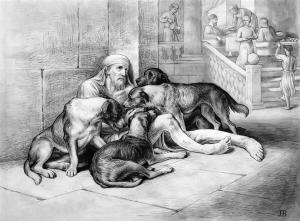
Lazarus is a Latinized form of Eleazar, meaning “God is my help.” Yet, it seems that he does not get much help from the Lord during his lifetime. He is a beggar, and as one living with terrible hygiene, skin diseases come and plague his body. Even the dogs are licking his wounds. He is now no different from a dog! However, God is just and gives His help to Lazarus in his death. He is brought by the angels to Abraham’s bosom to receive comfort, while the superrich guy is thrown to hell.

This is a powerful story that reminds us that apathy can send us to hell. The rich guy possesses tremendous amount of wealth, and yet he closes his eyes on his brother who is greatly in distress. A deeper root of apathy is just our selfishness. We only care about ourselves. We notice how the rich guy in hell asks Lazarus to quench his thirst, his immediate need. Then, the rich guy suddenly remembers that he has other brothers and he wants Lazarus to warn them. It might be a hint of empathy, but it can be the sign of deeper selfishness. He wants only those close to him are saved. He never utters any single word of sorry to Lazarus, for being too cruel. Fr. Richard Rohr, a Franciscan spiritual writer, once says, “The ego hates losing – even to God.”

God hates apathy because apathy is directly opposed to His mercy. The word Mercy in Latin is Misericordia, and it means the heart of those who are suffering. In the Bible, if there is one thing that always moves God, it is when someone begs for mercy. Pope Benedict XVI reminds us that God is mercy, and He cannot be but merciful. Thus, apathy is simply against God; it is a rejection of heaven.

Surely, we do not have to solve all the problem of the world; neither do we have to become the wealthiest guy in the world to care for others. We just need to look outside ourselves, outside our gadgets, outside our social media, outside places and people that give us comfort. Perhaps, our kids need someone to talk with, someone who can listen without judging. Maybe, the person beside us is having a bad day, and our little smile may help significantly. After all, Mother Teresa of Calcutta once said, “We shall never know all the good that a simple smile can do.”

Let us make our mission today to say a kind word and do a kind deed to someone who needs it. As Mother Teresa once again says, “Kind words can be short and easy to speak, but their echoes are truly endless.”

Valentinus Bayuhadi Ruseno, OP

Dealing with Mammon

25th Sunday in Ordinary Time [C] – September 22, 2019 – Luke 16:1-13

money for othersThere is something strange in our Gospel today. Jesus is praising the cunning steward. Why does Jesus commend his shrewd action? To understand Jesus’ words, we need to comprehend first what really takes place with this servant and his master.

There is a steward who had been entrusted by his master to take care of his master’s house and possession, and yet, instead doing his job, he prefers to squander his master’s wealth and betrays his master’s trust. Angered master does what he is expected to do. He fires his useless servant. Yet, upon this impending judgment, the servant realizes that he is not able to dig, meaning he cannot labor in the farmland or at the construction sites. He is also ashamed to become a beggar. Then, he engineers a way out. He calls all his master’s debtors and cut into half all their debts by manipulating their letter of agreement. By doing this, he is doing a favor to them and making them as their friends. This is to secure way to survive after his expulsion. Surely this is manipulation and corruption, and yet he is praised for doing so. What’s going on?

Jesus gives us an example of how smart the children of this world manage their affairs. In the time of crisis, the wicked servant is able to discern well what is most important in his life, that is his survival. For a while, the servant is attached to the wealth of his master and spending them as if this money is his. But, when he realizes he is in the great trouble, he makes the right choice. He detaches himself from his addiction from wealth and make them as a means to achieve his survival. Jesus then compares the children of this world, and the children of light. If the children of this world can use and manipulate the material possession for their earthly motives, so the children of light shall use the same wealth to attain even a loftier goal.

This teaching of Jesus is important and massive implication. We are not only allowed, but even encouraged to use the material goods and wealth in order to reach heaven. Jesus even uses a stronger term: make friends for yourself with dishonest wealth! Surely, it does not mean we can buy heaven, or we can bribe God! We cannot never do those things. These material possession and money serve us as means to live decent lives, help each other and worship God.

The problem is that we, the children of light, are not friends with wealth. We either hate money or we love money. Firstly, some of us may have a perspective that money is evil, dangerous and leading to sin. Thus, when we hate money, we detest also those who have money. The hatred of money may lead to hatred of others, and we may fail to fulfill Christ’s commandment: to love one another. Secondly, many of us love money. We are attached to earthly wealth that we forget their true purpose. We make means into the end, and end into the means. We turn our family, friends, employees, religion, even God as tools to gain more and more money. It is a disheartening reality nowadays that some people create new religions and churches to enrich themselves. We are only to love God and to love each other for the love of God, but never money. We make friends with earthly wealth in order for us to gain heaven.

Valentinus Bayuhadi Ruseno, OP

Tuhan dan Mamon

Minggu Biasa ke-25 [C] – 22 September 2019 – Lukas 16: 1-13

wealth growingAda sesuatu yang aneh dalam Injil kita hari ini. Yesus memuji pelayan yang curang itu. Mengapa Yesus memuji tindakan cerdiknya? Untuk memahami kata-kata Yesus, kita perlu memahami terlebih dahulu apa yang sebenarnya terjadi dengan hamba ini dan tuannya.

Ada seorang hamba yang telah dipercayakan oleh tuannya untuk mengurus rumah dan kepemilikan tuannya, namun, alih-alih melakukan pekerjaannya, ia lebih memilih untuk menghambur-hamburkan kekayaan tuannya dan mengkhianati kepercayaan tuannya. Tuannya tentu menjadi marah. Dia memecat hambanya yang tidak berguna itu. Namun, sebelum ia diusir oleh tuannya, sang hamba menyadari bahwa ia tidak dapat menggali, yang berarti ia tidak dapat bekerja di tanah pertanian atau di pekerjaan bangunan. Dia juga malu menjadi pengemis. Lalu, ia merekayasa jalan keluar. Dia memanggil semua orang yang berhutang pada tuannya dan menghapuskan sebagian dari  utang-utang mereka dengan memanipulasi surat perjanjian mereka. Tentunya, orang-orang ini senang hutang mereka berkurang. Dengan melakukan ini, sang hamba melakukan hal menguntungkan bagi dia dan para pengutang, dan menjadikan mereka sebagai teman mereka. Dan jika diusir oleh tuannya, dia memiliki teman untuk menampungnya dan dia bisa bertahan hidup. Sejatinya ini adalah sebuah manipulasi dan korupsi, namun ia malah dipuji karena melakukannya. Apa yang sebenarnya terjadi?

Yesus memberi kita hamba yang cerdik ini sebagai sebuah contoh tentang seberapa pintarnya anak-anak di dunia ini mengelola urusan mereka. Di masa krisis, hamba yang jahat mampu membedakan dengan baik apa yang paling penting dalam hidupnya, yaitu kelangsungan dan masa depan hidupnya. Pada awalnya, hamba terikat pada kekayaan tuannya dan menghambur-hamburkannya seolah-olah uang ini adalah miliknya. Tetapi, ketika dia menyadari bahwa dia berada dalam kesulitan besar, dia membuat pilihan yang tepat. Dia melepaskan diri dari kecanduannya dari kekayaan dan menjadikannya sebagai sarana untuk mencapai kelangsungan hidupnya. Yesus kemudian membandingkan anak-anak dunia ini dengan anak-anak terang. Jika anak-anak di dunia ini dapat menggunakan dan memanipulasi kepemilikan materi untuk motif duniawi mereka, anak-anak terang pun seharusnya menggunakan kekayaan yang sama untuk mencapai bahkan tujuan yang lebih tinggi.

Ajaran Yesus ini memiliki implikasi penting dan masif. Kita tidak hanya diizinkan, tetapi bahkan didorong untuk menggunakan barang-barang materi dan kekayaan untuk mencapai surga. Yesus bahkan menggunakan istilah yang lebih kuat: ikatlah persahabatan dengan mempergunakan kekayaan! Tentunya, itu tidak berarti kita dapat membeli surga, atau kita dapat menyuap Tuhan! Kita tidak bisa melakukan hal-hal itu. Kepemilikan materi dan uang ini ada sebagai sarana untuk hidup yang layak, membantu sesama dan menyembah Tuhan.

Masalahnya adalah kita, anak-anak terang, tidak tahu berteman dengan kekayaan. Ada dua ekstrem: entah kita benci uang atau kita cinta uang. Pertama, beberapa dari kita mungkin memiliki perspektif bahwa uang itu jahat, berbahaya dan sebuah godaan untuk dosa. Jadi, ketika kita membenci uang, kita membenci juga mereka yang punya uang. Kebencian terhadap uang dapat menyebabkan kebencian terhadap orang lain, dan kita bisa gagal memenuhi perintah Kristus: untuk saling mengasihi. Kedua, banyak dari kita cinta uang. Kita terikat pada kekayaan duniawi bahwa kita melupakan tujuan sejati kita. Kita membuat sarana menjadi tujuan, dan tujuan menjadi sarana. Kita menjadikan keluarga, teman, karyawan, agama, bahkan Tuhan kita sebagai sekedar sarana untuk mendapatkan lebih banyak uang. Adalah kenyataan yang menyedihkan saat ini bahwa beberapa orang membuat agama dan gereja baru untuk memperkaya diri mereka sendiri. Kita hanya mencintai Tuhan dan mencintai sesama demi cinta Tuhan, tetapi tidak pernah uang. Kita berteman dengan kekayaan duniawi agar kita mendapatkan surga.

Valentinus Bayuhadi Ruseno, OP