

29th Sunday in the Ordinary Time [October 21, 2018] Mark 10:35-45
Whoever wishes to be first among you will be the slave of all. (Mk. 10:44)
 “Power tends to corrupt, and absolute power corrupts absolutely.” This familiar adage comes from an English noble, Lord Acton in his letter to Bishop Mandell Creighton in 1887. Lord Acton observed that people who possessed absolute control over other persons were inclined to abuse their power and exploit their subjects. This happens throughout human history. Jesus and His disciples themselves witnessed these corrupt powerful leaders during their time and eventually, became victims of this corruption.
We recall how Herod the Great commissioned his army to slaughter all the babies under two years old in Bethlehem. He was having a paranoia that a baby born in this town of David would overthrow him from power someday. Herod Antipas, a son of Herod the Great, ordered the beheading of John the Baptist. This was done just to pacify the anger of his whimsical yet anti-critic wife. A Jewish historian, Josephus, narrated how Pilate, the Roman procurator, ruled Judea with iron and bloody hand. He commanded the crucifixion more than two thousand Jews during his brief stint in Jerusalem. With absolute power in their hands, human lives become so cheap. The only thing that matters is how they remain in power.
Ironically, despite witnessing those horrible events, James and John, as well as the rest of the disciples remain obsessed with power. James and John wish that they sit at the right and left hands of Jesus when His kingdom comes. The throne is the symbol of power. We are familiar with box-office hit “Game of Thrones.” This TV series is about people who are struggling to sit on the Iron Throne of the Seven Kingdom. And just any game, the different characters use various strategies, including deceit and deceptions to capture this throne. Friends and foes are the ones and the same. Enemies turn to be friends, and allies kill each other. If they cannot be on that throne, at least, they can be next to that seat of power.
Why do we want power so much? It is because, with power, we are in control. When we are in charge, we have this sense of independence and pride. When autonomy is within our grasp, we cannot but feel good about ourselves. The opposite is also true. When we lose control, we feel terrible. Powerlessness is just awful. Thus, the more power we have, the better we feel. However, this is a mere illusion. No matter how powerful we are, we cannot control everything. The mere fact that we are not able to control the desire to possess power is proof how powerless we are.
Knowing well the irony of power, Jesus gives us a solution: be the servant and slave of all. A slave is a person who is under control of somebody else. In a normal situation, to be slaves are dreadful. Yet, when we have power, our decision to be slaves for others can be liberating. Jesus understands that power is not to be acquired, but to be shared. Power is to empower and not to be hoarded. Yet, it is not the same with yielding to fate, powerlessness, and desperation. Pretty the opposite, to serve and empowering others, we need to exercise our power actively. Think of Mother Teresa of Calcutta. She was just a little religious sister who did nothing but dedicated her life for the poor, the abandoned and the dying. She was far from the image of a strong and powerful leader. Yet, because she became the slave of all, she was considered to be one of the most influential and admired persons in the twentieth century. Echoing the words of Her Lord, “God has not called me to be successful. He has called me to be faithful.”
Br. Valentinus Bayuhadi Ruseno, OP
 We discover at least three instances in the Bible in which Jesus explicitly expresses that He loves someone. The first instance is that Jesus loves the young rich man who seeks the eternal life (Mrk 10:21). The second is Jesus loves Martha, Mary, and Lazarus (Jn 11:5). The third is Jesus’ love for His disciples, especially His beloved disciple (Jn 13:34).
 If there is one prayer that can change the course of world history, it is the earnest recitation of the holy rosary. In 1571, through the unceasing prayer of the rosary, a league of Christian nations called by Pope Pius V was able to stop the military advancement of the mighty Ottoman empire to western Europe in the Gulf of Patras, near Lepanto, Greece. In 1917, Our Lady appeared to three little children in Fatima, and one of her messages was to pray the rosary for the peace of the world. Through nation-wide recitation of the rosary, Austria was freed from the communist regime in 1955. In 1960, led by Catholic women marching the streets while praying the rosary, Brazil was also spared from communism.
 When I was assigned to the hospital to serve as a chaplain, I witnessed the rise of diabetic cases as well as its terrifying effects on the patients. In simple term, diabetes is a condition in a person who can no longer naturally manage their blood sugar. In more serious cases, the body loses its natural ability to heal its wounds. In the beginning, it was a small open wound, yet since the body no longer heals, the infections set in, and this leads into gangrene or the death of the body’s tissues. I accompanied some patients who were struggling with this situation and witnessed how their fingers or even foot were darkened and deformed. When the ordinary treatment no longer worked, the amputation became the only merciful option as to prevent the spread of infections. As a chaplain, accompanying these patients was one of my toughest missions in the hospital.
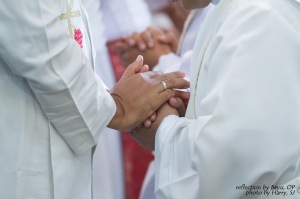 While I was reflecting on this Sunday’s Gospel, I was able to discover some news about our Church. Good News! The Catholic Church in the Philippines is preparing herself for the 500 years of the arrival of Christianity in this archipelago. The first baptism and Eucharist were taking place in 1521 as the Spanish missionaries began their evangelization mission. As part of this grand preparation, the Bishops of the Philippines have decided to celebrate this year as the year of the clergy and the consecrated persons. The major theme of this year is the renewed servant-leaders for the new evangelization. In view of this, many programs and activities are organized to help both the ordained ministers and the religious brothers and sisters to deepen their commitment to God and their service to the people.
 Several years ago, I gave a talk on the introduction to Christology to a group of young Filipino professionals who wished to deepen their spirituality. The first question I asked them as we commenced the short course was, “Who do you say that Jesus is?” The answers were varied. Some gave a dogmatic formula like Jesus is God, one quoted the Bible saying Jesus is the Word made flesh, one expressed boldly that Jesus is Savior and Lord, and the rest shared personal convictions like Jesus is their closest friend, or Jesus is their Shepherd. All these answers were right, but nobody claimed that Jesus is the Christ. Considering that our subject was Christology, we missed the basic Jesus’ title, in Greek, “Christos,” in Hebrew, “Messiah,” and translated into English, the Anointed One. Fortunately, around two thousand years ago, Simon Peter was able to spell the title when Jesus Himself asked the question.
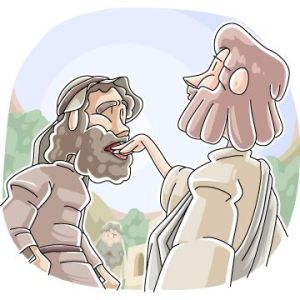 The deaf man whom Jesus heals is so blessed. He is able to see Jesus, and He finds healing. Inspired by this miracle, we wish that we will also meet Jesus and He will heal our sickness and solve our problems. Thus, we come to various places where we believe Jesus will heal us. We visit pilgrimage sites, we attend prayer and worship meetings, we recite various novenas, and we become actively involved in the Church’s organizations. We believe that our faith in Jesus will save us. However, what if our prayers are not granted? What if our problems are not solved but rather grow in number? What if our sickness is not healed, but gets worse? What if we do not feel that we are saved? One time, I visited Flora [not her real name], a colon-cancer patient, and she asked me, “Brother, I have faith in God, and I faithfully serve the Church, but why am I suffering from this terrible sickness?” Surely, it was a tough question.
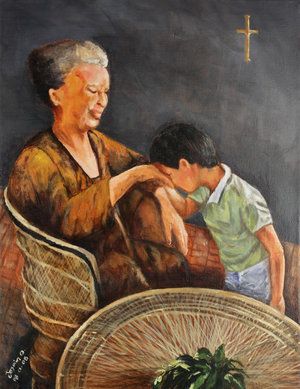 In today’s Gospel, Jesus seems to denounce all traditions. However, this position is rather simplistic and unattainable. The reason is that human beings are the creatures of traditions. Tradition comes from Latin word, “tradere”, meaning “to hand down”. Thus, crudely put, tradition is anything that has been handed down from our predecessors. Traditions range from something tangible like technologies and fashions, to something intangible like values, languages, sciences and many more. I remember how my mother taught me basic Christian prayers, like Our Father, Hail Mary, and the Rosary, and how my father would regularly bring us to the Church every Sunday. This is my family’s religious traditions. As an Indonesian living in the Philippines, I appreciate the “Mano Po” tradition among the Filipinos. This is a simple gesture of respect and blessing. The younger Filipinos are to hold a hand of older Filipino, and place it on their forehead.

 In Medio Ecclesiae