The Resurrection and the Dominican Spirituality

(Easter special)

 Easter Sunday. April 16, 2017 [John 20:1-10]

“On the first day of the week, Mary of Magdala came to the tomb early in the morning, while it was still dark, and saw the stone removed from the tomb (Joh 20:1).”
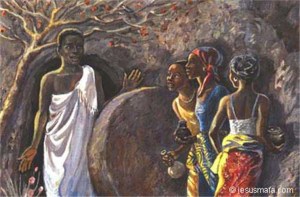
 

women at the tombIf we read the Resurrection narrative in the four Gospels, we will discover that each Evangelist has his own distinct story. Yet, there are some common features in the Resurrection episode: the empty tomb, the presence of women, the appearance of angel followed by the risen Christ, and the women announcing the Good News to the other disciples. Let us focus on one particular feature that we usually miss. The first witnesses of the resurrection were not men, but women. Where were the male disciples? Where were those men who promised to sacrifice their lives for Jesus? They were in hiding. They were afraid. They were scattered.

When Jesus was betrayed and arrested, the male disciples ran for their lives, but the women faithfully followed Jesus. They were there at the foot of the cross. They witnessed Jesus’ death. They brought Him to the tomb. They returned to the tomb to give him proper burial rites at the first day of the week. Because of their fidelity, they were honored to be the first witnesses of the Resurrection. Not only witnesses, they were the first preachers of Resurrection.

This particular feature is an essential part of the Dominican spirituality. One of the patrons of the Order of Preachers is St. Mary Magdalene, and she was chosen because we honor her as the apostle to the apostles, the preacher to the preachers. By making her our patroness, we acknowledge that the task of preaching is not exclusively limited to the members of the clergy, but to lay men and women as well. The first convent St. Dominic established was in Prouille, France, and this was a convent for religious women. For us, Preaching is a family effort, all brothers and sisters take part and contribute in the mission of naming grace.

While it remains true that only the Dominican priests can give the homily in the Mass, it does not mean that non-clerical brothers and sister can not preach. We, the brothers in formation in Manila, are involved in facilitating retreats and recollections, producing video catechesis in the social media, and are coming up with the “Joyful Friars”, a preaching band group. Our sisters are involved in the teaching ministry. Some of them, like Mary Catherine Hilkert and Helen Alford are in fact professors in great universities in the US and Europe. Our lay Dominicans serve as lay preachers or campus ministers. Yet most importantly, they preach to their children and educate them to be mature and committed Christians.

Further more, for the Dominicans, preaching is not limited to verbal communication, but also takes flesh in various forms, depending on the needs of the people. Fr. Mike Deeb, OP is currently a permanent delegate of the Order to the United States in Geneva. He challenges countries that neglect various issues of injustice like human trafficking, violence, human rights abuses, and many more. James MacMillan is a lay Dominican and a renowned composer from Scotland. He composed mass songs when Benedict XVI visited the UK in 2010. Sr. Katarina Pajchel, OP is both a religious sister and a physicist. She is involved in ATLAS project, a particle physics experiment at the Large Hadron Collider. These names are just few of many Dominicans who preach in their own right.

At the core of Dominican spirituality is the belief that each of us is called to witness to His Resurrection and to bring this Good News. Even better the news is that this spirituality is not only for the Dominicans. Every man and woman, clergy or lay, a Dominican or not, are called to this mission. We are to preach the Resurrection in our unique way. We are called to preach as a redeemed people, a family of God.

Blessed Easter!

Br. Valentinus Bayuhadi Ruseno, OP

Eli, Eli, lema sabachthani?

Palm Sunday of the Lord’s Passion

April 9, 2017

Matthew 26:14—27:66

“Eli, Eli, lema sabachthani?” which means, “My God, my God, why have you forsaken me? (Mat 27:46)”

holy week 1Many theologians and ordinary Christians alike are baffled by these words of Jesus on the cross. If Jesus is God, how is it possible for Him to be separated from God? Why does the most compassionate God abandon His beloved Son? It simply does not make any sense. The Catechism of the Catholic Church tries to explain that it is a consequence of sin. Not that Jesus had committed any sin, but He endured the sin of the world on the cross. The greatest effect of sin is separation from God. Thus, carrying the heaviest burden of sin, Jesus could not but feel the chilling effect of alienation from His own Father.

However, for early Christians and Jews who listened to the last words of Jesus on the cross, they understood that Jesus was actually reciting the beginning line of Psalm 22. The tradition considers this as a psalm of lamentation. In fact, the Book of Psalms contains a lot of psalms of lament. Despite its sorrowful nature, this kind of psalm remains true to its form, which is a prayer inspired by the Holy Spirit. Reading closely Psalm 22, we discover that the psalmist tried to express his desperate situation because of the enemies’ assault. The attack was so intense and brutal that he felt that even God abandoned him. Yet, despite the feeling of abandonment, he kept lamenting to God as if He was just near. Indeed, the psalmist was frustrated and complaining, but even this, he turned it into a prayer. Though it was the only prayer he could utter, it was an authentic prayer, without any pretension and pride. This is the paradox: when the psalmist became honest with himself and sufferings, God was closest to him.

In the cross, Jesus felt an excruciating pain both on physical and emotional levels. His triumphal entrance to Jerusalem in which He was welcomed as the King, the Son of David and Prophet, was a jubilant event, yet in a matter of days, many people who had followed Him turned to be His enemies and shouted, “Crucify Him!”. All his great successes as a preacher, teacher and wonder maker, were scattered. He was about to die as a criminal, a shame to Himself and His family. In this extreme sorrow, He decided to pray. Not any prayer, but the prayer that is most fitting to a suffering faithful Jew: a Psalm of Lament. This is the paradox of the cross: He felt abandonment and frustration, but in this prayer, this was the moment Jesus was closest to His Father.

We share also this experience of the cross in our lives. We might face terrible financial situation and uncertainty in our works. We might have health conditions that drain our resources. We might fail in our marriages or friendships. We might just lose our beloved family member. We are misunderstood and accused of wrongdoings we never committed. We might be wronged unjustly. We suddenly lose the works or the ministries we have built on for years. It seems we cannot see any light at the end of the tunnel. Yet, even in the horrifying experiences of the cross, Jesus teaches us to pray. Not any prayer, but a prayer of lamentation, a sincere prayer that expresses deepest desires, angst and pains. It is true that our situations might not change at all, but as we articulate ourselves and our situations, we are helped to find meanings, consolation, and hope. This is the paradox: in the prayer of lament, as we strip our pride and pretentiousness, even when we are in the lowest pit of our lives, God is actually closest to us.

Br. Valentinus Bayuhadi Ruseno, OP


Weep

 Fifth Sunday of Lent. April 2, 2017 [John 11:1-45]

Raising-of-Lazarus-2 Today’s Gospel contains my personal favorite verse: Then, Jesus wept. It is the shortest verse in the Bible, yet it is also one of the most powerful. However, its strength does not rest on any superhuman power that can multiply bread or calm the storm, but on the humanity of Jesus.
The death of Lazarus must have been overwhelming for the family. In the ancient Jewish society, man was responsible for the survival of the family. If presumably, Lazarus was the only bread winner, Martha and Mary would have a serious problem in surviving in that troubled and difficult times. But, more than any economic difficulty, a loss of a family member due to sickness and death had always crushed the entire family. Not only Martha and Mary were uncertain of their future, they also had to endure the terrible pain of losing someone they loved dearly, a brother with whom they shared a lot of good memories, and a friend to whom they could trust and rely on. Anyone of us who has lost a beloved family member can easily commensurate with Martha and Family.

When Jesus saw Martha and Mary were grieving and weeping, Jesus was groaned and was troubled. And when He saw the tomb, He began to shed tears as well. He did not pretend that He was Ok, or He did not appear as if nothing happened. He got affected by the overwhelming emotion and suffering, and He wept. We see today Jesus who is truly human and becomes one with our humanity with its all pains, sufferings, and grief. The revelation is that before Jesus does any miracle or sign, He first becomes part of our sorrow, our humanity. This very consoling.

We are living at a time where success and happiness are the determinants of a fulfilled life. No wonder, the books or seminars on ‘positive thinking’, ‘greatness’, ‘self-help’ or ‘success’ are mushrooming. Even we and some other churches follow suit and preach the ‘Gospel of Prosperity’. I guess there is nothing wrong with being successful and rich, all are a blessing of God. It becomes problematic when we tend to focus on the happy only emotions and suppress ‘negative’ emotions by reciting ‘positive thinking mantra’ or attending praise and worship. In the face of sufferings, failures, and loss of someone we love or we are crushed by burden of life, it is but natural to feel sorrow. Many psychologists would agree that suppression of this feeling will do more harm than good. In the animation film ‘Inside Out’, life of Riley, the main protagonist, turns to be a little mess when Sadness is pushed aside, and Joy is always at the helm. But, when Joy gives away to Sadness, things begin to fall in their places. God created Sadness also, and it is for a good purpose.

Certainly Jesus does not teach us to be melancholic, nor to dwell in our grief for eternity. He teaches us what it means to be fully and truly human, with all love, joy, sorrow, hope, fear, and anger. Our faith tells us that Jesus is not only fully divine, but also fully human, and this means that when we strive to know Jesus, not only we know more about God, but also about humanity. The more we love Jesus, the more we become truly human.

Br. Valentinus Bayuhadi Ruseno, OP


Jesus and the Samaritan Woman

Third Sunday of Lent. John 4:5-42 [March 19, 2017]

“Many of the Samaritans of that town began to believe in him because of the word of the woman (Jn 4:39)”

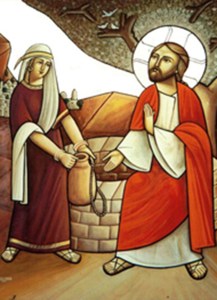
samaritan-woman-at-the-wellMany of us will see Jesus’ conversation with the Samaritan woman as something ordinary, a chat between a man and a woman. But, if we go back to the time of Jesus, we will discover it as unthinkable. This Samaritan woman embodied what the Jews hated most. Firstly, despite their common ancestry, the Samaritans and the Jews were excommunicating each other. Despite worshipping the same God, they condemned one another as religious heretics and they proclaimed their own religion as the true one. No wonder, sometimes, the encounter between the two turned violent and the Romans had to quell the riots.
Secondly, this Samaritan is a woman. The ancient Jewish society, just like many ancient cultures, placed women as second class citizens. They were treated as objects, either owned by the patriarch or the husband. They could be easily divorced by their husbands if they could not bear a child. Despite some outstanding and exceptional women due to their noble birth and wealth, women generally were discriminated from the public and religious sphere. Many could neither study the Torah nor have a voice of their own. No wonder, many Jews praised the Lord because they were born not as a woman!

However, in today’s Gospel, Jesus talked to a Samaritan woman. Not only talking, He asked for water. Not only did he asked for water, He revealed Himself for the first time as the Living Water as well as the Messiah. The conversation transformed her.  While many Jews refused to believe in Jesus, the Samaritan woman believed. Not only did she become a believer, she turned to be a preacher of faith. She spread the Good News to her townsfolk and they came to Jesus because of her. The Gospel of John narrates to us that even a Samaritan and a woman can be chosen by Jesus to be His preacher. The effects of her preaching were unprecedented. The Samaritans began to make peace with other Jews, the disciples who also believe in Jesus.

We are living in a better world. Women can enjoy the same rights that men enjoy almost in all aspects. Indonesia, a country with the largest Muslim population in the world, used to have a woman president. In the Philippines, many major positions are occupied by women, like Chief Justice, Senators, and even military general. Yet, still many women are subject to various forms of exploitation: human trafficking, prostitution, domestic violence, and abuses. Following Jesus means standing up against injustice against women.

The Gospel also points out to us that women are capable of preaching the faith. Surely, women cannot preach in the pulpit, but many of them are responsible for faith growth in many Christ-centered communities. I still remember how my mother taught me the basic prayers and the rosary. She also encouraged me as an altar server to love the Eucharist. In Indonesia, it is a practice in many parishes for priests to receive their daily meals from the people, and many women are doing their best to provide for the priests. Some religious sisters and lay women have contributed to my philosophical and theological formation, and they were great professors. Over and above these, many women have generously supported the Church and her Evangelization mission, through their resources, time, effort and prayer. From the depth of our hearts, we thank them.

Br. Valentinus Bayuhadi Ruseno, OP

The God of Transfiguration

Second Sunday of Lent (Year A). March 12, 2017 [Matthew 17:1-9]

“They were coming down from the mountain… (Mat 17:9)”

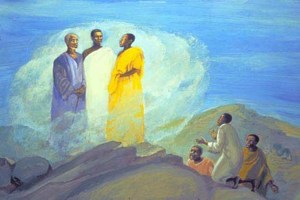
transfiguration-jesusmafa-438In the Bible, the mountain is the place where God meets His people. On Mount Horeb, Moses saw the burning bush and received his calling to lead Israel out of Egypt’s slavery (see Exo 3). On Mount Sinai, after the liberation of the Hebrews, Moses met the Lord and received the Law in the Mount Sinai (see Exo 19). Again on Mount Horeb, Elijah discovered the gentle presence of God (1 Kings 19:11-15).

Psalmists also considered the mountain as the Lord’s dwelling place (like Psa 3:5; 24:3). In fact, one of the titles of the Lord is El Shaddai, and one of its probable meaning is: the Lord, the strong mountain (Gen 17:1).

In today’s Gospel, Jesus led the three disciples up to the high mountain. There, he was transfigured. His face was shining like a sun and his cloth turned to be white as light. Then two great figures of Old Testament, Moses and Elijah appeared and conversed with Jesus. Finally, the bright cloud covered them and a voice was heard, “This is my beloved Son, with whom I am well pleased; listen to him.” The disciples were so terrified and overwhelmed. Turning back to the ordinary form, Jesus touched them and assured them, “Rise and do not be afraid.” Then they went down from the mountain and continued their journey to Jerusalem.

The Old Testament motif takes place once again in the New Testament, but looking closely, there are several striking differences. Firstly, people climb the Mountain to see God, but when the disciples were there, they saw Jesus transfigured instead. The episode becomes an early sign of Jesus’ divinity in the New Testament. Secondly, Moses and Elijah were representing the best of Old Testament: the Law and the Prophet. Yet, Moses and Elijah were also the very characters that encountered God on the mountain. They reappeared in the transfiguration because they wanted to tell us that Jesus was the God they had encountered in the mountains. Thirdly, Jesus did not stay forever on the mountain, but He went down and continued His life among His disciples and other Israelites. This is a life-changing revelation: our God does not stay and sit nicely on the high mountain, but He goes down and is staying with us, in our ordinariness of life.

Sometimes we are expecting to encounter the glorious God only on the high mountain. For some feel God in the charismatic worship meetings. Others encounter God in the great retreats and long recollections. Nothing’s wrong with these noble devotions and religious practices. Yet, the danger is that we begin to dichotomize the religious life that is limited to the church or rituals and our daily lives outside the church. We must not forget the point of transfiguration that our God is also dwelling among us. Jesus is with us in our family and our efforts in raising our children. The Lord is present in our workplaces as we toil for our daily bread. He embraces us in the moment of trials and pains. He is never far, and we are never alone. And He is our God.

 Br. Valentinus Bayuhadi Ruseno, OP

Love, not for the Fainthearted

7th Sunday in Ordinary Time (Year A). February 19, 2017 [Matthew 5:38-48]

“Love your enemies, and pray for those who persecute you, (Mat 5:44)”

john-paul-n-ali-agcaLove is not for the fainthearted. It is difficult to love, even those whom we are supposed to love naturally and easily. At times, we feel regret in having committed ourselves in marriage to someone who turns out to be moody, demanding and no longer attractive. Sometimes, we want to kick out our children who become too stubborn and rebellious. Sometimes, we also think that we enter the wrong Congregation or convent.

However, Jesus wants us to go beyond, and even love our enemies. If we have a hard time to love those who are close to our hearts, how is it possible to love our enemies? How are we going to love those who bully us in the office or in the school? Is it viable to be kind to people who spread malicious gossips about us? Why should we be nice to those who have cheated us and even exploited us? Do we need to forgive those who have abused us and left us a permanent traumatic experience?

Though it is extremely difficult to love, even almost impossible, Jesus is not out his mind when He asks us to love our enemies. He knows who we are, away better than we know ourselves. We were created in the Image of God.  St. John reminds us that God is love (see 1 John 4:8). Therefore, we were made in the image of love. It is our identity to love, and only in loving, do we find our happiness. Yet, again how do we love people we hate?

When Jesus commands to love, the Gospel deliberately chooses the word ‘agape’ for love. In Greek, Agape is slightly different from the other kinds of love like philia and eros. If philia and eros are the love that is born out of our natural affections for someone, agape basically comes from the power of the will, courage, and freedom. It is easier to love someone when we like them, but we were not created only in the image of philia and eros, we are the image of Agape. We have a built-in ability in us to love even despite the unpleasant and repugnant feelings.

St. Thomas Aquinas put in quite succinctly that ‘to love is to will the good in others’. We do not have to feel good about the person, in order to do good to the person. In the Church’s Tradition, we have various acts of charity and works of mercy, and all of these cannot be simply based on emotions. Many dioceses and parishes in the Philippines are actively helping the rehabilitation of drug-addicts in the communities. Nobody likes junkies, some even want them dead, but why do the Churchmen and women continue to help them, despite criticism? Because Jesus wants us to love them, and it is possible with our freedom to do good to them.

True love is difficult and not for the fainthearted. It demands courage, strength, sacrifice. Yet, without love, what is the point of living? Danny Thomas, an actor, and producer, said, “All of us are born for a reason, but all of us don’t discover why. Success in life has nothing to do with what you gain in life or accomplish for yourself. It’s what you do for others.”john-paul-n-ali-agca

 Br. Valentinus Bayuhadi Ruseno, OP


Surpassing the Pharisees

6th Sunday in Ordinary Time. February 12, 2017 [Matthew 5:20-37]

 “I tell you, unless your righteousness surpasses that of the scribes and Pharisees, you will not enter into the kingdom of heaven. (Mat 5:20)”

phariseeThe word ‘Pharisee’ has a rather negative connotation for us. In the Gospels, they are the bad guys. They often argued with Jesus and Jesus challenged their way of life. Even some planned to get rid of Jesus (see Mat 12:14). In our time, the term ‘Pharisaic’ simply means hypocrite.

However, if we look from another angle, the Pharisees are not that ugly. In the time of Jesus, they had important roles to play. They, in fact, revolutionized the Jewish society itself. What did they do? They brought the Law, various rituals and devotional practices from the Temple of Jerusalem to the Jewish communities and families in Israel. Many Pharisees took care of the local synagogues and made sure that the people would observe properly the Law and its traditions, like the Sabbath and rituals of cleansing. Unlike the priests who served in the Temple, the Pharisees were lay people who loved the Law in their ordinariness of life. Thus, when the Temple was destroyed by the Roman army in 70 AD, the priestly clan also disappeared, but the Jewish cultural fabrics and religion continued to live because of the Pharisees, the lay people.

Jesus criticized them not because they were following the Law and traditions, but because of their ‘interpretations’ of the Law. Doubtless, the Pharisees loved the Law of Moses dearly, but they fell into fundamentalism. They absolutized the letters of the Law and the traditions, and trivialized what or who is actually at the service of the Law: God and fellow human beings. To become a fundamentalist means we opt to follow the dead letters of the Law of the Bible, which is easier, rather than to dialogue with the Person behind it and persons in front of it.

Without realizing it, many of us are acting like the Pharisees. Like them, we love God, His Law, and His Church, but sometimes, we are too busy with the trivial things. I am sad when some people are arguing on how to receive the Holy Eucharist, kneeling, standing, by hands or directly to the mouth. Some accuse Charismatic mass as heretical. Others label the Latin Mass as ultra-conservative. I am also saddened with a young Catholic apologist who is zealously debating on the Internet, yet does not lift a finger to help his sick mother. Yes, Sacred Scripture and the Liturgy is an essential part of our faith as the exercise of the priestly office of Jesus Christ and means of salvation, but if we are disintegrated because of details of the rituals, we miss the point.

We forget to transform our love for God and His Church into love for others. St. Dominic sold his expensive books made of animal skins so he could feed the poor, and argued, “Would you have me study from these dead skins when the living skins are dying of hunger?” Who among us are involved in feeding the poor around us? Who among us are doing something meaningful to the victims of injustice in the society? Who among us have the patience towards our ‘difficult’ brothers and sisters in the family or community? Remember that we are called to surpass the righteousness of the Pharisees.

Br. Valentinus Bayuhadi Ruseno, OP


Why Salt?

5th Sunday in Ordinary Time. February 5, 2017 [Matthew 5:13-16]

“You are the salt of the earth… (Mat 5:13)”

Picture 006
Picture 006

 Jesus says that we are the salt of the earth. We note that He does not say we are ‘like’ the salt of the earth. In literature, we learn that the former is called a metaphor and the latter is a simile. The two sentences look similar, but actually, the difference is significant. Take note of the difference: I am Bayu and I am like Bayu.  The two illustrate that the usage of ‘like’ makes things different considerably. One gives us an essential connection, while the other points only to an accidental relationship.

Jesus sees that being the salt of the earth is not merely accessory, but essential and defining to the identity and mission of His disciples.  Like I cannot be Bayu in the morning and be John in the evening, so we cannot be salt on weekdays and be sugar in weekends. We are salt every second of our lives. This is what we call a vocation. Being salt is our vocation.

Ordinarily, salt is for seasoning. We hate it if the food is too salty, but we hate more if the food is tasteless. Once at our Lenten observance in my minor seminary, we ate salt-less food, and the taste was truly awful. Yet, since we were hungry, we still consumed the food. That was the moment I appreciated the importance of salt. Being salt, we are to make the difference in the world with our good deeds, yet not ‘too salty’ that we simply draw the attentions to ourselves. Again, we do good all the time, not only when others are looking at us, not only when we feel good and motivated, not only when we expect a reward.  A good mother will not do good to her children only Monday to Friday. Nor a good father will only raise his potentially successful children and abandon the rest.

However, we may ask a deeper question: why does it have to be salt? We are well aware that aside for spicing up, salt has practically no nutritional values. Even some scientists link excess salt to health problems like high blood pressure. Why not something more substantial like rice, pasta, or noodles? The answer may be simple: it is not our vocation to become the true source of sustenance and nourishment. It belongs to Jesus. That is in the Gospel of John, Jesus called Himself as the Bread of Life (Jn 6:35). In the Philippines, we have this popular bread called ‘pandesal’ (literally means bread of salt). It is a small bread made of flour, yeast, egg, sugar and salt, a bit sweet rather than salty. The amount of salt is insignificant, and yet it enhances the taste of the bread, makes it pleasurable to our senses. Yet again, salt is not the real thing, but the bread.

As salt, it is not us who give the fullness of life, but our vocation is to bring Jesus to others so that they may have the life. Our goodness, our achievement, our ministries are not to draw praise to ourselves, but through our good deeds others may feel God even more. That is who we are: Salt.

Br. Valentinus Bayuhadi Ruseno, OP

Disciples not Crowds

Fourth Sunday in the Ordinary Time. January 29, 2017 [Mat 5:1-12]

“When Jesus saw the crowds, he went up the mountain; and after he sat down, his disciples came to him (Mat 5:1).”

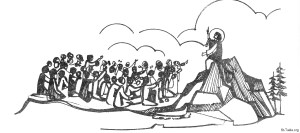
sermon-on-the-mountMatthew chapters 5 to 7 are well known as the Jesus’ sermons in the Mount. The section contains classic teachings and parables of Jesus like Beatitudes, the love for one’s enemy and the golden rule. Before Jesus began his sermon, He was sitting down. This gesture actually symbolizes the teaching authority of Jesus. On the Mount, Jesus was the teacher, and as a good teacher, He would expect people to listen attentively to His words. Thus, before Jesus commenced His sermon, He went up to the Mount to separate Himself from the crowd. Jesus knew that being part of the crowd was practically effortless and usually motivated selfishly: to be cured, to be fed and to be entertained. It could turn out to be very superficial, as a mass of people is drawn to one charismatic and powerful leader like Jesus, yet the moment its need is served or its leader is no longer satisfactory, it would be naturally disbanded.

The Sermon on the Mount was intended not for the crowd, but for a small group of people who would sit around Jesus and listen to Him carefully. These were the disciples.  Indeed, the teacher-disciples relationship is one of the most fundamental for us Christians. If we seek Jesus merely to be emotionally satisfied and economically profitable, we are just part of the crowd. And this is not our vocation. Jesus calls us into a more rooted and mature relationship with Him. He wants us to be His disciples, to listen to His teachings and follow Him.

However, to become a disciple in our time is seriously challenging. We are now part of the digital generation. We are people who hold latest iPhone or Android on our hands, access internet 24/7 and are exposed to countless TV channels. We move from one TV program to another, jump from one web to another, use one app to another, go from one entertainment to another. As a consequence, the span of attention of many people especially the young people is sharply declining. I am teaching Theology and Scriptures to young people, and I have to be always engaging and using various methods and multimedia. The moment these young ones lose their interest, they will not listen and immediately be busy with something else. Thus, no wonder that people cannot stand the boring and tedious homilies. Some choose another mass with a better preacher, some opt to look for another parish, others decide to attend worship service in other churches, and the rest find it altogether meaningless going to the mass.

Certainly, it is a challenge for preachers like myself to improve our preaching, to be more engaging and sensitive to the needs of the contemporary listeners. Yet, it is also true that we, the disciples of Christ, are invited to regain that humility and listening ears. Jesus and His Church are not a global amusement park. We come to Jesus not as crowd looking for instant happiness. Otherwise, we treat Jesus as a mere drug, and we are a kind of religious drug-addict! We pray that we continue to listen to Him even in times that we do not feel it as fun. We pray that we go beyond the crowd mentality and become Jesus’ true disciples.

Br. Valentinus Bayuhadi RUseno, OP

Capernaum

Third Sunday in Ordinary Time. January 22, 2017 [Matthew 4:12-23]

“He left Nazareth and went to live in Capernaum by the sea, in the region of Zebulun and Naphtali (Mat 4:13)”

journeyJesus began His public ministry by moving to another town in Galilee. From his hometown Nazareth to a bigger and more dense Capernaum. It was an ancient urbanization! Nazareth was small and scarcely populated, while Capernaum was one of the fishing centers in the Sea of Galilee. It was where people came, gathered, and interacted with each other. Had Jesus commenced His mission in Nazareth, probably, it would have taken more time to grow. Capernaum gave critical advantages for Jesus. It was easier to gather people, preach and attract followers. As a port city, it eased up Jesus mobility to other places in Galilee. And, Capernaum provided Jesus with shelter and other resources for His preaching. The reason for migrating was practical and yet decisive.

When St. Dominic started his Order, one of the first things he did was to send his small and fragile group of friars to big university cities like Paris and Bologna. His move was criticized as careless and dangerous. It could have swept away the infant community of Dominic. But, He insisted. “Stored seeds rot!” Dominic was actually able to think like Jesus. In bigger cities, it was much manageable not only to study, but also to preach and invite generous souls to be part of the community. Thus, Dominic made a clear instruction as he sent his brothers: “to study, preach and build community.

Our time is characterized with mega migration. Countless people move from town to another, from one country to another, and from one continent to another with ease and speed. And like Jesus, we migrate for practical cause as well as survival. We go places because of our works, our family, or our dreams. My life as a seminarian and a Dominican is also marked with constant movement. As early as fourteen years old, I left my hometown Bandung to enter the seminary in Magelang. Then, from Indonesia to Manila in the Philippines.

Going back to today’s Gospel, St. Matthew does not only see Jesus’ migration as practical solutions to His ministry, but as fulfillment of God’s promise: “the people who sits in darkness have seen a great light.” As Jesus travelled from one place to another, He brought light to others that they may see God whose Kingdom has come. Jesus immediately preached the Good News and called Andrew, Peter, James and John to His disciples. Jesus accommodated the practical and temporal things in His disposal for His mission. And He was faithful to this to the end. He used the cross, the practical means of torture and humiliation as means of presenting God’s love and salvation.

The same mission is given to us. As we move from one place to another, we bring also the light of Christ with us. Like newly-wed persons, we are called to enlighten our new families. As workers, we are to denounce what is evil in our new workplaces. As people who live on this earth, we shall take care of the creations in every land we step.   


Br. Valentinus Bayuhadi Ruseno, OP