

Seventeenth Sunday in Ordinary Time [July 29, 2018] John 6:1-15
Jesus said to Philip, “Where can we buy enough food for them to eat?” (Jn. 6:5)
 Unlike the other Gospels, the Gospel of John does not have the story of the Institution of the Eucharist on the Last Supper. However, it does not mean John the evangelist does not write anything about the Eucharist. In fact, John includes the most sublime discourse on the bread of life in his chapter 6. The chapter itself is relatively long, and the Church has distributed it into several Sunday Gospel readings (from today up to August 26). This discourse on the Bread of Life begins with the lovely story of Jesus feeding the multitude.
The story highlights Jesus’ question to Philip, “Where can we buy enough food for them to eat?” (Jn. 6:5) Philip, who seems to be familiar with the place, gives impossibility as an answer, “Two hundred denarii (or two hundred days’ wages) worth of food would not be enough…” (Jn. 6:7) Philip is just realistic, but he misses the mark. Jesus does not ask “how much,” but “where.” Perhaps, if Philip lives in the 21st century, he would direct Jesus to the nearest shopping mall! The point is that Philip would eagerly reduce the entire problem into a financial matter. Philip is not wrong because finance and economy are the backbones of our daily lives and even our survival as species, But money is not the only thing that matters. Philip will later see during the multiplication of the bread, that the “where” is pointing back to Jesus Himself. And as we will see in succeeding of chapter 6, the bread Jesus offers is not meant only for biological and economic benefits, but for eternal life.
I am currently having my clinical pastoral education at one of the hospitals in Metro Manila. One of the sacred missions entrusted to me as a chaplain is to distribute the Holy Communion to the sick. By ministering to the sick, especially through prayer and giving Holy Communion, I am reminded that the physical and biological aspects of our humanity are not the only things to be taken care of. It is true that many patients I have encountered are struggling with financial issues, like how to get the money to pay the hospital bills and expensive medicines. They have to wrestle also with their sickness that sometimes is incurable. I myself am at a loss on how to help them in these pressing concerns. However, often, the patients themselves are the ones who assure me that God will find a way, as He always does. What I do, then, is to affirm and strengthen their faith. Prayer and giving of the Holy Communion are the visible manifestations of Jesus’ real presence among us, and His presence is even more felt by the sick. Like our Gospel’s today, Jesus does not only take care of the physical aspect of our lives, but more fundamentally, He brings us to the deeper reality that our souls all long for. Paradoxically, in their hunger, they discover Jesus.
Being strong and healthy, we often forget this simple truth. Like Philip, we are more concerned with amassing wealth, attaining fame, and achieving success. Even as people serving the Church and the community, we are spending more time in organizing charity events, raising funds, and even arguing among ourselves over trivial matters. We miss the point why we are going to the Church. We miss encountering Jesus. We pray and hope that we are able to answer Jesus’ question rightly to Philip and us, “Where shall we find food for us to eat?”
Br. Valentinus Bayuhadi Ruseno, OP
 Tidak seperti Injil lainnya, Injil Yohanes tidak memiliki kisah tentang penetapan Ekaristi dalam Perjamuan Terakhir. Namun, ini tidak berarti Yohanes penginjil tidak menulis apa pun tentang Ekaristi. Nyatanya, Yohanes menulis tulisan yang paling luhur tentang roti hidup dalam bab 6 Injilnya. Bab itu sendiri relatif panjang, dan Gereja telah distribusikannya ke beberapa bacaan Injil hari Minggu (dari hari ini hingga 26 Agustus). Penjelasan tentang Roti Hidup ini dimulai dengan kisah Yesus yang memberi makan banyak orang.
 When Jesus teaches in the synagogue in Nazareth, the listeners are amazed by his wisdom. Jesus speaks like a mighty prophet. However, the people soon make a background check on Jesus, and they realize Jesus’ identity and his family background. Nazareth is a small rural town in Galilee, and everyone knows everyone in this kind of setting. The people of Nazareth know Jesus as a son of a carpenter, and himself a carpenter. They are familiar also with Jesus’ family and relatives.
 Ketika Yesus mengajar di sinagoga di Nazaret, para pendengar kagum dengan kebijaksanaan-Nya. Yesus berbicara seperti seorang nabi yang perkasa. Namun, orang-orang segera melakukan pemeriksaan latar belakang pada Yesus, dan mereka menyadari identitas Yesus dan latar belakang keluarganya. Nazaret adalah desa kecil di Galilea, dan semua penduduk saling mengenal satu sama lain di lingkungan seperti ini. Orang-orang Nazaret mengenal Yesus sebagai putra seorang tukang kayu, dan dirinya sendiri adalah tukang kayu. Mereka juga akrab dengan keluarga dan kerabat Yesus.
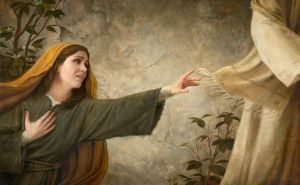 Today’s Gospel seems to be just another healing miracles of Jesus, but if we read it closely, the story of the healing of the woman with hemorrhage is extraordinary tale of faith. We are not sure what kind of hemorrhage she suffers, but the fact that she bears the sickness for 12 years, spends a lot for the medication, and does not get any better, means it is pretty serious, if not terminal. During this time, the physicians are extremely rare, and expectedly, the patients need to spend a lot of money. The woman may come from a wealthy family, but she is impoverished because her prolong sickness. The woman is losing her life and facing despair. I am currently assigned as an associate chaplain in one of the hospitals in Metro Manila, and my duty is to make pastoral visit to these patients. I encounter some patients who are suffering from certain health conditions that drain all their resources, and it seems the situation does not get any better. I realize the story of the woman with hemorrhage is not only her story happened in the far past, but it is also our stories here and now.
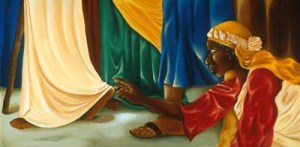 Injil hari ini tampaknya tidak berbeda dengan kisah-kisah mukjizat penyembuhan Yesus, tetapi jika kita membaca dengan seksama, kisah penyembuhan perempuan dengan pendarahan ini sebenarnya luar biasa. Kita tidak tahu dengan pasti pendarahan apa yang dideritanya, tetapi fakta bahwa ia menderita kondisi ini selama 12 tahun, menghabiskan banyak untuk pengobatan dan kondisinya semakin memburuk, ini berarti sangat serius. Pada zaman itu, tabib sangat jarang, dan berobat perlu mengeluarkan banyak uang. Perempuan ini mungkin berasal dari keluarga kaya, tetapi dia jatuh miskin karena kondisinya tersebut. Perempuan ini mulai kehilangan hidupnya dan menghadapi keputusasaan. Saya saat ini ditugaskan sebagai asisten imam di salah satu rumah sakit di Metro Manila, dan tugas saya adalah melakukan kunjungan pastoral ke pasien-pasien yang dirawat di rumah sakit tersebut. Tidak jarang saya menjumpai pasien yang menderita kondisi kesehatan yang menguras semua sumber daya mereka, dan tampaknya situasi mereka tidak menjadi lebih baik. Saya menyadari kisah perempuan dengan pendarahan ini bukan hanya kisahnya yang terjadi di masa lalu, tetapi juga kisah umat manusia di zaman ini.
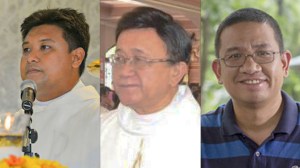 The Catholic Church in the Philippines is once again in profound grief after one of her priests was mercilessly murdered. Fr. Richmond Nilo, from the diocese of Cabanatuan was shot several times just before he celebrated the mass at a chapel in Zaragoza, Nueva Ecija. His body was laying on the floor at the foot of the image of Blessed Virgin, soaked with blood. Another disturbing and painful image. He becomes the third priest losing his life in a bloody attack in the past six months. On December 4, 2017, Fr. Marcelito Paez was ambushed in Jean, Nueva Ecija. Just a few weeks ago on April 29, Fr. Mark Ventura was also gunned down moment after celebrating the mass. We may also include Fr. Rey Urmeneta who was attacked by a hit man in Calamba, Laguna. He sustained a bullet in his body, yet he survived death.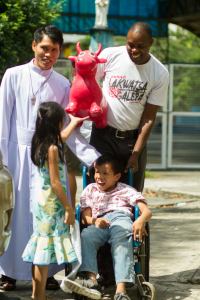
 In Medio Ecclesiae