The Faith of the Poor Widow

32nd Sunday in Ordinary Time [B]

November 10, 2024

Gospel: Mark 12:38-44

In the Gospel of Mark, Jesus commends a poor widow who gives her last two small coins to the Temple. He points out why her act is so remarkable: “Out of her poverty, she gave everything she had, all she had to live on” (Mark 12:44). Jesus admires her because, despite her extreme poverty, she displays extraordinary generosity. But there’s a deeper message here. What is it?

We need to ask, “Why is this widow poor?” In Jesus’ time, widows were among the most vulnerable, especially if they had no family to support and protect them. Because of this, God instructed the Israelites to care for widows (see Deu 14:29 and Isa 1:17). Yet, in this Gospel passage, there is a clue to why this widow has been pushed into poverty. Before praising the widow, Jesus condemns the scribes not just for seeking popularity, but for a more sinister reason, “They devour widows’ houses” (Mark 12:40).

How did the scribes take advantage of widows? There are a few possibilities:

Firstly, Abuse of Legal Authority. The scribes, experts in Jewish law, were trusted as legal advisors or trustees, especially for widows who needed help managing their affairs after their husbands’ death. Afterall, these scribes were men of God! Sadly, some of them abused this trust, using their legal knowledge to manipulate proceedings for personal gain, sometimes even committing fraud.

Secondly, Predatory Lending. Some scribes engaged in predatory lending practices. Under the guise of providing financial help, they would lend money to widows and gradually entrap them in severe debt. When the widows couldn’t repay these debts, they were forced to give up their homes and possessions, ultimately becoming destitute.

While we don’t know the exact way the widow in this story was exploited, we do know she suffered injustice. Despite this, her response is remarkable. Instead of feeling embittered or blaming God, she remains generous and devoted. Even in her suffering, she loves God with all her heart, strength, and life. Why? Because her faith rests in God Himself, not in flawed human representatives like the scribes. While people can fail or act unjustly, God does not. She believes God is watching her, and indeed, Jesus is watching her actions and recognizing her faith and sacrifice.

This story opens our eyes to harsh realities that can exist even within religious institutions. Yet, the widow’s example also teaches us how to respond to these challenges without losing our faith.

Reflection Questions:

Do we help bring people closer to God, or do we push them away? Do we use our position and knowledge to assist others or to take advantage of them? When bad things happen, do we blame God or maintain our trust in Him? Do we stand against injustice and wrongdoing within our communities and Church, or do we remain silent?

Rome

Valentinus Bayuhadi Ruseno, OP

Eucharist and Sacrifice of the Cross

31st Sunday in Ordinary Time

November 3, 2024

Hebrews 7:23-28

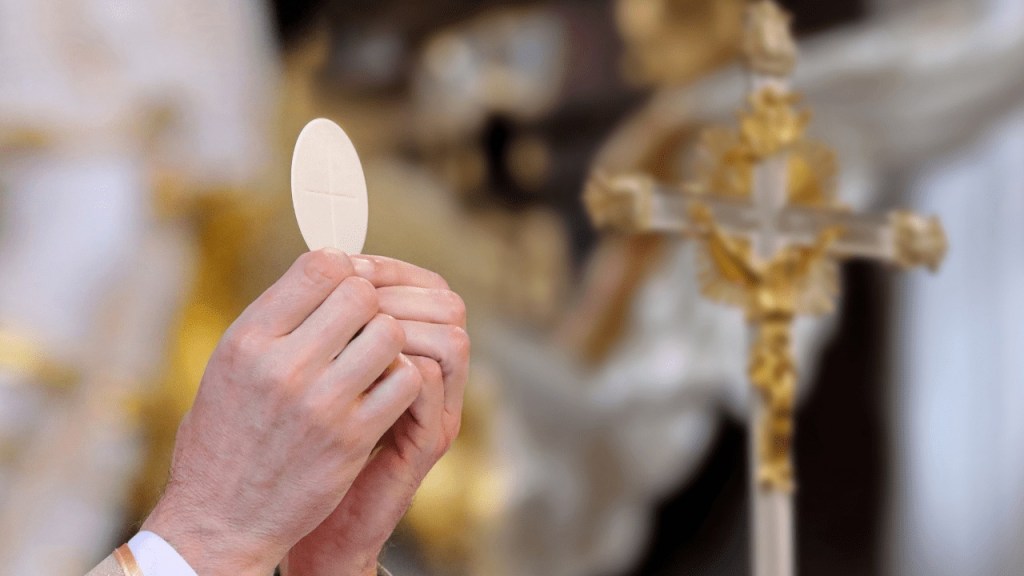
Every time we celebrate the Eucharist, we worship God by offering Him the perfect sacrifice. This sacrifice is Jesus Christ, who is truly present in the Eucharist. However, when we read the Letter to the Hebrews, its author writes that Jesus offered Himself on the cross “once and for all” (see Heb 7:27). So, why do we “sacrifice” or even “crucify” Jesus again in the Eucharist? Does this mean we misunderstand our worship?

Firstly, we need to understand the context of the Letter to the Hebrews. The author recognized that in order to worship God, a high priest must offer a sacrifice. Then, the author compares the Israelite high priest from the tribe of Levi with Jesus as the high priest. The Levitical high priest was an ordinary human and, therefore, a sinner. As such, he had to offer sacrifices repeatedly because he continued to fall into sin. Meanwhile, Jesus is truly divine and truly human, without any sin, yet sharing in our human struggles. While the Levitical high priest offered imperfect sacrifices of animals, Jesus gave Himself on the cross as the perfect and most acceptable sacrifice of love. Since the value of His sacrifice on the cross infinitely surpasses the Levitical or any human sacrifice, earthly sacrifices are no longer needed.

However, though Jesus has offered Himself once for all on earth, this does not mean He is inactive in heaven. The same letter to the Hebrews states, “…the heavenly things themselves (the heavenly sanctuary) need better sacrifices than these (earthly sacrifices)” (Heb 9:23). Entering heaven, Jesus does not cease His priestly ministry; rather, He perfects His identity by presenting an endless sacrifice. But how does He offer sacrifice without dying again on the cross? The answer is through a living sacrifice (see Rom 12:1). Jesus presents His own self—His glorious body still bearing the wounds of the cross—as a perfect gift to the Father, but this time, without further death. Since Jesus in heaven and Jesus on the cross are essentially the same, the living sacrifice He offers in heaven has the same infinite value as that on the cross.

Now, let us see what the Catholic Church teaches about the Eucharist as a sacrifice. The Catechism of the Catholic Church says, “When the Church celebrates the Eucharist, she commemorates Christ’s Passover, and it is made present: the sacrifice Christ offered once for all on the cross remains ever present” (CCC 1364). It further states, “The Eucharist is thus a sacrifice because it re-presents (makes present) the sacrifice of the cross, because it is its memorial, and because it applies its fruit” (CCC 1366). But what do these teachings mean?

This means that the Catholic Church understands the Eucharist as our participation in the heavenly liturgy. In the Eucharist, we make present the sacrifice of the cross—not by crucifying Jesus again, but by participating in Jesus’ self-offering in heaven, which holds the same infinite value as His sacrifice on the cross. Only in the Eucharist do we truly worship God and receive the fruits of the cross.

Rome

Valentinus Bayuhadi Ruseno, OP

Questions for Reflection:

How do we understand the Eucharist? Do we feel the need to participate in the Eucharist? Do we realize that, through the Eucharist, we are participating in heavenly worship? How can we deepen our participation in the Eucharist? What fruits do you receive from the Eucharist? Do you encourage your family and friends to participate in the Eucharist?

The Confession of Bartimaeus

30th Sunday in Ordinary Time [B]

October 27, 2024

Mark 10:46-52

Bartimaeus is a blind man, and his life is full of suffering. The ancient world was a cruel place to live and even merciless for people with disabilities. In some ancient cultures, babies born with physical imperfections were abandoned in the forest or thrown into the ravine. They were cursed and would bring a curse to people around them. If people with disabilities survived childhood, they grew marginalized, bullied and mocked. Bartimaeus was begging, and it was the only option left to survive. The city gates of Jericho were the ideal places because many people would traverse these passages.

However, despite being blind and poor, Bartimaeus was the first to call Jesus the son of David. The title “Son of David” is unique because several important prophecies in the Old Testament point to the Son of David. The famous one is from 2 Samuel 7, which says that God will establish the kingdom of the Son of David forever (v.13). Similar prophecies can also be found in Isaiah 9:6-7 and Jeremiah 23:5-6.

Deep in his heart, Bartimaeus knew that Jesus fulfilled the prophecies that would be the King of Israel forever. Ironically, no other disciples called Jesus with this important title. It takes a blind man to see the truth. Then, Jesus affirmed Bartimaeus’ confession and granted him the miracle of sight. The story ends with Bartimaeus following Jesus. Perhaps this is why Mark was able to write the story of Bartimaeus. He remained a follower of Jesus even after Jesus’ death and resurrection, and his name was known to the early Church.

Bartimaeus is one of the few characters who recognized Jesus’ true identity in the Gospel of Mark. The irony is that these characters are not followers of Jesus. Unclean spirits called Jesus ‘the holy one of God’ (Mr 1:24). The Roman centurion, an enemy of the Jews, acknowledged Jesus as the son of God (15:39). The Syrophoenician woman, a gentile, addressed Jesus as Lord (7:28). The only disciple who recognized Jesus’ true identity was Simon Peter when he confessed Jesus is the Christ or Messiah (8:29). Yet, Peter also failed to understand what he was confessing as Jesus rebuked him for having wrong idea of Jesus’ Messianic identity.

Through Bartimaeus and other characters, Mark gives us an important lesson. Yes, we are followers of Christ. Yes, we are baptized. Yes, we go to the Church every Sunday. Yet, it does not mean we see who Jesus is. We may confess Jesus is God, but do we love Him with all our heart, soul, and strength, or do we worship other gods like money, pleasure, and fame?  We may say that Jesus is Lord and King, but do we live according to the words and commands of our King, or do we just do whatever we want to do? We acclaim Jesus as our Savior, but do we live as someone who is saved and redeemed, or do we remain enslaved by sins?

Though Bartimaeus is physically blind, he has faith that enables him to see who Jesus truly is, and this saves him. We may have healthy physical eyes, but do we have true faith to see Jesus and follow Him?

Rome

Valentinus Bayuhadi Ruseno, OP

Jesus our High Priest

29th Sunday in Ordinary Time [B]

October 20, 2024

Heb 4:14-16

The letter to the Hebrews calls Jesus our high priest. As Catholics, we are not foreign to the word ‘priest’ since they are our liturgy or worship leaders. Yet, the author of the letter to the Hebrews does not call Jesus just as another priest but as the high priest. Why does the author of this letter address Jesus as this title? What makes a high priest different from other priests? What is it for us?

Firstly, we need to clarify the word’ priest.’ While it is true that a priest is appointed to oversee worship, he has one specific responsibility that only he can execute. In the Bible and many ancient civilizations, the most essential part of ritual worship is the sacrifice. Commonly, the sacrifice consists of offering something precious to God. In ancient agrarian societies, animals like lambs and crop yields like wheat grains may serve as sacrificial offerings. In the case of animal sacrifice, the ritual begins with the people handing the animal to the priest, and then the priest will slaughter the animal by separating the blood and the body. After this, the priest brings the animal to the altar to be burned as a symbol that God has accepted the sacrifice. In this sense, a priest serves as a mediator between God and the people.

The leader among the priests is called ‘high priest.’ The Hebrew word for high priest is כֹּהֵן גָּדוֹלkohen gadol, literally means “great priest.” In Greek, the high priest is ἀρχιερεύς, archiereus, and it can be translated as “the first priest.” Obviously, the high priest has to lead the other priests and manage the entire worship system. Yet, his fundamental function is to be the primary mediator between God and the people. Thus, only he can officiate the most solemn worship. In the Bible, only the high priest can offer the holy sacrifice on the day of atonement (Yom Kippur) and enter the holy of holies to atone for the nation’s sins (see Lev 16).

With this biblical background, we can better understand why the author of the letter to the Hebrews calls Jesus our high priest. Jesus is the supreme mediator between God the Father and us. Moreover, Jesus is far more perfect than other high priests because He is divine. Yet, Jesus is also fully human, experiencing all sufferings and various human problems and weaknesses. Because of this, He knows precisely our struggles and failures. But, most of all, our high priest also becomes the perfect sacrifice to Father as He offers Himself on the cross. Then, when we approach Jesus in humility, we can be hopeful that Jesus will accept us because He knows us, and finally, He will bring us to the Father and may receive mercy.

Questions for reflection:

How do we look at our priests in our parish/church? Do we recognize them as people who bring us closer to God? Do we know that the Eucharist is a sacrifice of Jesus Christ and, thus, our true worship of God? What sacrifice do we bring to the Eucharist? What makes us unable to approach Jesus? Shame, fear, anger, disappointment, resentment, inadequacy?

Consecrated Life

28thSunday in Ordinary Time [B]

October 13, 2024

Mark 10:17-30

The Church understands the story of Jesus and the rich man as one of the biblical foundations of vocation to consecrated life. Yet, what is consecrated life? How does this story become an inspiration for us?

The consecrated life is a radical way of life to follow Jesus. In our present time, we quickly recognize these men and women as people who wear religious habits, remain celibate (unmarried), and live inside communities like monasteries or convents. The word ‘consecrate’ here means to be separated or set aside for a particular purpose. The men and women are consecrated because they are ‘separated’ to love God more radically. But why do they have to live this kind of life? To answer this, we need to look closely at the story of Jesus and the rich man.

A man recognized that something fundamental was lacking in his life. When Jesus was coming, his heart knew that Jesus knew the answer. He rushed to Jesus and asked Him how to inherit eternal life. Jesus pointed out the commandments, especially those related to the love of neighbors (do not kill, do not steal, do not bear false witness, and honor your parents). Immediately, the man told Jesus he had been faithful to these laws. Jesus, then, looked at him intently and loved him for his courage to approach Him. Jesus knew that man had never broken the commandments, but he had also not fulfilled the first and most important commandment, “You shall love the Lord your God with all your heart and with all your soul and with all your might (Deu 6:5).”

However, Jesus did not just say this truth plainly but rather reformulated it into something more concrete and radical: “You shall love Me (Jesus) with all your heart, with all your soul, and with all your might!”  This call is radical because it required the man to abandon all that he had and walk with Jesus on His way to the cross. It is radical because Jesus’ invitation goes against the prevalent understanding of that time that to be rich is a sign of God’s blessing (see Deut 28:1–14; Prov 10:22). This is radical because all our time, energy, attention, indeed our lives, are for Jesus.

This man never killed or stole, perhaps went to synagogue every Sabbath, and occasionally went to Jerusalem to offer sacrifices at the Temple. But, deep inside, he was called to love God totally. Yet, when Jesus offered him the opportunity, he shied away because he had many possessions. Will this man be condemned? Indeed, he will not be punished and will remain the inheritor of eternal life. But he also cannot fulfill his deepest desire to love God radically.

In the present time, this radical following of Jesus manifests in men and women who totally give themselves to Jesus and the Church. These men and women do not get married, so their time may be devoted to prayers and service. They work or receive money not to be rich but simply to support their lives and ministry. Finally, they freely give up their freedom to love God and His people. Yet, the Church understands this vocation is not for everyone.

Rome

Valentinus Bayuhadi Ruseno, OP

Questions for reflections:

Do we love God totally and radically? Do we love God first, or do we love ourselves first? What hinders us from loving God? Money, wealth, professions, fame, hobby, or other things? Are we called into the consecrated life? Are we ready to answer yes to Jesus’ calling?

Why did Moses allow divorce?

27th Sunday in Ordinary Time [B]

October 6, 2024

Mark 10:2-16

The Pharisees once again put Jesus to the test. This time, they asked the question of divorce. However, Jesus did something unexpected. He ‘changed’ the law of divorce. Why did Jesus “erase” the law of divorce?

Jesus responded by inquiring about the foundation of this law of divorce. The Pharisees pointed to Moses as the source of the law as he allowed divorce by giving a certificate of divorce to the wife (see Deu 24:1). Then, immediately, Jesus fired back, “For your hardness of heart he wrote you this commandment. But from the beginning of creation, ‘God made them male and female.’” (Mar 10:5-6) Jesus made clear that divorce is not the will of God, but Moses was forced to permit it because of “the hardness of heart.” But what is this hardness of heart?

We recall that the Israelites in the time of Moses were so used to the ancient Egyptian practices including divorce. In ancient Egypt, marriage was primarily a private and cultural event, not religious. The couple themselves governed marriage. They would divorce their partner if they no longer saw their marriage viable. But divorce was not the only solution. If a man found his first wife no longer attractive, he could marry another wife without divorcing the first woman.

When God liberated Israelites from Egypt, God reintroduced His will that marriage is holy and part of God’s plan for men and women. Marriage was not just biologically or culturally driven but divinely instituted. Thus, God decreed that marriage must be monogamous and indissoluble. Yet, introducing God’s original plan to the ancient Israelites proved difficult. Indeed, the Israelites were physically liberated from Egypt, but their mentality remained enslaved. The Israelites were somehow able to accept monogamous marriage, but to add another requirement, that is, ‘no divorce’ was too much and too soon. Moses knew that the Israelites would commit more rebellions, and even men would kill their wives to get rid of them. Thus, Moses conceded that divorce should be allowed if the women were sufficiently protected through the divorce certificate.

Now, hundreds of years after Moses, God deemed the time has come to bring the original will of God into marriage. Thus, Jesus came not to ‘change’ the divorce law but to reintroduce God’s authentic will. Moreover, Jesus also brought the Holy Spirit to re-create human hearts, from the heart of stones into the heart of flesh. Now, the choice is ours. Will we follow God’s will in our lives and marriage by relying on His graces, or will we instead become stubborn and follow our own design?

Rome

Valentinus Bayuhadi Ruseno, OP

Questions for reflection

How do we understand marriage? Is it a biological necessity, social convention, or divinely instituted? How do we feel about marriage? Is it a burden, obligation, or a blessing? What do we want to achieve in marriage? Is it pleasure, welfare, comfort, or holiness? What do we do when we encounter difficulty in marriage? Do we see marriage without divorce as a curse or a path to heaven?

Mengapa Musa mengizinkan perceraian?

Hari Minggu ke-27 dalam Masa Biasa [B]
6 Oktober 2024
Markus 10:2-16

Orang-orang Farisi sekali lagi menguji Yesus. Kali ini, mereka mengajukan pertanyaan tentang perceraian. Namun, Yesus melakukan sesuatu yang tidak terduga. Dia ‘mengubah’ hukum perceraian. Mengapa Yesus “menghapus” hukum perceraian?

Yesus menjawab para Farisi dengan menanyakan dasar dari hukum perceraian ini. Orang-orang Farisi menunjuk Musa sebagai sumber hukum karena dia mengizinkan perceraian selama sang suami memberikan surat cerai kepada istri (lihat Ul. 24:1). Kemudian, Yesus membalas, “Karena kekerasan hatimu, maka Ia menuliskan perintah ini kepadamu. Tetapi sejak awal penciptaan, ‘Allah menjadikan mereka laki-laki dan perempuan’.” (Mar 10:5-6) Yesus menegaskan bahwa perceraian bukanlah kehendak Allah, tetapi Musa terpaksa mengizinkannya karena “kekerasan hati” bangsa Israel. Namun, apakah kekerasan hati ini?

Kita perlu tahu bahwa bangsa Israel pada zaman Musa sangat terbiasa dengan praktik-praktik hidup Mesir kuno, termasuk perceraian. Di Mesir kuno, pernikahan pada dasarnya adalah acara pribadi, bukan agama. Pasangan itu sendiri yang mengatur pernikahan. Mereka akan menceraikan pasangan mereka jika mereka tidak lagi melihat pernikahan mereka menguntungkan. Tapi perceraian bukanlah satu-satunya solusi. Jika seorang pria merasa istri pertamanya tidak lagi menarik, ia dapat menikahi istri yang lain tanpa harus menceraikan istri pertamanya.

Ketika Tuhan membebaskan bangsa Israel dari Mesir, Tuhan memperkenalkan kembali kehendak-Nya bahwa pernikahan itu kudus dan merupakan bagian dari rencana Tuhan bagi pria dan wanita. Pernikahan tidak hanya didorong oleh faktor biologis atau budaya, tetapi juga didirikan oleh Allah sendiri. Oleh karena itu, Allah menetapkan bahwa pernikahan haruslah monogami dan tidak dapat diceraikan. Namun, memperkenalkan rencana awal Allah kepada bangsa Israel kuno terbukti sulit. Memang, bangsa Israel secara fisik telah dibebaskan dari Mesir, tetapi mentalitas mereka tetap diperbudak. Orang Israel mungkin dapat menerima pernikahan monogami, tetapi menambahkan persyaratan lain, yaitu ‘tidak boleh bercerai’ terlalu berlebihan dan terlalu cepat bagi mereka. Musa tahu bahwa jika dipaksakan, bangsa Israel akan melakukan lebih banyak pemberontakan, dan bahkan para pria akan membunuh istri mereka untuk menyingkirkan mereka. Oleh karena itu, Musa mentolerir perceraian selama hak-hak para wanita terlindungi melalui surat cerai.

Sekarang, ratusan tahun setelah Musa, Tuhan menganggap bahwa waktunya telah tiba untuk membawa kehendak asli Tuhan ke dalam pernikahan. Oleh karena itu, Yesus datang bukan untuk ‘mengubah’ hukum perceraian, melainkan untuk memperkenalkan kembali kehendak Allah yang asli. Selain itu, Yesus juga membawa Roh Kudus untuk menciptakan kembali hati manusia, dari hati batu menjadi hati yang lembut. Sekarang, pilihan ada di tangan kita. Akankah kita mengikuti kehendak Tuhan dalam hidup dan pernikahan kita dengan mengandalkan kasih karunia-Nya, atau sebaliknya, akankah kita menjadi keras kepala dan mengikuti rancangan kita sendiri?

Roma
Valentinus Bayuhadi Ruseno, OP

Pertanyaan-pertanyaan untuk refleksi
Apakah kita berhati keras dan menolak kehendak Allah dalam hidup kita? Bagaimana kita memahami pernikahan? Apakah pernikahan merupakan kebutuhan biologis, konvensi sosial, atau sesuatu yang dilembagakan secara ilahi? Bagaimana perasaan kita tentang pernikahan? Apakah itu sebuah beban, kewajiban, atau berkat? Apa yang ingin kita capai dalam pernikahan? Apakah kesenangan, kesejahteraan, kenyamanan, atau kekudusan? Apa yang kita lakukan ketika kita menghadapi kesulitan dalam pernikahan? Apakah kita melihat pernikahan tanpa perceraian sebagai sebuah kutukan atau jalan menuju surga?

Sin and God’s Love

26th Sunday in Ordinary Time

September 29, 2024

Mark 9:38-48

Some people do not talk about sin. Some think that sins are no longer relevant in the modern world. The concept is a restriction on human freedom and creativity. Others see it as the Church’s invention to control its faithful, primarily through fear. Those who sin will be punished in hell! Others perceive that to talk about sin is incompatible with God, which is love. For some priests and preachers, the topic even becomes taboo to preach. Yet, this is all a misunderstanding. The proper understanding of sin will bring us a full appreciation of God’s love. Then how must we understand the concept of sin?

Firstly, the basic understanding of sin is a violation of God’s law, and God made His laws not to limit our freedom but rather the opposite. They are to protect us from harm, danger, and disasters. Every violation of God’s law brings catastrophic consequences. It destroys ourselves, others, and the world. Abortion kills innocent babies, destroys the holy vocation of motherhood, and treats sacred women’s bodies as mere tools. Masturbation seems less of a problem since it is something ‘personal’. But masturbation leads to mental health problems as we carve more and more dopamine (pleasure hormone) to satisfy us. Again, this causes us to see other people as mere tools to give us pleasure. By following God’s laws, we are not only avoiding harm in our lives but also walking on the path of happiness.

Secondly, sin is the contradiction of God’s love. God is love, and He loves us beyond our imagination. As divine Lover, He wills the best things happen to us, and He wills us to be united with Him as the only one who can satisfy our infinite desire. However, true love does not coerce and gives freedom to choose and love Him. Robots can obey all our orders, but there is no love since robots do not have freedom. A Labrador can abide by us and give us affectionate dog hugs, but this is not true love but a dog’s instinct to cling to his owner for survival. We have that true freedom. Unfortunately, we abuse our freedom to choose something much lesser than God and, thus, violate His laws. Therefore, sin is a radical choice to turn away from God. Hell is not God’s punishment but rather our decision to be separated from God, our true happiness.

Therefore, reading the Gospel, we immediately recognize that if there is one thing that Jesus hated the most, it is sin. He knows well what sin is and what it does to us humans. Adam and Eve sinned, and they brought the entire human race into a spiral of madness and despair. Jesus came to this world to get forgiveness of sin and to show God’s love on the cross so that we may be moved into repentance. Jesus loves sinners and not their sins in the sense that He wills them to embrace God’s forgiveness.

Therefore, preaching about sin and repentance and praying for sinners participates in Jesus’ mission and God’s love. But if we shy away from preaching repentance and even promote a fallacious concept of sin, we may deserve to be ‘thrown into the sea with miles stone’.

Surabaya

Valentinus Bayuhadi Ruseno, OP

Questions for reflection:

How do we understand the concept of sin? Do we speak about sins and repentance, or do we try to avoid it? Do we continue to evaluate and correct ourselves? Do we visit the sacrament of confession often? Do we invite others to reflect God’s love and repentance?

The True Greatness

25th Sunday in Ordinary Time [B]

September 22, 2024

Mark 9:30-37

The question of greatness is a major preoccupation of the disciples and many of us. What does it mean to be great? What is real greatness? What makes us great? Does Jesus teach us to pursue greatness, or does He shun it?

The disciples were arguing among themselves, ‘Who is the greatest?’ And this question was not coming out of the void but instead occasioned by Jesus’ revelation of His identity. In an earlier chapter, Jesus announced to His disciples that He is indeed the Christ, the Messiah expected by the Israelites. However, Jesus clarified further that this Christ must endure rejection, passion, and death. Unfortunately, the disciples did not understand the truth and persisted in their old beliefs. They thought Jesus was a Messiah like King David, who would lead Israel to victory against the enemies. The Messiah must not only free Israel from Roman oppression but also bring economic prosperity, religious freedom and renewal. To think a messiah would suffer and be defeated was incomprehensible and unacceptable.

Yet, Jesus seized the opportunity to teach about the true meaning of greatness. Jesus did not oppose the idea of greatness or having authority or power. Instead, Jesus clarified that to achieve true greatness, one must use his power and authority to serve and be the last. But what does it mean to serve? Is it enough to join and involve ourselves in charity programs or apostolates? Does serving mean giving donations to the poor or the Church?

After Jesus taught the disciples about true greatness, He did something extraordinary. He placed a little child amid His disciples and blessed the child. He said, “Whoever receives one child such as this in my name, receives me; and whoever receives me, receives not me but the One who sent me.” From here, we can conclude that to become great is to receive a little child in the name of Jesus. Then, where do we receive a child in the name of Jesus? The answer is in the family.

To become a parent, a father, and a mother is a call of true greatness. Accepting little and weak children in joy, raising them in faith, and finally offering them to the Lord require life-long sacrifice. This practically turns us into humble servants. This greatness does not make us famous, materially wealthy, politically powerful, or physically beautiful. In fact, we become the opposite! But this allows us to receive Jesus and the Father in our lives. Jesus seems to foresee a future where little children are rejected and even murdered.

Finally, true greatness is not here on earth but there in heaven. No wonder that in the Catholic tradition, the greatest saints in heaven are Mary, the mother of Jesus, and Joseph, Jesus’ foster father. Both Mary and Joseph accepted the little baby Jesus in their lives and raised Him in love and joy. They became the prime examples of true greatness.

Manila

Valentinus Bayuhadi Ruseno, OP

Questions for reflections:

How do we understand true greatness? Do we strive to be great? Do we serve others? How? Do we also make sacrifices for others? How? Do we recognize parenthood as a call to greatness? For parents, how do we accept and love our children? What sacrifices do we make for our children? Are we aware that we must bring our children to God? For those who are not married, how do we accept and love little children in our lives?

Sola Fide and Letter of James

24th Sunday in Ordinary Time [B]

September 15, 2024

James 2:14-18

When Martin Luther separated from the Catholic Church, he began translating the Bible into the native German language. However, he did not only translate but also segregate the books in the Bible. He placed some books in the appendix rather than in usual, and one of those books was The Letter of St. James. He dubbed the letter as ‘the epistle of straw.’  Fortunately, the Christians did not follow his advice and considered the epistle canonical. But why was Luther so eager to remove this letter from the Bible?

The reason Luther saw the letter as a mere straw is that the letter does not fit his theology. In his preface to the New Testament in 1522, he commented that the letter had ‘nothing of the nature of the Gospel about it.’ He judged that the letter contradicted his belief in salvation by faith alone (in Latin, sola fide). One particular verse that opposes the idea of sola fide is Jam 2:24. “You see that a person is justified by works and not by faith alone.”

To understand further what this verse means, we must first understand ‘sola fide.’  Martin Luther believed that man was justified before God by faith alone. When we sin, for Luther, our nature is totally corrupted, and we are destined for hell. Yet, the sacrifice of Jesus hides our broken natures, and we are justified because God did not see us, but Jesus who covers us. What we need to do is to have faith or to believe in God’s promise of salvation through Jesus Christ. Luther denied any work we do, no matter how good they are, would be beneficial for our justification.

Meanwhile, St. James, our Lord’s brother and Jerusalem’s bishop, wrote his letter around 1500 years before Luther. Indeed, he did not mainly write against Luther, yet providentially, he wrote against those with a Luther-like mentality. Aside from addressing some problems in his community, like the discrimination against poor people, especially in the celebration of the Eucharist (2:1-6) and violation of the Ten Commandments (2:6-13, James also criticized some people who had faith in Jesus Christ but neglected the works of charity. Faith based on intellect and conviction is not sufficient for salvation. James taught that saving faith would manifest in love. Here, James agreed with St. Paul as St. Paul wrote, “Only faith working through love (Gal 5:6)”.

Finally, James also taught what Jesus taught to His disciples. In today’s Gospel, Jesus asked His disciples, “Who am I.” Simon Peter correctly answered, “You are Christ.” However, Peter’s confession of faith entails a more fundamental truth. Jesus taught them that they had to carry their crosses to follow Christ. Faith in Jesus entails our cross, that is, the sacrifice of love. It is not enough to let Jesus carry His cross while we sit nicely and watch His sacrifice. We also need to take part in His cross.

The Letter of St. James is another reminder not to pick Bible verses that suit our theology but rather to live according to Jesus’ teachings, which were handed down to the apostles.

Valentinus Bayuhadi Ruseno, OP

Guide questions:

Do we have faith in God? How do we understand our faith? Do we bring our faith to live in the works of charity? What are the works of charity we do to express our faith? Are we able to explain our faith to people who ask? Do we share our faith? How do we share our faith? Do people get closer to God because of our faith? Or Do people go away from God because of us?