

28th Sunday of the Ordinary Time – October 13, 2019 – Luke 17:11-19
 Suffering, sickness, and death do not care whether you are Jews or Samaritans, whether you are rich or poor, whether you are old or young. When it strikes, it strikes. In time of Jesus, leprosy or Hansen’s disease was still one of most dreadful sicknesses. It ate you your skin and made you ugly. It is highly contagious, and thus, cut you from your community. It was incurable and thus brought you a slow and agonizing death.
While it is true, and we thank God, that leprosy is now curable, humanity continues to battle with deadly diseases that bring untold suffering and death. When I was still in a brother in the formation, he was assigned to the hospital in Manila to be a chaplain. My duty was to accompany those people who were struggling with terrible sickness. Some were battling cancers and they had to endure painful chemotherapy. Some were having kidney failures and had to patiently undergo hemodialysis. Some were helpless victims of HIV and had to bear various complications.
I never forgot to meet one young man in that hospital. We just call him John. He was a new college graduate, and he had high hopes for his future life. Yet, all were changed when just several weeks after his graduation, he was diagnosed with cancer, stage 3. Thus, to survive he must take up severe medication like surgery and chemotherapy. In the hospital, I learned how painful chemotherapy was and there was no assurance that the treatment would succeed. In fact, it may destroy the body in the process. He lost his hair, he lost his appetite, and every time he tried to eat, he would throw up. He became terribly weak and sickly.
One day, I decided to visit him and had a little chat. I was expecting a very depressing case, but to my surprise, he said that he was doing fine and in fact grateful. Initially, I thought the medication was working, but it was not really the case. I was confused with his answer. In dealing with patients with grave sickness, the chaplains were told about the five stages of grieving: denial, anger, bargaining, depression, and acceptance. Nowhere in the process, a sick person will be grateful. Yet, John was thankful for his condition. Why?
When I asked further, I heard an unforgettable answer. He said that in his sickness and suffering, he discovered what is truly important and indispensable in his life. He learned how the love of his parents made his life more meaningful. He saw how God has given life that is simple and yet totally free. A very breath, a very heartbeat, a very memory is precious gift from God. He cannot but be grateful for simple blessings from God, despite his deadly sickness.
John teaches me that suffering is sometimes God’s way to remind us to discover what is truly essential in our life. When we are suffering, we realize our beautiful bodies are no longer important, our richness is empty, and our ambitions are just like passing air. We thank the Lord that we are not suffering like John, but we do not have to wait until we get sick, to find the essentials. The time is now and the place is here.
Valentinus Bayuhadi Ruseno, OP
 Penderitaan, penyakit, dan kematian menyerang tanpa pandang bulu. Tidak peduli apakah orang Yahudi atau orang Samaria, apakah kaya atau miskin, apakah tua atau muda. Pada zaman Yesus, kusta atau penyakit Hansen masih merupakan salah satu penyakit yang paling mengerikan. Itu memakan kulit kita dan membuat kita jelek. Ini sangat menular, dan dengan demikian, dikucilkan dari komunitas. Penyakit ini tidak dapat disembuhkan dan dengan demikian membawa kematian yang lambat dan menyakitkan.
 If there is one most powerful force in the universe, it will be faith. Jesus teaches us that even faith as small as a mustard seed can do the impossible. Jesus preaches that with this little faith, we can command a sycamore tree be uprooted and be planted in the sea. One of the smallest things on earth can move the most significant reality in the world. The sycamore tree has both deep, strong and widespread roots. It is just impossible to uproot it when it has grown mature. Yet, Jesus surprises further even by saying that we can replant this on the bed of the ocean. That makes it doubly impossible. Jesus is pushing his teaching on faith beyond natural human reasoning!
 Jika ada satu kekuatan paling dahsyat di alam semesta, ini adalah iman. Yesus mengajarkan kepada kita bahwa iman sekecil biji sesawi dapat melakukan hal yang mustahil. Yesus menyatakan bahwa dengan iman yang kecil ini, kita dapat memerintahkan pohon ara dicabut dan ditanam di laut. Salah satu hal terkecil di bumi dapat menggerakkan realitas paling besar di dunia. Pohon ara memiliki akar yang dalam, kuat dan menyebar. Tidak mungkin mencabutnya ketika sudah dewasa. Namun, Yesus bahkan mengatakan bahwa kita tidak hanya mampu mencabutnya tetapi juga menanam kembali ini di dasar samudera. Itu membuatnya mustahilnya doble! Inilah hebatnya iman yang kita miliki.
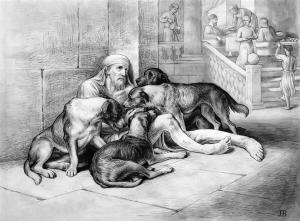 Once again, we listen to one of Jesus’s most remarkable stories. There is a rich man, and this guy is insanely wealthy. He is described as someone clothed with purple and fine linen. In ancient time, fine purple linen is an utmost luxury, and usually only nobilities could afford to buy this kind of cloth. Before the coming of synthetic coloring, purple dye is coming from snails of Mediterranean Sea, and it takes thousands of snails just to dye one ordinary garment. This rich guy is also throwing party every night. At the time of Jesus, where majority must toil to earn a little and to have something to eat, to enjoy feast every night is madly extravagant. At that time, fork, knife, and napkins were not common; thus, people are eating with their hands. In very wealthy houses, they will cleanse their hands by wiping them on hunks of bread that will be thrown away. These are pieces of bread Lazarus longs to receive.
 There is something strange in our Gospel today. Jesus is praising the cunning steward. Why does Jesus commend his shrewd action? To understand Jesus’ words, we need to comprehend first what really takes place with this servant and his master.
 Ada sesuatu yang aneh dalam Injil kita hari ini. Yesus memuji pelayan yang curang itu. Mengapa Yesus memuji tindakan cerdiknya? Untuk memahami kata-kata Yesus, kita perlu memahami terlebih dahulu apa yang sebenarnya terjadi dengan hamba ini dan tuannya.
 Chapter 15 of the Gospel of Luke contains three of the most heartwarming as well as powerful parables in the entire Bible. These three parables are known as the parable of the lost sheep, the parable of the lost coin, and the parable of the prodigal son. If we look closer into these three parables, what is so stunning and astonishing is how Jesus bends, twists and stretches human logic and natural tendency to nail His point.
 Bab 15 dari Injil Lukas berisi tiga perumpamaan yang paling mengharukan dan indah di seluruh Alkitab. Tiga perumpamaan ini dikenal sebagai perumpamaan tentang domba yang hilang, perumpamaan tentang koin yang hilang, dan juga perumpamaan tentang anak yang hilang. Jika kita melihat lebih dekat ke dalam ketiga perumpamaan ini, apa yang begitu menakjubkan dan mencengangkan adalah bagaimana Yesus membengkokkan, memutar dan merentangkan logika manusia dan budaya Israel untuk menyampaikan poin terdalam-Nya.
 In Medio Ecclesiae