

Reflection on the 28th Sunday in Ordinary Time [October 14, 2018] Mark 10:17-30
Jesus, looking at him, loved him and said to him, “You are lacking in one thing. Go…follow me.” (Mk. 10:21)
 We discover at least three instances in the Bible in which Jesus explicitly expresses that He loves someone. The first instance is that Jesus loves the young rich man who seeks the eternal life (Mrk 10:21). The second is Jesus loves Martha, Mary, and Lazarus (Jn 11:5). The third is Jesus’ love for His disciples, especially His beloved disciple (Jn 13:34).
In these three accounts, Jesus’ love is not simply an emotional kind of affection. It is not the love that causes an adrenalin rush, heart’s palpitation, and an explosion of imagination. It is not fickle love that comes in the morning but dies in the afternoon. The love of Jesus is a love rooted in free will and firm decision. No wonder the Greek word used to describe this love is “agape.” Neither it is “eros,” an emotional and sexual love, nor “philia,” an affection for friends. St. Thomas Aquinas succinctly yet powerfully describes “love” as willing the good of the others. When Jesus loves them, Jesus freely chooses that the good things may happen in their lives even though this means Jesus has to forgo His own goodness and benefits. It is the tough love that entails giving up oneself, sacrifice and even pain. It is the love that thrives even when life has turned sour, and feelings have become bitter.
Going back to the story of the rich young man who asks Jesus on how to inherit the eternal life, he is basically a good guy. He has done a lot of good deeds and been faithful to God and the Law of Moses. Jesus Himself gives him score nine out of ten. Only one thing is still lacking. When Jesus invites the young man to sell what he has, to give them to the poor, and follow Jesus, the man goes away sad. Why? The Evangelist gives us the answer: he has many “ ktemata ,” landed properties. This guy is not ordinarily rich, but super rich. Perhaps, the young man thinks that eternal life is something that can be added to his properties, something that is acquired by doing good and avoiding evil or something that can make him even richer. Yet, this is not eternal life, but a mere shopping in the mall.
Eternal life is a gratuitous gift from God given to those whom He loves. This young man is truly blessed because Jesus loves him. The eternal life is just a step away from this good young man. Yet, though the gift is free, it is never cheap. Jesus wants the young man to follow Him because He wishes to teach the young man how to love like Him. Jesus wants him to will the good of the others, and this begins with selling his precious properties and helping the poor. Here comes again the paradox of love: unless we give ourselves for others, we never have ourselves fully. In the words of St. Francis of Assisi, “For it is in giving that we receive, it is in pardoning that we are pardoned, and it’s in dying that we are born to eternal life.”
I have been in the formation for more than 16 years, more than half of my life. I used to get frustrated because I have done well and fulfilled the requirements, and yet the ordination never comes. However, I realize that I was thinking like the rich young man. I forget that the vocation, as well as ordination, are gifts, not reward. This perspective frees me from my pride and makes me humble and grateful. Jesus loves me, and He loves me tough .
Jesus loves us and yet, it is not an easy and pampering love. It is tough love. It is love that challenges us to grow beyond; it is love that dares us to remain in truth, it is love that propels us to love like Jesus.
Br. Valentinus Bayuhadi Ruseno, OP
.
 Kita menemukan setidaknya tiga episode dalam Alkitab di mana Yesus secara eksplisit menyatakan bahwa Dia mengasihi seseorang. Yang pertama adalah Yesus yang mengasihi Marta, Maria, dan Lazarus (Yohanes 11: 5). Yang kedua adalah kasih Yesus bagi murid-murid-Nya (Yohanes 13:34). Yang ketiga dan menjadi fokus kita hari ini adalah Yesus yang mengasihi orang muda kaya yang mencari kehidupan kekal (Mrk 10:21).
 If there is one prayer that can change the course of world history, it is the earnest recitation of the holy rosary. In 1571, through the unceasing prayer of the rosary, a league of Christian nations called by Pope Pius V was able to stop the military advancement of the mighty Ottoman empire to western Europe in the Gulf of Patras, near Lepanto, Greece. In 1917, Our Lady appeared to three little children in Fatima, and one of her messages was to pray the rosary for the peace of the world. Through nation-wide recitation of the rosary, Austria was freed from the communist regime in 1955. In 1960, led by Catholic women marching the streets while praying the rosary, Brazil was also spared from communism.
 Jika ada satu doa yang mampu mengubah jalannya sejarah dunia, itu adalah pendarasan rosario. Pada 1571, melalui doa rosario tanpa henti, liga negara-negara Katolik yang dipanggil oleh Paus Pius V mampu menghentikan kemajuan militer dari kerajaan Ottoman ke Eropa Barat di perang Lepanto, dekat Yunani. Pada tahun 1917, Bunda Maria menampakkan diri kepada tiga anak kecil di Fatima, dan salah satu pesannya adalah berdoa rosario untuk kedamaian dunia. Melalui pendarasaan rosario secara nasional, Austria terbebas dari rezim komunis pada tahun 1955. Pada tahun 1960, dipimpin oleh wanita-wanita Katolik yang turun ke jalan sambil berdoa rosario, Brasil juga terhindar dari komunisme.
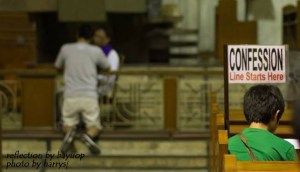 When I was assigned to the hospital to serve as a chaplain, I witnessed the rise of diabetic cases as well as its terrifying effects on the patients. In simple term, diabetes is a condition in a person who can no longer naturally manage their blood sugar. In more serious cases, the body loses its natural ability to heal its wounds. In the beginning, it was a small open wound, yet since the body no longer heals, the infections set in, and this leads into gangrene or the death of the body’s tissues. I accompanied some patients who were struggling with this situation and witnessed how their fingers or even foot were darkened and deformed. When the ordinary treatment no longer worked, the amputation became the only merciful option as to prevent the spread of infections. As a chaplain, accompanying these patients was one of my toughest missions in the hospital.
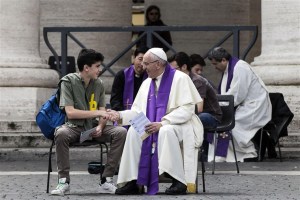 Ketika saya bertugas pelayanan di rumah sakit di Manila, saya menyadari bahwa kasus diabetes berkembang secara pesat, dan juga efeknya yang menakutkan bagi para pasien. Secara sederhana, diabetes adalah suatu kondisi pada seseorang yang tidak lagi dapat secara alami mengelola gula darahnya. Dalam kasus yang lebih serius, tubuh kehilangan kemampuan alami untuk menyembuhkan luka-lukanya. Pada awalnya adalah luka yang kecil, namun karena tubuh tidak lagi bisa meyembuhkan, infeksi-infeksi pun berkembang, dan ini mengarah pada gangren atau kematian jaringan-jaringan tubuh. Saya menemani beberapa pasien yang bergulat dengan situasi ini, dan menyaksikan bagaimana jari atau bahkan kaki mereka menghitam dan berubah bentuk. Ketika pengobatan biasa tidak lagi bekerja, amputasi menjadi satu-satunya pilihan untuk mencegah penyebaran infeksi. Sebagai seorang frater yang bertugas di rumah sakit, mendampingi pasien-pasien ini adalah salah satu misi terberat saya di rumah sakit.
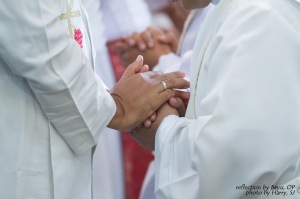 While I was reflecting on this Sunday’s Gospel, I was able to discover some news about our Church. Good News! The Catholic Church in the Philippines is preparing herself for the 500 years of the arrival of Christianity in this archipelago. The first baptism and Eucharist were taking place in 1521 as the Spanish missionaries began their evangelization mission. As part of this grand preparation, the Bishops of the Philippines have decided to celebrate this year as the year of the clergy and the consecrated persons. The major theme of this year is the renewed servant-leaders for the new evangelization. In view of this, many programs and activities are organized to help both the ordained ministers and the religious brothers and sisters to deepen their commitment to God and their service to the people.
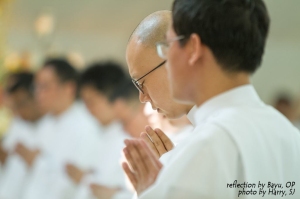 Ketika saya merenungkan Injil hari Minggu ini, saya membaca beberapa berita tentang Gereja. Ada Kabar baik. Gereja Katolik di Filipina mempersiapkan diri untuk perayaan 500 tahun kedatangan iman Kristiani di negara ini. Baptisan dan Ekaristi pertama terjadi pada tahun 1521 sewaktu para misionaris Spanyol memulai misi evangelisasi mereka. Sebagai bagian dari persiapan besar ini, para Uskup Filipina memutuskan untuk merayakan tahun ini sebagai tahun para klerus [daikon, imam, dan uskup] dan rohaniwan. Dengan demikian, banyak program dan kegiatan diselenggarakan di berbagai keuskupan di Filipina untuk membantu para klerus dan biarawan untuk memperdalam komitmen mereka pada Allah dan pelayanan mereka kepada umat dan bangsa.
 Several years ago, I gave a talk on the introduction to Christology to a group of young Filipino professionals who wished to deepen their spirituality. The first question I asked them as we commenced the short course was, “Who do you say that Jesus is?” The answers were varied. Some gave a dogmatic formula like Jesus is God, one quoted the Bible saying Jesus is the Word made flesh, one expressed boldly that Jesus is Savior and Lord, and the rest shared personal convictions like Jesus is their closest friend, or Jesus is their Shepherd. All these answers were right, but nobody claimed that Jesus is the Christ. Considering that our subject was Christology, we missed the basic Jesus’ title, in Greek, “Christos,” in Hebrew, “Messiah,” and translated into English, the Anointed One. Fortunately, around two thousand years ago, Simon Peter was able to spell the title when Jesus Himself asked the question.
 Beberapa tahun yang lalu, saya memberikan ceramah pengantar Kristologi bagi sekelompok profesional muda Filipina yang ingin memperdalam spiritualitas mereka. Pertanyaan pertama yang saya tanyakan kepada mereka adalah, “Menurut kamu, siapakah Yesus itu?” Jawabannya beragam. Beberapa memberikan formula dogmatis seperti Yesus adalah Allah, ada yang mengutip Alkitab dan mengatakan Yesus adalah Firman yang menjadi daging, seseorang menyatakan dengan berani bahwa Yesus adalah Juruselamat dan Tuhan, dan sisanya berbagi keyakinan pribadi seperti Yesus adalah sahabat terdekat mereka, atau Yesus adalah Gembala mereka. Semua jawaban ini benar, tetapi tidak ada yang mengklaim bahwa Yesus adalah Kristus. Mempertimbangkan bahwa ceramah kami adalah Kristologi, kami sepertinya lupa akan identitas dasar Yesus, dalam bahasa Yunani, “Christos,” dalam bahasa Ibrani, “Mesias,” yang berarti “Yang Diurapi”. Untungnya, sekitar dua ribu tahun yang lalu, Simon Petrus mampu mengucapkan identitas dasar ini ketika Yesus Sendiri menanyakan pertanyaan ini.
 In Medio Ecclesiae