


24th Sunday in Ordinary Time. September 17, 2017 [Matthew 18:21-35]
“Moved with compassion the master of that servant let him go and forgave him the loan. (Mat 18:27)”
 Why is it difficult to forgive? One of the reasons is that after we are wronged, the immediate reaction is to seek justice or even revenge. We want that the pain and the loss we experienced are also felt by those who inflicted them on us. We want “a tooth for a tooth, an eye for an eye”. Unfortunately, consumed by anger and hatred, our cry for justice can easily turn into an intense desire of revenge. If justice seeks to balance scale, revenge seeks to inflict a greater punishment, or even to destroy those who have harmed us. Unless we get what is due, unless they receive what they deserve, there is no forgiveness.
Despite this intense desire for vengeance, the good news is that the longing for justice is something that is embedded in every human soul. This sense of justice we have and we embrace is what we call human justice. This kind of justice is essential for our daily life because it propels us to reward good works and punish wrong doings. If we work hard for our companies, we deserve a good wage, but if we do not our job, the company has the right to fire us. If we study hard, we expect a good grade and learning, but if we are lazy, we expect no less that a failing mark. If we pay our taxes, we want the government to provide a dependable public service. This sense of justice regulates our daily lives, the school system, work policies and government conducts. Therefore, we are angered by the violence of this justice system. We are angered knowing our officemate who does little, gets the same salary like us. Though I do not want to focus on grade, I am usually pissed off knowing that after exerting much effort, I get a lower grade compared to those who did not study. We will be indignant if our taxes go to the corrupt and incompetent government officials. With this sense of justice, there is no place for forgiveness.
Thus, Peter’s proposal to forgive seven times sounds extraordinary. Yet, Jesus invites us to understand another sense of justice, the justice of God. The human justice begins with us, what we deserve, what is due to us, but the justice of God starts with God. Like the King in the parable, he demands the servant to pay his debt of astronomical amount. This is human justice. Yet, the king knows that he is so rich that the payment of his servant’s debt would not add much to his treasury. Thus, when the servant begs for mercy, the king could easily forgive him. The servant’s debt now turns to be his richness, and from being extremely poor because of the massive debt, he becomes instantly rich. The servant then is expected to perform his master’s justice and to forgive also his fellow servants who owe him a little. Unfortunately, he remains governed by human justice and even consumed by revenge. This brings about his own doom.
We owe God everything, our lives, all what we have, and even our redemption, yet nothing we do for Him can add to his glory. In His mercy, God forgives us. Our massive debt to God has been erased and in fact, transformed into our own richness. Mercy and forgiveness is not only possible but also the hallmark of God’s justice. As we become rich in His justice, we should forgive our brothers and sisters so that they may be also enriched. We forgive because we have been forgiven. We forgive because we are rich in His mercy. We forgive because God’s justice demands it.
Br. Valentinus Bayuhadi Ruseno, OP

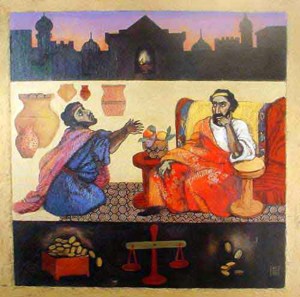 Mengapa sulit untuk memaafkan? Salah satu alasannya adalah bahwa setelah kita disakiti, reaksi kita adalah untuk mencari keadilan. Kita ingin apa rasa sakit yang kita alami juga dirasakan oleh orang-orang yang melakukannya pada kita. Kita ingin “gigi ganti gigi, mata ganti mata”. Terkadang, termakan oleh kemarahan dan kebencian, usaha kita untuk mencari keadilan dapat dengan mudah berubah menjadi keinginan membalas dendam. Jika rasa keadilan berusaha untuk menyeimbangkan skala, balas dendam berusaha untuk memberi hukuman yang lebih besar, atau bahkan untuk menghancurkan orang-orang yang telah merugikan kita. Jika kita tidak mendapatkan apa yang semestinya, jika mereka tidak menerima apa yang layak mereka dapatkan, tidak ada pengampunan.
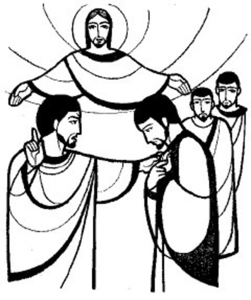 Jesus understands that in any human community, including His own community of disciples, or the Church, there are always members affected by human weakness and sinfulness. Even in the Christ-oriented communities like the religious convents, the parishes, and various ministries and groups in the Church, inevitably we are hurting each other. Thus, Jesus, the Just God and merciful man, outlines a procedure or ‘fraternal correction’ to deal with misunderstanding, quarrels, and conflicts. It begins with the individual and personal encounter, then when it does not work, we ask the help of a witness or mediator, and lastly it goes up to the community level.
 Yesus mengerti bahwa komunitas manusia, termasuk komunitas murid-murid-Nya sendiri, atau Gereja, akan selalu dipengaruhi oleh kelemahan manusia dan dosa. Bahkan di dalam komunitas yang berorientasi pada Kristus, seperti biara, paroki, dan berbagai pelayanan dan kelompok di Gereja, tak dapat dihindari bahwa kita saling menyakiti. Dengan demikian, Yesus menguraikan sebuah prosedur rekonsiliasi untuk mengatasi kesalahpahaman, pertengkaran, dan konflik. Ini dimulai dengan dialog pribadi atau empat mata, kemudian ketika hal itu tidak berhasil, kita meminta bantuan seorang saksi atau mediator, dan masih belum berhasil, kita naik ke tingkat komunitas.
 We come to one of the most heated exchange of words in the Gospel, and this occurs no less than between Jesus and Simon Peter. The apostle rebukes Jesus for revealing to the disciples that he has to go Jerusalem, suffer and die, but be raised on third day. In return, Jesus reproofs him and calls him Satan. Why does this harsh quarrel take place between Jesus, the most merciful Lord, and his trusted disciple, Simon whom he has just declared as the Rock?
 Kita mendengar sebuah pertukaran kata-kata yang paling panas dalam Injil, dan ini tidak tanggung-tanggung karena melibatkan Yesus dan Simon Petrus. Sang Rasul menegur Yesus karena telah menyatakan kepada murid-murid bahwa Ia harus pergi ke Yerusalem, menderita dan dibunuh, tetapi bangkit pada hari ketiga. Sebaliknya, Yesus menegur Petrus dan memanggilnya “Setan”. Mengapa pertengkaran yang hebat ini terjadi antara Yesus, yang adalah Tuhan yang maha pengasih, dan muridnya yang terpuji, Simon yang baru saja dinyatakan sebagai batu karang Gereja?
 Today’s Gospel is well known as the Confession of Peter. Jesus asks the disciples who He is, and Simon confesses that Jesus is the Christ, the Son of the living God. He gets it right, and Jesus Himself reveals that his answer does not come from his human weakness, but from the heavenly Father. I used to think that this revelation is an instant inception of divine idea inside Simon’s mind. Right there and then, like Archimedes who discovered the Law of Hydrostatic, Simon also shouts “Eureka! I have found it!”
 Yesus bertanya kepada murid-murid siapakah Dia, dan Simon menjawab bahwa Yesus adalah Kristus, Anak Allah yang hidup. Simon Petrus menjawab dengan benar, dan Yesus sendiri mengungkapkan bahwa jawabannya tidak berasal dari kelemahan manusiawi, namun dari Bapa di surga. Dulu saya berpikir bahwa pewahyuan ini terjadi secara instan di dalam pikiran Simon. Seperti Archimedes yang menemukan Hukum Hidrostatis, Simon juga berteriak “Eureka! Aku telah menemukannya!”
 Why does Jesus, the compassionate man and just God, have to “humiliate” the Canaanite woman? If we put ourselves in the context of Jesus’ time and culture, we will understand that what Jesus does is just expected of him. Jesus is dealing with a woman of gentile origin. Generally, Jews avoid contacts with the non-Jews, and a Jewish man does not engage in dialogue with a woman who is not his wife or family in public. Jesus does what every Jewish man has to do. However, in the end, Jesus praises the woman’s faith and heals her daughter. Eventually, mercy overcomes differences and love conquers all.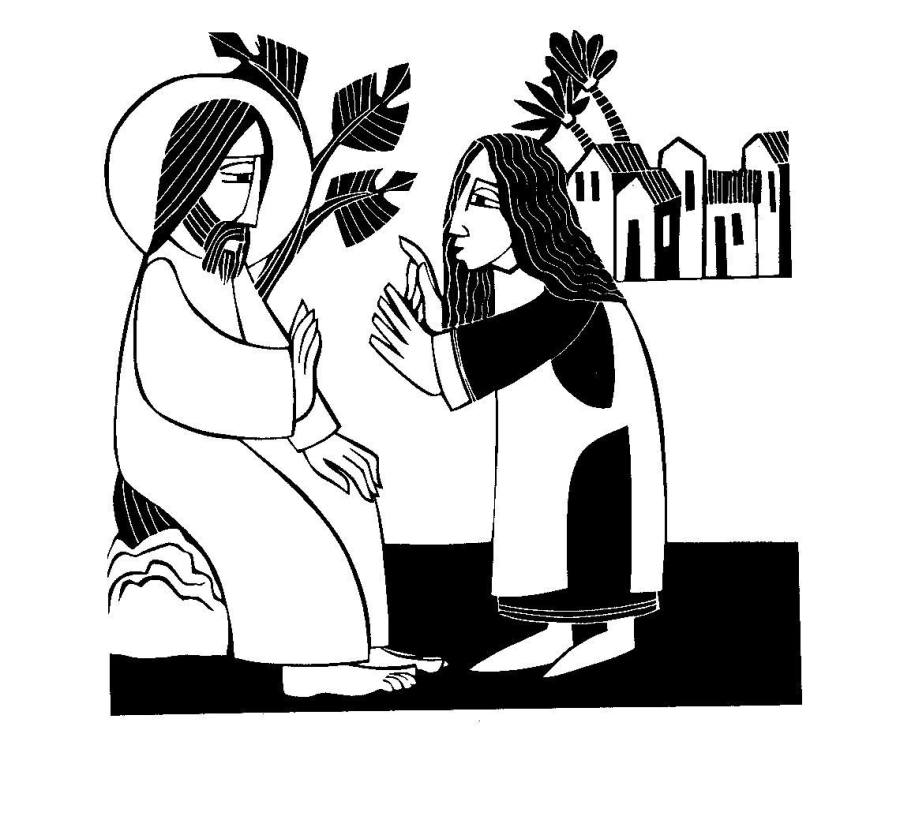

 In Medio Ecclesiae