

4th Sunday of Advent [C]
December 21, 2025
Matthew 1:18-24
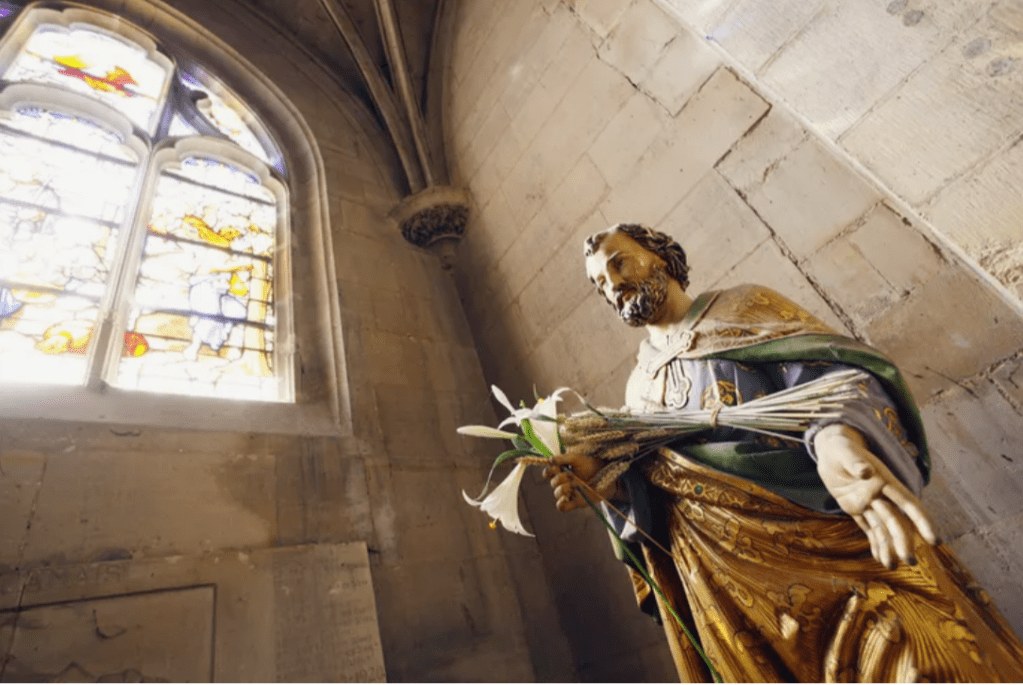
As we approach Christmas, the Gospel introduces us to the key figures surrounding the Messiah’s birth. Among them is Joseph, the foster father of Jesus. Matthew the Evangelist gives him a profound title: a “just man.” What does it mean to be like Joseph? What does it mean to be just?
Matthew uses the Greek word “δίκαιος” (dikaios), typically translated as “just” or “righteous.” In the Biblical context, being just means living in faithful obedience to God’s Law, particularly the Torah given through Moses at Sinai. This adjective is highly significant for an Israelite. Scripture consistently links the “just” person—one who lives by God’s Law—with true happiness and blessing. Psalm 1 declares, “Happy are those who… delight in the law of the Lord, and meditate on his law day and night.” Proverbs similarly praise, “The memory of the just is blessed” (10:7). Why is this life of justice so praiseworthy and fulfilling?
The answer lies in how the Israelites understood God’s Law. They did not view it primarily as a restriction on freedom, but as a gift of love and identity. God gave the Law at Sinai after choosing Israel as His holy nation. Therefore, living the Law was not merely an obligation; it was a sign of their covenant fidelity and their very identity as God’s people. Fundamentally, they saw the Law as God’s gracious guidance—the pathway to avoid the pitfalls of misery and to draw closer to Him, the source of all blessing.
Consequently, Joseph is called “just” because he is the true Israelite who meditates on, loves, and lives by God’s Law. During His formative years, Jesus would have received from Joseph not only a knowledge of the Law’s letters but also Joseph’s own love for God and His commandments. In Joseph, Jesus and Mary saw a happy and righteous man.
From St. Joseph, we learn to love God through faithful obedience. However, we must also avoid the trap of rigidity and legalism, which absolutizes the letter of the law over its spirit. Had Joseph chosen a rigid legalism, he might have applied the strictest penalty to Mary upon discovering her pregnancy, that is stoning. Yet, his justice was perfected by mercy. He recognized that the Law’s ultimate purpose is to love God and neighbor, leading him to protect Mary’s life. Joseph was a happy man because, through the Law, he loved God profoundly.
Finally, Jesus Himself holds the “just” in high esteem. He teaches, “Blessed are those who hunger and thirst for righteousness” (Matthew 5:6), and promises, “Then the just will shine like the sun in the kingdom of their Father” (13:43). While Joseph is not named explicitly in these verses, it is fitting to see in these verses a reflection of his own virtue—virtue that shaped the Holy Family.
Rome
Valentinus Bayuhadi Ruseno, OP
Questions for Meditation:
Do I strive to know God’s Law as revealed in Scripture and taught by the Church?
Do I meditate on God’s commandments, seeking the wisest way to live them out in love for God and my neighbor?
Do I follow rules blindly, or do I seek to understand the spirit and purpose behind them? How do I treat those who struggle to live by them?
 In Medio Ecclesiae