

Christmas Vigil – December 24, 2019 – Luke 2:1-14
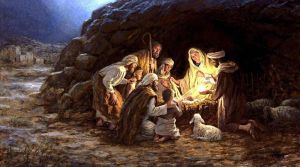 Today is Christmas, the day of Jesus was born in Bethlehem, and it is a traditional practice that in every Church or Christian family, there is a nativity scene. Usually, the baby Jesus was born in a kind of stable or shed, and He was placed on the wooden manger (a place where animals eat). Surely, Mary and Joseph are intently watching on the Baby, while other animals like sheep and cows become the silent witnesses of this most beautiful moment in human history. The scene will not be complete without the shepherds and the angel.
The nativity scene is indeed beautiful and always remains us of the simplicity of Christmas that we often miss.
However, if we go back to the time of Joseph and Mary, to first-century Palestine, we will discover a slightly different yet have a deeper meaning. Most probably, Joseph and Mary were not resting in a wooden stable, but inside a stone cave since this is a common feature in hill country Judea. Inside the stone cave is warm and sometimes spacious, and the shepherds use them as a safe and warm shelter for their sheep at night. The mangers provided for sheep were not made of wood, but stone. Sometimes, we see Baby Jesus half-naked on the manger, but Luke describes that Jesus was wrapped in a swaddling cloth. It is normal practice that a new-born baby will be cleansed, and then be enclosed by the cloth to keep the baby warm, protected and comfortable.
We discover that Jesus was born in a stone cave, rested on a stone manger and swaddled in cloth. These three things point to an even greater reality in the life of Christ: His death and resurrection. After the crucifixion, his body was enclosed in cloth, put inside the cave tomb, and rested on the large stone. Yet, it is also the same stone tomb where Jesus rose from death. From the very beginning of Jesus’ life here on earth, His destiny has been foretold: by His death and resurrection, He will save us.
However, there is something even more remarkable. Jesus was placed on a manger, and a manger is none other than a place for animal’s feed. From the beginning, Jesus is already presented to us as a food that will satisfy those who come to Him. Then, what “kind of food” is He? It is not a coincidence that Jesus was born in Bethlehem. The word Bethlehem comes from two Hebrew words: “Beth” meaning “house” and “Lehem” meaning “bread”; thus, Bethlehem is a house of bread. Jesus is given to us as bread, and indeed, Jesus calls Himself as the bread of life [Jn 6:35]. It is interesting also to ask why the shepherds were the first persons invited to see Jesus. One of the possible answers is that the shepherds are the first men who are aware of the birth of a lamb. The shepherds recognized that this holy Baby is a new-born lamb. Indeed, later, Jesus would be called as the Lamb of God [John 1:29]. In ancient Israel, lambs were also the main sacrificial animal in the Temple. Baby Jesus came to feed us, and He came as the bread of life and sacrifice that saves us.
While it is good to spend Christmas with vacation or festive celebration, the best way to celebrate Christmas is none other than to celebrate the Eucharist, to mediate the simplicity and humility of God who came to us as little baby, and to ponder His infinite love that He offered Himself to feed us. This is the beauty of Christmas, that God has chosen to love us to the end.
Valentinus Bayuhadi Ruseno, OP
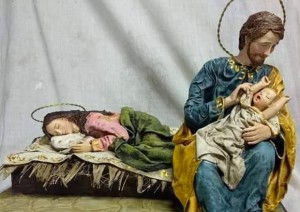 A few days ago, a nativity scene went viral. The image is called “Let Mom Rest”. The prominent character of this scene is that Joseph is taking care of the baby Jesus while Mary is resting. This image presents to us untouched yet powerful aspects of Jesus’ birth and thus, Christmas. Often, we focus our attention on Jesus with Mary, His mother. We honor Mary because of her willingness to carry Jesus on her womb despite so many dangers and difficulties and to remain a faithful disciple of Jesus till the end. However, the image brings us to another important character that we often overlook, St. Joseph, as the man of faith.
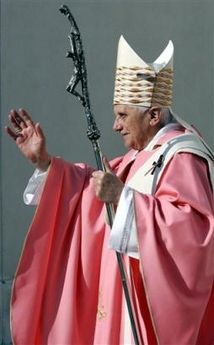 Today, we are going to see something different in the Church. Yes, the priests are not wearing a purple vestment, but a rose liturgical vestment. It is not because the priests are mistaken or want to make a fashion statement. It is because we are entering the third Sunday of Advent, also known as, the Gaudete Sunday. “Gaudete” is a Latin word meaning “rejoice!”. This color also symbolizes the joyful atmosphere. But, why do we need to celebrate Gaudete Sunday?
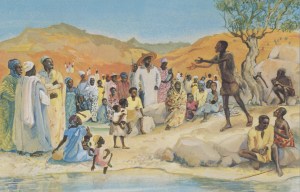 John the Baptist is a prominent figure in four Gospels, and he powerfully appears before Jesus begins His public ministry. But, who is this John the Baptist? His name is simply John, and the Church calls him the Baptist to distinguish him from other John in the Bible like John the son of Zebedee, one of Jesus’ disciples. John the Baptist is the miracle son of Zacharia and Elizabeth in their old days. And since Elizabeth and Mary, the mother of Jesus, are relatives, John and Jesus are closely related to each other.
 We are entering the season of Advent. This time marks the beginning of the new liturgical year of the Church. The season itself is a preparation for us to welcome the Christmas, the coming of Jesus Christ. The word Advent is coming from the Latin word “Adventus” that simply means “arrival.” The dominant liturgical color will be purple that signifies hope and joyful expectation of the coming of our Savior.
 Often we take for granted the name Jesus Christ, without realizing the meaning behind it. The word “Christ” is neither part of the personal name of Jesus nor the family name of Jesus. Jesus earns the name Christ not because of His foster father, Joseph, otherwise, we also call him Joseph Christ and his wife, Mary Christ.
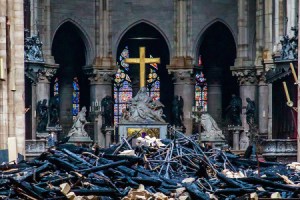 During the reign of Herod the Great, the Temple of Jerusalem was refurbished, adorned by gold and other precious metals, and expanded, and thus making it the crown jewel of the Jewish nation. However, the Temple was not merely a magnificent building, but primarily the center of Jewish religious worship and religion. Every morning and evening, sacrifices were offered, and every year, Jewish men from all over the world made their pilgrimage, and paid their homage the Lord God. It was the place where God chose to stay, the place where the Israelites meet their God, and the house of God.
 In the time of Jesus, there are at least two kinds of taxes. The first tax goes to the Temple of Jerusalem. This is a “sacred tax”. Those who collect them are performing a sacred duty, and those who pay are fulfilling their due to God. Yet, the second tax is exacted by the Roman government. In order to effectively get the taxes, the Romans employs the local collaborators. The Jews are heavily burdened by this tax because they are unjustly hefty, and often collected by coercion. The Jews understandably loathe those Jewish tax collectors who willingly betray their own people and are involved in greedy malpractices. These are the worst sinners, unclean, corrupt and traitors.
 In Jesus’ time, they were several Jewish religious groups and one of them is the Pharisees. These are the people who love the Lord and devoutly observe the Law of Moses and the traditions of the elders even in their daily lives. Thus, Jewish people regard them as righteous because they are faithful to the Law, and pious because they pray often. Many Pharisees turn to be the caretakers of the local synagogues and zealously teach the Law during Sabbath days. No wonders, the Jewish people offer the Pharisees the best places in the worship places and the parties. The leaders are called the Rabbis or teachers.
