

31st Sunday in Ordinary Time
November 3, 2024
Hebrews 7:23-28
Every time we celebrate the Eucharist, we worship God by offering Him the perfect sacrifice. This sacrifice is Jesus Christ, who is truly present in the Eucharist. However, when we read the Letter to the Hebrews, its author writes that Jesus offered Himself on the cross “once and for all” (see Heb 7:27). So, why do we “sacrifice” or even “crucify” Jesus again in the Eucharist? Does this mean we misunderstand our worship?
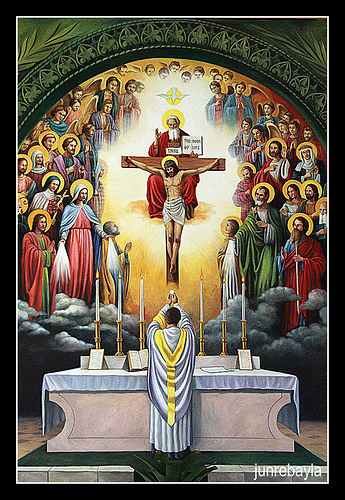
Firstly, we need to understand the context of the Letter to the Hebrews. The author recognized that in order to worship God, a high priest must offer a sacrifice. Then, the author compares the Israelite high priest from the tribe of Levi with Jesus as the high priest. The Levitical high priest was an ordinary human and, therefore, a sinner. As such, he had to offer sacrifices repeatedly because he continued to fall into sin. Meanwhile, Jesus is truly divine and truly human, without any sin, yet sharing in our human struggles. While the Levitical high priest offered imperfect sacrifices of animals, Jesus gave Himself on the cross as the perfect and most acceptable sacrifice of love. Since the value of His sacrifice on the cross infinitely surpasses the Levitical or any human sacrifice, earthly sacrifices are no longer needed.
However, though Jesus has offered Himself once for all on earth, this does not mean He is inactive in heaven. The same letter to the Hebrews states, “…the heavenly things themselves (the heavenly sanctuary) need better sacrifices than these (earthly sacrifices)” (Heb 9:23). Entering heaven, Jesus does not cease His priestly ministry; rather, He perfects His identity by presenting an endless sacrifice. But how does He offer sacrifice without dying again on the cross? The answer is through a living sacrifice (see Rom 12:1). Jesus presents His own self—His glorious body still bearing the wounds of the cross—as a perfect gift to the Father, but this time, without further death. Since Jesus in heaven and Jesus on the cross are essentially the same, the living sacrifice He offers in heaven has the same infinite value as that on the cross.
Now, let us see what the Catholic Church teaches about the Eucharist as a sacrifice. The Catechism of the Catholic Church says, “When the Church celebrates the Eucharist, she commemorates Christ’s Passover, and it is made present: the sacrifice Christ offered once for all on the cross remains ever present” (CCC 1364). It further states, “The Eucharist is thus a sacrifice because it re-presents (makes present) the sacrifice of the cross, because it is its memorial, and because it applies its fruit” (CCC 1366). But what do these teachings mean?
This means that the Catholic Church understands the Eucharist as our participation in the heavenly liturgy. In the Eucharist, we make present the sacrifice of the cross—not by crucifying Jesus again, but by participating in Jesus’ self-offering in heaven, which holds the same infinite value as His sacrifice on the cross. Only in the Eucharist do we truly worship God and receive the fruits of the cross.
Rome
Valentinus Bayuhadi Ruseno, OP
Questions for Reflection:
How do we understand the Eucharist? Do we feel the need to participate in the Eucharist? Do we realize that, through the Eucharist, we are participating in heavenly worship? How can we deepen our participation in the Eucharist? What fruits do you receive from the Eucharist? Do you encourage your family and friends to participate in the Eucharist?
 In Medio Ecclesiae