

5th Sunday of Easter
May 10, 2020
John 14:1-12
 We have closed our churches for public service for weeks. We shifted to livestreaming masses, and we are learning to adjust and to give priority to our health and life, we realize our hearts remain troubled. We long to see Jesus in the Most Blessed Sacrament, we desire to receive Him in the Eucharist, we want to serve Him in the churches, and we miss the sacrament of confession. We are unsure when it is going to end and be back to normal.
We are like the disciples in the Gospel. Their hearts were troubled because Jesus was about to leave them. They were having a Passover meal, and it was supposed a festive celebration. Yet, Jesus announced to them that someone would betray Him, and He would be taken away from them. The disciples had thrown everything away and followed Jesus because they were hoping that Jesus, as the Messiah, would overthrow the Roman empire and restore the glory of Israel. They could not square with the probability of utter failure. Were they holding on false hope? Was Jesus a hoax? Were their sacrifices useless? We are like the disciples. After we give everything to follow Jesus, to serve His Church, and to work in His vineyard, we feel He is missing. Where is Jesus when we needed Him most?
Jesus knew His disciples’ hearts and assured them as He did to have in God and Jesus. Yet, what comes after this word of affirmation is that Jesus told the disciples that there are many dwelling places in His Father’s house, and He will go to prepare the places. To comfort the disciples, Jesus did not say that He would come back victorious, or He would destroy all enemies of Israel. He said that He is going to prepare a dwelling place. It is just not making much sense.
To understand this, we need to know the wedding ceremony at the time of Jesus. During this time, the wedding was done in two steps. The first one is the betrothal, and the second stage is the wedding celebration. During the betrothal, the couple has exchanged vows and have become husband and wife in the eyes of the Law, but they have not stayed together in one house. They had to wait for around one year before the final ceremony. After around year, the bride would be brought in procession to the home of the groom, and they will have a week-long celebration. Why one-year wait? The reason is practical. It gives enough time for the man to prepare for the celebration as well as build a proper place for the bride.
One particular image that the Church has in relation to Jesus is that she is the bride of Christ. If we apply this Jewish wedding rite to the Church and Jesus, we discover that betrothal has taken place, but not yet the final step. Jesus is not with His Church because He is Father’s House to prepare the dwelling place for us, His bride.
In the time of the pandemic, our hearts are sorely troubled, and with the churches are closed, we feel that our Lord is taken away from us. Yet, a difficult time can actually be a passage going to the much better dwelling place prepared by Jesus. We may not see yet the better things we will experience, yet Jesus assures us that God is in control. In this stormy life, we may see a beautiful place prepared by Jesus, our groom.
Valentinus Bayuhadi Ruseno, OP
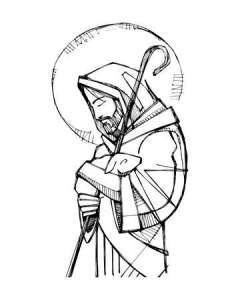 traditionally it is also called as the Good Shepherd Sunday. This is for an obvious reason. The Gospel reading tells us about Jesus who introduces Himself as the gate of the sheepfold and the Good Shepherd. The other readings also point the image of God as the good shepherd, like the world-renown psalm 23, “the Lord is my shepherd.”
 The two disciples went back home to Emmaus. One of them was Cleopas, and his companion probably was his wife. Perhaps they got afraid of the Roman and Jewish authorities who might go after them after they killed Jesus, the leader. Or maybe, they just got their hope and expectation shattered when Jesus, their expected Messiah, was crucified.
 The second Sunday of Easter is also known as the Divine Mercy Sunday. The liturgical celebration of the Divine Mercy Sunday is declared in the year 2000 by Pope St. John Paul II who had a strong devotion to the Divine Mercy revealed to St. Faustina. Though the feast itself is something recent, the truth of divine mercy is fundamental in the Bible and Sacred Tradition. If there is one prevailing character of God, it is not other than mercy. In the Old Testament, there are at least two Hebrew words that can be translated as mercy. One is rāḥam and the other is ḥeṣedh.
 Today is the day of resurrection. Today is the day Jesus has conquered sin and death. Today is the day of our victory. No wonder among the liturgical celebration of the Church, Easter is the grandest, the longest and the most spectacular. It is the time that the churches are flooded with the faithful. It is the time that parishioners got involved in many activities, practices, and services. It is the time when families gather and celebrate. It is the time the priests receive more blessings!
 If there is one thing that unites people from different nations, languages, and religions, that is the experience of suffering. With the ultra-fast spreading coronavirus, covid-19, people with different backgrounds, young and old, rich or poor, and noblemen or commoners, and laypeople or clergy fall in their knees and tremble. Indeed, this microscopic virus has shattered countless lives. People are dying, hospitals are overwhelmed, cities are isolated, families are separated, workers are jobless, governments are at loss, and churches are empty. Pope Francis notes that “we are just one the same boat”, and this boat is sinking. Suffering forces us to admit our human frailty and all that we are proud of, are a mere breath.
 Today, we are celebrating the Palm Sunday of the Lord’s Passion. In many countries, today is a big celebration where people excitedly throng the Church. I remember when I was still studying in the Philippines, the faithful would pack almost all the 11 masses in our Church, Santo Domingo Church. It was a festive celebration as many people were carrying palm branches of a coconut tree.
 Among the five human senses, the sense of touch is the most basic and foundation to other senses. The sense of sight needs to be in touch with the light spectrum. The sense of taste requires to be in contact with the chemical in the food. The sense of hearing must receive air vibration or sound waves. This sense makes us a human being, a bodily being. No wonder that many traumatic experiences [even mental problems] are rooted in the lack (or excess) of touch.
 The Church has selected the story of Transfiguration as the reading of the second Sunday of Lent. We may ask how this kind of powerful story may fit into the entire season of Lent. The key is that the Transfiguration is fundamentally linked to the Cross of Jesus. In Luke’s version of the transfiguration, Jesus was talking to Moses and Elijah about His “exodus.” This reminds the ancient Israelites who exited Egypt, walked through the desert, and entered the Promised Land. Yet, the real end of the exodus is the city of Jerusalem, and eventually the holy Temple where God dwelled among His people. Just like the ancient Israelites, Jesus’ exodus has to end in Jerusalem.
