

19th Sunday in Ordinary Time
August 9, 2020
Matthew 14:22-33
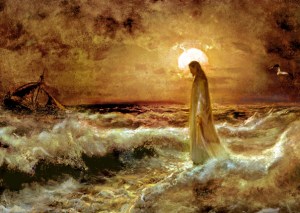 The story of Jesus walking on water is a well-known account being shared by three gospels: Matthew 14:22-33, Mark 6:45–52 and John 6:15–21. However, unique to Matthew is the part of Peter who also walked on water, but sank after a few steps. Let us focus our attention on this unique moment in the life of Simon Peter.
The sudden and unusual appearance of Jesus startled the disciples who were still battling the strong wind. The disciples’ natural reaction was fear. They thought they saw a ghost. Matthew gives us a little interesting detail: the disciples were afraid not because of the raft sea, but because of Jesus’ presence. We remember that many of them were seasoned fishermen and dealing with unpredictable conditions in the lake of Galilee was their part of their job description. Yet, to see someone walked on water was just unprecedented. Thus, Jesus took the initiative to calm the storms inside their hearts and assured them that He is the “I AM” who controlled the forces of nature.
Peter, the bold leader and yet impulsive man, wanted to prove what he saw and heard. He then challenged Jesus and himself by saying, “Lord, if it is you, command me to come to you on the water.” Jesus invited him to come. The miracle took place. Simon Peter was able to walk on water. Yet, his weak human nature once again set in. After a few miraculous steps, he got distracted by the wind, lost his focus on Jesus, and he began to sink. Jesus had to save him and told him, “O you of little faith, why did you doubt?” We notice that Jesus did not say, “You, who have no faith!” but rather, “little faith.” This shows that Peter possessed indeed faith, proven by his several miraculous steps, but it was still small, easily distracted, and doubt-ridden.
Many of us can easily relate to Simon Peter, our first Pope. We believe in Jesus, and we know that we have faith in Him. Yet, we are aware also that our faith is still small. We may go to the Church every Sunday or pray from time to time, believe that Jesus, our God and Savior, and accept the teachings of the Church, but our faith is just tiny part of our life, that can be set aside when other and bigger concerns like work, career, relationship and others. We give God our leftovers, our time and effort. Even in our prayer and worship, we are easily distracted. Rather than focusing ourselves in Jesus, we give our attention to our cellphones and all the excitement they offer. Then, when we face the storms of life, we begin to sink, and when we are drowning, that is that the time, we shout, like Peter, “Lord, save me!”
We are called to set our gaze on Him and to learn to have true eyes of faith. These are eyes to ponder the Eucharist not as mere bread and wine, not as monotonous repetition, but as the real presence of Jesus who has sacrificed His life for us. This is a faith that empowers us to see Jesus’ presence in our daily and ordinary events. Thus, not even the fiercest storms can sink us because we focus our eyes on Jesus.
Valentinus Bayuhadi Ruseno, OP
 The miracle of the multiplication of the bread is one of the few stories that appear in the four Gospels. This may point to the veracity of the miracle itself that impressed and impacted the lives of the apostles. Though the general plot is the same, every Evangelist has presented their own emphasis. Today we are zeroing in the Gospel of Matthew and his particular emphases.
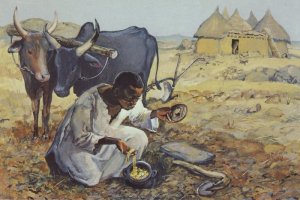 The parables of the hidden treasure and of fine pearl are among the shortest yet loveliest parables of Jesus. Finding a fine pearl or a hidden treasure is surely an exciting discovery. We can naturally share the joyful experience. Yet, the key to unlock the secrets of the parables is to spot the surprising twists. If we find a treasure, we instinctively grab it and bring it home. If the treasure is exceedingly huge and many, we can grab some and use them to buy the land. It is a bit reckless to sell everything first and then buy the land. What if the owner of the land suddenly refused to give up the land? The same goes for the purchase of the fine pearl. Sometimes a businessman would make a risky investment to gain more profit. Yet, to throw everything for a pearl is a bit of foolishness. The merchant still needs money to sustain his daily life and business, and what if the investment fails?
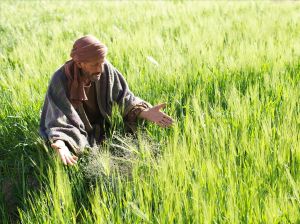 The parable of the wheat and weed is one of a kind. If we survey the details, we are supposed to raise our eyebrows. Firstly, if you become a person who will destroy your opponent’s field of wheat, you know that there are several other effective ways to accomplish that. We can simply set a small fire on the wheat, and the entire field will eventually turn to be an inferno. But, the enemy chose unorthodox tactic: to sow seeds of weed during the planting period. While the weed may disturb the growth of the wheat, they will not sufficiently damage and stop the harvest. So, what is the purpose? What is surprising is that the decision of the field’s owner. When he was notified about the presence of the weed, he immediately knew the culprit, and instead to act promptly and protect their wheat, he decided to allow the weeds to thrive among his wheat.
 From the previous two Sundays, we learn that Jesus lays down the cost of following Him, how to become His disciples. And they are extremely tough. One has to follow Jesus wherever He goes. One must love Jesus above anyone else. One must be ready to suffer persecutions and hardships, carry his cross, and give up his life for Jesus. It is Jesus or nothing at all. However, following Jesus is not all about hardship and sacrifice. Today we hear that to walking with Him, we receive certain “perks” that others cannot even dare to offer.
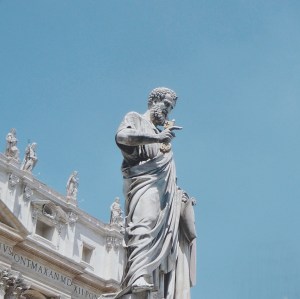 Jesus never promises that the disciple will have easy and prosperous lives. Jesus demands the opposite. After being chosen, the twelve disciples are sent to preach that the Kingdom is at hand, and yet they will not go like any royal emissaries with their military escort. No! They will travel as simple men going on foot and carrying minimal provision. They will rely on the generosity of their hosts, and the worst part is that they are going to face rejection.
 The solemnity of the Body and Blood of Jesus Christ takes its origin from the initiative of St. Juliana of Liege, who asked his bishop and his friends to honor, in a special way, the institution of the Eucharist, and the real presence of Jesus Christ in the Blessed Sacrament. The institution of the Eucharist itself took place in the Last Supper of the Lord, and every Holy Thursday, the Church celebrates this event. However, since Holy Thursday is an inseparable part of the Easter Triduum, the attention is given to the mystery of the Passion and Resurrection of our Lord. Because of its rootedness in Holy Thursday, the solemnity of Corpus Christi is celebrated on Thursday after the Trinity Sunday. Yet, in several countries, the celebration is moved to the next Sunday to accommodate the greater participation of the faithful.
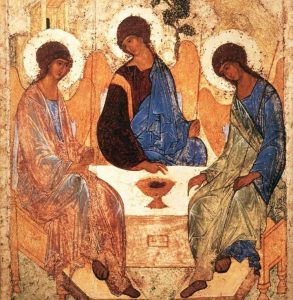 We are re-entering the ordinary season of the Church, and one of the greatest feasts within the ordinary time is the solemnity of the Most Holy Trinity. The Church has placed the celebration of the great feast on Sunday after the Pentecost. The reason may not be that obvious, but if we look at the bigger picture, it is nothing but a natural procession of truth. In Easter, we are celebrating the resurrection of Jesus that cements the divinity of Christ. On the Pentecost, we witness the divinity of the Holy Spirit being affirmed [see last Sunday’s reflection]. Now, we are rejoicing for the Three divine persons in God.
