

Pentecost Sunday [A]
May 31, 2020
John 20:19-23
 “Happy Birthday!” today is the feast of Pentecost, and today is the birth of the Church. We should rejoice because our Church is getting older by age, but getting ever stronger by vitality and creativity in preaching the Good News. Yet, the question is why we celebrate the birthday of the Church on the Pentecost Sunday?
To answer this, we need to understand the biblical meaning of the celebration of Pentecost and what took place to the disciples on the day the Holy Spirit descended upon them. The word Pentecost means the fiftieth, and the feast of Pentecost takes place on the fiftieth day after Sunday Easter. However, the Christian feast itself is originally a Jewish religious festival: the feast of Shavuot or the Feast of Weeks. The feast took place seven weeks after the grand celebration of the Passover. Together with Passover and the Feast of Tabernacle (Booths), Pentecost are the major pilgrimage festivals that require any male Jews to make their way to Jerusalem. Initially, the feast is agricultural in nature. The people of Israel gave thanks for the successful harvests and offered the fruits of their harvest to the Lord. Yet, it also gained a religious meaning. In the feast of Shavuot, the Israelites commemorate the giving of the Law and the making of the covenant with the Lord God in Mount Sinai.
This explains why many people from different nations gathered in around the place of the disciples: they were pilgrims of Pentecost. This answers a more fundamental question about the identity of the Holy Spirit: Why did the Holy Spirit have to present Himself as fire, and no other image like a dove? If we go back to the Sinaitic event itself, we are going to find something remarkable. When God made His covenant and handed down His Law, He appeared Himself to entire Israel as fire [see Exo 19:18]. The Holy Spirit appeared in fire simply because He was the same God who manifested Himself in Sinai. The Pentecost Sunday reveals the fundamental truth about the Holy Spirit that the promised Paraclete is divine.
In Sinai, the Israelites received the Law and entered into a covenant with the Lord. God embraced them and made them “a priestly kingdom and a holy nation [see Exo 19:6]. Israelites became a nation that belongs to God. In the new Pentecost, the Holy Spirit came upon the disciples and instilled in them the New Law of Love. He fashioned them to be new People of God [see Pet 2:9]. The new community of God’s family has been born!
Yet, these new people are even greater. The Holy Spirit empowered the disciples to preach the Good News to people from different nations and languages. The Pentecost reversed the negative effect of the tower of Babel [see Gen 11:1-9]. When people were so proud of themselves and tried to become like God with their power, different languages turned out to be a curse that divides them. Yet, with the Holy Spirit that transformed the hearts and instilled humility, languages become a blessing that unites the different people.
We thank the Holy Spirit that gave birth to the Church. We give thanks to the Holy Spirit that has called us to part of the new people of God.
Valentinus Bayuhadi Ruseno, OP
 We are aware that prayer is a fundamental part of Jesus’ life. He prays on a regular basis, and especially when He is preparing to embrace decisive events, like Baptism on the Jordan [Luke 3:21], the election of the twelve apostles [Luke 6:12], transfiguration [Luke 9:28], and the Passion [Matt 26:36–44]. However, we seldom hear what Jesus says in His prayers. In the Synoptic Gospels [Matthew, Mark, and Luke], we are fortunate enough to hear Jesus’ compact and emotional prayer in the Garden of Gethsemane before He enters into His Passion. However, John the evangelist makes sure that we are going to discover what Jesus prays, and it is substantially longer than we ever heard before.
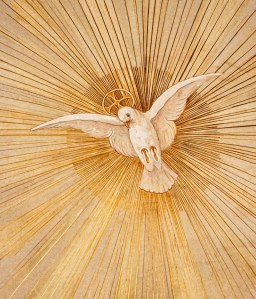 In the last supper, Jesus promised the disciples that He would send another advocate to be with them forever. Who is this other advocate?
 We have closed our churches for public service for weeks. We shifted to livestreaming masses, and we are learning to adjust and to give priority to our health and life, we realize our hearts remain troubled. We long to see Jesus in the Most Blessed Sacrament, we desire to receive Him in the Eucharist, we want to serve Him in the churches, and we miss the sacrament of confession. We are unsure when it is going to end and be back to normal.
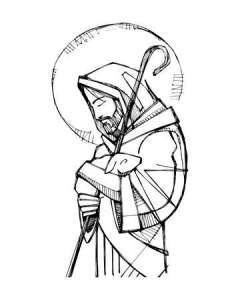 traditionally it is also called as the Good Shepherd Sunday. This is for an obvious reason. The Gospel reading tells us about Jesus who introduces Himself as the gate of the sheepfold and the Good Shepherd. The other readings also point the image of God as the good shepherd, like the world-renown psalm 23, “the Lord is my shepherd.”
 The two disciples went back home to Emmaus. One of them was Cleopas, and his companion probably was his wife. Perhaps they got afraid of the Roman and Jewish authorities who might go after them after they killed Jesus, the leader. Or maybe, they just got their hope and expectation shattered when Jesus, their expected Messiah, was crucified.
 The second Sunday of Easter is also known as the Divine Mercy Sunday. The liturgical celebration of the Divine Mercy Sunday is declared in the year 2000 by Pope St. John Paul II who had a strong devotion to the Divine Mercy revealed to St. Faustina. Though the feast itself is something recent, the truth of divine mercy is fundamental in the Bible and Sacred Tradition. If there is one prevailing character of God, it is not other than mercy. In the Old Testament, there are at least two Hebrew words that can be translated as mercy. One is rāḥam and the other is ḥeṣedh.
 Today is the day of resurrection. Today is the day Jesus has conquered sin and death. Today is the day of our victory. No wonder among the liturgical celebration of the Church, Easter is the grandest, the longest and the most spectacular. It is the time that the churches are flooded with the faithful. It is the time that parishioners got involved in many activities, practices, and services. It is the time when families gather and celebrate. It is the time the priests receive more blessings!
 Among the five human senses, the sense of touch is the most basic and foundation to other senses. The sense of sight needs to be in touch with the light spectrum. The sense of taste requires to be in contact with the chemical in the food. The sense of hearing must receive air vibration or sound waves. This sense makes us a human being, a bodily being. No wonder that many traumatic experiences [even mental problems] are rooted in the lack (or excess) of touch.
