Fear

12th Sunday in Ordinary Time [A]
June 25, 2023
Matthew 10:26-33

Fear is one of the most basic and primitive human emotions. Fear can be defined as an emotional and physiological reaction to perceived dangers or threats. In humans and many animals, an archaic part of our brain called the amygdala plays an important role in regulating fear. When potential threats to our lives are perceived, the amygdala releases stress hormones like cortisol and adrenalin. These hormones heighten our alertness and strengthen our bodies, and thus, increase our chances of survival. The amygdala (and its fear) is responsible for our survival.

However, there is a big problem. Our brains, unlike animal brains, are much more complex and advanced. Amygdala is just a very small part of a bigger system. As our intellect goes sophisticated, our understanding of fear is getting complicated. We are afraid not only of physical danger before our eyes, like fire, explosion, and venomous animals but also of potential threats and dangers that do not exist yet. Here comes the problem. We fear something that is not a real danger or even something that is not real. This fear manifests in different forms like ‘overthinking,’ ‘staying in your comfort zone,’ and ‘insecurity.’ This fear paralyzes us and even suppresses our authentic growth.

How does Jesus teach us about fear? We often read in the Gospel that Jesus said to His disciples, “Do not fear!” Yet, what does it mean ‘to have no fear’? Does it mean Jesus wants us to repress our emotions? Does Jesus instruct us to be reckless and disregard fear altogether? Today’s Gospel gives us a deeper insight into Jesus’ teaching on fear. Jesus said, “And do not be afraid of those who kill the body but cannot kill the soul; rather, be afraid of the one who can destroy both soul and body in Gehenna.” Jesus did not ask us to be numb to all kinds of fear but rather to know what or who we must truly fear.

Jesus knows well that fear is fundamental emotion of a human person. Fear serves the critical purpose of survival; without it, the human species would have ceased to exist long ago. Thus, distinguishing between the real objects of fear and the fake ones is imperative in properly handling our fear. However, Jesus reminds us that we are not simply earthly beings but primarily beings created for God. Consequently, we must fear the most things that will separate us from God. Yes, we are naturally afraid of those things that harm our bodies, but we must fear those things that harm our souls more, even if these things give us comfort and security from bodily harm. Jesus’ teaching is in harmony with Old Testament’s wisdom: one must fear the Lord (see Ecc 12:13; Psa 34:9). We do not fear the Lord because He is fearsome, but we fear that we may lose Him for eternity.

Now, it is our time to reflect and evaluate our lives. What are the false objects of fear in our lives prevent us from growing and loving God and our neighbors? Do we fear more those things that harm our earthly lives or those that put us away from eternal life? Are we ready to face our fear for the sake of Jesus?

Rome
Valentinus Bayuhadi Ruseno, OP

Why We Believe in the Holy Trinity

The Most Holy Trinity

June 4, 2023

John 3:16-18

On Sunday after Pentecost, the Church celebrates the mystery of all mysteries, the Most Holy Trinity. Doubtless, this truth is most challenging to understand, let alone to explain. Yet, why does the Church insist on teaching this and even celebrate the mystery? Why doesn’t the Church teach something more straightforward than the mystery of the Trinity, and perhaps, the Church could have gained more followers?

The Church cannot change the teaching of the Holy Trinity. Why? It is the truth of the Gospel! Had the Church proclaimed watered-down versions of God, the Church would be in grave error and lose its identity as the Church founded by Christ. In fact, there have been attempts to change this mystery since the beginning of the Church’s history. Some theologians proposed that God is one, but He appeared in different modes when dealing with creation. He was the Father when He created the world, the Son when He saved it, and the Holy Spirit when He sanctified it. This teaching is traditionally called modalism. The Church rejected this teaching.

Another teaching says that the Father is the only God, while Jesus (and the Holy Spirit) are not divine, and thus there is no ‘Trinity’. One of the proponents of this view is Arius of Alexandria from the fourth century AD. He said that Jesus was not divine, but a created being gifted with superpowers. In his own words about Jesus, “There was time that he was not.” At that time, it was a huge controversy, and the simplicity of his teaching attracted a lot of people. The Church declared it a false teaching, and because of that, the Church had to endure persecution. Many faithful chose death rather than renounce the mystery of the Holy Trinity.

Why don’t we go for the simpler teaching of God? Why does the Church stand for the highly complex and difficult truth of the Holy Trinity? Simple teachings may be attractive and easy to accept, but it does not mean that more complex teachings are automatically false or irrelevant. For example, addition and subtraction are foundational and simplest in mathematics, but the same mathematics also contains complex algebra and geometry. Does it mean we can easily ignore algebra and dismiss it as false because it is too complex to understand? Certainly not! The truth does not change even if we do not like it or ignore it. The truth remains, even though we try to water it down.

For the Church, the mystery of the Holy Trinity is not just any truth but the truth of all truths and the mystery of all mysteries. In fact, it is the truth that saves. Studying mathematical truths can help us in building houses and, thus, improve our lives, so researching and living the ultimate reality, the mystery of the Trinity, can bring us closer and closer to eternal life. However, the opposite is also true. If we believe and teach the wrong understandings of our God, this may lead us astray and put our souls in a precarious situation. This is why we constantly believe, teach, and live the mystery of the Holy Trinity.

Rome

Valentinus Bayuhadi Ruseno, OP

The Holy Spirit and the Gift of Tongue

Pentecost [A]
May 28, 2023
John 20:19-23 [Acts 2:1-11]

The day of Pentecost is also called the day of the outpouring of the Holy Spirit upon the Church that Christ has just established. As the Holy Spirit came down to each disciple in the form of tongue like fire, the disciples began to speak different languages as to proclaim God’s great deeds. Many people call this miraculous ability to speak different languages in the day of Pentecost as ‘the gift of tongue’. But, did the disciples truly receive the gift of tongue? What is the gift of tongue all about? And, what did exactly happen to the disciples?

Firstly, why does it call as the gift of tongue? Luke, the author of the Acts of the Apostles, described what happened to the disciples. after they had received the Holy Spirit, they began to speak other languages (Greek: ἕτεραι γλῶσσαι – eterai glossai). The word ‘glossa’ in Greek can mean both tongue (the instrument of speech) and language itself. Thus, if the disciples received the gift of tongue, it means they receive the gift of language.

Secondly, what language did the disciples speak? Contrary to some popular beliefs, the disciples did not speak some unintelligible languages or language of the ‘spirit’ or of the angels. They uttered normal human languages. But, what language did the disciples actually say? We can say that the disciples were speaking new languages. Some disciples may speak Greek, others may say in Latin, other still may speak other Mediterranean languages of that time. Yet, there is another theory. It says that the disciples remained speaking in their native language, most probably Galilean Aramaic, but those who were present heard them in their own native languages. This is properly speaking, not really gift of tongue, but the gift of hearing or the gift of translation. The Holy Spirit ‘translated’ the words of the disciples in the hearers’ ears.

The gift of the Holy Spirit in the day of Pentecost is indeed remarkable, but what is it for us? In reality, most of us do not have this kind of extraordinary gift of tongue. I have been in Rome for almost one year, and spent all the time to study Biblical languages, Hebrew and Greek. Yet, after almost a year, I am still struggling with these languages. I wish the Holy Spirit come down during the day of Pentecost and suddenly I could speak Hebrew and Greek!

While it is true that most of us do not have the gift of tongue, but it does not mean we do not possess the Holy Spirit of Pentecost. In fact, if we only focus on the gift of tongue or the gifts of the Spirit, we may miss the entire point. The Pentecost is about the Spirit that gives new birth to each disciple that they become a new person in Christ. As new creations, they now have the courage to preach ‘the mighty deeds of God’.

Pentecost means we allow the Holy Spirit enter into our lives and inspire us to share the Gospel of Jesus Christ in our own particular ways. When we teach our children to pray and bring them to the Church, it is a Pentecost. When some of us volunteer as catechists and even involve in teaching the catechumens, it is a Pentecost. When we do our best to resist the ways of the world, and follow Jesus, it is a Pentecost.

Blessed Pentecost!

Valentinus Bayuhadi Ruseno, OP

Jesus and the Holy Spirit

Sixth Sunday of Easter

May 14, 2023

John 14:15-21

Jesus makes its clear, “If you love me, you will keep my commandments (John 14:15).” Thus, when we genuine love Jesus, it is never enough to simply shout, “Jesus, I believe in You!” or say, “Yes, I love You, Lord!” To love Jesus means that we are committed to observe His laws, follow His teachings, and imitate His examples. Why is to keep Jesus’ commandment fundamental for us Christians?

To get the answer we must go back and understand the Old Testament better. For the Israelites, the Law of the Lord (Hebrew: Torah) is not only important, but also precious, identity-forming, and salvific. It is precious because God Himself crafted and gave the laws to the Israelites in Mount Sinai. It is even more precious because the Law became the fundamental sign of Israel’s covenant with the Lord. By keeping the Law, Israel gradually formed their identity as the people of God. By observing the Law, they longer worshiped other deities, but the Lord alone. By living the ten commandments, they lived no longer like other people surrounding them, who committed atrocious acts like child-sacrifice, various sexual perversions, and other immoral behaviors.

However, what makes this Law truly precious is there is salvation for those are faithful to the covenant and who devoutly keep the Law of the Lord. Because of this, the Israelites recognized that the Law is neither arbitrary nor burdensome, but the proof of God’s love for them. Therefore, to repay God’s love, there is no other better way than observing God’s Law faithfully. From this Old Testament background, we now recognize why it is fundamental to keep Jesus’ commandment as a sign of our love for Him. As the people of the Old Testament observe the Law as their way to show fidelity and love to the God, the Giver of Law, so also, we keep Jesus’ commandment as our way to express our love and faithfulness.

Yet, we admit that to keep Jesus’ Laws is much difficult that we often imagine. To control and moderate our anger is already very difficult, but Jesus instructs us to forgive those who wrong us. To love our own relatives and friends are already tough, but Jesus commands us to love those we consider enemies. To keep marriage intact is challenging, but Jesus teaches that marriage cannot be dissolved by man and couples are expected to be faithful until death.

How is possible to love Jesus if to keep His commandments seem impossible? It is indeed impossible if we rely on our own strength, but it is made possible with God’s power. That’s why after Jesus taught, “If you love me, you will keep my commandments.” Immediately, He promised to send the Holy Spirit, the Paraclete or in Greek, “Parakletos.” This exceptional word comes from two more basic Greek words, “para” means “at the side,” and “kaleo” means “to call.” Thus, “parakletos” can be understood as someone who is called to be at our side, especially in times of need. The only way, we love Jesus and keep His commandments is through the help and power of the Holy Spirit.

As we are moving closer to the day of Pentecost, the day of the Holy Spirit, we are invited to deepen our relationship with the Holy Spirit. We continue to ask His assistance and grace that enable us to do the impossible: to keep His commandments and to love Jesus.

Rome

Valentinus Bayuhadi Ruseno, OP

Why Gate

Fourth Sunday of Easter [A]

April 30, 2023

John 10:1-10

Today is the fourth Sunday of Easter and traditionally it is also called as the Good Shepherd Sunday. This is for an obvious reason. The Gospel reading tells us about Jesus who introduces Himself as the gate of the sheepfold and the Good Shepherd. The other readings also point the image of God as the good shepherd, like the world-renown psalm 23, “the Lord is my shepherd.”

When Jesus proclaims that He is the gate of the sheep, it means that only through Jesus, we, His sheep, may find true rest and salvation. Yet, why did Jesus call himself a gate? Is not being a good shepherd already sufficient for us? The answer lies on the life and duties of a shepherd in the time of Jesus. One of the main purposes of a shepherd is precisely to become a ‘gate’ to the sheepfold.

A sheep is generally an animal who stays at the field rather than inside the stable or barn. Thus, to gather and protect the sheep during the night, the shepherds built a stone enclosure as high as 1.5 meter (around 5 feet) at the open field. The size of the enclosure would surely depend on the volume of the sheep. Then, generally it had only one passageway, and what made this passage unique is that the shepherd would station himself at the access way during the night both to prevent the sheep from going out and to protect the sheep from wild animals that tried to enter. From the point, the shepherd must be alert and vigilant for thieves who would jump over the enclosure wall and harm the shepherd. From here, we know that the shepherd is literally the gate of the sheepfold. At the morning, the shepherd would call his sheep and they would follow him to him as they were going out through the gate and marching to the green pasture.

Jesus is the gate of the sheepfold. This means that only in Him and through Him, we find true safety from the real dangers coming from the evil ones (symbolized as ‘wild animals’ and the ‘thieves’). While it is true that living in this world, we are constantly facing dangers in the forms of sickness, financial crisis, mental and relational issues, and other physical harms, the only danger that can have eternal consequence is one that destroys our souls. There are no other beings working relentlessly to harm our souls except the devil and his minions. Facing these extremely dangerous spiritual enemies, we can only rely in Jesus, our shepherd and gate.

Again, we need to be reminded that cases of demonic possessions, harassment and infestation are extraordinary ways. The ordinary and usual ways to harm our souls is through temptations to sin. Thus, only in Jesus and through the means He has given us through His Church, we find our true security from the onslaughts of the evil one. Through regular and pious reception of the Eucharist, we continue to graze in ‘spiritual green pasture’. Through the sacrament of reconciliation, the Good Shepherd once again brings us, the lost sheep, to the fold. Through various spiritual exercises, like devotions, fasting and almsgiving, we are growing in sensitivity to our Shepherd’s voice as well as the voice of our enemies. Only in and through Jesus, the gate of the sheepfold, we find our true security and peace.

Rome

Valentinus Bayuhadi Ruseno, OP

The Road to Emmaus, the Road to the Eucharist

3rd Sunday of Easter [A]
April 23, 2023
Luke 24:13-35

Two of Jesus’ disciples went to a village called Emmaus. One of them was Cleopas, and his traveling companion was probably his own wife, Mary [see John 19:25]. Why did they go to Emmaus? Perhaps they were afraid of the Roman and Jewish authorities who were pursuing the disciples after Jesus’ body was found missing. Therefore, they hid in Emmaus. Another reason was hopelessness. Although the Gospels do not explicitly say that Emmaus was the hometown of Cleopas, there is a high probability that Emmaus was indeed his hometown. Their hopes and expectations were shattered when Jesus, their expected Messiah, was betrayed and crucified. They no longer had any reason to stay in Jerusalem. Finally, they decided to leave the other disciples and return to their home in Emmaus.

However, Jesus had a special plan for them. On the way, Jesus appeared to them, although they could not recognize Him. Jesus started a dialog by asking them how they were doing. In sadness, they began to tell Him how they expected Jesus to redeem Israel, but He failed, and died on the cross. Even in their disappointment, Cleopas only regarded Jesus as a prophet, no longer the Messiah. Then, Jesus rebuked them for their slowness to believe what the Old Testament prophets had foretold about the Messiah. Then, Jesus began to explain ‘Moses and the prophets’ (i.e. the Old Testament Scriptures) to them. This was the first post-resurrection bible study and was given by Jesus himself!

Luke gives us interesting details on how Jesus’ method of conducting a bible study. “Then he explained to them what was written about him in all the Scriptures… [Lk 24:27].” The center of gravity of this bible study is Jesus. He shows how Moses and the prophets had prophesied about Him, and how now Jesus has fulfilled those prophecies through His suffering, death, and resurrection. In Church tradition, this method is called ‘typological catechesis’ [cf. CCC 129). Simply put, typology is a way of seeing Old Testament characters, places and events fulfilled in the New Testament, particularly in Jesus Christ. In fact, the early Church also used this method of Jesus right on. For example, Paul in his letters, referred to Jesus as the new Adam or the second Adam [cf. Romans 5:12-21; 1 Cor 15:45-49]. However, Jesus is more than just the new Adam. He is also the new Moses, the new David, and many more.

However, Jesus Bible Study is not just about good methods. In fact, it is not only about deepening the knowledge of the Scriptures. The story of Cleopas and his companion did not end with the end of the Bible Study, although they wanted Jesus to stay longer with them. So, Jesus stayed with them, but in a new and eternal way. He took bread, blessed it, broke it, and gave it to them. Any honest Catholic who regularly goes to Church will immediately recognize this act of Jesus as the Eucharist, and the Eucharist is Jesus himself. Likewise, the eyes of Cleopas and his companion were opened, and they recognized Jesus in this first post-resurrection Eucharist. So, the ultimate goal of Jesus’ bible study is to lead us to the Eucharist.

The story of Cleopas and his journey to Emmaus has always been my personal inspiration. Before I went to Rome, I used to give a Bible study every Saturday night. In this program, I explained the readings for the following Sunday. Yet, this activity is not only to go deeper into the Bible especially through the method of Jesus, but the real purpose is to help us experience a deeper encounter with Jesus in the Eucharist. If a Bible Study does not lead us to Jesus in the Eucharist, then it is not a Jesus’ Bible Study.

Rome
Valentinus Bayuhadi Ruseno, OP

Divine Mercy and Sacrament of Confession

Second Sunday of Easter [A]
Divine Mercy Sunday
April 15, 2023
John 20:19-31

On April 30, 2000, Pope St. John Paul II has declared the Second Sunday of Easter as the Divine Mercy Sunday. Then, the question is “Why did St. John Paul II choose second Sunday of Easter as the Divine Mercy Sunday?” Partially, the answer is related to the diary of St. Faustina, who recorded Jesus’ instruction to make the second Sunday of Easter as the divine Mercy Sunday. Through St. Faustina, Jesus did not only ask to create the divine Mercy Sunday, but also invite the faithful to make confessions and receive the communion in this day. However, what makes the second Sunday of Easter is worth to be called the Divine Mercy Sunday is the Gospel of the day. Let’s explore further.

John the evangelist narrated the two appearances of the risen Christ to His disciples, at the Sunday of resurrection and the following Sunday. Obviously, the connecting protagonist is St. Thomas, apostle. However, aside from the story of Thomas, there is a particular detail that we often miss. Jesus rose from the dead to give this particular grace of the Holy Spirit to His Church, “Peace be with you. As the Father has sent me, even so I send you.” And when he had said this, he breathed on them, and said to them, “Receive the Holy Spirit. If you forgive the sins of any, they are forgiven; if you retain the sins of any, they are retained (John 20:21-23).”

Jesus came not only to show His resurrection and offered peace to His fearful disciples. He sent His disciples as the Father sent Jesus to the world. As He commissioned His disciples, Jesus breathed on them the Holy Spirit. This Jesus’ act is particularly re-enactment of what God did when God made the first humans alive (see Gen 2:7). Thus, He came to recreate His disciples and to send them for a mission. What’s mission?

It is the mission to forgive sins, or the mission of mercy. Jesus particularly recreated His disciples as to enable them to receive the divine power, that is to forgive sins. We recall in the Gospel that Jesus was accused as blasphemy when He forgave sins because the Pharisees recognized that the forgiveness of sins is God’s prerogative. Yet, Jesus rose from the dead and proved His divine nature. Thus, He indeed possesses the authority to forgive sins. But, He does not stop there. He wills that His Church continue His mission of mercy, and thus, He shares this divine authority to His disciples.

This is the biblical foundation of the sacrament of reconciliation. This event also answers an objection, “why do we need to confess our sins and ask forgiveness to another sinful man?” The answer is simple: because God wills it to be so. It is true that men have no power to forgive sins, but the situation radically changes when God shares this divine authority to His representatives on earth and commissions them to bring more and more people to the divine Mercy.

In fact, the practice of confession of sins has been practiced since the primitive Church. St. James recorded in his letter that the faithful were confessing their sins before the Church and the prayer of the righteous men, that is, the elders of the Church, would bring healing and forgiveness (see James 5:14-16). Throughout the centuries, the rite of the sacrament of reconciliation has indeed evolved, but it retains its basic structure, that is, contrition, confession and satisfaction (see CCC 1448). More fundamentally, the sacrament remains the testament of God’s Mercy to us.

Rome
Valentinus Bayuhadi Ruseno, OP

Why Palm

Palm Sunday of the Lord’s Passion
April 2, 2023
Matthew 21:1-11

Palm Sunday signals the beginning of the most sacred week in the liturgy of the Church. At the same time, the liturgical celebration of this Sunday is one of the most unique among the other Sundays. The day is named Palm Sunday of the Lord’s Passion because it includes two different Gospel readings: the triumphant entrance of Jesus to Jerusalem and the Passion Narrative from the Synoptic Gospels (Matthew, Mark, or Luke, depending on the liturgical year). However, if we carefully read today’s Gospel, we will not find the word ‘palm’. So, where do we find ‘Palm’?

Before we answer this question, I will share a little of my personal experience with Palm Sunday. My first experience with this solemn event is surely in my own country Indonesia. There, people will bring palm branches to the Church to be blessed and later, we bring these home to be placed on our crucifixes. The type of branches commonly used are from areca palms or bamboo palms. I used to believe that this is the only type branch the Church uses worldwide. Yet, when I come to the Philippines for my priestly formation, I discover that the Filipinos make use of coconut palm branches. Then, when I come to Rome, I find out that the faithful are using different kind of branches!

Going back to our question, ‘where do we find palm in the gospel?’ The answer is that not in the synoptic gospels but in the Gospel of John (see John 12:13). However, while today’s Gospel reading does not mention the word “palm,” it is likely that many people in Jerusalem used palm branches because date palm trees were abundant in the area. Yet, the most important question remains ‘why do we use palm branches?’

In the Old Testament, Psalm 118:25-27 describes how people would welcome the Messiah with a procession of branches when he entered Jerusalem. Similarly, in 1 Maccabees 13:51, people of Jerusalem entered the citadel with palm branches after their enemies were driven out. These stories illustrate that tree branches, especially palm, are symbols of the coming of the Messiah and his victory.

However, if we see from a bigger perspective, the presence of branches in Jesus’ entry to Jerusalem becomes a powerful symbol of His mission of salvation. In the beginning, Adam and Eve lived in the garden where various plants grew. Their first sin and disobedience involved the tree. Now, in His redemption reverses the curse. His Passion begins in the garden of Gethsemane. His final act of love and obedience involve the tree of the cross.

As we are holding our palm branches, may it not become a meaningless annual ritual. They remind us on our commitment to participate in mission of Jesus’ redemption, to walk into His Passion, and to carry our own crosses with Him. It is never easy, but we are never alone and the reward is beyond our imagination. May we be inspired also by our brothers and sisters who chose to die for Christ, rather live denying Him. These martyrs have fought a good fight, have finished the race, and have kept the faith (see 2 Tim 4:7). Now, they have received the palm branches as the sign of their victory (see Rev 7:9)!

Rome
Valentinus Bayuhadi Ruseno, OP
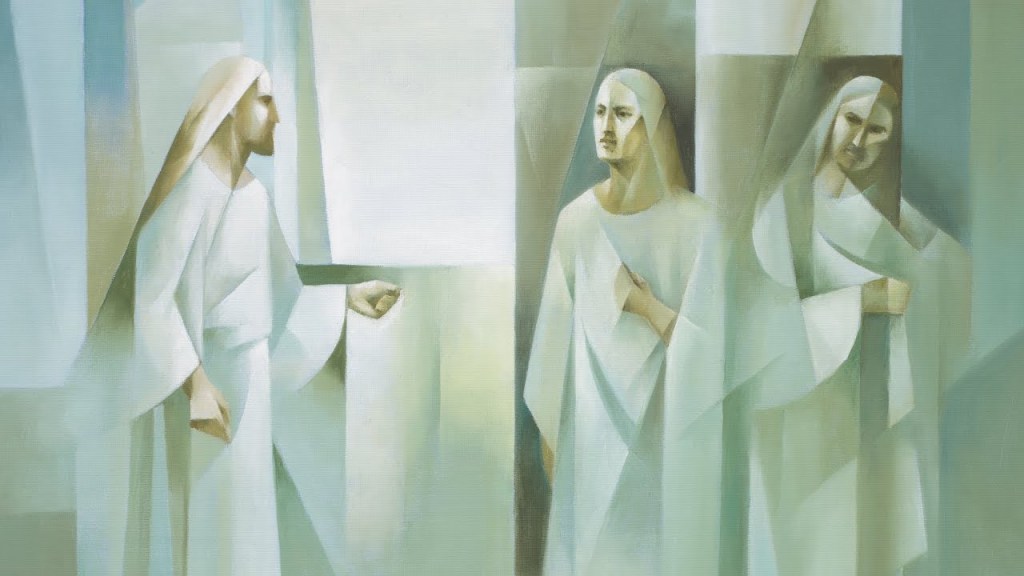
Lazarus and the Sacrament of Confirmation

5th Sunday of Lent [A]
March 26, 2023
John 11:1-45

There are seven signs (or miracles) in the Gospel of John. Naturally, the Church has recognized these seven miracles correspond to the seven sacraments. Last Sunday, we have seen that the healing of the man born blind turns out to be the sign to the sacrament of Baptism (see John 9:1-41). Now, we discover another Jesus’ sign-miracle, that is, the raising Lazarus to life. This miracle points to the sacrament of confirmation.

The sacrament of confirmation is often misunderstood and even neglected. There are many reasons for this. Some of us may feel that it is not necessary. We feel that we are already fulfilling sacred obligation when we are baptized, go to the Mass every now and then, and perhaps go to the confession once a year. Other receive an insufficient catechesis, and therefore, our understanding on the sacrament is very limited and even fussy. Others do not want to trouble themselves with another series of catechesis before the Confirmation. Others receive the sacrament without proper catechesis because their weddings are fast approaching. Thus, many see the confirmation as the second-rate sacrament.

However, this is not true at all. The Church continues to teach that this sacrament has indispensable role in the lives of the faithful. In fact, it is the second of the three sacraments of the initiation (together with baptism and Eucharist). To be full and mature member of the Church, we must receive the grace of the Holy Spirit imparted in the sacrament of confirmation. Now, how does today’s Gospel relate to the sacrament?

Firstly, Lazarus, together with Mary and Martha, has a loving friendship with Jesus before the miracle. This condition shows us that Lazarus is the symbol of baptized Christians who live in Christ. Secondly, Lazarus’ death and his going back to life point to the new life in the Spirit. John the Evangelist narrated explicitly that Lazarus has been in the tomb for four days (John 11:17). This is important detail, that is, Lazarus is truly dead, and his soul is no longer with his body. Thus, miracle of Jesus is a divine act that brings back life, uniting body and soul. While it is true that the Holy Spirit is not mentioned, but Jesus’ miracle brings us back to the creation of man where the Spirit of God was active and life-giving.

Finally, the miracle has enduring effects in Lazarus. After his return from the dead, Lazarus becomes a living witness to Jesus’ power and love. Because of Lazarus’ testimony, many come to Jesus and believe in Him. And for the same reason, Lazarus faces persecutions from Jesus’ enemies [see John 12:9-11]. Yet, Lazarus does not coward. He has been through death, but not even death can separate him from the love of Christ.

What happen to Lazarus are also happening in us. When we are baptized, we receive a loving friendship with Christ. Yet, in the sacrament of confirmation, our souls receive the gifts of the Holy Spirit and we become a mature Christians. We are now transformed to be a living witnesses of Jesus Christ and bring more people to God. We also are empowered to endure hardship and persecution because of Christ.

This is why before receiving the sacrament of holy matrimony or the sacrament of holy orders, we need to receive the confirmation. These two are the sacraments of service and witnessing, that bring other closer to holiness. Thus, only mature Christians are fit for this tasks. We are not only called to be Jesus’ friends, but also His brave witnesses to the world, and this sacrament makes us one.

Rome
Valentinus Bayuhadi Ruseno, OP

Healing of the Blind Man and Baptism

4th Sunday of Lent [A]
April 19, 2023
John 9:1-41

There are seven signs (or miracles) in the Gospel of John. Naturally, the Church has recognized these seven miracles corresponds to the seven sacraments entrusted to her. The healing of the man born blind turns out to be the sign to the sacrament of Baptism. Since the basic theme of Lenten season is baptism, the Church does not hesitate to place this reading during this holy season. But, is true that this miracles is related to baptism? And how do we know?

The story begins with Jesus and disciples saw a poor blind man. Then, His disciples start to ask Him, ‘Rabbi, who sinned, this man or his parents, that he was born blind (John 9:2)?’ Jesus’ disciples believe that his sufferings are consequences of his personal sins, or at least his parents. Yet, Jesus immediately teaches them the truth. Jesus points out that neither blind man nor his parents have sinned to cause him blindness. Although sufferings and death are indeed related to sin, but the relation is not linear, but a mystery. The man does not commit personal sins, but he bears the consequence of sin. How is it possible?

The Church recognizes this condition as the original sin. Every descendant of Adam and Eve was born into the world as ‘enemies’ of God. Since we are in the womb of our mothers, we were ‘sinners’, not because we commit any personal sins, but because we are far from God and do not have a spiritual friendship with Him. Thus, because of the original sin, we are susceptible to various sufferings as well as struggling with concupiscence (check also my reflection two weeks ago).

How does Jesus heal this blind man? Jesus spats on the ground and makes clay with the saliva, and smears the clay on his eyes. Finally, He asks the blind man to wash himself with water. Why does Jesus perform such a weird and unhygienic treatment? Jesus performs what God did in the beginning: the creation of man. When God created Adam, He molded a soil of the ground. There is a Jewish tradition that says that God used His own saliva to make soil easier to form. Jesus does the same here. He is bringing the man with blindness into healing by ‘re-creating’ him. Then, the final healing takes place when the man wash himself with water.

What happens to the healed man, takes place also in every person during the baptism. What we see in our eyes is someone is washed with water, but spiritually, God is making us a new creation. All sins, both original and personal sins, are cleansed. Our souls are transformed into the likeness of Christ and are elevated into the adopted children of God. Thus, we call God our Father, not in the metaphorical sense, but in the real one.

Lastly, towards the end of the story, Jesus asks him, ‘Do you believe in the Son of Man?’ Eventually, the man professes his faith in Jesus and worships Him. Faith is integral part of baptism; whether we believe before the baptism (like in the case of adult baptism) or after baptism (in the case of infant baptism). However, baptism is just the beginning, and our faith must also grow.

We are not sure what the man does after the healing he received, but we may believe that he becomes Jesus’s disciple and follow Him. After baptism and initial faith in Jesus, the Church encourages us to continue our journey of holiness. We grow in faith through living in Christ, works of charity, and proper reception of other sacraments.

Rome
Valentinus Bayuhadi Ruseno, OP