

Reflection on the 32nd Sunday in Ordinary Time [November 11, 2018] Mark 12: 38-44
[the Scribes] devour the houses of widows and, as a pretext, recite lengthy prayers. They will receive a very severe condemnation. (Mk. 12:40)
 In Jesus’ time, the scribes are the well-educated Jewish men who are expert in the Law of Moses. Some of them come from the wealthy families, and others hail from the priestly clan. Being able to teach and interpret the Law, they receive the respect and honor from the ancient Jewish society. Thus, ordinary Jews will greet them and prepare them the seats of honor in the synagogues and the banquets. Surely, there is no problem with receiving greetings and sitting as honor guests. Jesus Himself is often greeted as “Teacher” or “Rabbi”, and He attends the banquets as guest of honor (see Mar 14:3). The problem comes when some of the scribes possesses “narcissistic desire” and intentionally look for these privileges.
However, not only Jesus criticizes them for this narcissistic attitude, He gravely condemns also their acts of injustice, particularly “devouring the houses of widows.” In Jesus’ time, widows (Hebrew “almanah”) is considered to be one of the poorest and weakest. They are women who do not only lose their husband, but also fall into deeper poverty because they no longer have anybody to support them. They are lucky if their family and relatives take care of them, but in difficult times, they are left to their own. The Law of Moses provides that the widows, together with the orphans and strangers should be protected (see Deu 10:18).
Since the scribes are the respected and wealthy members of the society, it is a logical choice to entrust the care of Jewish widows to them. Unfortunately, instead helping and defending the widows, some of the scribes oppress and steal from the little the widows have. To steal is evil, but to rob the poor people who place their trust in us is far greater evil. Yet, it is not yet worst. After perfectly hiding their acts of injustice, some of the scribes continue going to the Temple and reciting lengthy prayer, as if there is nothing happens. This is hypocrisy, a double-life attitude at its finest!
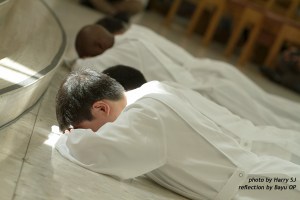
As my ordination day to the diaconate is drawing closer, some of my brothers in the community and friends began to call me with title of honor like “reverend” or simply, “rev”. Admittedly, I am not comfortable with it. I wish that the people remain calling me brother. However, it has become the common practice in the Catholic Church to honor her ordained ministers. It is my prayer and my sincere wish I will not be like some of the Scribes who become “narcissistic” and “covets” the people’s adulation and all the privileges it brings. George Weigel, an American Catholic author, in his recent article, traces the root of Catholic anger against the clergy in the US. He writes that while it is true that many clergymen are good and holy, it is the clerical narcissism that builds anger of the Catholic lay.
Learning from the scribes, the narcissism is the seed. The vice grows into hidden acts of injustice. And from evil of injustice, the men in white garment are turning worse as they live in hypocrisy. It is my earnest hope that we continue praying, supporting and even correcting our brothers who are ordained to become the servants of God and His people. Without God’s grace, the right dose of humility and lay people’ prayer and help, our deacons, priests and bishops may become like the scribes who earn Jesus’ condemnation.
Br. Valentinus Bayuhadi Ruseno, OP
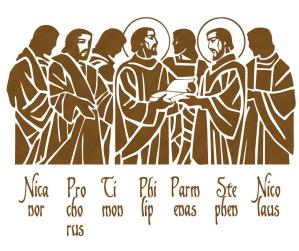 I am currently preparing for my ordination to the diaconate. It is a transitional stage before I become a priest of Jesus Christ. Despite the fact of being transitional, a deacon in itself is an important state in the life of the Church. Bishop Virgilio David, DD of Kalookan reminded the 15 newly-ordained Jesuit deacons in his homily last October that we shall not see a deacon as a mere stepping step toward higher states, like priests and bishops. It is the very core in the layers of concentric circles that make up the ordained ministries of the Church. The diaconate is not a lower rank but the core, without which both the offices of presbyters and bishops collapse. It is the foundation on which we build leadership in the Church. Yet, why do the deacons have to be placed at the core, and become the foundation?
 I made my religious vow more than eight years ago with 12 other Dominican brothers. One of the most touching moments within this rite of the religious profession was when Fr. Provincial asked us, “What do you seek?” and we all prostrated, kiss the ground, and declared, “God’s mercy and yours!” After a brief moment, Fr. Provincial asked us to stand, and we began professing our vows before him. As I recall this defining moment in my life, I am pondering in my heart, “Why it has to be mercy?” Why do we not choose other Christian virtues? Why not fortitude, one of the cardinal virtues in the Christian tradition? Why not love, the greatest of all virtues?
 “Power tends to corrupt, and absolute power corrupts absolutely.” This familiar adage comes from an English noble, Lord Acton in his letter to Bishop Mandell Creighton in 1887. Lord Acton observed that people who possessed absolute control over other persons were inclined to abuse their power and exploit their subjects. This happens throughout human history. Jesus and His disciples themselves witnessed these corrupt powerful leaders during their time and eventually, became victims of this corruption.
 We discover at least three instances in the Bible in which Jesus explicitly expresses that He loves someone. The first instance is that Jesus loves the young rich man who seeks the eternal life (Mrk 10:21). The second is Jesus loves Martha, Mary, and Lazarus (Jn 11:5). The third is Jesus’ love for His disciples, especially His beloved disciple (Jn 13:34).
 If there is one prayer that can change the course of world history, it is the earnest recitation of the holy rosary. In 1571, through the unceasing prayer of the rosary, a league of Christian nations called by Pope Pius V was able to stop the military advancement of the mighty Ottoman empire to western Europe in the Gulf of Patras, near Lepanto, Greece. In 1917, Our Lady appeared to three little children in Fatima, and one of her messages was to pray the rosary for the peace of the world. Through nation-wide recitation of the rosary, Austria was freed from the communist regime in 1955. In 1960, led by Catholic women marching the streets while praying the rosary, Brazil was also spared from communism.
 When I was assigned to the hospital to serve as a chaplain, I witnessed the rise of diabetic cases as well as its terrifying effects on the patients. In simple term, diabetes is a condition in a person who can no longer naturally manage their blood sugar. In more serious cases, the body loses its natural ability to heal its wounds. In the beginning, it was a small open wound, yet since the body no longer heals, the infections set in, and this leads into gangrene or the death of the body’s tissues. I accompanied some patients who were struggling with this situation and witnessed how their fingers or even foot were darkened and deformed. When the ordinary treatment no longer worked, the amputation became the only merciful option as to prevent the spread of infections. As a chaplain, accompanying these patients was one of my toughest missions in the hospital.
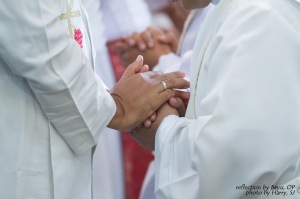 While I was reflecting on this Sunday’s Gospel, I was able to discover some news about our Church. Good News! The Catholic Church in the Philippines is preparing herself for the 500 years of the arrival of Christianity in this archipelago. The first baptism and Eucharist were taking place in 1521 as the Spanish missionaries began their evangelization mission. As part of this grand preparation, the Bishops of the Philippines have decided to celebrate this year as the year of the clergy and the consecrated persons. The major theme of this year is the renewed servant-leaders for the new evangelization. In view of this, many programs and activities are organized to help both the ordained ministers and the religious brothers and sisters to deepen their commitment to God and their service to the people.
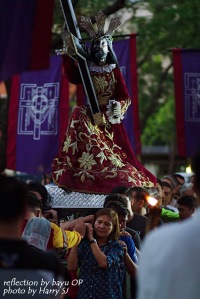 Several years ago, I gave a talk on the introduction to Christology to a group of young Filipino professionals who wished to deepen their spirituality. The first question I asked them as we commenced the short course was, “Who do you say that Jesus is?” The answers were varied. Some gave a dogmatic formula like Jesus is God, one quoted the Bible saying Jesus is the Word made flesh, one expressed boldly that Jesus is Savior and Lord, and the rest shared personal convictions like Jesus is their closest friend, or Jesus is their Shepherd. All these answers were right, but nobody claimed that Jesus is the Christ. Considering that our subject was Christology, we missed the basic Jesus’ title, in Greek, “Christos,” in Hebrew, “Messiah,” and translated into English, the Anointed One. Fortunately, around two thousand years ago, Simon Peter was able to spell the title when Jesus Himself asked the question.
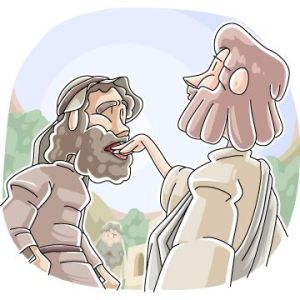 The deaf man whom Jesus heals is so blessed. He is able to see Jesus, and He finds healing. Inspired by this miracle, we wish that we will also meet Jesus and He will heal our sickness and solve our problems. Thus, we come to various places where we believe Jesus will heal us. We visit pilgrimage sites, we attend prayer and worship meetings, we recite various novenas, and we become actively involved in the Church’s organizations. We believe that our faith in Jesus will save us. However, what if our prayers are not granted? What if our problems are not solved but rather grow in number? What if our sickness is not healed, but gets worse? What if we do not feel that we are saved? One time, I visited Flora [not her real name], a colon-cancer patient, and she asked me, “Brother, I have faith in God, and I faithfully serve the Church, but why am I suffering from this terrible sickness?” Surely, it was a tough question.
