

30th Sunday in Ordinary Time [October 27, 2019] Luke 18:9-14
 In Jesus’ time, they were several Jewish religious groups and one of them is the Pharisees. These are the people who love the Lord and devoutly observe the Law of Moses and the traditions of the elders even in their daily lives. Thus, Jewish people regard them as righteous because they are faithful to the Law, and pious because they pray often. Many Pharisees turn to be the caretakers of the local synagogues and zealously teach the Law during Sabbath days. No wonders, the Jewish people offer the Pharisees the best places in the worship places and the parties. The leaders are called the Rabbis or teachers.
In contrast, we have tax collectors. This is the profession that most Jews hate at least for two reasons. Firstly, tax collectors tend to corrupt by demanding more than what is due. Secondly, the tax collectors work for the Roman Empire, a gentile and oppressive nation. This makes them both sinners and unclean.
When Jesus presents these two characters in His parable, His Jewish listeners immediately see that the Pharisee is the good guy and the tax collector is the bad guy. The Temple of Jerusalem consists of several courts, from the Holy of Holies going out to the court of the Gentiles. The Pharisee as a devout and clean Israelite will pray at the inner court of the Temple, closer to the sanctuary. While the tax collector is standing perhaps at the court of the Gentiles, where the unclean people and sinners are allowed to get closer.
However, Jesus once again twists the minds of His listeners. The tax collector comes up as the hero of the story, as God hears his prayers and accepts his sincere repentance.
Before God, we are judged not so much by external appearance and social standing, but primarily by internal disposition, by faith. The Pharisee is full of himself and doing nothing but praying to himself [see verse 11]. How can a person pray to himself? He boastfully compares himself with others and puts down others. This is not a prayer, but rather a litany of self-praise. But, the tax collector in all humility recognizes himself as a sinner and asks nothing but God’s mercy.
Appearances and social standing do not guarantee our holiness, and this has a massive implication in our daily lives. We cannot simply judge that a priest who celebrates the mass, who stands on the sanctuary, is holier than an ordinary man who prays at last pew of the Church. We cannot judge a woman who visits the adoration chapel and recite the rosary every day is holier than a woman who has no time to visit the Church because she has to work hard to feed her children. We cannot judge that a man who is active in the parish is holier than a man who is inside the jail. In the first place, it is not our duty to judge others’ holiness. If we are busy judging others, we are no different from the Pharisee in the story who even prays to himself.
Valentinus Bayuhadi Ruseno, OP
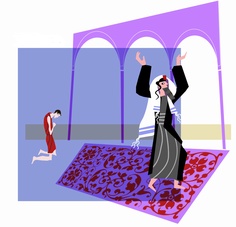 Pada zaman Yesus, ada beberapa kelompok di dalam agama Yahudi dan salah satunya adalah orang-orang Farisi. Inilah orang-orang yang mencintai Tuhan dan dengan taat mematuhi Hukum Musa dan tradisi para penatua bahkan dalam kehidupan sehari-hari mereka. Jadi, orang Yahudi menganggap mereka sebagai orang benar karena mereka setia kepada Hukum, dan saleh karena mereka sering berdoa. Banyak orang Farisi menjadi pengurus sinagoga dan dengan tekun mengajarkan Hukum saat hari-hari Sabat. Tidak heran, orang-orang Yahudi memberikan kepada orang-orang Farisi tempat-tempat terbaik di tempat-tempat ibadah dan pesta-pesta, dan memanggil beberapa dari mereka sebagai Rabi atau guru.
 Suffering, sickness, and death do not care whether you are Jews or Samaritans, whether you are rich or poor, whether you are old or young. When it strikes, it strikes. In time of Jesus, leprosy or Hansen’s disease was still one of most dreadful sicknesses. It ate you your skin and made you ugly. It is highly contagious, and thus, cut you from your community. It was incurable and thus brought you a slow and agonizing death.
 Penderitaan, penyakit, dan kematian menyerang tanpa pandang bulu. Tidak peduli apakah orang Yahudi atau orang Samaria, apakah kaya atau miskin, apakah tua atau muda. Pada zaman Yesus, kusta atau penyakit Hansen masih merupakan salah satu penyakit yang paling mengerikan. Itu memakan kulit kita dan membuat kita jelek. Ini sangat menular, dan dengan demikian, dikucilkan dari komunitas. Penyakit ini tidak dapat disembuhkan dan dengan demikian membawa kematian yang lambat dan menyakitkan.
 If there is one most powerful force in the universe, it will be faith. Jesus teaches us that even faith as small as a mustard seed can do the impossible. Jesus preaches that with this little faith, we can command a sycamore tree be uprooted and be planted in the sea. One of the smallest things on earth can move the most significant reality in the world. The sycamore tree has both deep, strong and widespread roots. It is just impossible to uproot it when it has grown mature. Yet, Jesus surprises further even by saying that we can replant this on the bed of the ocean. That makes it doubly impossible. Jesus is pushing his teaching on faith beyond natural human reasoning!
 Jika ada satu kekuatan paling dahsyat di alam semesta, ini adalah iman. Yesus mengajarkan kepada kita bahwa iman sekecil biji sesawi dapat melakukan hal yang mustahil. Yesus menyatakan bahwa dengan iman yang kecil ini, kita dapat memerintahkan pohon ara dicabut dan ditanam di laut. Salah satu hal terkecil di bumi dapat menggerakkan realitas paling besar di dunia. Pohon ara memiliki akar yang dalam, kuat dan menyebar. Tidak mungkin mencabutnya ketika sudah dewasa. Namun, Yesus bahkan mengatakan bahwa kita tidak hanya mampu mencabutnya tetapi juga menanam kembali ini di dasar samudera. Itu membuatnya mustahilnya doble! Inilah hebatnya iman yang kita miliki.
 Chapter 15 of the Gospel of Luke contains three of the most heartwarming as well as powerful parables in the entire Bible. These three parables are known as the parable of the lost sheep, the parable of the lost coin, and the parable of the prodigal son. If we look closer into these three parables, what is so stunning and astonishing is how Jesus bends, twists and stretches human logic and natural tendency to nail His point.
 In ancient Israel, the masters of the house were often leaving their homes for business trips or attending social gatherings like weddings. They would entrust their houses and their possessions to chief servants. And this was the world without a cellular phone, internet, and GPS. Thus, the servants have no idea of the ETA (estimated time of arrival) of their masters. It could be 8 PM, midnight or even early in the morning. The best attitude of a servant in this scenario is to be always vigilant and prepared for the arrival of his master.
 Di Israel kuno, tuan rumah sering meninggalkan rumah mereka untuk perjalanan bisnis atau menghadiri pertemuan sosial seperti pernikahan. Mereka akan mempercayakan rumah dan harta benda mereka kepada seorang hamba yang adalah hamba utama. Dan kita perlu ingat bahwa ini adalah dunia tanpa telepon seluler, internet dan GPS. Dengan demikian, para pelayan tidak tahu dengan pasti waktu kedatangan dari tuan mereka. Bisa jadi jam 8 malam, tengah malam atau bahkan dini hari. Sikap terbaik seorang pelayan dalam skenario ini adalah untuk selalu waspada dan siap menghadapi kedatangan tuannya.
 Today the Church is celebrating the solemnity of the Body and Blood of Jesus Christ. In many countries like Indonesia, today is the best time for the children who are already prepared to receive their first Holy Communion. I still recall the day I partook of the sacred host and the holy wine. Many of us were around 10 years old, old enough to recognize the presence of Christ in the Eucharist and we were dressed in white. I was wearing long-sleeved white shirt with a tie and black pants. When the priest dipped the white bread into the chalice of wine and said, “the body and blood of Christ”, I said “Amen.” It was my first time to savor the sweetness of wine, and of course, alcoholic beverage!
