
Pentecost Sunday [A]
Acts 2:1-11
May 24, 2026
Pentecost is often seen as the reverse of the Tower of Babel. Yet, why does the Church draw a connection between these two distinct stories? The answer is language.
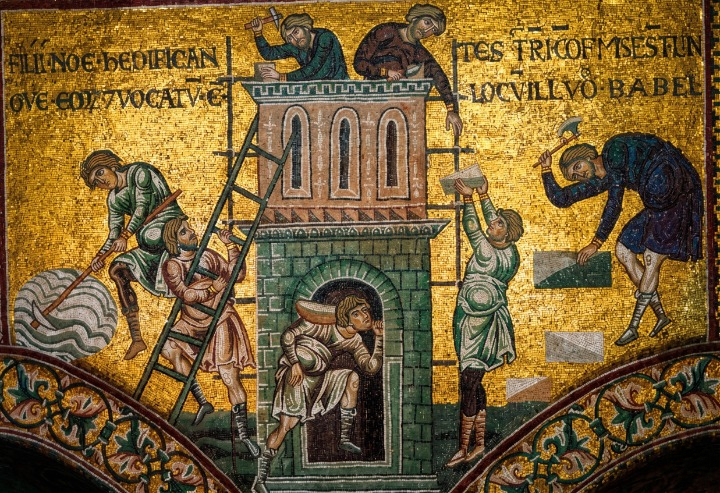
In Genesis 11, we see the function of language in action. The text tells us that early humans shared one language and the same words. This unity allowed them to share ideas seamlessly and cooperate easily, driving their progress as a society. Language enabled them to develop technologies like brick-making, build a city that required complex political and economic systems, and construct a massive tower demanding advanced engineering.
Language sets us apart from all other creatures. While animals communicate, only humans share complex ideas. Animals can exchange basic information about food and predators, but humans convey ideals, future dreams, imagination, past wisdom, and learning. While animals communicate through sounds and scents, only humans can put their words into writing, passing their thoughts down to future generations. Through written language, we transform our words into art, poetry, music, and science.
Consider the fascinating development of human babies. Compared to other animals, human infants are incredibly vulnerable, relying entirely on their parents for survival for several years. Yet, despite this physical weakness, they possess something no other animal has: an innate capacity for language. In their first two to three months, babies begin making musical, vowel-like sounds like “ooh” and “ah.” They cry, smile, and laugh in response to their parents. By four to six months, they start combining consonants and vowels into repetitive sounds like “ba-ba” or “ma-ma,” practicing with their vocal cords. Between six and twelve months, they begin connecting sounds to meaning—saying “mama” to specifically call for their mother. They also start using gestures, pointing at what they want or waving goodbye, and begin to understand simple words like “no.” It is clear that babies are born to use language.
Unfortunately, the people of Genesis 11 forgot one fundamental truth: human language is essentially a gift from God. In Genesis 1, God created the world through His words, meaning that words and language belong properly to Him. When He created man and woman in His image, He empowered us with intellectual capacity, including the ability to form and use language. The builders of Babel, however, believed that their intellect, language, science, art, and other great gifts were entirely their own achievements. Armed with these tools, they pridefully sought to reach the heavens and make a name for themselves (Gen 11:4).
Pentecost reverses the incident at Babel by revealing that language is a gift of the Holy Spirit. The primary purpose of this gift is to proclaim the great works of the Lord, not the works of humans. Pentecost reminds us that our language not only unites us with one another, but also connects us to God. Before the disciples received the gifts of the Spirit, they spent their time praying—and prayer is simply communication with the Lord. Before they spoke about God, they first spoke to God. We do not need to build towers with our hands to reach the heavens; we only need to use our God-given language to reach Him in humility.
Rome
Valentinus Bayuhadi Ruseno, OP
guide questions:
In our daily lives, do we use our words to build a name for ourselves (like at Babel), or to unite and uplift those around me?The disciples spoke to God before they spoke about Him—how much of our daily language is dedicated to speaking with God in humility?Since our words are a gift meant to proclaim the Lord’s great works, what message is our speech broadcasting to the world right now?

