

Sixth Sunday of Easter. May 21, 2017 [John 14:15-21]
“I will ask the Father, and he will give you another Advocate to be with you always, (Joh 14:15)”
 Have you seen a spirit? When the word ‘spirit’ is mentioned, what image does appear in your mind? Perhaps, scary ghosts from some urban legends or Hollywood horror movies. The word ‘spirit’ conjures terrifying and often creepy images because it is related with the dead, the afterlife, and unexplained paranormal phenomenon. The Church herself warrants the existence of evil spirit or the demons, as the Church fights them through the ministry of exorcism.
However, in the bible, spirit is not frightening, and in fact, it is a fundamental concept and reality. In Hebrew language, spirit is ‘ruah’. This word ‘ruah’ is closely related to breath, air or wind. Spirit is like an air. It is formless and invisible, but all things are filled and surrounded by it. Spirit is like a wind. It cannot be controlled, but it is a powerful force that shapes nature. And spirit is like a breath. We cannot see and touch it, yet it fills us with life. Early in the story of creation, the Spirit of God was already introduced, as this Spirit swept over the waters (Gen 1:2). This ‘breath’ appeared once again in the story of human creation. God then breathed to his nostril the breath of life and man came to life (Gen 2:7). Then, when men and women became wicked, God would take away His ‘spirit’ from them and they would go back to earth (see Gen 6:3). From here, we can learn that the spirit is the power behind creation. It is the source of life in us. Moreover, it connects us with the Divine. Yet, because of sins, it might be lost, and man and woman shall go back to earth.
In today’s Gospel, Jesus taught that this Spirit of God is not just an inanimate force, but He is also a person. Jesus introduced Him as another Advocate. The word ‘another’ is significant, because the first Advocate is actually Jesus Himself (see 1 John 2:1). When Jesus went to the Father, the Spirit shall continue the works of Jesus and stand as His witness. As the divine Advocate, He will help, defend, strengthen, console and teach those who have faith in Jesus. It is important also to note that the Spirit is given in the context of keeping Jesus’ commandment. What is the new and greatest commandment of Jesus? “Love one another. As I have loved you, so you also should love one another (Jn 13:34).” The Spirit aids us in loving God and one another. In fact, He is our very power and capacity to love. Without Him, it is just impossible to love like Jesus.
Now we learn that the presence of the Holy Spirit is not only during the charismatic prayer meetings where someone begins to speak in tongue, but His presence and activity are permeating our lives. When we wake up in the morning and we are reminded to pray, He is in us. When we are hated and persecuted, yet we still proclaim the truth, He is in us. When living becomes laborious and painful, but we continue to love, He is in us. He is our Advocate, the third person in the holy Trinity, the Holy Spirit
Br. Valentinus Bayuhadi Ruseno, OP.

 Jesus was about to leave His disciples and go back to His Father. The disciples were confused and failed to understand. Some were afraid of losing their Messiah. Some were puzzled by the actions of Jesus. Yet, despite this confusion and fear, Jesus reminded them not be troubled and to have faith in God and in Him.
 Jesus is not the gatekeeper, but Jesus is the gate Himself. A gate or a door gives a passage or access to a sheepfold, a house, a building or a room. It both separates and connects the insiders and the outsiders. In fact, the gate is as essential as the house itself. What is the building without a door or an entry point? It is either a construction error or it is not a sheepfold or a house at all. The gate is not only an accessory to the house, but it also defines the house itself. Is it an accessible house, locked house or not a house at all?
 Luke wonderfully narrated the Journey to Emmaus in such a way that it became a catechetical instruction on the Eucharist. The two disciples were actually running away from Jerusalem. After the death of their master, the situation turned to be dangerous for their lives. They were afraid of the Jewish authorities and their hope and dream of having a Messiah were shattered. Better for them to go away and return to their former lives. Yet, Jesus surprisingly came, healed their wounds, and reappointed them as His apostles. However, let us see some details of today’s Gospel and how this narrative speaks of the Eucharist.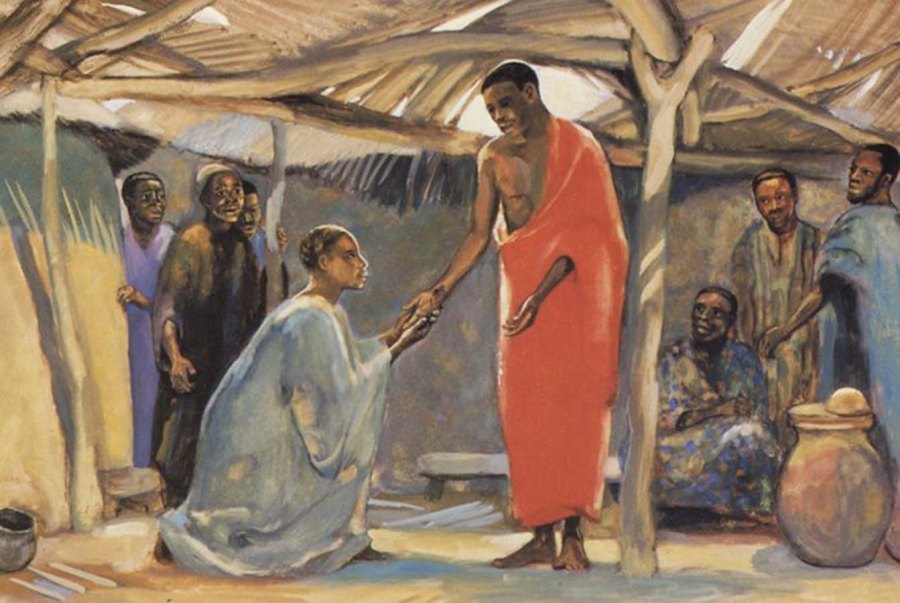
 Thomas was looking for a proof that Jesus truly rose from the dead. Not only seeing Him in person, he required another sign: touching the crucifixion marks that Jesus bore. He was one of the Twelve, the inner cycle of Jesus’ disciples, and being one, he had the privilege to walk with Jesus, dine with Him, and witness His mighty deeds. At a first glance, he would easily recognize Jesus, his Master, but still, he demanded the marks of the nails. Why did Thomas insist on searching the wounds?
 If we read the Resurrection narrative in the four Gospels, we will discover that each Evangelist has his own distinct story. Yet, there are some common features in the Resurrection episode: the empty tomb, the presence of women, the appearance of angel followed by the risen Christ, and the women announcing the Good News to the other disciples. Let us focus on one particular feature that we usually miss. The first witnesses of the resurrection were not men, but women. Where were the male disciples? Where were those men who promised to sacrifice their lives for Jesus? They were in hiding. They were afraid. They were scattered.
 Many theologians and ordinary Christians alike are baffled by these words of Jesus on the cross. If Jesus is God, how is it possible for Him to be separated from God? Why does the most compassionate God abandon His beloved Son? It simply does not make any sense. The Catechism of the Catholic Church tries to explain that it is a consequence of sin. Not that Jesus had committed any sin, but He endured the sin of the world on the cross. The greatest effect of sin is separation from God. Thus, carrying the heaviest burden of sin, Jesus could not but feel the chilling effect of alienation from His own Father.
 Today’s Gospel contains my personal favorite verse: Then, Jesus wept. It is the shortest verse in the Bible, yet it is also one of the most powerful. However, its strength does not rest on any superhuman power that can multiply bread or calm the storm, but on the humanity of Jesus.
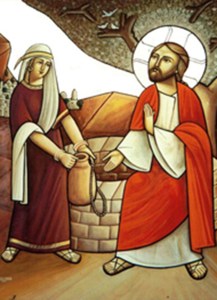 Many of us will see Jesus’ conversation with the Samaritan woman as something ordinary, a chat between a man and a woman. But, if we go back to the time of Jesus, we will discover it as unthinkable. This Samaritan woman embodied what the Jews hated most. Firstly, despite their common ancestry, the Samaritans and the Jews were excommunicating each other. Despite worshipping the same God, they condemned one another as religious heretics and they proclaimed their own religion as the true one. No wonder, sometimes, the encounter between the two turned violent and the Romans had to quell the riots.
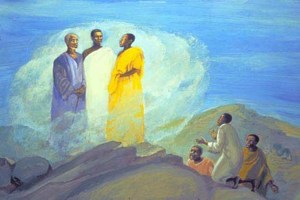 In the Bible, the mountain is the place where God meets His people. On Mount Horeb, Moses saw the burning bush and received his calling to lead Israel out of Egypt’s slavery (see Exo 3). On Mount Sinai, after the liberation of the Hebrews, Moses met the Lord and received the Law in the Mount Sinai (see Exo 19). Again on Mount Horeb, Elijah discovered the gentle presence of God (1 Kings 19:11-15).
