The Story of the Elder Son

4th Sunday of Lent [C]
March 27, 2022
Luke 15:1-3, 11-32

The parable of the prodigal is one of the most beautiful and heart-warming stories in the entire Bible. It is, in fact, the longest among Jesus’ parables and loaded with exciting details. While a great deal of the parable is given to the younger son, the story ends with the elder son. Many of us identify with the younger son. We used to live in the life of sin, far from God, and even become the enemies of God. Yet, we felt empty, and our lives go in the wrong direction. Then, going back to our senses, we repent and go back to the Lord. However, not a few identify themselves with the elder son.

Personally, I tend to be sympathetic to the elder son, perhaps because I am also the eldest in the family. I feel that the elder son’s anger is nothing but natural. I will be angry if my younger brothers ask for his inheritance and leave the family behind for a life of dissipation. I will be even more enraged when he suddenly comes back, and my parents will accept him as if nothing happens. At least, he must be disciplined and make reparations for what he has done. It is just and right!

Yet, after I go deeper into the story, I realize some critical details. The elder son is angry, and, in his wrath, he refuses to enter the home. Without realizing it, the elder son does what, the younger son did: leaving his house. Then, He says, “this son of yours!” He could have said, “Father, why do you treat my brother like this!” Without realizing it, the elder son does what the younger son did: distancing and disassociating himself from his father. Another interesting fact is that the elder son says, “I have been working like a slave for you.” Without realizing it, the elder son becomes what, the younger son has been: a slave.

Son though he is, he never considers himself as one, but rather a mere slave. We can see how the elder son only views his brother as another runaway slave and his father as an enslaver. A disobedient slave must be punished severely, and the loyal servant must be rewarded. Therefore, he is distraught. His paradigm is violated. He fails to see from his father’s perspective, and thus, he suffers.

From this story, we see a deeper meaning of metanoia or repentance. Metanoia [change of mind] does not simply mean turning from a life of sin to a life with God. It also means having the mind and heart of God. We are invited to think and act, no longer as slaves fearing punishment, but as mature children of God. Unfortunately, some of us are like the lost firstborn, who see ourselves as nothing more than servants, and we build our relationship with God based on fear, not love. We go to church because otherwise, we will go to hell. We serve because otherwise, we will be cursed. And we begin to see our neighbors as servants who have to follow the rules blindly; otherwise, they will be severely punished. Metanoia means no longer living in fear but as children of God living in love and freedom.

Valentinus Bayuhadi Ruseno, OP

From Transfiguration to Calvary

Second Sunday of Lent [C]
March 12, 2022
Luke 9:28b-36

Every second Sunday of Lent, the Church chooses the event of Transfiguration for our Gospel reading. During this moment, Jesus, together with three trusted disciples, went up to the mountain, and there, he was transfigured or changed appearance. He was radiating a divine glory, and His face turned to be a bright light. The two most outstanding persons in the Old Testament, Moses and Elijah, appeared and accompanied Jesus. He was manifesting His divine nature to the three disciples, and it was an overwhelmingly joyful moment. Simon did not want the experience to pass and offered to build tents there. The question is that why does the Church choose this reading for this season of Lent?

The answer lies on the topic that Moses, Elijah and Jesus were discussing: Jesus’ exodus. When we hear the word exodus, the first thing that comes to mind is that the Israelites under Moses escaped the slavery of Egypt. The Israelites passed through the Reed Sea, the desert from Egypt and eventually entered the Promised Land. Their final destination was the city of Jerusalem.
Then, why did Jesus speak about His exodus?
The reason is that Jesus is the new Israel, and as the old Israel passed through exodus, Jesus had to undergo His exodus. However, unlike the old Israel that started their exodus in Egypt, Jesus began His exodus in Jerusalem. Unlike the old Israel that was not faithful to God in the desert and worshipped idols, Jesus was obedient to His Father through suffering and death. Unlike the old Israel who entered the promised Land with many lost battles, Jesus rose from the death and won definitively against Satan and His kingdom. Unlike the old Israel who went up to the earthly city of Jerusalem, Jesus gloriously ascended to the heavenly Jerusalem.
After the event of Transfiguration, Jesus no longer stayed in Galilee but steadily moved toward the city of Jerusalem. This is why we have this reading for the season of Lent. As Jesus journeyed to His exodus in Jerusalem, we are also walking with Jesus in this season of Lent toward the Paschal Triduum: from the Mount of Transfiguration to the mount of Calvary.
The story of Transfiguration in the context of Lent gives us a precious lesson. Like Peter, we like to linger in the glorious moments of our lives. Yet, Jesus teaches that our real glory has to pass exodus. Our Egypt, our starting point, is none other than our old and sinful selves. Any moment of glory without dying to ourselves is fake, fickle and even addictive. It is undoubtedly not easy because we are craving for the feeling of pleasure, and when we get used to it, the harder it is to detach ourselves. Through the disciple of Lent, fasting, prayer and almsgiving, we are learning how to die to our desire to enjoy instant gratifications. When we can adequately order our worldly desires, the more our hearts desire for God, and the moment we are one with God, we find our true joy.

Valentinus Bayuhadi Ruseno, OP

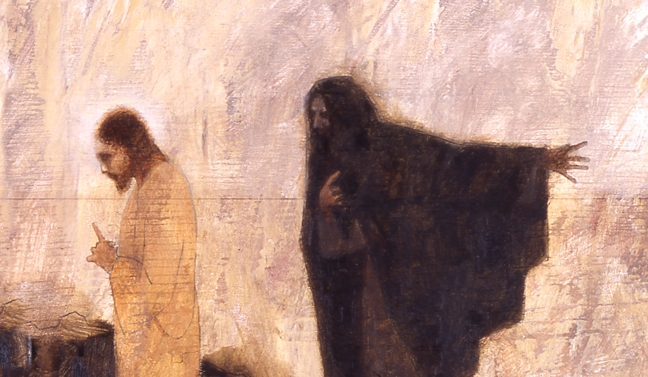
Yesus, sang Setan, dan Sabda Allah

Minggu Prapaskah ke-1 [C]
6 Maret 2022
Lukas 4:1-13

Minggu Prapaskah ke-1 [C]
6 Maret 2022
Lukas 4:1-13

Pada Minggu pertama Prapaskah, Gereja selalu memberikan bacaan Injil tentang Yesus di padang gurun selama 40 hari. Ada beberapa alasan untuk pilihan ini. Pertama, karena Yesus tinggal selama empat puluh hari di padang gurun, kita juga diundang untuk memasuki padang gurun Prapaskah selama 40 hari. Kedua, karena Yesus berpuasa dan berdoa di padang gurun, kita juga dipanggil untuk berpuasa dan berdoa selama masa Prapaskah ini. Ketiga, Yesus mengajar kita bagaimana melawan iblis dan godaannya. Karena saat ini kita berada di Tahun Liturgi C, kita dapat belajar dari kisah Yesus di padang gurun dari sudut pandang Lukas. Salah satu yang menonjol dalam perdebatan antara Yesus dan sang iblis adalah bagaimana firman Tuhan digunakan.

Pada Minggu pertama Prapaskah, Gereja selalu memberikan bacaan Injil tentang Yesus di padang gurun selama 40 hari. Ada beberapa alasan untuk pilihan ini. Pertama, karena Yesus tinggal selama empat puluh hari di padang gurun, kita juga diundang untuk memasuki padang gurun Prapaskah selama 40 hari. Kedua, karena Yesus berpuasa dan berdoa di padang gurun, kita juga dipanggil untuk berpuasa dan berdoa selama masa Prapaskah ini. Ketiga, Yesus mengajar kita bagaimana melawan iblis dan godaannya. Karena saat ini kita berada di Tahun Liturgi C, kita dapat belajar dari kisah Yesus di padang gurun dari sudut pandang Lukas. Salah satu yang menonjol dalam perdebatan antara Yesus dan sang iblis adalah bagaimana firman Tuhan digunakan.

Yesus menghadapi tiga godaan Iblis. Ini adalah tiga area di mana pribadi manusia secara rohani lemah. Yang pertama adalah godaan kedagingan, dan hal ini menyerang keinginan kita untuk kenikmatan badani seperti makanan dan hubungan suami-istri. Yang kedua adalah godaan keserakahan, dan hal ini mengeksploitasi keinginan kita untuk memiliki hal-hal yang kita lihat. Terakhir tapi paling mematikan, adalah godaan keangkuhan. Godaan ini membingungkan cinta-diri yang sejati dengan perilaku narsistik. Godaan ini adalah yang terburuk karena keangkuhan akhirnya menyedot kita ke dalam gagasan palsu bahwa kita bisa menjadi tuhan-tuhan kecil.

Ini adalah godaan yang Iblis lemparkan kepada Yesus. Godaan kedagingan diluncurkan ketika Yesus lapar dan diminta untuk mengubah batu dan roti. Godaan keserakahan dimulai ketika Yesus dibawa untuk melihat keajaiban dunia dan ditawarkan untuk memiliki semuanya. Terakhir, godaan keangkuhan dimulai ketika Yesus diundang untuk memamerkan kuasa-Nya karena Dia memiliki otoritas untuk memerintahkan para malaikat.

Tentu saja, iblis gagal total. Namun, yang lebih menarik adalah cara Yesus melawan iblis. Setiap kali iblis melancarkan serangan, Yesus dengan bijak membalasnya dengan kutipan dari Perjanjian Lama. Sungguh, Firman Tuhan adalah senjata ampuh melawan serangan dan godaan iblis. Jadi, penting bagi kita untuk mengenal Alkitab kita dan mempelajarinya dengan baik.

Namun, itu bukan akhir dari cerita karena iblis pun menggunakan ayat Alkitab. Dia mengutip bagian dari Mazmur 91, “Dia akan memerintahkan malaikat-malaikat-Nya tentang kamu, untuk menjaga kamu… [Mzm 91:11]”. Apa yang lebih luar biasa adalah bahwa Mazmur 91 secara tradisional digunakan untuk pengusiran setan. Iblis menggunakan kata-kata yang digunakan untuk mengusirnya! Bagaimana ini mungkin? Pasalnya, iblis menggunakan ayat alkitab di luar konteks dan hanya sesuai dengan tujuannya, yaitu menjebak Yesus.

Dari kisah ini, kita mendapat pelajaran berharga. Kata-kata Kitab Suci, bila digunakan dengan cara yang tidak tepat dan hanya sesuai dengan tujuan kita, menjadi alat Iblis. Kita dipanggil untuk meneladani Yesus dalam menjalankan firman Tuhan. Hanya jika kita benar-benar membaca Alkitab dalam konteks yang tepat dan dalam relasi kasih dengan Tuhan, ini benar-benar menjadi Firman Tuhan yang penuh kuasa.

Valentinus Bayuhadi Ruseno, OP

Jesus, the devil, and the Word of God

1st Sunday of Lent [C]
March 6, 2022
Luke 4:1-13

On the first Sunday of Lent, the Church always gives the Gospel reading on Jesus in the desert for 40 days. There are several reasons for this choice. Firstly, as Jesus stayed for forty days in the desert, we are also invited to enter the desert of Lenten season for 40 days. Secondly, as Jesus fasted and prayed in the desert, we are also called to fast and pray during this season of Lent. Thirdly, Jesus teaches us how to fight against the devil and his temptation. Since we are currently in the Liturgical Year C, we can learn from the story of Jesus in the wilderness from Luke’s perspective. One is prominent in the debate between Jesus and the devil is how the word of God is used.

Jesus is facing three devil’s temptations. The traditions call the three Concupiscences. These are three areas where human persons are spiritually weak. The first is the lust of the flesh, and it attacks our desire for bodily pleasures like food and sexual relationship. The second is the lust of eyes, and it exploits our desire to possess the things we see. Lastly but most deadly is pride. This confuses genuine self-love with narcissistic behaviors. This is the worst because pride eventually sucks us into the false idea that we can become a god without God.

These are the temptations that the devil throws into Jesus. The lust of the flesh is launched when Jesus is hungry and asked to turn stone and bread. The lust of the eye is commenced when Jesus is brought to see the worldly wonders and offers to have them all. Lastly, the temptation of pride is initiated when Jesus is invited to show off His power as He has the authority to command the angels.

Surely enough, the devil fails miserably. Yet, what is more, interesting is the way Jesus resists the devil. Every time the devil launches an attack, Jesus wisely counters it with the quotations from the Old Testaments. Indeed, the Word of God is a powerful weapon against the assault and temptation of the devil. Thus, we need to know our Bible and learn them by heart!

Yet, that is not the end of the story because even the devil uses the Bible verse. He quotes parts of Psalm 91, “He will command his angels concerning you, to guard you… [Psa 91:11]”. What is more remarkable is that Psalm 91 is traditionally used for exorcism. The devil is using the very words that used to expel him! How is this possible? The reason is that the devil uses the bible verse out of context and only to suit his purpose: to trap Jesus.

From this story, we learn a valuable lesson. The words of Scriptures, when misused way and only to fit our purpose, are become the instruments of the devil. We are called to imitate Jesus in living the word of God. Only if we indeed read the Bible in its proper context and a loving relationship with God, they truly become the powerful Word of God.

Valentinus Bayuhadi Ruseno, OP

Beyond Ordinary Love

7th Sunday in Ordinary Time [C]
February 20, 2022
Luke 6:27-38

‘To love your enemies’ is considered the most difficult of Jesus’ teachings. It is not only extremely tough, but it is practically impossible. Our natural tendency and feelings are to hate those who hurt us and despise those who harm us. Especially when we are still hurting, we want to get even as soon as possible. We desire our enemies to feel our pains, and the more pain, the better. How is this teaching even possible?

photocredit: Jan Tyson

However, Jesus does not say, ‘like your enemies’, but ‘love them’. The Gospel even specifies that the Greek word for ‘love’ here is ‘agape’. This is a love based not primarily on emotions but free will and commitment. It may be impossible to change our adverse feelings toward someone who hurt us, but it remains possible to decide not to inflict injuries and even do something good for them. Thus, after He says, ‘love your enemies, Jesus further clarifies, ‘do good to those who hate you, bless those who curse you, and pray for those who abuse you.’ To do good, bless, and pray are not feelings of love but acts of love. St. Thomas Aquinas synthesizes this teaching of Jesus and defines love as ‘to will the good of others’

Yet, despite the truth about agape and our God-given ability to perform something against our natural inclination, loving our enemies is just a hard pill to swallow. Though we know the theories, we are also struggling to do it. Then, we are back at our original question: ‘why does Jesus teach something impossible?’

To answer this, we have to see a bigger picture. The teaching to love our enemies is not the only hard saying of Jesus. Through His ministries, Jesus teaches several teachings and commandments that seems unthinkable. Jesus declares that divorce is not the plan of God for man and woman. Jesus reveals that His body is real food and His blood is a real drink, and only by consuming His body and blood we can have eternal life. And, most of all, Jesus unveils the most profound mystery of God, the Trinity, and He Himself is the second person of the Trinity than became flesh. All of these are humanly impossible to do and to believe, but why does Jesus insist on teaching them?

The answer lies in the grace of God. Jesus understands that these are divine revelations, and relying only on human wisdom and strength, we are bound to fail. Thus, the Holy Spirit and His grace supply what is fundamentally lacking in us. Like we cannot believe in Jesus as our Lord unless moved by the Holy Spirit, we will not be able to love our enemies unless the same Holy Spirit empowers us. Jesus knows that His teachings are humanly impossible, but He also gives us the necessary grace to enable us to perform the impossible. Then, loving our enemies is indeed grace-filled love and supernatural love. If we are still finding it hard to love our enemies, perhaps, this is the time to rely more on God’s grace.

Valentinus Bayuhadi Ruseno, OP

Woe to You

6th Sunday in Ordinary Time [C]
February 13, 2022
Luke 6:17, 20-26

Today’s Gospel presents us with the Beatitudes according to St. Luke. There is a fundamental similarity with Matthew’s version [see Mat 5:1-11], yet there are also some glaring differences between the two. One of the most apparent distinctions is the presence of ‘woes’ in Luke’s version. What is a ‘woe’ anyway?


In the context of the Bible, ‘woe’ is a cry of impending distress used by the prophet Israel [see Is 5:8–22; Amos 6:1; Hab 2:6–20]. The prophets called for repentance of Israel and return to the Lord God, yet if the Israelites remained stubborn, the woe should become a reality, and they would endure the terrible consequences. In the Gospel, Jesus practically did what His predecessors had done. Yet, there is also something new that Jesus introduced.


The prophets were pronouncing the woes to hardened people of Israel who truly did wicked things before the Lord. They worshipped other gods, abandoned the true God, and even worse, offered their children to these gods. They were also involved in sexual immorality and injustice to the weak and the poor. The Israelites were violating every single commandment in the Decalogue. In this context, God’s severe judgment was right and just. However, if we try to compare the prophets of the Old Testament and Jesus, we notice something remarkably odd.


Jesus’ woes were to those who are rich, filled with food, laughing, and praised. Jesus never said, ‘woe to you, idolaters!’ or ‘woe to you adulterers!’, but He pronounced judgment to those who are laughing. But why? Is it not to laugh is healthy? Is it genuinely evil to have money? Is it wrong to praise someone who deserves it? It seems that Jesus is a bit excessive when giving away His woes.
However, we must see entire things of Jesus’ saying. Jesus did not simply say ‘woe to you, rich people.’ The complete sentence is, ‘woe to you, who are rich, for you have received your consolation.’ Jesus emphasized the truth that the woe is for those who make wealth their consolation. Earthly goods, including wealth, are naturally good, but they always serve as means, not the end. The same with laughter and other bodily pleasures. These are good and natural to us human persons. In fact, laughter makes us uniquely human, as no other animals can do the same. Yet, again, if we prioritize our bodily pleasures and lose God in the process, everything will be for nothing.


It is also the same with praises and affirmation we receive. Parents’ honest appreciation will solidify our self-esteem as little kids, and genuine commendation will make us grow in confidence. Yet, if we are obsessed with getting praises and oblations, this may do more harm than good. The highest honors belong to God.


Like the prophets of old, Jesus sounded harsh teachings, but He is genuinely concerned with our salvation and happiness. Jesus tells us that if we fail to make God our end, blessing, especially earthly ones, can turn curses and woes. Jesus’ tough love constantly pulls us away from the eternal sadness.

Valentinus Bayuhadi Ruseno, OP

The Called

5th Sunday in Ordinary Time [C]
February 6, 2022
Luke 5:1-11

This Sunday, we listen to the vocation stories of three great persons in the Bible: Isaiah, Paul, and Peter. Indeed, they have their own unique stories with a different context. Isaiah had a vision of the heavenly Temple of God. Paul was making his journey towards Damascus. In contrast, Simon was doing his job as a fisherman. However, there is something common with the three of them.

photocredit: Jacquelin o Gara

Simon, Paul, and Isaiah admitted that they were sinners before God. The most obvious case is Paul, who used to be the persecutor of the Church. He was involved in many terrible sufferings of many Christians, and in fact, he saw the Lord in his mission to bind the Catholics in a chain in Damascus. Before the Lord, Isaiah claimed that he was a man of unclean lips and living among the people of the unclean lips. We are not entirely sure what ‘unclean lips’ means. It may refer to the sin of blasphemy that is insulting God’s name. Another possibility is the sin of untruthfulness. Isaiah and the Israelites were living in lies and dishonesty.

Meanwhile, Simon acknowledged before Jesus that he was a sinful man. Again, we are not sure what Simon’s sin was. He might be someone who possessed anger issues, which affected his life and others.

The response of Jesus to Simon’s admission of his sinfulness was not belittling his condition. Jesus never said, “It is fine. It is not a big deal!” Jesus recognized Simon’s human weakness and frailty. Perhaps, in His divine intellect, Jesus knew that Simon would eventually deny Him thrice and run away like a coward. Yet, Jesus still called Simon and said, “Do not be afraid; you will be catching men.”

God does not call Simon, Paul, and Isaiah because they are perfect and blameless men. God calls them despite their sinfulness and invites them to be part of His work. God makes Simon the fisher of men, Paul the greatest apostle to the nations, and Isaiah the great prophet of the Old Testament. Amazing things happen when we say ‘yes’ to God’s plan. They failed and faltered, and God will raise them again. If we say ‘no’ to God’s plan and our excuse is that we are sinful, weak, and incapable, that is false humility and, in fact, lack of faith. We do not trust God enough that He can transform us into a better version of ourselves. We doubt that God will equip us for the mission.

Yet, it is equally vital always to remember who we are: both weak and sinful as well as loved and called. We cannot be boastful if we succeed in our ministries because apart from God, we are nothing. Paul said in his letter that he is the most hardworking among all the apostles, but immediately he admitted that it was because of the grace of God [see 1 Cor 11:10]. Paul eventually concluded, “Whoever boasts should boast in the Lord [1 Cor 1:31].”

Valentinus Bayuhadi Ruseno, OP

Agape

5th Sunday in Ordinary Time [C]
January 30, 2022
Luk 4:21-30
1 Cor 12:31 – 13:13

What is the greatest gift of the Holy Spirit for Paul? Is it speaking in tongue? Gift of understanding intricate mysteries of God? Gift of performing mighty deeds or healing? For Paul, it is love.

photocredit: Brett Jordan

Paul himself says that if we have the gift of tongues to speak foreign languages or the language of angels, it will be useless without love. If we have the gift of prophecy or possess the knowledge and understanding of the mysteries of faith or the faith to move the mountains, they will be meaningless without love. If we donate everything we have, and to the point of sacrificing ourselves, but the motive is not to love, then it will be useless.

But, what makes this love is special? In Greek, several words can be translated as ‘love,’ namely ‘eros,’ ‘filia,’ and ‘agape.’ Eros is a love that unites man and woman in marriage and is open to new life. Filia is the love of friendship. People who have the same interest or vision in life tend to like and stick together as friends. Then, we have ‘Agape.’ This kind of love is radically different from Eros and Filia. While the other two are love moved by emotional power, agape primarily is the willpower and commitment. No wonder it is also called sacrificial love.

One powerful element that Paul introduces to the agape as a gift of the Holy Spirit is that it is not a static gift. It is not only something received and then given. Paul calls it ‘the most excellent way.’ The word ‘way’ points to journey, process, and growth. Agape is dynamic and growth-oriented. We do not only love, but we also grow in love.

In English, the words used to describe agape are adjectives, but these words are verbs in original Greek. Agape is not something static but action-oriented and dynamic. Agape is not simply patient, but agape is trying to be patient. Agape is not merely kind, but it is performing kindness. There is a transformation from someone who does not care about others to someone who learns to show compassion. Agape is not simply quick-tempered but is making a great effort not to be destructive in expressing anger.

What is fantastic about agape is that it is a gift of God for every Christian, and we possess the ability to learn and grow in love. We might not have the gift of healing, or the gift of prophecy, or the gift of performing miracles, but we can learn to be more patient with one another. We might not have the charism to teach or the authority to govern our communities, but we can decide not to be rude to people we do not like. We might not be the most brilliant guys in the group or someone who contributes a lot to others, but we can always be someone who patiently listens.

Agape is both the most fundamental as well as the most excellent. We are called to grow in love each time because, in the end, all things will cease, and only love remains.

Valentinus Bayuhadi Ruseno, OP

Rahasia Pernikahan yang Bahagia

Minggu ke-2 Masa Biasa [C]
16 Januari 2022
Yohanes 2:1-11

Saya benar-benar beruntung dapat mengunjungi kota Kana di Galilea tepat sebelum pandemi covid-19 merajalela. Di sana, saya berkesempatan memimpin pembaruan ikrar janji nikah pasangan-pasangan yang ikut dalam perziarahan. Salah satunya adalah orang tua saya, dan tentu saja, itu adalah saat yang cukup membuat saya canggung. Namun, saya sangat bersyukur ketika saya menyadari kesetiaan mereka, melalui suka dan duka kehidupan pernikahan, tetapi yang terpenting, saya bersyukur atas rahmat Tuhan yang berkerja dalam hidup mereka.

Masyarakat modern kita ditandai oleh banyaknya pasangan suami istri yang menghadapi masalah pelik pernikahan dan juga orang-orang muda yang tidak lagi melihat pernikahan sebagai bagian mendasar dari kehidupan mereka. Perceraian menjadi normal baru, dan perselingkuhan merajalela. Kekerasan dalam rumah tangga mewarnai media berita dan media sosial kita. Ada pasangan-pasangan menolak untuk memiliki anak atau hanya menyerahkan anak kecil mereka ke babysitter. Beberapa orang bahkan menolak sama sekali pernikahan, dan menganggap pernikahan dan keluarga sebagai beban dan ‘penjara’. Beberapa lebih memilih hewan peliharaan daripada membesarkan keluarga manusia yang nyata.

Pernikahan dan membesarkan anak tentunya tidak mudah, tetapi itu sangat penting bagi masa depan kita sebagai umat manusia. Namun, hal ini bukan hanya masalah kelansungan kita sebagai spesies, tetapi juga merupakan rencana Tuhan bagi kita untuk berpartisipasi dalam kepenuhan hidup. Jika kita melihat lebih dekat pada Alkitab, kita akan menemukan tempat sentral dari pernikahan di dalam Kitab Suci. Kisah penciptaan memuncak dengan pria dan wanita menjadi satu dalam perjanjian pernikahan. Mukjizat pertama Yesus terjadi dalam konteks pernikahan dan bagi pasangan yang sedang menikah. Buku terakhir dari Alkitab, Kitab Wahyu, berakhir dengan pesta pernikahan Anak Domba.

Lalu, bagaimana kita mengatasi masalah-masalah besar yang menimpa pernikahan? Tentu banyak hal yang perlu kita lakukan, namun ada satu cara mendasar yang tidak boleh kita lewatkan. Injil memberitahu kita bahwa masalah kekurangan anggur dihindari karena pasangan itu mengundang Yesus, dan ibu-Nya. Maria memperhatikan masalah serius yang ada dan meminta Putranya untuk campur tangan. Yesus melakukan mukjizat-Nya yang pertama, dan bukan hanya masalah anggur terpecahkan, tetapi mereka juga mendapatkan anggur terbaik. Semua ini terjadi bahkan tanpa disadari oleh pasangan yang berpesta tersebut tersebut.

Ini adalah pelajaran berharga dari Pernikahan Kana. Sudahkah kita mengundang Yesus dan sang Bunda-Nya ke dalam pernikahan dan keluarga kita? Apakah kita mengandalkan Tuhan dalam upaya kita membesarkan anak-anak kita? Sudahkah kita mendekatkan satu sama lain kepada Tuhan? Jika kita membawa Tuhan dalam pernikahan dan keluarga kita, saya percaya bahwa Tuhan telah melakukan hal-hal yang luar biasa bahkan tanpa kita sadari.

Kembali ke Injil ini, kepala pelayan memuji pengantin pria karena anggur terbaik yang bertahan sampai akhir. Ketika pernikahan dan keluarga kita berhasil melewati badai kehidupan, kita diundang untuk menyadari bahwa anggur terbaik adalah dari Tuhan. Pernikahan yang bahagia terdiri dari pasangan yang bersyukur.

Valentinus Bayuhadi Ruseno, OP

The Secret of Happy Marriage

2nd Sunday in Ordinary Time [C]
January 16, 2022
John 2:1-11

I was truly fortunate that I could visit Cana in Galilee just before the covid-19 pandemic. There, I had the opportunity to officiate the renewal of marriage vows of the couples who participated in the pilgrimage. One of them was my parents, and indeed, it was an awkward moment for me. Yet, I was full of gratitude as I recognized their faithfulness to one another through the thick and thin of marriage life, but most of all, I am grateful for God’s grace in their life.

Our modern societies are marked by countless married couples facing complex problems and young people who do not see marriage as a fundamental part of their lives. Divorce becomes the new normal, and infidelity is rampant. Domestic violence colors our news outlets and social media. Couples refuse to have children or hand over their little children to babysitters. Some people even decline to commit to married life and consider marriage and family a burden and ‘prison.’ Some choose pets rather than raising a real human family.

Marriage and rearing children are not easy, but they are critical to our survival to our future as a human race. Yet, it is not only for us as species, but it is also God’s plan for us to participate in the fullness of life. If we look closely at the Bible, we will discover the central place of marriage within the Scriptures. The story of creation culminates with the man and the woman becoming one in a marriage covenant. The first miracle of Jesus took place within the context of marriage and for the sake of the married couples. The final book of the Bible, the Revelation, ends with the wedding feast of the Lamb.

How, then, do we counter these herculean problems that beset marriage? Indeed, there are many things we need to do, yet, there is one fundamental way we must not miss. The Gospel tells us that the lack of wine was averted because the couple invited Jesus and His mother. Mary noticed the looming serious problem and requested her Son to intervene. Jesus did His first miracle, and not only problem solved, but they got the best wine. All this happened even without the couple being aware of it.

This is a precious lesson from the Wedding of Cana. Have we invited Jesus and His mother into our marriage and family? Do we rely on God in our effort to raise our children? Do we bring one another closer to God? If we bring God into our marriage and family, I believe that God has done marvelous things even without noticing it.

Going back to the story, the steward praised the groom for the best wine that lasted to the end. When our marriages and families succeed through the storms of life, we are invited to recognize that the best wine is from the Lord. Happy marriages consist of grateful couples.

Valentinus Bayuhadi Ruseno, OP