Basilica St. John Lateran

Feast of the Dedication of the Lateran Basilica in Rome [C]

November 9, 2025

John 2:13-22

Today, the Church celebrates the Dedication of the Basilica of St. John Lateran in Rome. While many of us may be unfamiliar with this basilica, and others may wonder why its dedication is celebrated with such solemnity. To understand why, we must journey back to the earliest days of the Catholic Church.

The first Christian community in Rome was likely established around 33-34 AD. The Acts of the Apostles tells us that Jewish pilgrims from Rome were present at Pentecost, heard Peter’s preaching, were baptized, and carried the faith back to the imperial capital (Acts 2:1-42). This was the seed of the Church in Rome. When St. Peter himself arrived, he was recognized as the leader—the first Bishop of Rome.

For centuries, this fledgling Church endured severe persecution. The first state-sanctioned persecution began under Emperor Nero in 65 AD, who scapegoated Christians for a great fire in Rome. Nero’a persecution claimed the lives of the great Apostles Peter and Paul. The most systematic and brutal persecution, however, came later under Emperor Diocletian (303-311 AD), who ordered the destruction of scriptures, sacred places, and the execution of Christians across the empire.

This era of darkness gave way to light. After Diocletian, the empire fell into civil wars. Several generals, including Constatine, fought for the throne. On the eve of the decisive Battle of the Milvian Bridge, near Rome, in 312 AD, Constantine reportedly saw a vision of a cross in the sky with the words, “En Toutō Nika”—”In this sign, conquer.” Following a dream of Christ, he had his soldiers mark their shields with the Chi-Rho (☧). After his victory, Constantine not only ended the persecution of Christians but became a powerful patron of the Church.

In thanksgiving, he donated the former property of the Lateran family to the Church. On this land, he built a great basilica dedicated to Christ the Savior—the first public papal basilica (later, it would be dedicated also to St. John the Baptist and St. John the Evangelist). Pope St. Silvester accepted this gift and established it as his cathedral, the official seat of the Bishop of Rome. This was a monumental shift: the Church emerged from the hidden catacombs into the public square, a powerful sign of God’s providence and victory.

This is why the Basilica of St. John Lateran holds the title “Omnium Urbis et Orbis Ecclesiarum Mater et Caput”—”The Mother and Head of All Churches in the City and the World.” Though the popes moved their residence to the Vatican in the 14th century after a fire, the Lateran remains the Pope’s cathedral. Therefore, in celebrating its dedication, we celebrate the very foundation of the Church of Rome, the See of Peter, and the triumph of Christ’s Church over evil.

Rome

Valentinus Bayuhadi Ruseno, OP

Guide questions:

Are we truly aware of the rich and long history of our Church? Do we recognize that we belong to a greater, universal Catholic family spread across the world? How deeply do we live our faith each day? Have we ever experienced persecution, or are we blessed with the freedom to express our faith openly? What are we doing—personally and as a community—to help our Church grow in faith, love, and witness?

St. Joseph and the Happy Death

The Commemoration of All the Faithful Departed (All Souls)

November 2, 2025

John 6:37-40

St. Joseph, the foster father of Jesus, is celebrated as a holy model for husbands, fathers, and workers. Yet, he also holds a more poignant title: the patron saint of a happy death. But what does this mean? How can death, so often shrouded in fear and sorrow, ever be considered happy?

To understand this, we must first ask a more fundamental question: What constitutes a happy death? Does it mean being surrounded by family at a ripe old age, free from pain? Or a beautiful funeral in a well-kept cemetery? At first glance, happiness and death seem to be irreconcilable opposites. We are hardwired for life; we instinctively recoil from the suffering that reminds us of our mortality. So, how can we find happiness in the very event our entire being resists? To seek a happy death can feel like trying to capture the wind.

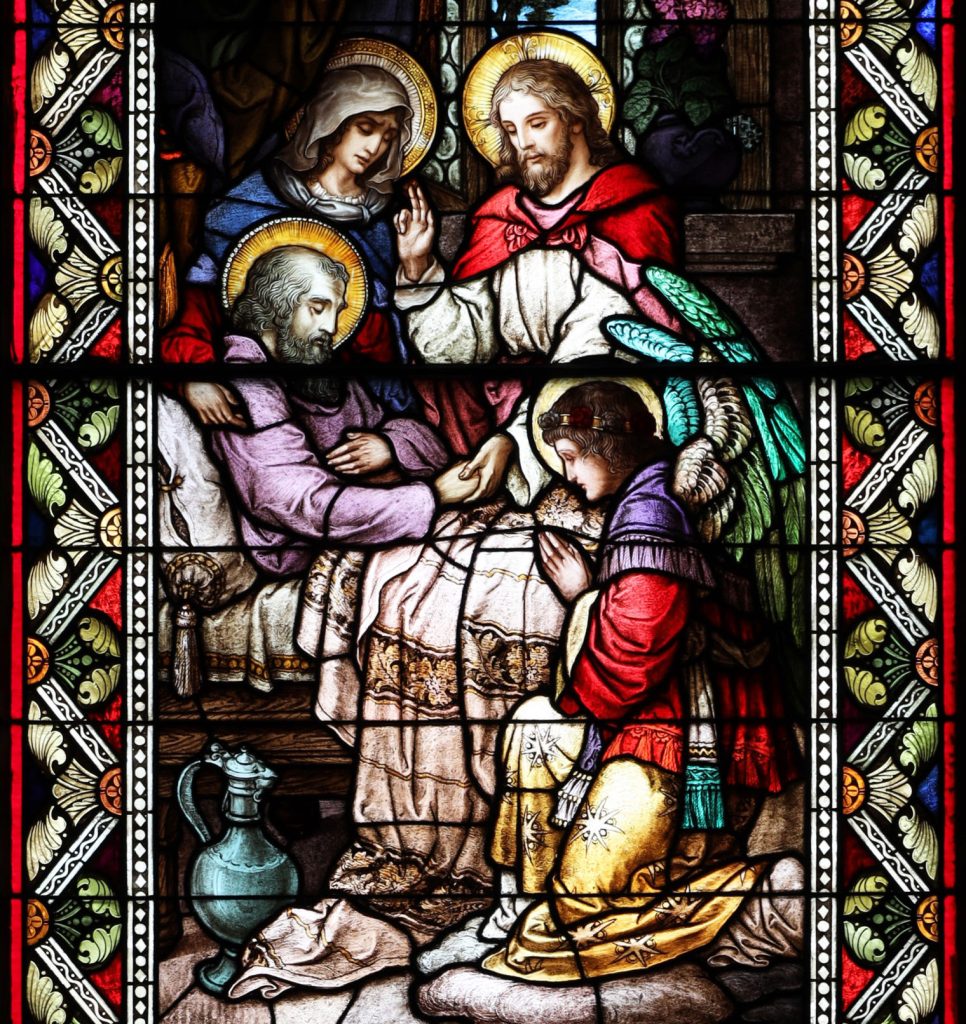
It is here that St. Joseph comes to our aid. His life provides the answer to this profound puzzle. Catholic tradition holds that at his dying moment, Joseph was not alone. He was cradled in the presence of Jesus and Mary. This sacred companionship at life’s end was simply the culmination of a life lived in constant communion with God. The key to a happy death is a life lived with God.

In the Catholic faith, death is the final and decisive act of life, eternally sealing our choice for or against God. St. Joseph embodies the ideal: on his deathbed, he turned to Jesus, his adopted son and the Lord of Mercy, and to Mary, his wife and the Mother of God. His was a happy death because the Jesus he embraced with his final breath was the same Jesus who welcomed him into the eternal joy of heaven.

Yet, St. Joseph’s lesson is not merely about how to die, but fundamentally, about how to live. The Gospel describes him as a “righteous man” (Matt 1:19). His entire life was a faithful “yes”—a dedication to God’s will, often at great personal cost. He faced uncertainty, exile, and hardship for the sake of his family. Because he spent his life seeking the Lord in every circumstance, it was the most natural thing in the world for him to seek Jesus at his final moment. His good death was the fruit of a faithful life.

As we pray for our dearly departed, St. Joseph offers us a profound hope. He reminds us that for those who live faithfully with Christ, death does not destroy life but perfects it. It is not an end, but a gateway to unquenchable joy. This is the happy death.

St. Joseph, patron saint of a happy death, pray for us!

Guide Questions for Reflection:

Are we cultivating a life with Christ that prepares us to face our death with peace? Do we see death as a terrifying end, or as a passage to eternal life? In our daily choices, are we building the habit of turning to Jesus, as Joseph did? Do we seek the intercession of St. Joseph, asking him to pray for a holy death for ourselves and for all those who need it most?

The Nameless Rich Man

26th Sunday in Ordinary Time [C]

September 28, 2025

Luke 16:19-31

The story of Lazarus and the Rich man does not only have a lot of lessons we can learn and imitate, but it also reveals the truth about our salvation. What are those?

1. The Plot Twist

The story of Lazarus and the rich man demonstrate Jesus’ wisdom as both a storyteller and a teacher. Most would assume the rich man is the protagonist, as his material wealth was seen as a sign of God’s favour. Conversely, Lazarus, in his poverty and sickness, would be viewed as a loser, suffering from divine disfavour. Yet, Jesus delivers a shocking twist that challenged his original Jewish audience and continues to challenge us today. In the end, the rich man, despite his extreme wealth, cannot save himself, while Lazarus, the poor man, receives God’s mercy and rests in the bosom of Abraham.

2. Not Just About Wealth

However, a deeper look reveals that Jesus is not simply condemning the rich and glorifying the poor. The rich man loses his salvation not merely because of his wealth, which can be a blessing from God when used as a means to an end. The core of his failure is his selfishness. He is depicted wearing expensive purple garments and feasting sumptuously every night, yet he chooses to ignore the desperately poor man at his gate. Despite having more than enough capacity to help, he closes his eyes, focusing only on his own pleasure.

Similarly, poverty alone does not automatically grant Lazarus a place with Abraham. The poor are also susceptible to sin, such as stealing or manipulation. Yet, Lazarus is described as one who “gladly” received the scraps from the rich man’s table. He refused to use his poverty as an excuse for sin, instead choosing gratitude for the little he had.

3. The Nameless Rich Man

Among the story’s three major characters, only one is left nameless: the rich man. Abraham, whose name means “father of many nations,” receives Lazarus, whose name is a Latinized form of the Hebrew “Eliazer,” meaning “My God is my helper.” This small detail is significant, illustrating a profound truth: we become what we love.

The rich man loved his wealth so dearly that he lost his unique identity, becoming known simply by his material status. He defined himself by his luxurious garments and lavish lifestyle. In contrast, Lazarus and Abraham loved God. The more they loved Him, the more they reflected His image, allowing their authentic, God-given identities to shine. Lazarus lived as one dependent on God’s help, and Abraham as a father to many nations. The more we love earthly things, we are absorbed into them, and gradually losing ourselves, yet the more we love God, the more we become like God, and we become more authentic.

Lourdes, France

Valentinus Bayuhadi Ruseno, OP

Guide questions:

Do we love God more than anything? What are things that prevent us from loving God? What are God-given missions in this life? Do we care for our unfortunate brothers and sisters around us?

The Cross that Heals

Feast of the Exaltation of the Holy Cross

September 14, 2025

John 3:13-17

The cross is a universal symbol of Christianity. People wear it as jewelry, like necklaces, rings, and earrings, either as a sign of devotion or simply as fashion. Churches and other Christian buildings are often crowned with its shape. Yet, despite its familiarity, the profound history and meaning of the cross can often be overlooked.

Historically, the cross was not a sacred symbol but a tool of terror. Crucifixion was a Roman method of execution designed for criminals and rebels. The condemned person was stripped naked, nailed to a wooden beam, and left to die a slow, public death exposed to the elements and humiliation. It was the ultimate symbol of human cruelty. This is the torture Jesus endured.

Yet, Jesus did not escape His cross. He embraced it. Through His resurrection, He transformed the cross from an instrument of torture into an instrument of God’s mercy and healing. In the Gospel, Jesus Himself draws a typological connection between His cross and the bronze serpent raised by Moses. Just as those who looked at the bronze serpent were healed, all who look to Jesus’ cross with faith will be saved.

This leads to the essential question: how does the cross heal us?

First, it heals through love. When we look at the cross, we see the ultimate proof of God’s love: He sent His only Son to offer Himself as a sacrifice to reconcile us to Himself. As St. Paul writes, “But God proves his love for us in that while we still were sinners Christ died for us” (Rom 5:8). We receive this healing from sin primarily through Baptism and the Sacrament of Reconciliation. Every sin wounds our soul and separates us from God; the cross stands as a permanent call to repent and return to Him.

Second, it heals through God’s presence. The cross shows us that God is not a distant deity, remote from our pain. He chose to become one of us, to share in our human experience with all its suffering. On the cross, Jesus embraced the worst of human agony, demonstrating that when we unite our sufferings with His, our own crosses can be transformed. They can become a divine means of healing and grace.

When suffering hits us, it is easy to complain and despair. But the cross reminds us we are not alone. Just as Jesus used His suffering to become a blessing for the world, we too can offer our own pains to God and become a source of strength and compassion for others.

St. Francis of Assisi once sought glory as a knight. After being captured in battle and becoming seriously ill, he recovered physically but still felt a spiritual emptiness. Everything changed while he was praying in a broken-down chapel. He had a vision of Jesus on the cross, who said to him, “Francis, go and repair my house, which is falling into ruin.” This moment gave Francis the true healing he needed, helping him discover who he was and what he was meant to do, to be God’s instrument of peace and healings.

Valentinus Bayuhadi Ruseno, OP

Guide questions:

What are our crosses in our lives? How do Jesus’ cross heal us? How? Do we become the means of God’s healing for others also? How?

To Hate and To Love

23rd Sunday in Ordinary Time [C]

September 7, 2025

Luke 14:25-33

We now encounter one of Jesus’ most challenging statements: He demands that we “hate” our parents, siblings, and even our own children. How are we to understand this hard saying?

To find the answer, we must consider three key elements: Jesus’ full statement, the meaning of the word “hate,” and the broader context of Jesus’ life and mission.

  1. The Full Statement
    First, we need to read the entire sentence. Jesus said, “If anyone comes to me without hating his father and mother, wife and children, brothers and sisters, and even his own life, he cannot be my disciple.” This is not a general command for everyone, but a specific condition addressed to those who wish to become His true followers.
  • The Biblical Meaning of “Hate”
    The word “hate” here (from the Greek μισέω – miseo) does not imply a feeling of strong aversion or enmity. In the Bible, this word often carries a comparative meaning: “to love less” or “to disfavor” in order to show preferential treatment to something else (see Genesis 29:31, Deuteronomy 21:15-16, Luke 16:13). In this context, Jesus is demanding that His followers make Him their absolute top priority. He is not asking us to detest our families, but to love Him so much that all other loves—even for our own lives—seem like hatred by comparison. A simpler way to phrase it is: Unless we love Jesus more than everything and everyone else, we cannot be His disciples.
  • The Broader Context
    Finally, we must remember that Jesus was speaking as He walked toward Jerusalem, where He would face His Passion and death on the cross. To follow Him meant to share in His suffering. This is only possible if a disciple prioritizes Jesus above all else. We see this exemplified in figures like Mary, His mother, who refused to hide but stood firmly at the foot of the cross, sharing in His agony. Other disciples, like John and Mary Magdalene, also followed Him to the very end, demonstrating this ultimate priority.


This teaching remains true for us today. To follow Jesus to the end requires loving Him above all. While not everyone is called to physical martyrdom like St. Ignatius of Antioch who was fed to the lions or St. Francis de Capillas was tortured and killed when he preached Jesus in China, every disciple is called to make Jesus the central priority of their life.

This doesn’t mean we must pray every second of the day. Instead, it means making daily decisions that reflect our love for Jesus and our desire to please God. This can be as simple as: Choosing to avoid sin and vice; Refusing to be a stumbling block for others; Prioritizing Sunday Mass, even while on vacation; Gently inviting family members to know Jesus more.

Loving Jesus is a conscious, daily decision to choose what strengthens our holiness and deepens our relationship with Him.

Surabaya

Valentinus Bayuhadi Ruseno, OP

Reflection Questions:

How do I concretely show my love for Jesus in my daily routine? Do my actions and words encourage others to love Jesus? Could my behavior be making it difficult for someone else to approach Jesus?

Honor and Holiness

22nd Sunday in Ordinary Time [C]

August 31, 2025

Luke 14:1,7-14

Honor is a fundamental concept that defines our humanity. It guides our behaviors and conduct, and in extreme cases, can compel people to die or even kill others.

Defining “honor” is challenging because it is deeply embedded in both our individual and communal identities. It refers to the ideals that we as humans, holds dear, such as loyalty, bravery, honesty, hardworking and moral integrity. While these values may vary across cultures, some are universally acknowledged and admired. Honor is earned when others recognize our efforts to achieve these difficult ideals. For example, a student may be honored with a medal for their hard-earned academic achievements.

The pursuit of honor is, therefore, a pursuit of our highest ideals, a striving for greatness that makes us more fully human. Conversely, dishonor signifies a failure to uphold these values. We are dishonored when we betray someone, whom we pledge our loyalty or cowardly avoid difficulty. Some societies value honor so deeply that they see a dishonorable life, like one of dishonesty, unfaithfulness, and cowardice, as worse than an animal’s existence. During World War II, many Japanese soldiers and civilians chose suicide over the shame of capture or coming home in defeat.

As our Lord, Jesus understood that honor is fundamental to humanity. Yet, He also recognized how sin can corrupt and twist it. In the Gospel, Jesus criticized those who sought places of honor without striving for the ideals they represent. Jesus taught that the true value of a seat at the banquet is not its prominence, but the virtuous life of the person sitting in it. More importantly, He called us to pursue true ideals and reject corrupt values, introducing humility as a virtue that earns genuine honor.

Jesus’ criticism of the Pharisees is timeless and profoundly relevant today. In postmodern societies, we often replace “the seat of honor” with superficial markers like clothing, cars, and bank accounts. While possessions are not inherently bad, they become harmful when we treat them as our standard of honor, and in the process, we sacrifice true ideals like honesty and loyalty to gain them. Spousal fidelity was once highly honored, but now some cultures praise promiscuity. We once lauded hard work, but now often celebrate only results, even if achieved through deceit.  To follow Jesus is to continually examine our ideals. It means rejecting those that do not lead to human flourishing and embracing those that foster genuine growth. Jesus, our Lord, wants nothing but our holistic growth as humans that eventually brings us into the fullness of human life and holiness.


Guide Questions:

What ideals do we strive for? Are they conducive to our development as humans? Do we feel shame when we fail to achieve our ideals or when we sin? Do we teach our children what it means to have a true sense of honor?

What is Faith?

19th Sunday in Ordinary Time

August 10, 2025

Hebrew 11:1-2, 8-19

The author of the Letter to the Hebrews gives us a profound definition of faith: “Now faith is the foundation of things hoped for, the evidence of things not seen” (Hebrews 11:1-2). But what does this truly mean?

Faith as a Firm Foundation

The Greek word used for “foundation” is ὑπόστασις (hupostasis), which literally means “that which stands underneath.” This tells us that faith is not a fleeting emotion or a momentary burst of belief. It is not something can instantly be produced through loud music or strong screams. Instead, it is a steady, unshakable confidence in God’s promises. Faith anchors us, giving substance to what we hope for even when we cannot yet see it.

Faith as Convincing Evidence

The author also describes faith as ἔλεγχος (elengkos), a term often used in legal contexts to refer to irrefutable proof. In a courtroom, verified evidence determines guilt or innocence. Similarly, faith serves as undeniable confirmation of spiritual realities we cannot perceive with our physical senses, our eyes, our ears, and our mouth. Though unseen, these realities are just as real because faith testifies to their truth.

Where Does Such Faith Come From?

But how can faith be so strong? How can it serve as both foundation and evidence? The answer lies in its source: faith does not originate from within us but from God’s faithfulness. The promises we hope for are not human wishes but divine guarantees. Since God is trustworthy, our faith rests on His unchanging commitment to fulfil His promises

Then, how do we know God is truly faithful? History proves it. The Old Testament is filled with stories of God keeping His word, and Hebrews highlights Abraham as a key example. At seventy-five, Abraham obeyed God’s call to leave his comfortable homeland for an unknown future and uncharted land. Despite his old age and Sarah’s barrenness, he believed God’s promise of descendants as numerous as the stars. Even when tested with the unthinkable, sacrificing his son Isaac, Abraham trusted God’s faithfulness that everything would turn just right. He died without seeing the full fulfilment, yet God’s promises came to pass.

The Ultimate Fulfilment in Christ

Hebrews shows us that God’s faithfulness, demonstrated through generations, culminates in Jesus Christ. He is the final and fullest expression of God’s promises. He was born like us humans, suffered and died for us, and resurrected. Our faith, therefore, is not only built on emotions or human reasoning but on historical acts of God, proven in the lives of believers before us and sealed in Christ. Faith is more than simple belief. It is trust in the One who has never failed. And because God is faithful, we can stand firm, even when the path ahead is unseen.

Valentinus Bayuhadi Ruseno, OP

Reflection Questions

  • How do we understand faith? Is it merely an emotional feeling, a product of logic, or a personal encounter with God?
  • Have we faced moments of doubt or a crisis of faith? How did we overcome them?
  • How does recognizing God’s faithfulness in Scripture strengthen our trust in Him today?

The Crisis of Fatherhood

17th Sunday in the Ordinary Time [C]

July 27, 2025

Luke 11:1-13

Many societies today face a silent yet deeply dangerous crisis: the crisis of fatherhood. But what exactly is this crisis, and how can we confront it?

At its core, the crisis of fatherhood reflects a reality where countless children grow up without an authentic father figure. Some fathers are physically absent; others are emotionally distant or fail to model the virtues their children desperately need. Meanwhile, modern culture—through films, advertisements, video games, and media—often portrays men as either violent villains or bumbling, indecisive figures. Rarely are they depicted as loving, responsible leaders.

This erosion of fatherhood is unravelling the fabric of society. Studies consistently show that children raised without engaged fathers face higher risks of drug and alcohol abuse, mental illness, poor academic performance, teen pregnancy, and criminal behavior. The consequences are profound and far-reaching for our societies.

So how do we address this crisis? There are no easy solutions, but we can begin by turning to Jesus. In the face of this global challenge, the prayer He taught His disciples, which we fondly call the Our Father, becomes more relevant than ever.

The most striking aspect of this prayer is how Jesus instructs us to address God. Though He is the Almighty Creator of heaven and earth, the God of the Old Testament, Jesus tells us not only to call Him “God,” but, He teaches us to say, “Our Father in heaven.” By using this intimate, human term, Jesus reveals a profound truth: God is not only infinitely powerful but also intimately close. He is not a distant, absent, and indifferent deity but a loving Father who provides, protects, and guides His children. As Deuteronomy 4:7 reminds us, He is near “whenever we call upon Him.”

Yet Jesus further clarifies that God is the Father in heaven. He is unlike earthly fathers, who are flawed and limited. God cares for us perfectly, giving sunshine and rain to both the just and the unjust (Mat 5:45). Even in suffering, His ways may seem mysterious, but His fatherly wisdom is at work even in the midst of trials. Ultimately, His deepest desire is for us to dwell with Him in heaven (1 Tim 2:3-4). As Jesus declares in John 3:16, “For God so loved the world that He gave His only Son, that whoever believes in Him should not perish but have eternal life.” The Father values us, His adopted children, so deeply that He sent His Son to be human like us to bring us home.

Every time we pray “Our Father,” we affirm two truths: First, despite our imperfections, we have a perfect Father who loves us unconditionally. Second, this prayer calls us—especially men—to reflect His goodness. It challenges us to grow from immaturity and irresponsibility into the kind of men who embody His love, dedication, and strength.

Valentinus Bayuhadi Ruseno, OP

Guide Questions: How do we relate to our fathers? What lessons have we learned from them? Are we becoming good fathers (or role models) to the next generation? How does recognizing God as “Father” transform our relationship with Him?

Rejoice in Sufferings


16th Sunday in Ordinary Time [C]

July 20, 2025

Colossians 1:24-28

Suffering is an unavoidable part of human existence. Across religions and philosophies, people have sought to explain its purpose. Yet, what is the Christian view about sufferings? How is it different from other views?

 Some view suffering as divine punishment for wrongdoing, implying that those who suffer must be guilty and sinners. Others dismiss it as an illusion, urging total detachment. Some attribute it to karma, the result of bad actions in the previous lives. While others see it as meaningless, something to avoid at all costs.

But what does Christianity teach about suffering? How does our perspective differ? The Old Testament grapples with this question, particularly in the Book of Job. Job was a righteous and sinless man, yet he endured immense suffering. Why? The Book reveals that sufferings is not a punishment, but part of God’s mysterious plan to refine his faith. This challenges the simplistic idea that suffering is always a consequence of sin.

In the New Testament, St. Paul offers a radical perspective. He writes, “I rejoice in my sufferings” (Col 1:24). At first glance, this seems astonishing—how can anyone rejoice in pain? Job of the Old Testament lamented his suffering, yet Paul expresses gratitude. Was Paul a masochist, someone who takes pleasures in pain?

Far from it. To understand, we must read his full statement: “Now I rejoice in my sufferings for your sake, and in my flesh, I complete what is lacking in Christ’s afflictions for the sake of His body, the church.” Paul bore a lot sufferings for the sake of Christ, and His Church. He experienced beatings, imprisonment, hunger, and betrayal. Yet he saw his suffering not as meaningless, but as a way of sharing in Christ’s own redemptive suffering. Indeed, Jesus endured an extremely painful suffering and horrifying death on the cross, yet through His divine love, Jesus transformed these sufferings into a way of salvation.

Jesus’ crucifixion was the perfect sacrifice, which was completely sufficient for salvation. However, the Church, the body of Christ, continues to suffer because she still journeys in the world and walks in the way of Jesus’ cross. Jesus had warned His followers that they would face persecution for His name (Mt 10:38; Jn 15:20; Acts 9:16). Then, Paul had a choice: blame God for his suffering, or see it as an opportunity to perfect the suffering of the Church. Paul chose the latter, and offered his suffering as a means of blessing for the people in Colossae.

Some suffering results from our own mistakes, but often, we endure trials beyond our control. In those moments, we have a choice: to resent God or to embrace suffering as a share in Christ’s cross. When we unite our pain with His, it becomes more than just hardship: it becomes a path to holiness, a means of grace for ourselves and others.

Valentinus Bayuhadi Ruseno, OP

Guide Questions:

What sufferings are we facing today? How do we perceive them? How do we respond to them – with anger, despair, or trust? Do we see our struggles as part of Christ’s redemptive work?

Know Who and How to Love

15th Sunday in Ordinary Time [C]

July 13, 2025

Luke 10:25-37

If we found ourselves in the same situation as the parable Jesus told, who would we become? Would we act like the priest and the Levites—ignoring and avoiding the wounded man altogether? Or would we, like the Samaritan, show mercy and help the one in need? Or would we do something entirely different?

In today’s digital age, equipped with high-tech gadgets, we might even do the unthinkable and unimaginable especially in Jesus’ time. Instead of helping, we might pull out our smartphones to record the scene, take a selfie with the victim, or even livestream the incident! As absurd as it sounds, this is not entirely far-fetched.

We are living two millennia after the Good Samaritan, and modern life has made it even harder to do good and help those in need. Before assisting someone injured on the street, we face countless doubts and uncertainties: Is this person truly hurt, or is it a scam? Could I get in trouble for helping? Do I even have time, with work and other responsibilities? The complexities of modern living often paralyze us, making it difficult to love our neighbors, especially those who need it most. So how should we respond?

1. Love for Others Is Love for God

We need to remember that loving our neighbors must be an expression of our love for God. We are called to love God wholeheartedly in all that we do. This means that working hard to provide for our families is an act of love for God, because God entrusted them to our care. Raising our children in wisdom and faith is an expression of devotion to Him because they are gifts from God. Even taking care of our bodies, through good food and habits, honors God, as our bodies are His blessing to us.

2. Know Your Priorities in Love

We are not superheroes; we can’t help everyone at once. Our first responsibility is to love those God has placed in our care. As parents, our primary duty is to protect, provide for, and educate our children. If we spend more time serving in church while neglecting our family, something is wrong. Only when we’ve fulfilled our primary responsibilities should we extend love and help to others which comes naturally.

3. Learn How to Love Well

After knowing who we need to love, then we need to know how to love them. Parenting, for example, demands total dedication. Why? God designed children to need more than just food, shelter, and clothing—they require emotional presence, role models, and constant guidance. Many mental health struggles in children today stem from absent parents—whether physically or emotionally—who assume money alone can solve everything.

Being a Good Samaritan starts at home. If we cannot love those closest to us, how can we truly love strangers?

Valentinus Bayuhadi Ruseno, OP

Guide questions:

How do we love ourselves? How do we love our spouse? How do we love our children? How do we love our vocations? How do we see our priority of love?