Dialogue of Truth

Sunday of Advent. December 11, 2016 [Matthew 11:2-11]

 “Are you the one who is to come, or should we look for another? (Mat 11:3)”

dialogue The truth is born out of a conversation. Genuine conversation is coming from our ability to listen. And listening to one another is not easy because it presupposes great humility. The turning point of St. Dominic de Guzman, the founder of the Order of Preachers, was inside the pub. He had an overnight conversation with the innkeeper, an Albigensian whose religion denied the goodness of creation. This long yet open dialogue did not only bring the innkeeper back to the Catholic faith, but also led Dominic to discover his mission in life. This encounter revealed the truth both for the innkeeper and Dominic.
Unfortunately, not everyone is trained to listen. Not everybody is humble enough to open their minds and heart to vast possibilities the truth offers. Not many have the endurance and perseverance to involve in long and tedious dialogue. We rather shut out ears and minds. We prefer to stay in our comfortable yet small world. Then, we are suspicious of those who are different from us. We even become violent towards those who initiate the conversation of truth with us.

Last week, we listened to John who preached the truth and invited people to conversion. Today, we discover that John was already in jail. He was imprisoned apparently because some people did not like to listen to what John said. These people did not want to be disturbed by the truth, and thus, they decided to silence John. I guess that situation is just not much different nowadays. Those who are able to listen and converse, simply come up with instant yet deadly solutions. Those who try to begin a dialogue of truth in social media immediately fall victims into online buzzing and bullying. In more serious situations, people involved in crimes and corruptions try to bribe, threaten or even kill those who begin to speak the truth. Pierre Claverie, OP, bishop of Oran in Algeria, dedicated his life in dialogue with his Muslim brothers and sisters, yet eventually he was murdered by the terrorists who hated his effort in building peace and harmony in Algeria.

In a dialogue of truth, we need to learn from John. In the prison, he was in doubt because Jesus was not behaving like the expected Messiah. Perhaps like other Jews, John also expected a Messiah who was a military and political leader, or perhaps he wanted a Messiah that dealt severely with sinners and outlaws. Jesus simply did not meet his standards. Yet, instead shutting down the possibilities and dealing with his own problems, he opened the conversation with Jesus through his disciples. Jesus graciously answered him by giving some concrete evident of His identity as the Messiah. Jesus also unlocked the new paradigm that helped John unearthed a more profound truth. The truth that set John free from his self-imprisonment.

The season of Advent invites us to this dialogue of truth. We are invited to be more listening to our family members even to the youngest member. We are challenged not to immediately condemn those people who have a different opinion with us but to find the truth in them. St. Thomas Aquinas always included the arguments of those who had opposing views because he believed that there were grains of truth in them as well as they sharpened his own position. It is time for us go out from our small and solitary world and to seek the vast and spacious truth. The Truth that liberates us.

Br. Valentinus Bayuhadi Ruseno, OP

John and Our Longing for Truth

 Second Sunday of Advent. December 4, 2016. Matthew 3:1-12

In those days John the Baptist appeared, preaching in the desert of Judea and saying, ‘Repent, for the kingdom of heaven is at hand!”

john-the-baptist-2Why did many people come to John the Baptist and listen to him? I believe that the Jewish people hungered for the truth. It might be an inconvenient and hurtful truth, but they longed to hear it.   They were tired of listening to their leaders, like the Pharisees and the Sadducees, who were not honest but were living in hypocrisy. They were exhausted by numerous religious obligations but did not find any inspiration and a good example from their leaders. John came and preached to them the truth with simplicity and integrity, and the Israelites knew that they had to hear him.

Despite the various advancements in our lives, our society is experiencing also the same hunger for truth. We spend years in schools and we learn a different kind of knowledge and various skills needed to survive the demands of our society, but we fail to discover the truth in our midst. After the presidential election in the US, many experts lamented how social media, especially the internet, has opened the floodgate of lies, hoaxes, and fake, perverted news. In Indonesia, especially Jakarta, the situation is not much different. The election of Jakarta’s governor as well as the case of a Basuki Tjahaja Purnama, an out-going governor involved in blasphemy row, have thrown the nation into deeper fragmentations. In the Philippines, various issues from the war on drug that kills thousands, to former president Ferdinand Marcos’ burial, have divided the nation. Various groups have disseminated myriads of news and reports to support their cause and destroy other opposing groups. People have become more and more confused and distracted, not knowing what the truth is.

In this chaos of overloaded information, Hossein Derakhshan, a researcher from MIT, has predicted that our society will become deeply fragmented, driven by emotions, and radicalized by a lack of contact and challenge from the outside. In short, we will make our decisions based on feelings instead of truth. This will create even more confusion despite instant pleasures here and there. All these will lead eventually to despair and profound unhappiness. Yet, deep inside we long for the truth because we are created for truth and have an innate capacity to seek for the truth.

In the midst of this deluge of information, we are called to be John the Baptist, the preacher of truth. Yet, before we proclaim the truth and go against the tide of news, we have to be rooted in prayer and study. John was spending his time in the desert, and in this deserted place, he could train his mind and heart to discern the truth. Some days ago, I delivered a talk on the death penalty in the Bible. Some fundamentalist Bible interpreters can easily lift some verses and justify the capital punishment. This is an easy and instant answer, but it is simplistic. I need to spend hours in research and study just to understand the truth that in the Scriptures, God does not wish the death of sinners in the first place.

Advent becomes a proper time for us to follow the footsteps of St. John the Baptist. We are called to train ourselves to listen to the truth, and preach it with confidence.

Br. Valentinus Bayuhadi Ruseno, OP

Advent: Season of Finding God

First Sunday of Advent. November 27, 2016. Matthew 24:37-44

“So too, you also must be prepared, for at an hour you do not expect, the Son of Man will come (Mat 24:44).”

advent-deeperWe are entering the Season of Advent. This season marks the beginning of the new Church’s liturgical year as well as of the four Sundays preparation for Christmas. Advent is from the Latin word ‘Adventus’ meaning ‘arrival’, and thus, this season prepares us for the coming of Christ.
Our faith speaks of two Advents of Jesus. Historically, Jesus’ first coming was in the little town Bethlehem more than two millennia ago, as a little baby, meek and gentle. We fondly call this day as the first Christmas. Theologians  name this sacred moment in history as the Incarnation. This means the Second Person of the Trinity became flesh and dwelt among us (see John 1:14). on the other hand the Second Coming calls our attention to His final coming as the King and Judge of the living and dead. This Second Coming is integral to our belief system as it was explicitly written in both Apostles’ and Nicea-Constantinople’ Creeds.

In the first coming, nobody expected the Messiah would be born in an extremely simple condition and from the poor family of Joseph and Mary. In time of Jesus, Jews naturally expected a Messiah coming from the royal, influential and well-off families. Though we all believe in the Second Coming, nobody knows also when exactly it will knock on our door. There were a lot of self-proclaimed prophets announcing the end of the world, but none were proven true. As the first coming caught the Jews unprepared, so too the second coming will bring great surprise to all of us.

Thus, to avoid the false expectations as well as complacency, the Church invites us to celebrate the season of Advent. This season trains us to expect His Coming and to expect rightly. But, how does the Season of Advent really make us truly prepare? The answer lies on a third coming. St. Bernard of Clairvaux reminded us that there is also the third coming of Christ. This is taking place between the first and the second Advent of Jesus. Jesus is present in our daily lives and knocks in our hearts. If we possess the virtue to discover God in our daily lives, we will not be caught unguarded with His Final Coming.

The Season of Advent reminds us that the presence of God is actually real and manifold. We need to exert effort to open our eyes and heart. Firstly, His presence is the sacraments, especially in the Eucharist. Every time we partake of the Eucharist, we receive the Real Body of Christ in the form of the sacred host. Secondly, His presence is also manifested in the Sacred Scriptures as the Word of God. Saint Augustine reminds us not only to read and study the Bible but also pray with it, as he writes, “When you read the Bible, God speaks to you; when you pray, you speak to God.” Thirdly, we are also trained to seek His invisible presence around us. On the door of his room, our formator in the seminary placed a large inscription. It writes, “Train your mind to see the good in everything.” Yes, we cannot see God directly, but we can always unearth His good works around us. He is present when we choose to forgive rather than take revenge. He is just around when suddenly our children give us much-needed warm hugs. He is not far when a little-impoverished boy decides to share his small piece of bread for his sickly mother.

Be prepared and find God in your midst!

The Temple

33rd Sunday in Ordinary Time [November 13, 2016] Luke 21:5-19

 “All that you see here– the days will come when there will not be left a stone upon another stone that will not be thrown down. (Luk 21:6)”

jesus-teaching-at-the-temple In many other ancient religions, temple was a sacred place. It is holy because their gods or goddesses chose to make their dwelling place and they may serve and worship their gods there. Thus, many cultic rituals in honor of their gods like animal sacrifices and prayers took place in the temples. The temple became the visible signs of the divine presence among the people. Zeus was felt alive in his temple in Mount Olympus, or the gods of Rome were present in the Pantheon.
The Israelites incorporated the mindset and they built their own temples for the God of Israel. Initially, they had several major temples like in Bethel (see Gen 35:1), Shiloh (see Jos 18:1), and Shechem (see Gen 12:6). Yet, when David and Solomon tried to consolidate tribes of Israel into one unified nation, the worship of Yahweh then was centralized at the temple of Jerusalem. Eventually, the Temple of Jerusalem became the only temple in land of Israel.

In the center of this temple, there was the most sacred ground called the Holy of Holiest. One day a year, only a high priest may enter this space and offer the sacrifice. Jesus himself called the Temple as His Father’s place. It is the house of the Lord and there, the tribes have come, the tribes of the LORD (Psa 122:4). In the time of Jesus, the Temple had been structurally enhanced and richly adorned by King Herod the Great. Not only the holiest site for the Jewish, but perhaps it was the most beautiful edifice in Jerusalem. Because of its beauty, importance and sacredness, people of Israel thought it was indestructible.

However, Jesus prophesied that this magnificent Temple would be destroyed. Jews who honored the Temple would be shocked and scandalized. To say bad against the Temple meant to say bad against the Lord who dwelt in it. No wonder Jesus was accused of blasphemy and indeed this was one of the accusations against Jesus during His persecution. Jesus was then crucified, and in 70 AD, forty years after Christ died, the Temple would follow the same fate. The Roman soldiers under Titus captured Jerusalem and destroyed the Temple. Jesus’ prophesy turned to be a reality. What remains to the present day is the West Wall of the Temple, known also as the Wailing Wall.

Then we may ask ourselves: What is our Temple? What becomes the symbol of the presence and blessing of God in our lives? What part of our lives that we think so important and indestructible? Are these our achievements, success, wealth or status and title in life? Are these our families, friendships and even our religious practices?  Yet, all these things are not indestructible.

Indeed, the Temple of Jerusalem was destroyed, but it did not mean God was lost also. True that sacred Temple was associated with the Most High, but temple was not God. When Jesus was murdered, the disciples thought it was the end, but they were wrong. It was rather the end of their false expectations and ideas of Jesus. Even God would allow the greatest symbol of our God in our lives to be destroyed, it does not mean our God is lost. It means that He calls us to reorient our lives not to ourselves but to Him, to come into a truer and deeper relationship with Him.

Br. Valentinus Bayuhadi Ruseno, OP

Our God: the God of the Living

32nd Sunday in Ordinary Time. November 6, 2016 [Luke 20:27-38]

 “He is not God of the dead, but of the living, for to him all are alive.” (Luk 20:38)

resurrection-of-deadThe month of November is dedicated to honor all the saints in heaven as well as to pray for the souls in the purgatory. It begins with the celebration of All Saints’ Day on November 1 and the commemoration of the All Souls Day on November 2. We, the Dominicans, celebrate the all Dominican Saints on November 7 and pray for the souls of our Dominican family on November 8. This Church’s celebration traces its origin to Pope Boniface IV in the 7th century, yet its roots go deeper into Jesus Christ Himself.

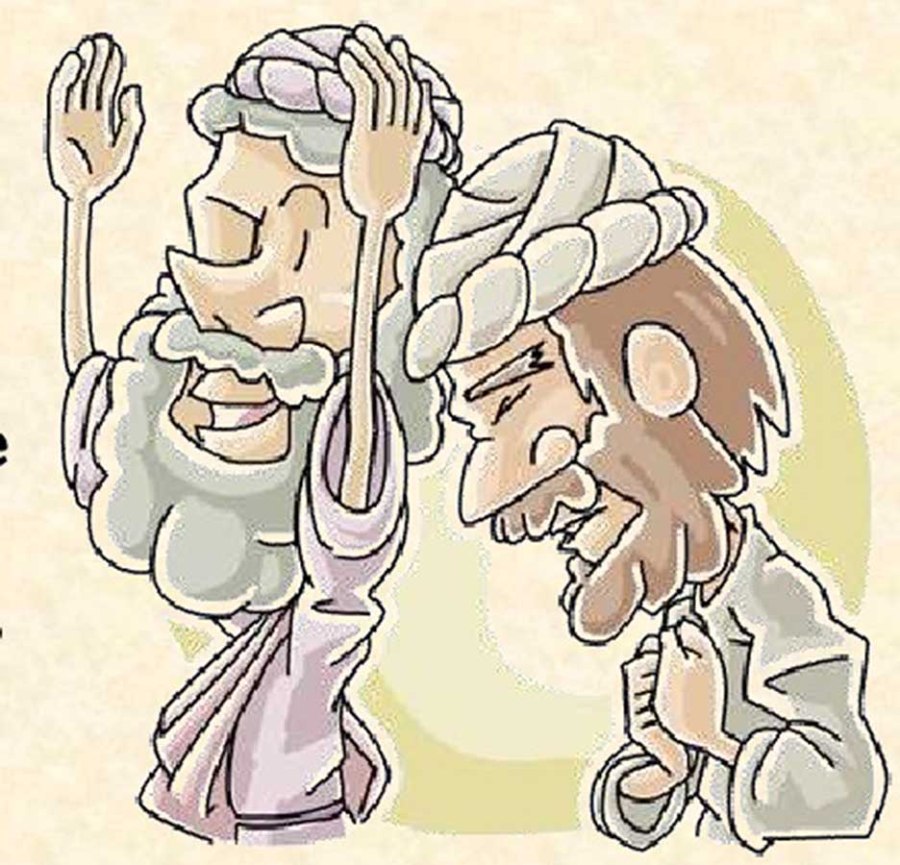
In today’s Gospel, Jesus affirmed the truth of the resurrection of the dead. This truth presupposes that life is not ended in death but transformed. There is hope after this earthly sojourn. The probable context behind this verse is that of Jesus’ critique of the Sadducees’ unbelief as well as the pagan belief of the realm of the dead. During those times, ancient civilizations worshiped the gods of death more than other gods because they feared the power of death that could destroy life and bring human existence to nothing. The Greeks had Hades, the Romans worshiped Pluto and the Egyptians honored Osiris. Yet, Jesus revealed fundamentally a different truth: Our God is not God of the dead, but God of the living. He still gives us life despite our physical death. This means that we are not mere afterlife disposable garbage or useless souls wandering on earth. We are loved even if we are no longer here on earth. Thus when Jesus commanded us to love one another, this love is not only for our Christian fellows who are still alive, but also for our brothers and sisters who have gone ahead of us.

In ancient Roman tradition, the cemetery was located far away from the cities. These were called necropolis, literally the city of the dead, because the dead had nothing to do anymore with the living. Yet, early Christians opted to do their liturgy inside the catacomb, the underground cemetery. True, it was a hiding place from the Roman authority who persecuted the early Christians, but it was also reflected their faith that they were actually praying for and with the dead brothers and sisters. In many churches, the burial ground was within the same complex. Even in our place in Manila, the burial place of the departed Dominican brothers and priests is just beside our seminary. Their permanent rest place is just a few meters away from our temporary rest place! This proximity reminds us of the bond of brotherhood and love among us. We are reminded to pray for them and to imitate them who were faithful until death. We are reminded, too, that they also pray for us from heaven.

Following the teaching of Jesus, the Church believes that those who are no longer with us, are still part of the Church. Those in heaven are members of the Church triumphant; those in purgatory belong to the Church suffering, and we here on earth are part of the Church militant. Yet, all are one of the same Church, profess the same faith, and worship the same God. Since all are members of the body of Christ, we are united closely in Christ and His love. Thus, it is proper for us to manifest our love for our departed brothers and sister through our prayers and they help us in prayer and intercessions.

Br. Valentinus Bayuhadi Ruseno, OP

When Jesus Sees Us…

31st Sunday in the Ordinary Time. October 30, 2016 [Luke 19:1-10]

“Zacchaeus, come down quickly, for today I must stay at your house.” (Luk 19:5)

zacchaeus

A true encounter with Jesus brings real and joyful transformation in Zacchaeus. In our Gospel today, we read that Zacchaeus had no intention to invite Jesus to stay at his house, let alone to reform his life. After performing a lot of miracles and down-to-earth preaching, Jesus was like a rock-star, and everyone, including Zacchaeus, was excited to see Jesus. Yet, he was rather short in stature and the taller guys prevented him to get a glimpse of Jesus. Zaccheus was persistent and he decided to climb the sycamore tree.

Yet, when Jesus saw him, He called his name and wanted to stay at his house. Zacchaeus was overwhelmed. He was deeply touched by that unexpected yet meaningful gesture and this brought transformation in Zacchaeus. One of the splendid signs of his conversion was that his generosity took the better side of him. From taking advantage of the poor, he returned back to them abundantly what he has taken. More importantly, he generously gave himself to Jesus as he welcomed Him at his house and life.

However, the transformation did not only take place in Zacchaeus. It also happened in Jesus. He was in his journey to Jerusalem, to face His final hours on earth. Jericho was a major town that was not far from Jerusalem, and thus, travelers and pilgrims to Jerusalem would make a short stop in Jericho. Looking closely at the text, we discover that the original intention of Jesus was to pass through Jericho. He did not plan to stay in Jericho, but when He saw Zacchaeus, He changed His itinerary. What made Jesus change his plan?

Being a tax collector, Zacchaeus was a public sinner. Being tax collector, he was exposed to malpractices and corruptions, and he was also considered a collaborator of the Roman Empire, the enemy of Jews. Not only an ordinary tax collector, he was the chief, and certainly all eyes in Jericho gazed upon him with disdain. His short stature might not only mean a biological limitation, but also symbolized his status in society. But, Jesus was able to see into the depth of Zacchaeus’ soul and find his true identity, the son of Abraham.  Despite sins and weaknesses, Jesus was able to see that beautiful image of God in Zacchaeus.

Jesus’ transformation even went beyond any expectation. He also wanted to dwell in Zaccheus’ place. In Jewish society and even in many other, a righteous Jew would avoid contact with sinners, fearing that he would become impure. But, Jesus defied the practice, and wanted to share the same meal from the same table under the same roof with Zacchaeus.  By entering his house and eating together with him, Jesus showed everyone that He had mercy, and wanted to be part of the life of Zacchaeus. Only when Jesus expressed His mercy and care to him, did Zacchaeus begun his own transformation.

Encounter with Jesus changes us, but this encounter with us changes Jesus first. Our God is not a passive God who sits at his throne waiting for people to come and worship Him. He takes the initiative and embraces us first in a way that we never expected. When He sees us, He discovers His image, that image that was in us ever since the creation of the world. Despite we being buried in sins and weaknesses, Jesus never loses sight of this beauty. And just like Bruno Mars, Jesus simply says, “You are so amazing, just the way you are.”  Now, it is up to us to either shun His invitation or welcome Him in our home and let His presence transform us.

Br. Valentinus Bayuhadi Ruseno, OP

Our Prayer, True Prayer?

 30th Sunday in the Ordinary Time. October 23, 2016 [Luke 18:9-14]

 The Pharisee took up his position and spoke this prayer to himself, ‘O God, I thank you…” (Luk 18:11)

pharisee-n-taxcollectorLast Sunday, Jesus reminded us to pray without getting weary. But, in today’s Gospel, Jesus tells us that there is something more than perseverance in prayer. It has something to do with the way we pray. Not only quantity of prayer, but also the quality of prayer. Yet, how do we know that we have a quality prayer?

Once I stumbled upon a Facebook post, and it said, “Pray not because you need something, but because you got a lot to thank God for.” True enough, everything I have is God’s gift. I am nothing without Him, and it is fitting to thank Him. In fact, the highest form of worship in the Church is the Eucharist. The word Eucharist simply means thanksgiving. I liked the post right away. However, when I read the parable in today’s Gospel, I realized that even the Pharisee did a thanksgiving prayer. In fact, in original Greek, when the Pharisee thanked God, he used the word ‘eucharisto’, the root word of the Eucharist. On the other hand, the tax collector was justified because he was asking mercy and forgiveness. Does it mean prayer of supplication and begging for mercy is better and more effective than the prayer of thanksgiving and other kinds of prayer?

Yet, if we read closely, there are some interesting details in the Parable. The first is that the Pharisee expressed his self-righteousness, paraded his good works, and felt better from the rest of humanity, especially the tax collector. Meanwhile the tax collector did nothing but humble himself, acknowledging that he was a sinner and in need of God’s mercy. Thus, prayer needs a right disposition. Humility is the foundation of prayer. Indeed, repentant David himself said, “My sacrifice, God, is a broken spirit; God, do not spurn a broken, humbled heart. (Psa 51:17)”

 The second detail that we often miss is that the Pharisee was actually praying to himself, not to God (see closely verse 11). True that he mentioned God, but he was talking to himself. He offered prayer to himself not to God. If then prayer is our communication with God, the Pharisee nullified the very meaning of prayer. Perhaps, by mentioning God, he wanted God to be his audience and to listen to the litany of his successes, not really to build a relationship. Certainly, it felt good and edifying, but this was not prayer. What the Pharisee did was not a prayer at all, but a self-praise and self-service.

We may hear the Holy Eucharist every day, recite the Liturgy of the Hours faithfully, and pray the rosary. We may also join the Charismatic prayer meetings or the praise and worship. We may also attend the Latin Traditional Mass, or just simply spend silent prayer or meditation. Yet, from the parable, we may ask ourselves, whether our prayers are a true prayer? Do we pray because we feel great about it? Do we pray because we are proud of our achievements? Do we pray because we are more pious than others? Does our pray make us closer to God or just to ourselves? Is humility the foundation of our prayer? Our prayer should be a quantity and quality prayer. We pray with perseverance and proper disposition. But more than these, our prayer should be a true prayer.

Br. Valentinus Bayuhadi Ruseno, OP

My Nagging God

29th Sunday in the Ordinary Time. October 16, 2016 [Luke 18:1-8]

 “…This widow keeps bothering me… (Luk 18:5)”

persistent-widow-2Getting tired and bored is unwanted yet unavoidable part of our lives. After doing things for a certain period of time, we get exhausted. Even if we are doing something we love, we are also bound to feel weary. Indeed, a man marries the woman he loves, but after sometime, encountering disappointments and problems, he begins to think whether he made the right decision. A woman loves dearly her teenage girl, but after sometime, her girl gets involved in substance abuse and runs away with his friends. She spends all her money and energy to win her daughter back yet to no avail, and she simply gets tired. As a religious brother, I love my vocation, but after years of waking up early, attending Mass and prayers, and plunging myself in rigorous study, I get bored.

In these times that we feel weak and weary, the temptation will set in and lure us to abandon our commitments. We are even emboldened to do crazy things and sin. We become like the judge in today’s Gospel, who “neither fear God nor respect human being’. We begin doing unthinkable things. We hurt people we love. We cause sufferings and misery to other people and ourselves.

However, we are so blessed that we have God who is like the nagging widow in the Gospel. He is knocking at our hearts day and night so that we may render justice to Him and our neighbors. Tirelessly He reminds us to be faithful to our commitments, repeatedly encourages us to persevere in doing good, and ceaselessly calls us back everytime we falter.

His unceasing care and ‘disturbance’ are manifested in subtle yet manifold ways. He places in us His subtle grace and joy in our daily prayer, despite boredom and sleepiness. He gives us family and friends who remain supportive to us in time of trials. He provides us with little blessings that we tend to ignore. One sustaining factor in my vocation, I believe, is that the Lord gives me a community. Indeed, sometimes living in a community is troublesome, but it provides also a structure and living ecosystem to support my Dominican religious life. My brothers will knock my door reminding me not to be late in prayer, encourage and evaluate my preaching, and in fact, correct me if I commit mistake. My community is my nagging God.

We may be tired of many things, exhausted in keeping our demanding commitments as spouses or parents, and bored of doing again and again our obligations as students or ministry as priests or religious. Yet, we remember we have our nagging God who persistently loves us and does not give up on us, even if we have already given up on ourselves. What we need to do is just open our eyes, ears and hearts to His subtle yet constant actions in us.

Br. Valentinus Bayuhadi Ruseno, OP

The Rosary and Us

October 7, 2016 – Mary, Queen of the Holy Rosary

rosary-1October is the month of the rosary. Allow me to reflect on this ancient yet ever new form of prayer. Why October? It all started when Pope Pius V, a Dominican, dedicated October 7 as the feast of Mary Our Lady of the Rosary after the battle of Lepanto. In this naval battle of October 7, 1571, the smaller Christian army fought the much larger and powerful Ottoman Turks’ forces that planned to invade Europe at the Gulf of Lepanto in Greece. While the battle was being waged, the Holy Pontiff and all Christians prayed the rosary asking the intercession of Our Lady. After hours of confrontation, the enemy’s fleet was roundly defeated.

However, the devotion to the rosary itself began even much earlier. In fact, the prayer was a product of a long evolution. The devotion actually began as a lay spiritual movement. In the early middle ages, the monks and nuns in the monasteries recited 150 Psalms of the Old Testament as part of their daily prayer. The practice was ideal to sanctify the entire day as the recitation of the Psalms was distributed during the important hours of the day (thus, Liturgy of the Hours). Yet, this was not for the lay people. They had no copy of the Bible, least the ability to read it. Thus, the lay people who desired to make their day holy, started to recite 150 ‘Our Father’. To keep track of the prayer, they also made use of a long cord with knots on it. After some time, they prayed 50 Our Father at three different times of the day.

In the 12th century, the Angelic salutation formula “Hail Mary, full of grace, the Lord is with you. Blessed you among women and blessed is the fruit of your womb” became part of this 150 ‘Our Father’ prayer. Shortly after this, the meditation on mysteries of the life of Jesus and Mary began to be incorporated into this devotion. Gradually, it evolved into 150 ‘Hail Mary’. St. Dominic de Guzman and his Order of Preachers received special mandate from the Virgin herself to promote this ‘Psalter of Mary’. In the 15th century, that devotion acquired the name Rosarium (rose garden). In 1569, the same Pope Pius V issued the papal decree ‘Consueverunt Romani Pontifices’ that regulated and standardized the praying of the Rosary, taking into account its long history and its Dominican tradition. He also affirmed the efficaciousness of the rosary as one of the many means to obtain graces and indulgence. The praying of the rosary continues to evolve even to this day. The latest major innovation was from Saint John Paul II who added five mysteries of Light.

October then turns to be a fitting time to intensify our praying of the rosary and to remember the role of Mary and her rosary in the life of the Church and our lives. I guess more importantly we remember that rosary was born from the desire of lay people to be holy. The rosary came from the simple hands of ordinary people who recited the Our Father and Hail Mary and meditated on the mysteries of salvation. We pray the rosary because it is a devotion that comes from the hearts of the laity. When we pray the rosary, we pray together with Mary who is a lay woman. When we pray the rosary, because we, just like countless people, desire to be closer to God in a simplest and humblest way.

Br. Valentinus Bayuhadi Ruseno, OP