Faith the Size of a Mustard Seed

27th Sunday in Ordinary Time. October 2, 2016 [Luke 17:5-10]

“If you have faith the size of a mustard seed, you would say to this mulberry tree, ‘Be uprooted and planted in the sea,’ and it would obey you (Luk 15:6).

mustard-seedReading through today’s Gospel, it seems to have faith is to perform some sort of magical power. If I have faith, I can create rice field on the seabed. If I have faith, I can made a Lamborghini car out of pile of garbage. If I have faith, I can transform my voice like Ed Sheeran. But, faith is not like that. It is not a magical show to entertain us. It is neither an instant answer to our wishes. Yet, it remains true that even the smallest of faith can make the difference.

Jesus spoke of faith as like the size of a mustard seed, that symbolizes our little faith. Yet even, this little faith can make a significant difference in our life, even to do the impossible. True, our lives practically do not change. We are still struggling with financial difficulties. We still need to deal with demanding bosses or terror professors. We are facing horrendous traffic everyday especially in big cities like Manila and Jakarta. We are battling various sickness plaguing our bodies and not knowing how to pay the medical bills. Yes, our lives do not change, yet at the same time, our little faith will make our lives never the same again. How is this possible?

With faith, we are empowered to believe in the unseen God. If we are able to see the unseen God, then we are also able to discover His unseen love and mercy working in our lives. God is not asleep and does not let us struggle alone with myriads of problems and stresses. We remember Peter, the man of little faith, who attempted to walk on the waters, but failed and began to sink. In his little faith, he saw Jesus holding his hand and thus saving him. Like Peter, we are falling into the ocean of difficulties, but we do not drown, because through our little faith, we see Jesus holding our hands.

We learn from many saints. Their faith does not make their lives any better. Many, like St. Francis of Assisi and St. Martin de Porres, remained poor through their lives like. Many still dealt with a lot of problems. Mother Teresa struggled to sustain her charity works and her young Congregation. St. Bernadette Soubirous endured severe pain due to tuberculosis of the bone. Martyrs were cruelly tortured and executed for this faith. But, this little faith have made them more generous, more persevering,  even more joyful in the midst of trials. As St. Lorenzo Ruiz, the Filipino proto-martyr, proclaimed when he was about to be executed, “I am a Catholic and wholeheartedly do accept death for God; had I a thousand lives, all these to Him shall I offer.” Faith does not take away our suffering, but it empowers us to see God. This is enough to change us.

Br. Valentinus Bayuhadi Ruseno, OP

Lazarus and Us

26th Sunday in Ordinary Time. September 25, 2016 [Luke 16:19-31]

“Lazarus, covered with sores, who would gladly have eaten his fill of the scraps that fell from the rich man’s table (Luk 16:20-21).”

richman-n-lazarusWhen Abraham said to the tormented rich man, “My child, you have received what was good during your life,” does it mean I will be thrown to the netherworld as well? I admit I have received so many good things in my life. I enjoy three good meals a day. I am studying in one of the best schools in the country. I do not have to worry about the security and future of my life. Many of us are enjoying the good things in this world, and we may ask ourselves, “are we going to have the same fate with this rich man in the parable?”
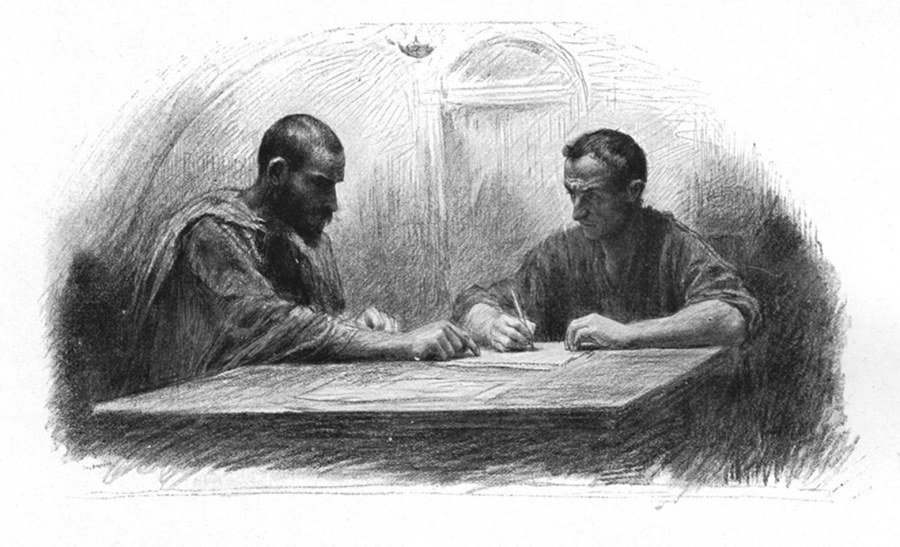
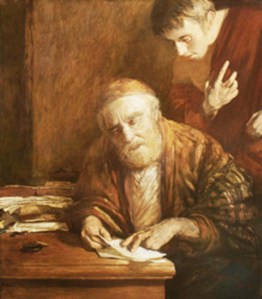
Reading closely on the Gospel, the rich man was sent to the netherworld not because of the good things he received in life. In fact, it would be unfair for him and for us. Many of us are working diligently and we deserve to enjoy our lives after all the backbreaking jobs. He was there because he did not care for Lazarus, his poor brother. If we pay attention to the proximity between the rich man and Lazarus, there is something unusual. Initially, Lazarus was outside the door, but then when he ate the food scraps that fell from the rich man’s table, he was actually inside the house. In fact, Lazarus was under the table of the rich guy. With this extreme closeness the rich man acted as if Lazarus did not exist. What sent him to the netherworld is not because of the good things he received, but his gross neglect and grave ignorance of his own poor brother.

We may have the same fate as the rich man if we do not care for our poor brothers and sisters around us. In fact, our ignorance may be the cause of their poverty and misery. Sometimes, we just feel good after donating some coins to the beggars, but is that enough? Indeed, we cannot do much to help the thousands of refugees in war-torn Syria, but do we do something for those who are close to us? Are we too busy working and earning, so much so that we forget to share? Do we close our eyes to our relatives who are struggling with their children’s education? Do we shield ourselves from the social issues in our society, like the increasing number of poor people being killed simply because they are thought to be small-time drug addicts?

We give thanks to God for the blessings and good things we receive in this life. Yet, we should remember also our brothers and sisters who are just outside our doors, those who are just under our table, waiting for our food scraps.

Br. Valentinus Bayuhadi Ruseno, OP

Becoming Whole

25th Sunday in Ordinary Time. September 18, 2016 [Luke 16:1-13]

“Make friends for yourselves with dishonest wealth, so that when it fails, you will be welcomed into eternal dwellings (Luk 16:9).”

unjust-steward1We were created in the image of God. Thus, our true happiness is only in God. As St. Augustine would say, “You have created us for Yourself, O God, and our hearts are restless until they rest in You.” St. Teresa of the Avilla would echo the same truth when she simply said, “God alone suffices.” But, we were also born into the real human body within a complex and concrete world. As we journey toward God, we cannot totally separate our soul from the various mundane concerns. Even the monks and nuns living in monasteries will still work hard to fulfill their daily and basic needs.
Our humanity and temporal aspects of our life are integral part of who we are. They are blessing and gift of God. We must not be enslaved by money, wealth and other material possessions. Certainly, easier said than done. Who among us are concerned with the latest version of our cellular phone? Who among us spending hours just to choose most fashionable dress? In a bigger scale, corruption, injustice and exploitation are the offshoots of this attachment to this temporal aspect of our lives. Thus, the proper and prudent thing to do is to place the gift of our body and temporal dimension of our life in the service of God and others. I do believe that in order to preach well, it is imperative for the preachers to take care of their health. As an ancient Latin proverbs goes, ‘Mens sana in corpore sano’ (healthy mind in healthy body).

Learning from the parable of the dishonest steward, Jesus taught us to be like the steward in dealing with worldly things. In ancient Israel, for a master entrusting the business to his steward was a common practice. Some stewards would manipulate their position and raise wealth by practice of usury. They charged the borrowers of his masters’ property with high interest. Unfortunately, the steward was caught with this usurious practice as well as squandering his master’s wealth. To save his life, he chose to be smart. He met the debtors and to ask them to rewrite the debt’s notes. He decided to erase the interest that would go to him and let them pay the original amount. The borrowers would be indebted to him, and he might save himself. Like the steward, we need to know what truly matters for our happiness and salvation, as well as well aware of the place of worldly goods in the totality of our lives.

Jesus becomes a splendid example for all us. He is divine and spiritual being. He controlled the forces of nature, He overpowered the evil spirits, and He forgave sins. Though, He was divine, He did not disregard his humanity as useless. He, in fact, was humanly practical and respectful of His own Jewish culture. He observed Jewish traditions and customs, He worshipped God in the synagogues and He taught using the language that His original listeners would understand. Thus, He is truly God and truly man.  Indeed, our salvation rest in this balance and unity of this spiritual and bodily aspects of our humanity.

Br. Valentinus Bayuhadi Ruseno, OP

One Shepherd

24th Sunday in Ordinary Time. September 11, 2016 [Luke 15:1-10]

“Rejoice with me because I have found my lost sheep (Luk 15:6).”

parable-lost-sheep-good-shepherdThe parable of the lost sheep subtly speaks of who we are fundamentally to Jesus. We are all His sheep and He is our shepherd. Whether we faithfully remain inside the sheepfold or go astray, we are still His sheep.

From this truth, we may ask ourselves. Why is it that some of us are going astray? Why are some of us no longer going to the Church or not active in the parish? Why are some abandoning the Church? Why do some turn to be our enemies and haters? We might be easily tempted to say that that is their fault. But, we are sheep of the same flock, sharers of the same pasture and have the same Shepherd. In one way or another, we might be responsible for our brothers and sisters who stray.

It is easy to pass the blame on others, but do we ever bother to ask why they fail? We tend to see them as problems to be solved, objects to dissect into logical parts. We no longer see them as our brothers and sisters, our co-sheep in Jesus’ sheepfold. Our brothers are no longer going to Church perhaps because we no longer care to help them. Our sisters are leaving the Church perhaps because we are living like hypocrites.

 The war on drugs in the Philippines has caused more than two thousand lives in just two months. As one national news outlet remarks ‘the bodies continues pilling up’. Indeed, many of them are small-time drug-pushers and addicts, and if we look at them as mere problems and pests to the society, death seems the fastest and easy answer. But, if we have headache, do we cut the head? Do we ever wonder why they fall victims of that deadly narcotics? A Lion share of those who got killed were actually poor people. Do we ever lift a finger to alleviate their poverty? Our ignorance and negligence may have indirectly led them into poverty and misery.

Fr. Gerard Timoner III, OP, our provincial, used to teach an idea of brothers shepherding brothers in the seminary. This means that the responsibility of taking care of our brothers in formation does not only rest only on the formators, but also on every brother. We need to become shepherds to one another, especially when the shepherds seem to stray away. Recently, he met us and shared what he gained from the Dominican General Chapter in Bologna last August. He emphasized that to promote vocation is not only about recruiting new members, but also nurturing and safeguarding the vocation of our own brothers in the Order.

To become a sheep of Christ means that we are also part of a bigger sheepfold. As Jesus takes care of each one of us, so we need to take care of one another. As the Good Shepherd reaches out to the lost sheep, we shall stretch ourselves to meet those who are lost in their journey. Surely, it is difficult, but they are still our brothers and sisters, fellow-sheep of Christ.

Br. Valentinus Bayuhadi Ruseno, OP

Jesus’ Disciples

Twenty-third Sunday in Ordinary Time. September 4, 2016 [Luke 14:25-33]

“If any one comes to me without hating his father and mother, wife and children, brothers and sisters, and even his own life, he cannot be my disciple (Luk 14:26).

carry crossBeing a disciple is an essential character of Jesus’ followers. In our time, a disciple may mean a student of particular teachers or schools. Like Br. Bayu is a student of the University of Santo Tomas, Manila. In ancient time, especially in Eastern and Jewish tradition, being a disciple has a different understanding. A disciple would not only accept his master’s teachings, but literally follow his Master wherever he would go and stay. Disciples would not only learn on various insight, but also witness and imitate how their master lived his life. They shared their master’s meal, and they were part of their teachers’ joy and sadness. Thus, being a disciple is not only about an intellectual education, but also a holistic formation. It is fundamentally sharing the very life of the master himself.
Therefore, it makes sense for us now, when Jesus demanded that his disciples ‘hate’ their family as well as their own lives. To follow Jesus wherever he goes literally meant the disciples had to leave behind the family and the lives and works they used to have. ‘Hating’ did not mean that they should harbor enmity to their family, but rather place them as secondary priority. Jesus was their new family, their first priority and their real life.

Jesus Himself gave us a fitting imagery of discipleship: following Him is like carrying a cross.  To be a disciple of Christ is indeed difficult, tough; it demands a radical re-orientation of one’s life. Yet, the good news is that to be Jesus’ disciples is not impossible. A good number of young men and women, leaving behind their promising careers, enter the monastery and dedicate themselves for the Lord in constant prayer. Lay Men and women offer themselves as missionaries and are sent to far corners of the globe to share the joy of the Gospel. The evangelization of the Philippines were nearly impossible if not for zealous Spanish friars who travelled for months, risked their lives and many never returned to their homeland. These generous people literally left everything behind to follow Christ.

However, being Jesus’ disciple does not mean for many that they have to abandon our families. Following Christ may take place within the family. When a man and a woman decide to leave their families of origin, and build their own Christian family, then they have become the community of Christ’ disciples. When parents commit themselves to the demanding task of raising their children to be God-fearing and honest Christians, they are following Christ. More fundamentally, our discipleship manifests clearly in the sacraments, especially the Eucharist. In the Eucharist, we become disciples who listen to His teachings and partake in His very life in the sacred host. Then, finally we are sent to preach what we have learned and lived in the Eucharist.

We continue to pray that we may become His true disciples and many will be also inspired to follow Him and share His life.

Br. Valentinus Bayuhadi Ruseno, OP

Connect

22nd Sunday in Ordinary Time. August 28, 2016 [Luke 14:1, 7-14]

“Rather, when you hold a banquet, invite the poor, the crippled, the lame, the blind (Luk 14:13)”

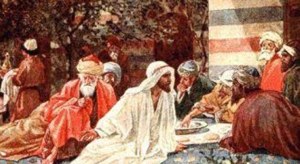
jesus diningIn the time of Jesus, Jews had their own special way of dining. Instead of sitting or standing the Jews would recline on a low table where food and wine are served. Reclining was the sign of free man in Greco-Roman culture. The slaves stood and served the guests. Aside reclining posture, their place in the dining table indicated their importance to the host. The closer they were to the host, the more significant they were to the host. Thus, persons sitting beside the host were expected to be the most important guests.
Jesus noticed that some guests wanted to occupy the place of importance in the dining table. Certainly, situating oneself in the place of honor, gave a sense of prestige, but more significantly, the closer they were to the host, the better connection they had with the host who was a leading and influential Pharisee in town.

From ancient times to present days, to connect oneself to the figure of authority and power will give us a better position to improve our lives or advance our cause. With good connection, an unemployed can get a good job. With connection, an employee can have his desired promotion. With connection, a student can enjoy the trust of his teachers. John Maxwell, an inspirational teacher, told us how he was able to win the heart of his wife Margaret, despite many other handsome suitors. He made a good connection with her mother! I guess one of the reasons why I have more preaching opportunities is that I am connected with good friends who also are active in the Church.

Jesus did not intend to erase this kind of connection. In fact, He himself is our connection to the Father (cf. 1 Tim 2:5). In today’s Gospel, what he desire was to re-orient our understanding of our connection. We must not use our connection just to advance our individual and selfish plans, but rather we employ it for the empowerment of others. Jesus invited the hosts to invite the poor in their meals. This was not only about feeding the hungry, but the rich hosts are to make connection with the poor. With connection, the possibility of enabling the less fortunate is opened.

I was fortunate to meet a Columban lay missionary from Korea. Leaving behind her promising career in the US, Ms. Anna volunteers to do ministry in the Philippines. She shared to me what she is doing to help the poor. She gathered the poor mothers living near her place and created a livelihood project. She taught them how to make a candle and sell them at the nearby parishes. Most of the mothers were high school dropouts and at the mercy of their husbands. But, with this project, some are able to continue their study, support their family and more importantly, they now have financial independence and no longer dependent on their husbands. Ms. Anna made connection with these mothers and this connection empowers them.

Jesus calls us to be a good host. This means we who are endowed with blessings will connect with those who are not so fortunate in their lives. Let our connection empower others more tham simply enriching ourselves.

Br. Valentinus Bayuhadi Ruseno, OP

Salvation: Gift and Choice

21st Sunday in Ordinary Time. Luke 13:22-30 [August 21, 2016]

 “Lord, will only a few people be saved? (Luk 13:23)”

jesus the gateSalvation is both a gift and a choice. It is free yet it is never cheap. It is a gift because it is freely given by God and no one earns it. Yet, it is a choice because we make all the efforts to receive it and make it ours. Through His death and resurrection, Jesus has made available the grace of salvation for everyone. But, we need to participate in His work of salvation by living out the gift of faith in our daily lives.

There is a story of a rabbi who visited a soap maker to buy a supply for his household. Suddenly, the soap maker asked, “What good is religion? Look at all the suffering and evil in the world! Still there, even after years and thousand years of teaching about goodness and peace. Still there, after all the prayers and preaching. If religion is good and true, why should we continue to suffer?” The rabbi said nothing. He then noticed a child playing in the gutter in front of the shop, and the rabbi said, “Look at that child. You say that soap makes people clean, but do you see the dirt on that kid. Of what good is soap? With all the soap in the world, over thousand years, the child is still dirty. I wonder how effective your soap is, after all?” The soup maker protested, “But, Rabbi, soap cannot do any good unless it is properly used.” The rabbi replied, “Exactly!”

To make the gift of salvation ours is not an easy job. Jesus Himself admitted, “Strive to enter through the narrow gate, for many, I tell you, will attempt to enter but will not be strong enough (Luk 22:24).” It is tough because it demands radical transformation of our hearts, or metanoia. All external forces, like rules, regulations and commands, will not last. The gift of salvation cannot be forced from the outside, but has to grow from within us so that it will be stable and permanent in us. Yes, we are saved, but we are also saved each day of our lives.

The call for living out our salvation is the call of the prophets of the Old Testament. The prophets reminded the Israelites that they indeed have been chosen by God as His own precious possessions, saved from Egypt and dwelt in the land of milk and honey. Yet, this wonderful gift will not last unless they also reform their hearts and truly become God’s people. God, through prophet Ezekiel, demanded this, “I will give you a new heart and place a new spirit within you, taking from your bodies your stony hearts and giving you natural hearts (Ezekiel 36:26).”

It is a radical choice to live up our salvation daily. We can be baptized as Catholics or Christians, yet we never go to the Church. We profess our belief in only one God, but we enjoy reading horoscopes, consulting fortunetellers and use religious items as mere protective amulets. We can easily shout, “God is good all the time,” but we have a lot of complaints in our lives. We are often instructed by Jesus Himself to love our enemies, yet we maintain hatred, remain vengeance-oriented and take pleasure when our enemies suffer misfortunes. We enjoy the worship and good preachings, yet we simply look for feeling-good experiences.

God shall remove our stony hearts and replace them with natural hearts if we make the way. We are saved if we shall make every gift of salvation counts. We shall enjoy the Kingdom, if together with Jesus, we enter our daily narrow gate.

Br. Valentinus Bayuhadi Ruseno, OP

Fire of Jesus

20th Sunday in Ordinary Time. August 14, 2016 [Luke 12:49-53]

“I have come to set the earth on fire, and how I wish it were already blazing! (Luk 12:49)”

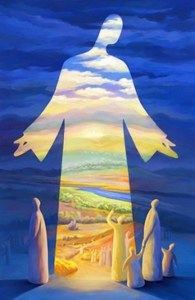
pentecost 1In the midst of all super-advanced digital gadgets and nano technologies, making fire seems rather archaic and a bit useless. Why will we set a fire and cause pollution, if we have energy-saving LED lamp in our house? However, making fire is the earliest and one of the most significant human invention. Fire revolutionized the lives of our ancestors and gave us substantial advantages over other creatures. Fire brings warm and comfort in chilling and unforgiving weathers. Fire protects us from bigger and fiercer predators. Fire provides light that shed off the darkness. Fire also is needed to forge other inventions and technologies, like various tools and weapons.
Yet, fire also may cause us serious headaches. Almost every year, fire sets ablaze parts of Borneo rain forest and emits global-scale smoke. Fire also is a serious problem in densely populated cities like Manila. A firefighter once conducted a seminar in our seminary. He said that it just takes less than one minute for fire to burn an entire body of a little kid. Thus, fire has become the symbol of both powerful force of nature and human ingenuity. It may bring heavy destructions as fire burns and consumes almost everything. Yet, it also gives creativity, hope and future to humanity.

When Jesus said he brought fire to the world, Luke used the Greek word ‘phur’, meaning ‘wild fire’. Now, we may understand that Jesus came to the world to bring not a warming and delightful fire, but massive transformative energy and power. This fire can consume our past and wicked ways. Yet, more importantly, this fire energizes and empowers us to be creative in our preaching and in Christian life. On the day of Pentecost, the Holy Spirit came into the form of tongues of fire. This same fire emboldened the fearful disciples in the Upper room and moved them to preach the Good News with freshness. They made a creative breakthrough as they began to speak in the different languages of their hearers.

Saints are people who are blazed by Christ’ fire. Their lives exemplify the ever-fresh and transformative Spirit. When St. Dominic de Guzman saw the need to preach the Gospel to bring back the Albigensian heretics in Southern France, he established the first preaching religious Order in the Church. When the first Spanish Missionaries came to the Philippine Islands, one of their main preoccupations was how to understand the local languages and cultures, so that their preaching may be easily understood by the native Filipinos. As early as the 16th century, the Dominican friars had produced grammar books and dictionaries of Philippine languages like Tagalog, Bisaya, and Ivatan.

It is His desire to set the world in fire, but has the fire of Christ touched our lives? Have the Eucharist and Sacrament of reconciliation renewed us? Do we feel that energy to engage in the proclamation of the Good News, or we are just fine with Sunday masses? Do we have the perseverance amidst trials of life? Do we allow the Spirit to animate our lives?

Br. Valentinus Bayuhadi Ruseno, OP

Giving Up All

 19th Sunday in Ordinary Time. August 7, 2016 [Luke 12:32-48]

 “For where your treasure is, there also will your heart be (Luk 12:34).”

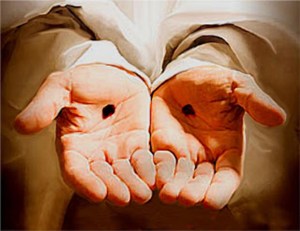
jesus-hands-holesAre we ready to sell everything we have and follow Jesus? Are we prepared to give up our dreams and ambitions for the Kingdom? Are we willing to place our hearts, our treasures where no moth can destroy and no thief can steal?

St. Dominic de Guzman whose feast day we will celebrate tomorrow, is a shining example for us to emulate. When he was a canon regular in the Cathedral of Osma, Spain, he was actually a rising star. He was elected sub-prior at a very young age. To be a sub-prior means he was next to the leader of the Cathedral and was groomed to the position of the Bishop. Osma was a fortified city and had a beautiful Church. Osma provided Dominic tranquility and comfort when wars and famine ravaged portions of Spain. He was also prepared to take the coveted position in Osma as its bishop. Yet, Dominic decided to abandon all of these. Facing overwhelming difficulties and life-threating dangers, he went to preach the Gospel in Southern France where the heretic group, Albigentians, took its root.

St. Dominic and many other saints are indeed illustrious models of this evangelical self-giving, but how many among us are doing what the saints did? In all honesty, many of us are not ready to do what Jesus commanded in today’s Gospel. Some of us cannot simply sell everything we have because we need to feed our children and send them to school. Some cannot just give up their studies because they need to prepare for a better future. Some of us have to run our businesses because we are responsible for the lives of our workers and their families. I myself have to admit that it is difficult for me even to let go of my book collections.

We are entangled with so many complexity of life. Yet, deep inside us, we always feel that yearning to surrender everything for the sake of the Kingdom. Sometimes, the best thing we can do is to do simple sacrifices everyday.

A mother who wakes up early morning, prepares the breakfast for the family, brings her children to school, go to work to earn a living, cooks dinner for her husband, and basically puts aside her dream to work with the urban poor, is truly giving herself to the Lord. I have a friend who is young, intelligent and very determined to become a priest. I am sure that he can become a good priest someday. But, his father is old and sickly, his siblings are still studying, and his mother earns very little. With a heavy heart, he decided to leave the seminary and work to help his family. He sacrificed his hope to serve the Lord as a priest, yet he surrenders his life to serve the Lord, through his family.

I do believe that God is very compassionate and merciful. He understands our daily struggles to follow Him. Thus, God does not leave us alone. He empowers us in our struggles and His grace enables us to give our lives despite the complexity of our lives.

St. Dominic de Guzman, pray for us!

Br. Valentinus Bayuhadi Ruseno, OP

Conquering Greed

18th Sunday in Ordinary Time. July 31, 2016 [Luke 12:13-21]

 “…is not rich in what matters to God (Luk 12:21).”

rich foolGreed is one of the most sickening sins. It can plague practically anyone, rich and poor, young and old, lay people and even the leaders of the Church. Greed as the inordinate desire for wealth or money. Greed breeds corruption, stealing, cheating and violence. Greed produces injustice and poverty. And injustice and poverty cause nothing but suffering of countless people and permanent destruction to our mother earth.

Sometimes, we can easily accuse some persons in government and in business world as the greedy ones. Indeed, with their positions of power and intellectual capacity, they can suck a massive amount of money just for themselves. Instead using the money of the tax payers for building up the nations, the big portion of it goes to their individual pockets. But, we need to remember that greed does not only affect the affluent, but also the poor.

Movie Slumdog Millionaire (2008) tells us a story of Salim and Jamal Malik who are victims of this injustice and greed. After the killing of their mother because of religious hatred in slam area in India, they were forced to stay in a sanitary landfill. Then, they were adopted by ‘professional beggars’ syndicate. One particular scene that reveals the gruesome manifestation of greed is one little boy with sweet voice, Arwind, was blinded. Jamal later remarks, “Blind singers earn double.” The worst part of the movie is that the movie is not totally fiction, but many events are true to life.

Greed is even more sickening because it is not only about wealth or material possession. It is a vice that consumes our identity as human person, created as the image of God, with the capacity to love and share. In the parable of the rich fool, we discover the rich man only cares for himself, his harvest, his possessions, his life and his future. There is no place for other people, let alone God in his heart. Greed destroys our humanity to its core. We cling to our lives and our possession, and fail to see that all we have is blessings to share.

Just few days ago, Fr. Jacques Hamel was murdered inside the Church by the armed terrorists. The church Saint Etienne-du-Rouvray in Northern French was stormed during the morning mass. He and a mass-goer finally died after their throats were slit. While the world was shocked by this heinous cowardly act, we are once again invited to examine the life of this simple priest who gave his very life to the end. We may believe that life is stripped of him, but we forgot that actually he had given his life even before the day of his martyrdom. He lived a simple life and at age of 84, and he remained faithful to celebrate the sacraments and serve the people all the day of his life. He gave his life for God and the Church. His death is no longer loss but a moment of confirmation of his generosity that inspires the world. As St. Tertulian once said, the blood of the martyrs is the seed of Christians.

This utter generosity is a reflection of our deepest calling as human person, created in the image of God. And only in this true charity and abundant generosity, we may fight the greed that plague our souls.

Br. Valentinus Bayuhadi Ruseno, OP