Virtue of Patience and Advent

3rd Sunday of Advent [C]
December 11, 2022
James 5:7-10

St. James advised us in this Advent Season, “Be patient, brothers and sisters,
until the coming of the Lord (Jam 5:7, second reading).” Why do we need to be patient, especially in this season? If we go back to the time of St. James, we will understand better this advice. During the early Church, there was a strong sense of Jesus’ second coming, and the same time, the Church was facing persecutions from different fronts, from the pagans and the Jews as well as internal conflicts. Thus, the Church’s members were truly eager to welcome the Savior’s second coming. Yet, He did not came as early as expected, and thus, some Christians became impatient and were complaining. Even some began to lose its faith. Here, St. James give his word: patient.

photocredit: Jon Tyson

The word used by St. James is ‘μακροθυμέω’ (makrothumeo). Interestingly, it is not adjective, but a verb. Patience is not simply passively waiting and receiving, but this virtue is proactive and dynamic. Often, we think that patience means that we cannot do anything, but endure our hardships. But, it is not always the case. While bearing our trials, patience empowers and transforms us into better persons, and even leads us to holiness.

St. James used the prophets of the Old Testament as his models. Many prophets prophesized the coming of Messiah, Jesus Christ, but they knew that this would not happen in their lives’ times. Even, many prophets were persecuted, even martyred. According to the traditions, Isaiah was sawed into two by evil king Manasseh, and while Jeremiah was murdered in Egypt. Yet, did they stop prophesying? No, they actively engaged in their missions until the end.

We are living two thousand years after the early Church and St. James, and our world has changed and been significantly different. However, the virtue of patience remains relevant and arguably, needed more than ever. We are living in the world filled with instant mechanisms, digitalization and automation. Surely, these are something good as to facilitate our lives. Yet, it also poses a danger to our mentality. As we are used to instant processes, we easily become impatient especially when we did not get the result we desire. We get disappointed, we get upset, and we complain. When our lives are full of complains, we become bitter and unhappy. Sometimes, prolonged bitterness will lead to mental problems.

Before I went to Rome for my study, I was serving the parish in Surabaya. Some young people came to me and began to share their problems. Surely, there were serious problems that required professional assistance, like medical doctor, psychiatrist or lawyer. However, in most of the cases, they were unhappy with their lives because they were impatience. I would invite them to see a bigger perspective in their lives, and count the blessings in their lives. Then, suddenly, they would realize their lives are full of blessings, and their problems were actually exaggerated. In one hand, we just do not have the endurance to bear the sufferings, and the on the other hand, we do not have the patience to articulate the blessings, to discover how God works in our lives.

To appreciate lives, we need patience. We have to spend time and energy with God in prayer, to read and reflect the Word of God, and to perform small yet consistent good works. We may not see the second coming of Jesus in this Advent, but with the virtue of patience, we will be able to see the coming of Jesus in our hearts every day.

Rome
Valentinus Bayuhadi Ruseno, OP

The Scriptures and the Advent

2nd Sunday of Advent [A]
December 4, 2022
Matthew 3:1-12
Rome 15:4-9

For the second Sunday of Advent, the Church has chosen for us a text from St. Paul as our second reading. It is the last part of St. Paul’s letter to the Romans. In a simple sentence, Paul gave an essential purpose of the scriptures. He wrote, “For whatever was written previously was written for our instruction, that by endurance and by the encouragement of the scriptures we might have hope (Rom 15:4).” Let us unpack together this verse as we journey through the Advent season.

photocredit: Jonathan Sanchez

At the time of Paul, 27 books of New Testament as we know now has not yet come to existence. Thus, when Paul mentioned ‘scriptures’ or ‘what was written previously’, he was referring to the books of the Old Testament. These books were originally part of Hebrew Bible, but also accepted, used, and considered sacred by the early Church. Why so? This is because Jesus read, preached, and fulfilled these books. Jesus handed down these scriptures to the apostles and gave them the authority to teach them in His name. This is the reason that we do not throw away the books of the Old Testament, even though, they do not speak directly about Jesus Christ. Yet, it is also important that though we keep and read the Old Testament, we must read them not as a Jewish person, but as followers of Christ and the members of the Church.

Now, Paul explained two fundamental functions of the Scriptures: for instructions and encouragements. The first is instructions, and the Greek word here is ‘διδασκαλία’ (didaskalia), and its literal meaning is ‘teaching’. Thus, through the words of the Scriptures, God teaches us. When a teacher teaches his students, the aim is that the students may have wider and deeper knowledge. As we read and study the scriptures through the guidance of our shepherds, we know God better and deeper, who He is, what His plans for us, and what is His relationship to us.

The second is the encouragement. Paul believed that the words of the God in the scriptures do not only teach, but also encourage us. The original word used by Paul is ‘παράκλησις’ (paraklesis), and it has a range of meanings, but the basic meaning is something or someone that assists us in facing difficulty. Through the words of the Scriptures, God is supporting, encouraging, consoling us in time of trials. From here, we know one of the best things to do in troubled moments is reading and meditating the scriptures.

However, these two goals, instruction, and encouragement, are leading us into a bigger purpose: ‘hope in Christ’. Without hope, the Bible are simply object of research and studies, but it will not bring closer and more intimate friendship with Jesus. Without hope, the bible only contains an encouraging and sweet words, but it never makes us persevere and grow in trials.

The Advent season gives us time to listen to various texts of the Old Testament (both in Sunday and weekly readings) and how these readings are eventually fulfilled in the coming of Christ. And once again, I would like to invite all of us, to spend more time to listen to the words of God this Advent season as our spiritual practice. Aside reading from the Gospel of Matthew, I recommend reading the book of Isaiah for this advent Season.

Rome
Valentinus Bayuhadi Ruseno, OP

Matthew and His Gospel

1st Sunday of Advent (A)
November 27, 2022
Matthew 24:37-44

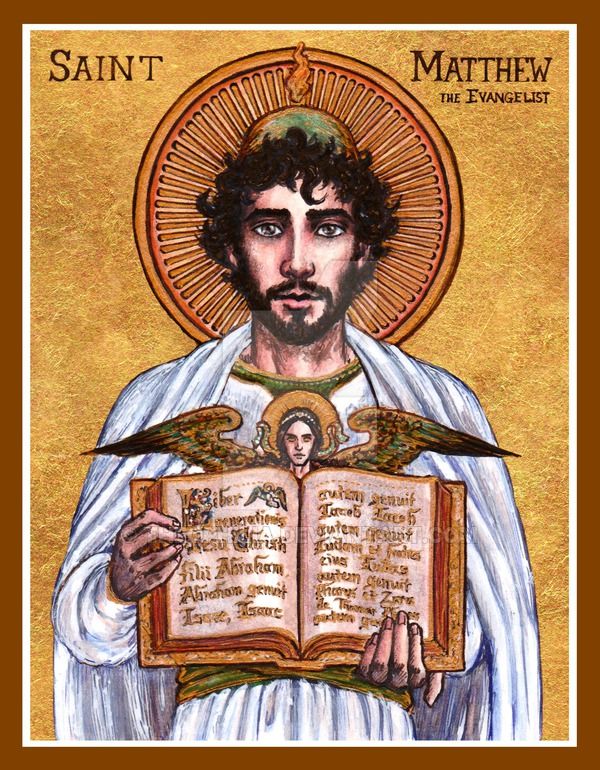
The season of Advent marks the beginning of the Church’s liturgical year. This time, we enter the year of Matthew (year A) because on most Sundays of this year, we are going to listen and reflect together the texts from the gospel of Matthew. Now, since we will journey together with Matthew, let us be familiar with this evangelist and his gospel.

The origin, composition and authorship of this gospel have become a subject of endless speculation and debates among the modern scholars. However, the long tradition of the Catholic Church has firmly held that apostle Matthew is the author, and many ancient witnesses, like St. Irenaeus (c. 130 – 200), St. Clement of Alexandria (ca. 150-215) and Bishop Eusebius of Caesarea (c. 260 – c. 340) testified that Matthew is indeed the writer.

An interesting characteristic on Matthew’s Gospel is that its Jewish character. It is believed that the original readers of Matthew are the early Jewish Christians. Matthew quoted a lot from the Old Testament (around 60 times). He placed them from the beginning to the end, from ‘… they shall call Him Emmanuel.’ (Mat 1:23, cf. Isa 8:10), to ‘Eli, Eli lema sebachtani (Mat 27:46, cf. Ps. 22:1).’ Not only from Old Testament, but Matthew also used the Jewish traditions at the time of Jesus, like the tradition about Moses’ chair (Mat 23:2). Clearly, Matthew wished to teach that Jesus is the fulfillment of God’s promises in the Old Testament. As a Catholic philosopher and theologian, Peter Kreeft, summarizes the Gospel of Matthew as ‘A Gospel from a Jew, for the Jews about the Jewish Messiah.’

However, despite being very Jewish, Matthew remains firm that Jesus is not only the Savior of the Jews alone, but for everyone. Only in Matthew, we have the story of the Magi, the representatives of the nations that came and worshiped baby Jesus (Mat 2). In Matthew also, Jesus instructed the disciples, “Go therefore and make disciples of all nations, baptizing them in the name of the Father and of the Son and of the Holy Spirit (Mat 28:19).” It is from Israel, for the world.

Another character of Matthew is that it is the Gospel of the Church. Certainly, the other three gospels are also for the Church, yet only in Matthew, the word ‘Church’ (Ecclesia) comes from the mouth of Jesus. Firstly, it is when Jesus would establish His Church on Peter (Mat 16:13-20) and secondly, when Jesus taught fraternal correction among the members of the Church (Mat 18:15ff). The Gospel turns to be the foundation charter of our Church, the Church Jesus has founded. No wonder why this Gospel becomes favorite of many saints.

Going back to the life of Matthew, we know that he was a former tax collector. Jesus called him and he got up, left everything, and followed Jesus. Yet, he did not really leave everything. He brought along his intellectual and scribal capacity that he used as a tax collector and utilized it to write the Gospel and to bring people closer to Jesus.

The season of Advent prepares us for the coming of Jesus, and the invitation is what we shall offer to Jesus when he comes. If Matthew was giving his life and his skill in writing to Jesus, what shall we offer to Jesus in this Advent season?
In this Advent also, I am inviting you to read the entire gospel of Matthew. Let us spend one chapter for each day of this season, as part of our spiritual exercise.

Rome
Valentinus Bayuhadi Ruseno, OP
How to prepare for the End of Time

33rd Sunday in Ordinary Time [C]
November 13, 2022
2 Thes 3:7-12 (Luk 21:5-19)

As the end of the liturgical is drawing closer, the Church selects readings that related to the end of time. Now, the question that always appears regarding the end of the world is ‘when’. Truly, we do not know the answer because the Lord does not reveal it to us. Many self-proclaimed prophets have attempted to predict the doomsday, but all failed. Another question that is related to the end of the world is ‘how it’s going to end’. Again, we do not know exactly. Some speculate that a meteorite would hit and destroy the earth, others say that there would be nuclear wars that would decimate all lives, and still others believe in a zombie apocalypse, where a deadly virus would globally spread and turn humans into monsters. Again, these are wild speculations.

Fresco from San Mauricio, Milan.

However, the real question is not ‘when’ but ‘how it happens’, but ‘how’ we prepare ourselves for the end time.’ Fortunately, we have St. Paul to help us. St. Paul in his letter to the Thessalonians (our second reading), gives a strong rebuke to those lazy Christians. The reason why they were acting like busybodies but actually doing nothing is interestingly related to the eschatology (fancy word for theology of end time). They believed that Christ would come soon during their lives time, and thus, it would be unnecessary for them to work meaningfully. They just waited, ate and slept. This theology is not acceptable to Paul, and he reminded them, “if a man does not work, he shall not eat (2 Thes 3:10).”

The second coming of Jesus is fundamental to St. Paul’s theology, but it does not make him lazy at all. In fact, he worked tirelessly both as a tent-maker and as an apostle. Even when in prison, he did not cease preaching and proclaiming the good news. These he did are to follow the example of our Lord Jesus. Reading through the four gospels we can easily see that Jesus is a man of action. He worked as a carpenter, taught as a Rabbi, and worked miracles as a Son of God. In His rest and quite time, Jesus spent it in prayer and in union with the Father. Even in His suffering and death, He carried His cross and made sure that the salvation is offered to all of us. Laziness is abnormality in our Christian DNA.

While it is true that our redemption is a free gift from God, it is never cheap. Our faith in Jesus is never passive acceptance, but dynamic and growing response. Yes, we do not earn our salvation, but essential to our faith is the growth in holiness and labours of love. St. Paul reminds the Thessalonians that those who do not work meaningfully, shall not eat the bread. We can also apply this to us, “Those who do not work the labour of love, shall not eat the spiritual bread.”

In the celebration of the Eucharist, there is part called the preparation of the gifts. Here, the priest prepares the bread and the wine, and he then says, “Blessed are you, Lord God of all creation, for through your goodness we have received the bread we offer you: fruit of the earth and work of human hands, it will become for us the bread of life.” The prayer is a simple but profound. It teaches us the bread is coming from God’s goodness. Yet, God wants us and all creations to participate in the forming the bread. Till such point, that the bread is ready to offer back to God in Christ. The bread (and the wine) are the symbol of salvation. It is coming from God, but He wants us actively participate in the process of maturing. To such moment, that we are to offer it back to God.

Thus the best way to prepare the end is not to be lazy.

Rome
Valentinus Bayuhadi Ruseno, OP

Why Marriage?

32nd Sunday in Ordinary Time [C]
November 6, 2022
Luke 20:27-38

In today’s Gospel, the Sadducees attempt to test Jesus. Sadducees are a religious faction in first-century Judaism like the Pharisees, but unlike the more popular Pharisees, they only hold Torah as the only valid source of Jewish religious teachings and practices, and refuse the writings of the prophets, the wisdom books, and later traditions. One of their main teachings is that they do not believe in the resurrection of the body. Jesus and the Pharisees though always in debate, they share in a common fundamental belief in the bodily resurrection. Later on, the resurrection of the body will be one of the Christian core beliefs.

Thus, to ridicule this kind of belief, the Sadducees are using the practice of the levirate marriage. In the Law of Moses, there is a practice to secure the bloodline and inheritance of a man who does not have any offspring. As a solution, the brothers or relatives of the diseased man will marry the widow and produce offspring in his behalf. Then, the Sadducees move to checkmate position. “In the resurrection, whose husband, this woman be?” There will be confusion in heaven!

Yet, Jesus makes it crystal clear that in the resurrection, men and women are living like angels, and marriage is no longer needed. There will be no confusion in heaven. However, we can go deeper and ask, “If marriage is no longer necessary in heaven, why do we need to have it here on earth?

The first answer is that marriage is a biological necessity, like the need to eat, to rest, and to breath. It is necessary for our survival, especially as a species on earth. Yet, if marriage is just biological need, then why does the Church honor greatly the marriage? Why does the devil and his cohorts try their best to destroy the traditional institution of marriage? Marriage must not be only about biology, but also God’s design for men and women. Marriage is not just biological or cultural motivated, but divinely planned. Yet, if marriage is part of God’s plan, why does it cease in heaven?

The answer lays on the purpose of marriage itself. Marriage is a means for men and women to give themselves totally in love. It empowers us to go beyond ourselves and love radically. It is a way of holiness, a staircase to heaven. Now, if we have reached our goal in heaven, then the marriage, as the means, is no longer necessary. Marriage has served its purpose.

This is the reason that holy marriage is fundamental on earth. The Savior also raises the dignity of marriage to a sacrament because it is truly a means of holiness (see CCC 1601), just like the sacrament of baptism or penance. Before men and women become like angels, we must live fully as human persons on earth, and one of the best ways to make us live fully as men and women of God is marriage.

Rome
Valentinus Bayuhadi Ruseno, OP

Zacchaeus and the Tree

31st Sunday in Ordinary Time [C]
October 30,
Luke 19:1-10

In time of Jesus, tax collector is considered a grave sinner because they are colluding with the Roman occupiers, and often, they are involved in various dirty activities to enrich themselves. On the top of that, the tax collectors tend not to observe the laws of Moses as often, they work on Sabbath. Now, Zacchaeus is the chief tax collector of important city Jericho. Indeed, he is one of the richest guys in town, but at the same time, the most hated person.

Luke also describes Zacchaeus as ‘short’ in stature. The Greek word is ‘μικρὸς’ (mikros), that simply means ‘small’. Zacchaeus is a small man. We do not know how small he is, but he is not tall enough for the average Jewish men at that time. Thus, when Jesus passes by, he is not able to overcome the heights of other Jewish people swarming Jesus. He then takes the initiative to climb a tree, and to his surprise, Jesus takes notice of him. It seems that Jesus has been waiting for him. In the end, it is not Zacchaeus that is looking for us, but Jesus is the one searching Zacchaeus, one of His lost sheep.

There are several things to ponder. If Zacchaeus is truly rich and powerful figure, why don’t he hire some bodyguards as to open the way to Jesus? Why don’t he send someone to invite Jesus? He has the power and wealth to facilitate his way to Jesus, but he chooses the more arduous way, that is, to climb the sycamore tree. The real answer remains mystery, but by climbing the tree, he finds his Lord and salvation. Interestingly, what Zacchaeus does, prefigures what Jesus will do in Jerusalem. He will ‘climb’ the tree of the cross, and from there, He brings redemption to whole world.

If Adam and Eve ate the fruits of the forbidden tree because they were tempted to take the shortcut and be like ‘god’, Jesus, the true God, carries the tree of the cross, ‘climbs’ the tree and from the tree, He gives us His life for our redemption. Zacchaeus follows the footsteps of Jesus, and climbs the tree to overcome his smallness and finds his God. Like Zacchaeus who discovers that the Lord has been waiting for him, we are also invited to climb our trees, to see our Lord who has been giving His life for us.

What is our tree? This can be the tree of sufferings and trials. This may be financial instabilities, health problems, difficult relations in the family, or failures in life. These things make us feel that we are small, short, and crammed, and worse, unable to see Jesus. Yet, if we are faithfully carrying the life’s trials, and spiritually unite our sufferings with the suffering of Christ in the cross, we believe that it would not be useless. Jesus is on the tree of the cross, and He is waiting for those, like Zacchaeus, makes humble effort to climb the tree.

Valentinus Bayuhadi Ruseno, OP

Prayer and Pride

30th Sunday in Ordinary Time [C]
October 23, 2022
Luke 18:9-14

In the communication, there are three constitutive elements: the sender, the medium and the recipient. Arguably, the most crucial among the three is the recipient because everything changes when the recipient changes. For example, we cannot speak the same way to children as to old people, though we talk the same topic. It is the same with prayer. If prayer is a communication with God, then the kind of God we have in mind, will dramatically affect our prayer. If we consider God as our loving father, then we can approach Him as his children with confidence. If we see God as an instant troubleshooter, we may seek Him only if we have problems. Now, pride or arrogance is one of the deadliest sins precisely because it destroys the true image of God in our hearts. How is it possible?

photocredit: Timothy Eberly

Jesus masterfully explains the relation between prayer, pride and humility through His parable. The parable looks simple, but as always, there is more than what meets the eyes. Jesus compares two well-known figures in ancient Israel, the righteous Pharisee, and the sinful tax collector. Both are praying in the Temple, though in opposite manners: the Pharisee in prideful fashion, and the tax collector in humble way. But, how do you know that the Pharisee prays with pride, and the tax collector with humility?

It is not because he is standing closer to the altar. It is not because he is listing the good things he has done or received. The problem lays on the receipt of his prayer. If we read carefully, he is actually praying ‘to himself’. In some translations, this is not obvious, but if we go back to original Greek, the phrase used is ‘πρὸς ἑαυτὸν’ [pros eauton], and it simply means ‘to himself’. We all well know that we pray and worship God alone, but here, the Pharisee prays to himself. Thus, we can infer that the god of this Pharisee is no other than himself. The core issue with pride is that make ourselves as gods. In truth, we were created in the image of God, but in pride, we fashion god in our images. That is idolatry. Pride is extremely dangerous because it leads us to idolatry.

The tax collector became the model of humility because he prays to the one and true God. Standing before the true God, he recognizes who he is, a mere dust, a terrible sinner. Yet, it is not hopeless, because in humility, the tax collector also realizes who his God is, the just and merciful God. He goes home justified because neither because he is standing at the back, nor he strikes his chest as strongly as possible. It is because he prays for mercy to the true God, and the true God never fails to answer.

Some points of reflections: Indeed, we pray to God, but is He the true God? Or, do we pray to ourselves, to a god we created in our likeness and desire? What kind of image of God do we have in our hearts? Do we make God as our kind of genie that grants all our wishes? Do we use God to show off? Does pride secretly interferes in our prayers and relationship with God? Do we have the humility to throw away our false idols, and allow the true God reigns in our lives?

Rome
Valentinus Bayuhadi Ruseno, OP

How to Persevere in Prayer

29th Sunday in Ordinary Time [C]
October 16, 2022
Luke 18:1-9

Jesus gives us a powerful lesson through his parable of a persevering widow and the wicked judge. Initially the judge had no interest whatsoever to the request of the widow, since widow was one of the weakest and poorest groups in ancient societies. Yet, the widow was extremely persistent and would not stop until her request for justice was rendered. The judge eventually gave in and granted the plea.

Jesus once again employed the teaching technique of His time, “Kal V’homer” (literally, light and heavy). Simply put, this method compares and contrasts two things. What applies in a less important case will certainly apply in a more important one. Thus, Jesus taught that if the terrible judge can eventually do good because of the widow’s perseverance, the more God will do infinitely good for those who hope and approach Him.

In this reflection, we will not only explore the ‘why’ we need to pray persistently, but also, on ‘how’ we can persevere in prayer. Surprisingly, the answer can be found in our first reading. The Church gives us the story of the Israelites battling the Amalekites (Exo 17:8-13). Amalek was an ancient nomadic tribe living in Sinai region in time of Exodus, and as Israelites passed their area, Amalek decided to wage war. As an act of self-defense, Moses sent Joshua and his men to battle the Amalek, and to ensure the victory, Moses would pray and intercede for them. As long as Moses kept his hands raised up, Israel had the better of the fight, but when he let his hands rest, Amalek had the better of the fight. However, the battle lasted the whole day, and naturally Moses grew tired. Thus, to sustain his prayers, his companions, Aaron and Hur, decided to support his hands until the victory was achieved.

From here, we discover that when our prayer seems unanswered, it does not mean there is nothing at all. Like the Isreal had the upper hand, when Moses prayed, though it was still far from the victory, so also something good is happening when we keep praying, though we do not see the result yet. St. Augustine once wrote to Proba, “[He] wants us rather to exercise our desire through our prayers, so that we may be able to receive what He is preparing to give us. His gift is very great indeed, but our capacity is too small and limited to receive it.”

Then, how will we persevere in prayers? As Aaron and Hur supported Moses in his prayer, often we also need a support system or a community. This wisdom is coming from our human nature, as social being. Thus, Jesus calls us not only as individual, but also Church, an community of believers. Since the beginning, we pray and worship as one community, and this is one of the reasons why the Church continues to grow despite so many persecutions. Surely, we can pray alone, but as we get tired and see no result, good companions in prayers will make things bearable. A man has a sacred duty to lead his family in daily prayer, and the task can be burdensome, but if his wife encourages and accompanies him, the holy obligation can be source of joy.

Rome
Valentinus Bayuhadi Ruseno, OP

The Healer, not the Healings

28th Sunday in Ordinary Time [C]
October 9, 2022
Luke 17:11-19

Who is this one leper that returned to Jesus to give thanks after he knew that he was healed? We never know the answer because like many other characters in the Bible, this person is nameless. The only information we had is that he was a Samaritan leper. What does it mean to be a Samaritan as well as a leper in time of Jesus? And why did he went back to Jews, while the other nine did not?

photocredit: Paul Zoe

We have to remember that Jesus instructed to the lepers to go the Jewish priests. Why to a priest? According to the Law of Moses, the priest has the authority to declare someone clean from leper and allow them to return to the community [See Lev 13]. As the lepers went to see a priest, they were miraculously healed. One of them, a Samaritan, immediately returned to Jesus and as he put his face to the ground, he thanked Jesus. Why only one Samaritan? Precisely because he is a Samaritan. As a Samaritan, he has no obligation to see a Jewish priest, while the other nine, eager to be reintegrated into their families and community, sought the priest first. Yet, there is one deeper truth that we must not miss: this Samaritan bended his knees before Jesus, a Jewish man.

Simply put, Samaritans and Jews were bitter enemies. Though Samaritans and the Jews worshiped the same God of Israel, yet they truly hated each other. Each claimed to be the true Israel, while denounced the other as heretics. Despite having one God, they refused to share the common place of worship, let alone the common place to stay. Since the kingdom of David was torn into two, the Jewish and Samaritan have shared the bloody histories of enmity and violence. The Samaritan dan the Jewish have become the reflections of humanity’s dark side: how people can hate each other and do harm to others because of racial, economic, religious and ideological differences.

By healing both the Jews and the Samaritan, Jesus shows Himself not only as the Saviour of the Jews, but to those who seek Him and have faith in Him. Surely, the nine lepers have faith in Jesus. Yet, greater faith is needed for the Samaritan leper to kneel and admit that his Saviour is a Jewish man. With profound humility comes the great faith. True humility enables him to seek God first, rather than his personal needs and biases, the Healer first, rather the healings. This humility empowers him to set aside all his hatred and prejudices, and bow before Jesus, a Jewish man. While faith may have cured physical disease, humility heals the spiritual leprosy.

The Samaritan leper becomes a point of reflection for all of us. Do we come to the Church because primarily we look for the healing or solutions to our problems, or we seek God? Do we worship Jesus because we feel good and happy about it, or because we do justice to God? What is lacking in us is often not faith, but humility. The humility to see that everything is from God, the humility to put God first before our needs, the humility to make things move according to His plan, not our designs.

Roma
Valentinus Bayuhadi Ruseno, OP

Dangerous Faith

27th Sunday in Ordinary Time [C]
October 2, 2022
Luke 17:5-10

Jesus says if we have faith as big as mustard seed, we will be able to command a mulberry tree to be uprooted and be replanted in the sea. What does it really mean? When fully grown, mulberry tree is a huge plant with sturdy trunk and limbs, as well as a spreading and deep roots. To uproot is extremely difficult, if not impossible. Yet, Jesus’ words are not only uprooting the tree, but replanting it, not in other fertile soil, but at the ocean! Thus, simply put, to have faith, even a small one, enable us to do the impossible. What are the impossible things that now become possible because of faith?

photocredit: rachel macdermott

Nowadays, there is a growing trend to understand faith as an immediate problem solver. Thus, to have to faith means that we will be healed from our grave illness and our problems will be immediately solved. To have faith means we are going to pass our financial crisis. Then, the logic is that if we are still sick or struggling with the same problems, we are lacking faith, or even have no faith all together.

I remember a story of a sick man who sought help of a religious leader. The leader prophesied that the man would be healed of his illness in the following week. Yet, after one week passed, the expected healing did not come. Then, the man complained to the leader that he remained sick. The leader immediately countered, “you lack faith! Have more faith, and you will be healed!”

This kind concept of faith is incomplete and even dangerous. Faith is heavily equated with personal desire and emotional conviction. The greater the conviction we feel and exert, the greater the faith, and the greater the faith, the greater the possibility we get what we want. This is dangerous in several ways. Firstly, this kind of faith is now about us, humans, and what we desire, and not about God and His plan for us. Secondly, this kind of faith makes us proud when we get what we want, but we blame ourselves if we do not achieve it. Too much blaming either makes us depressed or abandon God altogether. Thirdly, for some irresponsible ‘religious leaders’, this kind of faith may become a tool of manipulation and means to increase richness and popularity.

Though emotional conviction is important part of faith, but true faith goes beyond that. Faith includes intellectual quest for the Truth. Faith is also commitment to do God’s will and laws. Faith also means to trust in God’s presence in times we do not emotionally encounter Him. Faith allows us to believe in God’s providence even though we are struggling with various problems.

Going back to our initial question: What are the impossible things that now become possible because of faith? Indeed, God often does miracles of healing in our lives, yet God’s plan for us is even greater: spiritual healing from sins. Truly, Jesus can calm the storms, yet His mission is “to serve, and to give his life as a ransom for many [Mar 10:45].” Yes, God can bring back dead people to life, but God’s real will is that we resurrect into eternal life.

Roma
Valentinus Bayuhadi Ruseno, OP